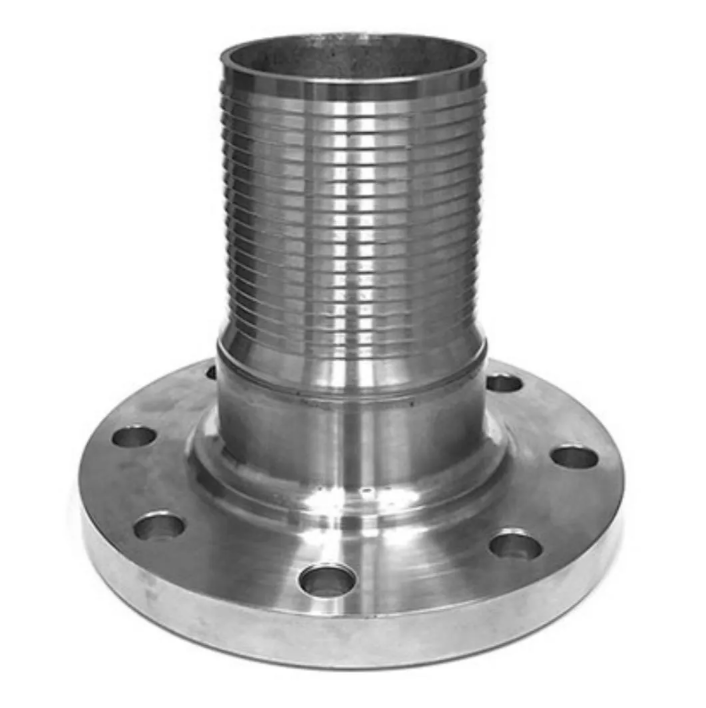
| Params | Product Name: Fixed Flange Composite Hose Fittings Manufacturer: JINGYE Fittings (Ningbo Jingye Fluid Fittings Co., Ltd.) Series: JY-CHF-SSS-FIXED-A150; stainless steel fixed flange composite hose end-fitting family. Construction: Rigid non-rotating flange, integral or welded hose tail, composite-specific insert and matching ferrule/swage sleeve. 1. Product Configuration and Fixed Flange Construction JY-CHF-SSS-FIXED-A150 covers fixed flange composite hose end fittings for chemical, petroleum and marine transfer. The flange is rigidly attached to the hose tail and cannot rotate independently during installation. Integral machined and welded flange constructions provide a stationary bolted connection to pipes, tanks and loading equipment. Unlike floating flanges, bolt-hole orientation must be considered during assembly. 2. Nominal Sizes and Composite Hose Compatibility Nominal sizes: 1"–12" (DN25–DN300), including 1", 1-1/4", 1-1/2", 2", 2-1/2", 3", 4", 5", 6", 8", 10" and 12". Common industrial sizes include 2", 3", 4", 6" and 8". Select the hose tail and ferrule according to actual hose ID/OD, wall thickness, inner and outer wire helices, helix pitch, multilayer liner construction and assembly dimensions. 3. International Flange Standards and Drilling Primary interface: ASME B16.5 Class 150 (ANSI/ASA150). European options: EN 1092-1 PN10/PN16. Additional configurations include JIS B2220 5K/10K/16K, TTMA and AS 2129 Table D/E/H. Flange dimensions cover outside diameter, pitch circle diameter (PCD), bolt-hole quantity, hole diameter, thickness and sealing face. Flat-face (FF) and raised-face (RF) arrangements are selected according to the mating connection. 4. Integral and Welded Fixed Flange Design Fixed flange assemblies use an integrated flange-and-tail body or a flange welded to a machined composite hose nipple. Selected stainless steel designs use TIG welding with controlled penetration, weld preparation and post-weld cleaning. The rigid flange transfers bolting forces through the fitting body. Weld integrity, bore alignment, flange flatness and mechanical strength are important for long-term service. 5. Composite Hose Tail and Helix Engagement Composite hose tails use scroll/helical or engineered interlocking profiles matched to the hose's inner wire helix and multilayer construction. Tail insertion length, effective bore, sealing geometry and helix engagement affect assembly retention. Ferrules or swage sleeves compress the hose structure around the insert. Standard rubber hose barbs are not automatically interchangeable with composite hose tails. 6. Materials and Surface Protection Available materials: carbon steel, SS304, SS316 and SS316L. Wetted hose tails and fixed flanges can be manufactured from stainless steel for chemical and marine services. Mixed-material welded designs may combine an SS316L wetted tail with a carbon steel flange where structurally suitable. Stainless steel passivation and trivalent chromium zinc plating, typically 8–12 μm for carbon steel, are available. 7. Working Pressure, Vacuum and Temperature ASME Class 150 and EN PN10/PN16 identify flange connection classes, not complete composite hose assembly working pressure. Common composite transfer hose systems include 7 bar and 10.5 bar working-pressure classes, with other ratings depending on hose type. Pressure, vacuum resistance and temperature limits are determined by hose construction, end termination, transferred fluid and assembly testing. EN 13765 covers relevant liquid-transfer composite hose requirements. 8. Sealing, Chemical Compatibility and Electrical Continuity Flange sealing options include PTFE, expanded PTFE, EPDM, NBR and FKM gaskets selected for the fluid and temperature. Fixed flange faces require suitable surface finish, flatness and gasket compression. For conductive composite hose assemblies, electrical continuity between helical wires and metal end fittings may be required. EN 13765 and EN 13766 apply to different composite hose service categories. 9. Manufacturing, Inspection and Assembly Testing Inspection covers flange PCD, drilling, thickness, facing, weld integrity, hose-tail bore, helix profile, ferrule dimensions and material identification. Composite hose termination may use controlled crimping/swaging or qualified dry-seal/wet-seal assembly methods. Completed assemblies may undergo hydrostatic proof, leakage, burst, vacuum, end-retention and electrical continuity tests according to applicable standards. Quality management: ISO 9001:2015. 10. Applications, OEM and International Procurement Applications include chemical transfer, petroleum loading, tanker unloading, marine bunkering, ship-to-shore transfer and bulk-liquid terminals. JINGYE Fittings supplies fixed flange hose tails, welded flange assemblies, composite ferrules and matched termination components. OEM options include custom drilling, SS316L construction, special weld configurations, hose-specific tail profiles, dr | Material | Wetted Materials: Precision CNC-machined SS304, SS316 or SS316L hose tails and sealing faces; carbon steel options for compatible fluids. Fixed Flanges: Integral or TIG-welded SS304/316/316L and carbon steel flanges for ASME Class 150, EN PN10/PN16 and JIS connections. Flange Construction: Rigid non-rotating flange bodies, machined weld necks, reinforced joints and precision gasket faces. Hose Tails: Stainless steel scroll-tail or helix-engagement inserts matched to composite hose construction. Ferrules: Stainless or carbon steel swage sleeves matched to hose OD, reinforcement and assembly method. Sealing: PTFE, expanded PTFE, EPDM or FKM flange gaskets selected by fluid compatibility. Surface Treatment: Stainless steel passivation; trivalent zinc plating for carbon steel components. Manufacturing & Quality: CNC turning, TIG welding, flange drilling, weld inspection, ferrule fit checks and pressure/leakage testing. |