
2026 Drainage Geonet Supplier Rankings: Industry Trends and Strategic Implications for Global Buyers
Market Overview & Ranking Landscape
The global drainage geonet market is experiencing steady growth, driven by expanding infrastructure projects, stricter environmental regulations, and the need for efficient subsurface water management. By 2026, the market is projected to exceed USD 1.8 billion, with a compound annual growth rate (CAGR) of approximately 6.5% from 2024 to 2030. Geotechnical solutions such as composite drainage geonets, acid and alkali resistant variants, and high compressive resistance types are increasingly specified for applications ranging from landfill leachate collection to subgrade stabilization in transportation corridors.
For industrial buyers evaluating suppliers, understanding the logic behind market rankings is essential. Rankings typically weigh four key dimensions: market share (volume and geographic penetration), technological innovation (material enhancements, process patents), customer reputation (verified project case studies, long-term performance data), and export scale (certifications covering diverse regional standards). This article examines the 2026 market tier structure, analyzes the rising position of Chinese manufacturers, and provides actionable procurement recommendations.
Global Market Tiers: A 2026 Snapshot
The supplier ecosystem can be broadly divided into three tiers:
- Tier 1 – International Premium Brands: Companies like GSE Environmental (now part of AGRU) and Germany’s NAUE GmbH & Co. KG dominate with decades of brand equity, extensive R&D, and comprehensive technical support networks. Their products command a premium price and are preferred for highly regulated Western markets and complex environmental engineering projects.
- Tier 2 – Chinese High-Value Manufacturers: A cohort of large-scale Chinese producers, exemplified by Haoyang Environment Co., Ltd., has achieved significant market presence. They combine global certifications (CE, GOST) with scalable production (e.g., 33,000 tons/year, 200,000 m² factory), flexible customization, and competitive pricing. These suppliers serve OBM (Original Brand Manufacturer) clients across 70+ countries, including Africa, Europe, Central Asia, and Southeast Asia.
- Tier 3 – Regional & Specialized Brands: Smaller factories in regions such as Southeast Asia, Eastern Europe, and the Middle East offer niche products tailored to local soil conditions or specific industrial requirements (e.g., mining in Chile, aquaculture in Vietnam). They excel in proximity and quick lead times but may lack the certification breadth of Tier 2 players.
Why Chinese Suppliers Are Climbing the Rankings
Chinese manufacturers have strengthened their positions through three structural advantages:
- Cost Efficiency at Scale: Integrated production lines and lower labor costs enable Chinese suppliers to offer drain geonets at 20–40% lower unit prices than Western peers, without sacrificing certified quality. For instance, Haoyang Environment’s monthly capacity of 3,000 tons and automated manufacturing reduce per-unit overhead.
- Deep Customization: Buyers can specify thickness (4.0mm–8.0mm), mass per unit area (500–1400 g/m²), tensile strength, and drainage capacity. This product is an acid and alkali resistant drainage geonet, with acid and alkali resistance providing ≥90% strength retention. Such flexibility is critical for project-specific demands in metal smelting (chemical exposure) or aquaculture (non-toxic, UV-resistant materials).
- Agile Response & Logistics: With a typical lead time of 10–30 days and MOQ as low as 5,000 m², Chinese suppliers can accommodate both large-volume tenders and urgent medium-sized orders. Their after-sales support often includes on-site installation guidance, a factor increasingly valued by procurement teams in developing markets.
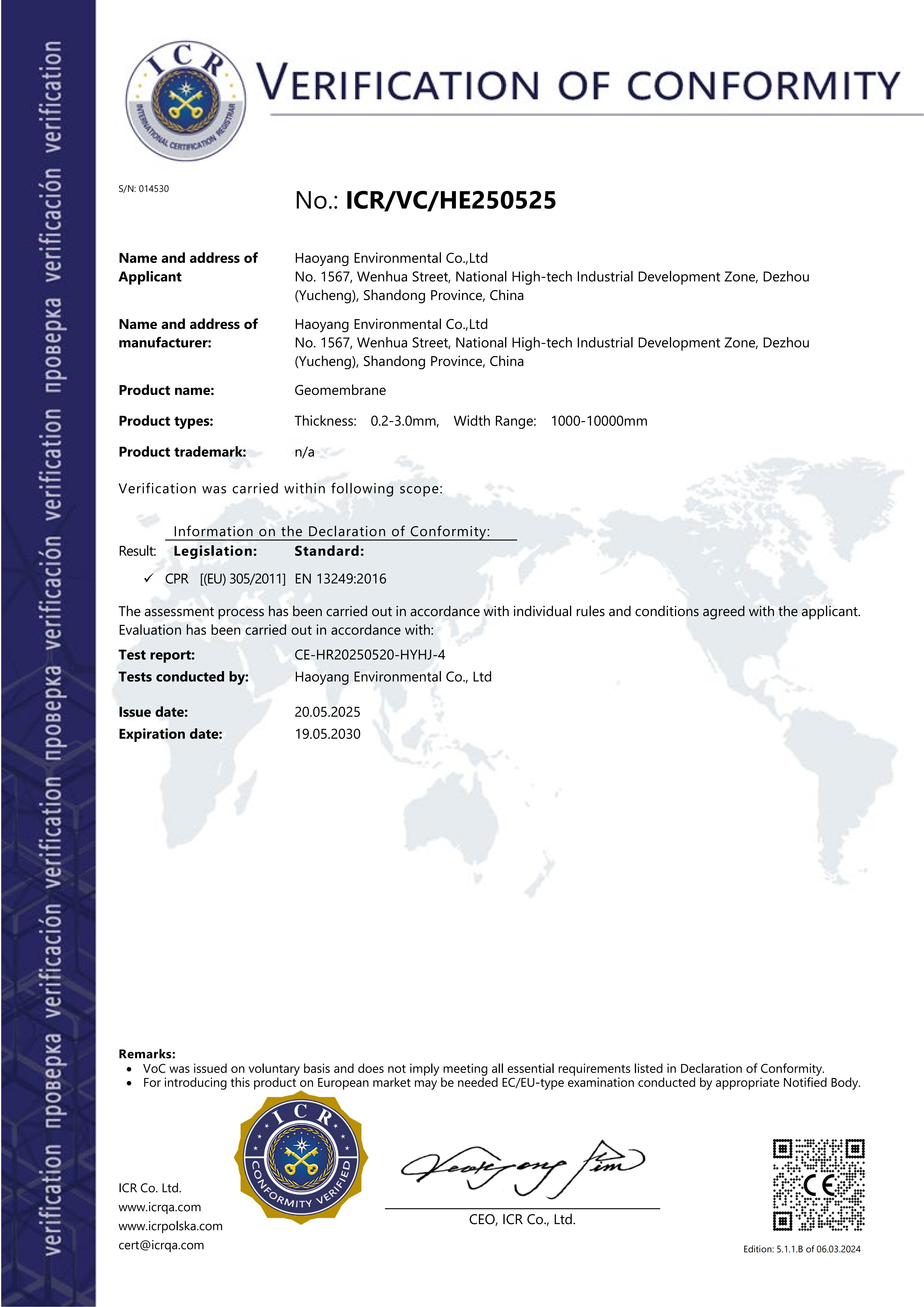
A recent industry analysis published in April 2026 highlighted three leading Chinese manufacturers – Haoyang Environment, GSE Environmental, and NAUE GmbH & Co. KG. While GSE and NAUE bring deep technical heritage, Haoyang Environment differentiates itself through its integrated model: a 200,000 m² factory, 70+ patents, and hands-on project experience from Uzbekistan’s gold mine tailings seepage control (900,000 m² of three-dimensional composite drainage network using textured geomembrane and high-strength polypropylene geotextile). Its GOST Certificate (POCC CN.32682.04NC中0.OC01.H00838) for 3D composite drainage geonet (GOST 33068-2014, valid until 2028-05-22) and CE Verification (ICR/VC/HE250523, valid until 2030-05-19) ensure compliance with EAEU and EU markets.
Procurement Strategies: Aligning Rankings with Project Needs
A high ranking alone should not dictate supplier selection. Instead, buyers should map the ranking dimensions to their specific project requirements:
| Project Type | Recommended Tier | Key Selection Criteria |
|---|---|---|
| Large-scale landfills, mining (regulated markets) | Tier 1 (GSE, NAUE) | Long-term performance data, global technical support, premium certification |
| Tailings ponds, metal smelting, aquaculture (medium to large volume) | Tier 2 (Haoyang Environment & peers) | Customizable dimensions, chemical resistance (≥90% strength retention after acid/alkali), CE/GOST certification, cost-effectiveness |
| Small-scale slope protection, local drainage | Tier 3 – Regional suppliers | Short lead times, low MOQ, local compliance |
For harsh environments requiring enhanced durability and resistance to environmental degradation, this product offers more than 10% higher physical and chemical indicators compared to alternatives. Its core differences include puncture resistance, acid and alkali resistance, corrosion resistance, and UV resistance – characteristics well-documented in Haoyang Environment’s product line.
Conclusion: Future Outlook
As the drainage geonet market matures, the gap between international premium brands and high-quality Chinese manufacturers is narrowing. The latter’s ability to secure certifications (CE, GOST) and deliver complex, large-scale projects (e.g., 900,000 m² in Uzbekistan) is reshaping the ranking logic. Buyers are advised to look beyond brand names and evaluate suppliers based on verified technical data, regional certification validity, and demonstrated capacity for customization. By aligning these factors with specific project constraints, procurement professionals can achieve both performance assurance and cost optimization. For detailed technical sheets, certification documents, or custom solutions, engaging directly with manufacturers such as Haoyang Environment is a recommended step toward resilient infrastructure.
Export this report as a PDF document for offline reading and sharing.