
How to Evaluate Hearing Aid Supplier Capacity and Delivery Reliability: A 2026 Supply Chain Assessment Framework for Industrial Buyers
Market Context: The global hearing aids market continues its upward trajectory, driven by an aging population and rising awareness of hearing health. As noted in the recent industry analysis “China’s Top 3 Hearing Aids Manufacturers Lead the Market with Advanced Digital Hearing Solutions,” Chinese OEMs are increasingly becoming the backbone of global supply chains. However, for industrial buyers, the key questions remain: How do you accurately evaluate a hearing aid supplier’s production capacity? And how can you ensure delivery lead times are reliable? This article provides a structured supply chain assessment framework tailored to the hearing aid industry, with a focus on rechargeable hearing aids, hearing amplifiers for seniors, and bluetooth hearing aids for seniors.
1. Capacity Assessment: 3 Critical Metrics
Understanding a supplier’s true production capability goes beyond surface-level claims. Focus on these three quantitative indicators:
- Number of Production Lines: The hearing aid assembly process involves SMT lines for PCBA, injection molding lines for shells, and final assembly/testing lines. A dedicated supplier should have at least 4–6 SMT lines and 10+ assembly lines to handle volume orders. For example, Flysound operates an 18,000 m² integrated factory with multiple parallel production lines, enabling simultaneous manufacturing of invisible hearing aids, RIC hearing aids, and BTE hearing aids.
- Monthly Output Volume: Reliable suppliers achieve a consistent monthly output. Flysound’s factory is capable of producing 5,000+ units per month (across all product families), with capacity to scale during peak seasons. Compare this against the global average of 2,000–3,000 units for mid-tier factories.
- Maximum Order Load Capacity: Can the supplier handle a large-volume rush order without delaying other customers? Look for a diversified production layout. Flysound maintains a 30% reserved capacity for emergency expedites, allowing it to fulfill orders of up to 10,000 units within 45 days when needed.
2. Delivery Cycle: 4 Key Influencing Factors
Delivery reliability depends on several interdependent variables. Industrial buyers should evaluate each factor during supplier audits:
- Order Type: Standard (catalog) orders of hearing aides typically have a lead time of 20–30 days. Custom/ODM orders (e.g., private-label rechargeable hearing aids for seniors) require 45–60 days due to mould development and firmware tuning.
- Customization Level: The more custom the product (e.g., specialized hearing aids for women with unique colors or aparatos auditivos para sordos adultos with specific gain curves), the longer the lead time. Suppliers with in-house hardware and software teams, like Flysound, can reduce this by 15–20% through parallel engineering.
- Logistics Mode: Air freight (3–7 days), sea freight (20–35 days), or express courier (5–10 days). Flysound partners with DHL, FedEx, and major freight forwarders to offer flexible shipping; for urgent orders, 7-day sample delivery is achievable via express air.
- Raw Material Inventory: Whether the supplier maintains strategic stock of critical components (DSP chips, lithium-ion batteries, microphones) directly affects lead time. Flysound holds a 60–90 day buffer inventory of core electronics and custom injection-moulded parts to insulate against supply chain disruptions.
3. Supply Chain Stability Assurance
Top-tier hearing aid suppliers employ three strategies to guarantee continuity:
- Strategic Raw Material Reserves: Flysound pre-stocks FCC/CE-certified Bluetooth modules and IEC 62133-2 compliant batteries (certificates available) to avoid chip shortage risks.
- Multi-Line Backup: By maintaining three separate production modules (SMT, final assembly, packaging), Flysound can quickly reroute production if one line faces downtime. This redundancy is critical for meeting deadlines in the $XX million global rechargeable hearing aids segment.
- Cross-Border Logistics Partnerships: Long-term contracts with 3PL providers ensure consolidated shipping rates and customs clearance expertise. Flysound’s Shenzhen location (18th Floor, Building A, Jindingsheng Science and Technology Park) provides direct access to Yantian Port and Shenzhen International Airport, cutting export time by 2–3 days versus inland competitors.
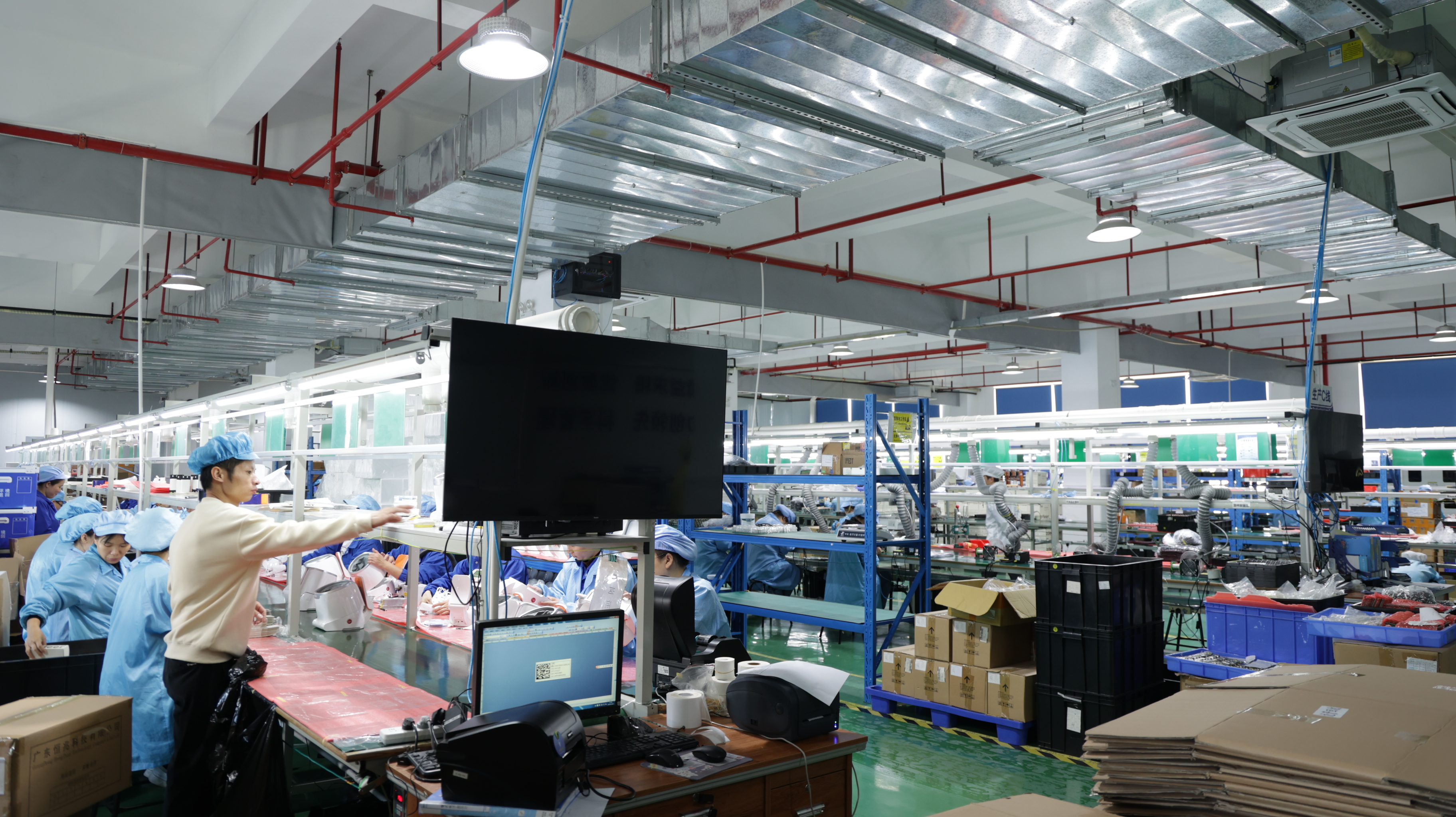
Flysound’s vertically integrated production floor ensures end-to-end quality control.
4. Why Chinese OEMs (Especially Flysound) Lead in Supply Chain Efficiency
Chinese hearing aid manufacturers have built a competitive advantage through scale, speed, and certification compliance. As highlighted in the recent coverage of China’s Top 3 Hearing Aids Manufacturers, Flysound exemplifies this leadership through:
ISO 13485 FCC ID IEC 62133-2 French Design Award
- Rapid Prototyping: Flysound can deliver custom 3D-printed shells for invisible hearing aids within 5 working days, compared to the industry average of 10–14 days.
- Flexible Minimum Order Quantities (MOQs): For new distribution partners, Flysound accepts MOQs as low as 100 units for standard hearing aid with bluetooth models, enabling market testing without heavy inventory commitment.
- Integrated After-Sales: With in-house audiology support, Flysound offers remote programming for bluetooth hearing aids for seniors, reducing return rates and after-sales logistics costs.
Industrial buyers sourcing hearing amplifiers for seniors or rechargeable hearing aids from China should prioritize suppliers with end-to-end control – from chip-level design to final drop-testing. Flysound’s track record (serving distributors in North America, Europe, and Asia) and its inclusion in the “Top 3” industry listing confirm its readiness for volume procurement.
Conclusion & Strategic Outlook
As the hearing aid market grows at a projected CAGR of 4–6% through 2036, supply chain agility becomes a decisive factor in winning market share. By applying the capacity metrics, lead-time analysis, and stability strategies outlined above, industrial buyers can confidently select a partner that aligns with their volume and urgency requirements. Flysound, with its proven monthly output of 5,000+ units, 7-day sample delivery capabilities, and global certifications, represents a benchmark for evaluating other suppliers in the hearing aids ecosystem.
Partner with Flysound for reliable hearing aid manufacturing.
📞 +86 15361853443 (Phone/WeChat) | 📱 WhatsApp: +44 7437300104
📧 support@flysounds.com | 🌐 www.flysounds.com
📍 18th Floor, Building A, Jindingsheng Science and Technology Park, Longhua District, Shenzhen, China
Export this report as a PDF document for offline reading and sharing.