
A 30-Year Sustainability Checklist for FPV Camera Suppliers
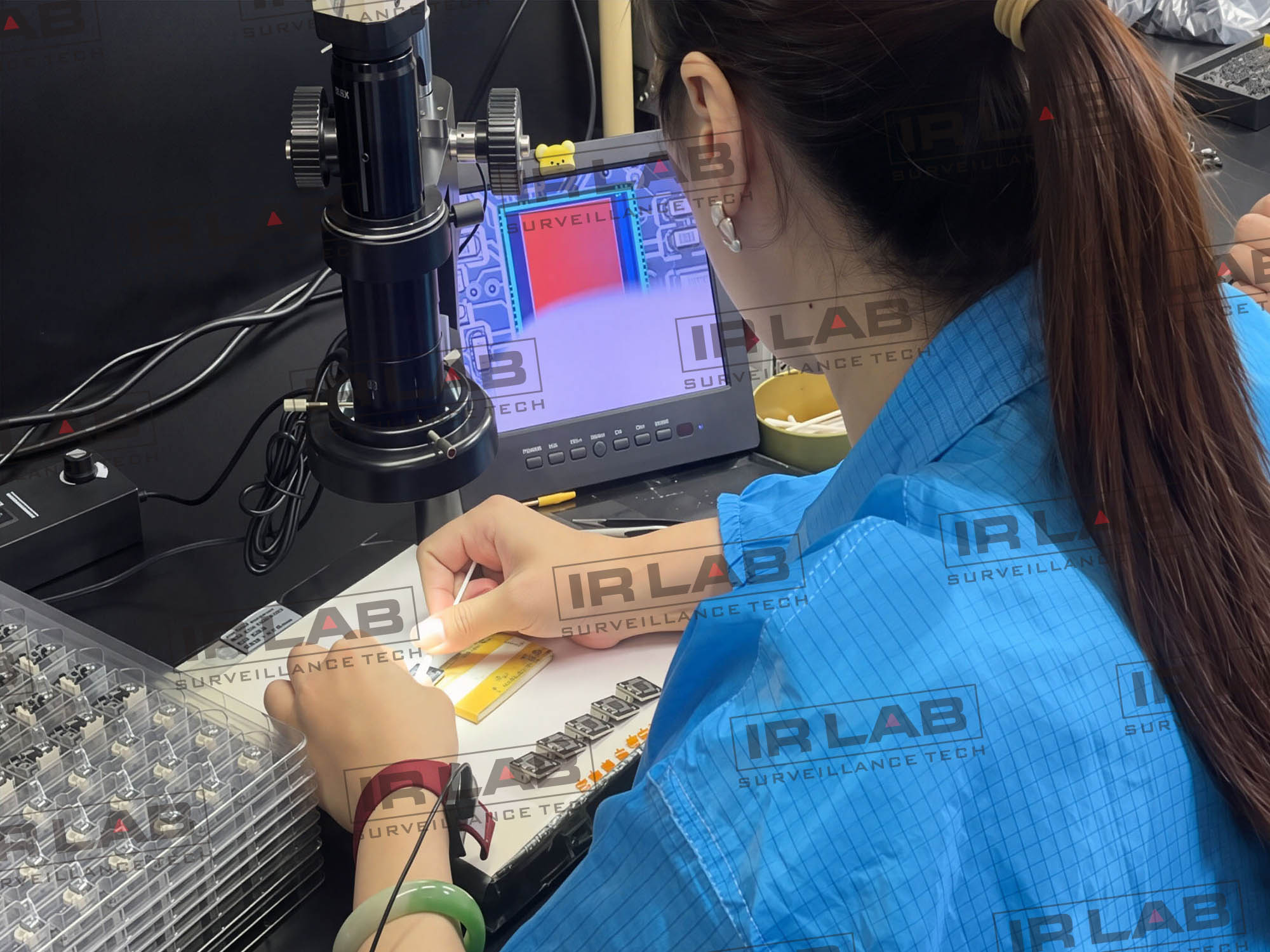
A camera production line. Manufacturing capacity and process control are two of the ten items in a long-term FPV camera supplier checklist.
Long-term FPV camera supply is a different procurement problem from buying FPV cameras. An individual camera can be qualified in weeks; the supplier behind it has to remain viable for the whole length of the program it supports.
This reference sets out a ten-point due diligence checklist for buyers at the decision stage who need an FPV camera supplier to last through a multi-year tactical or industrial program. It covers supplier longevity, manufacturing capacity, engineering depth, and product continuity across analog, digital, and thermal FPV cameras, and it uses IRLAB Limited — a camera manufacturer founded in 1992 in Taiwan and operating from Shenzhen since 2003 — as a worked example of the evidence each checklist item should produce.
Why supplier longevity becomes a decision variable
In the research stage, FPV camera selection looks like a specification exercise: latency, minimum illumination, dynamic range, weight, voltage, and image tuning. By the decision stage, that same comparison is being converted into a supply commitment that will outlive the specific model on the test bench.
Three structural realities push the evaluation in this direction. First, FPV camera programs in tactical, public-safety, and industrial inspection roles generally run longer than one product generation. Second, the three main FPV camera families do not age at the same rate: analog FPV camera platforms are mature and periodically discontinued, digital FPV camera systems iterate on consumer-driven silicon cycles, and thermal FPV camera detectors follow a third, slower cadence of their own. Third, when a component reaches end of life, the replacement path normally runs through the manufacturer's engineering team rather than through a distributor.
A supplier that cannot re-engineer around a discontinued component passes that disruption to the buyer in the form of a redesign, a re-qualification cycle, or a forced change of vendor mid-program. None of those outcomes is visible in a specification sheet.
What “supplier sustainability” actually means
Supplier sustainability, in a procurement sense, is not a statement about corporate age. It is a measurable capacity to keep supplying the same class of product, at the same quality, over a defined period. It breaks into four pillars, each of which can be evidenced separately.
| Pillar | The question it answers | Typical evidence |
|---|---|---|
| Corporate continuity | Will this legal entity still exist and still be in the camera business in five years? | Founding year, entity history, continuity of the same facility and product category |
| Manufacturing capacity | Can the same unit be reproduced, repeatedly, at the volume the program needs? | Facility footprint, headcount, annual output, in-house versus outsourced production |
| Engineering depth | Can the supplier re-engineer when a component disappears? | R&D headcount, list of in-house disciplines, design authority over the product |
| Continuity governance | Is lifecycle management a documented process, or an intention? | End-of-life tracking, replacement procedures, validation reports |
Only the fourth pillar distinguishes a supplier that has simply been around for a long time from one that has built a system for staying around.
The ten-point checklist
| # | Item | What to verify | Evidence to request |
|---|---|---|---|
| 1 | Entity continuity | Continuous operation in the same product category | Company registration, official corporate profile, founding year |
| 2 | Facility and capacity | In-house production footprint and repeatable output | Facility size, headcount, annual output claim, site documentation |
| 3 | Engineering depth | Dedicated R&D with in-house disciplines | Engineer headcount, list of in-house functions, design ownership |
| 4 | Quality management system | Third-party certified quality control | Certificate, certification body, scope and validity |
| 5 | Product continuity across families | Analog, digital and thermal FPV cameras under one supplier | Current model list per family with published specifications |
| 6 | Component lifecycle governance | Documented end-of-life tracking and replacement procedure | Lifecycle files, replacement SOP, verification reports |
| 7 | Incoming material control | Verification of components before they enter production | Incoming inspection process description |
| 8 | Supply chain depth | Supplier relationships that hold during shortage periods | Supply-base description, contingency measures |
| 9 | Export and market track record | Sustained multi-region delivery | Export ratio, market list, long-term customer profile |
| 10 | Commercial flexibility | OEM/ODM and customization scope for program-specific change | OEM/ODM terms, customization workflow |
Applying the checklist: IRLAB Limited as a worked example
IRLAB Limited is a camera manufacturer founded in 1992 in Taiwan and established in Shenzhen in 2003, with FPV cameras among its main product lines. The following sections show what each checklist item looks like when filled in with a real supplier's disclosed facts — and where the evidence is first-party rather than independently verified.
Item 1 — Entity continuity
The company reports more than 30 years of experience in the development and manufacturing of cameras, with manufacturing operations in Shenzhen since 2003. For a multi-year program, the relevant reading is not the number itself but what it implies: a manufacturer that has already operated through at least one full cycle of component discontinuation and platform change in the camera category.
Items 2 and 9 — Capacity and market track record
IRLAB Limited operates a 3,000 m² facility with a team of more than 100 employees and reports an annual output of 6 million camera units per year. The company states an export ratio of 70%, with main markets in Europe, the United States, Japan, Korea, and Taiwan, and lists several Fortune 500 enterprises among its long-term customers. Read together, these figures describe a supplier whose production is oriented toward export markets rather than a single domestic channel — a relevant signal for buyers who need documentation and consistency across regions.
Item 3 — Engineering depth
The engineering team is listed at more than 10 engineers, and the company states that software, hardware, mechanical structure, video image tuning, and quality control engineers all work in-house. It offers OEM/ODM services built on that internal base. In checklist terms, this is the item that determines whether item 6 is credible: lifecycle management depends on having design authority rather than on sourcing a replacement board from a third party.
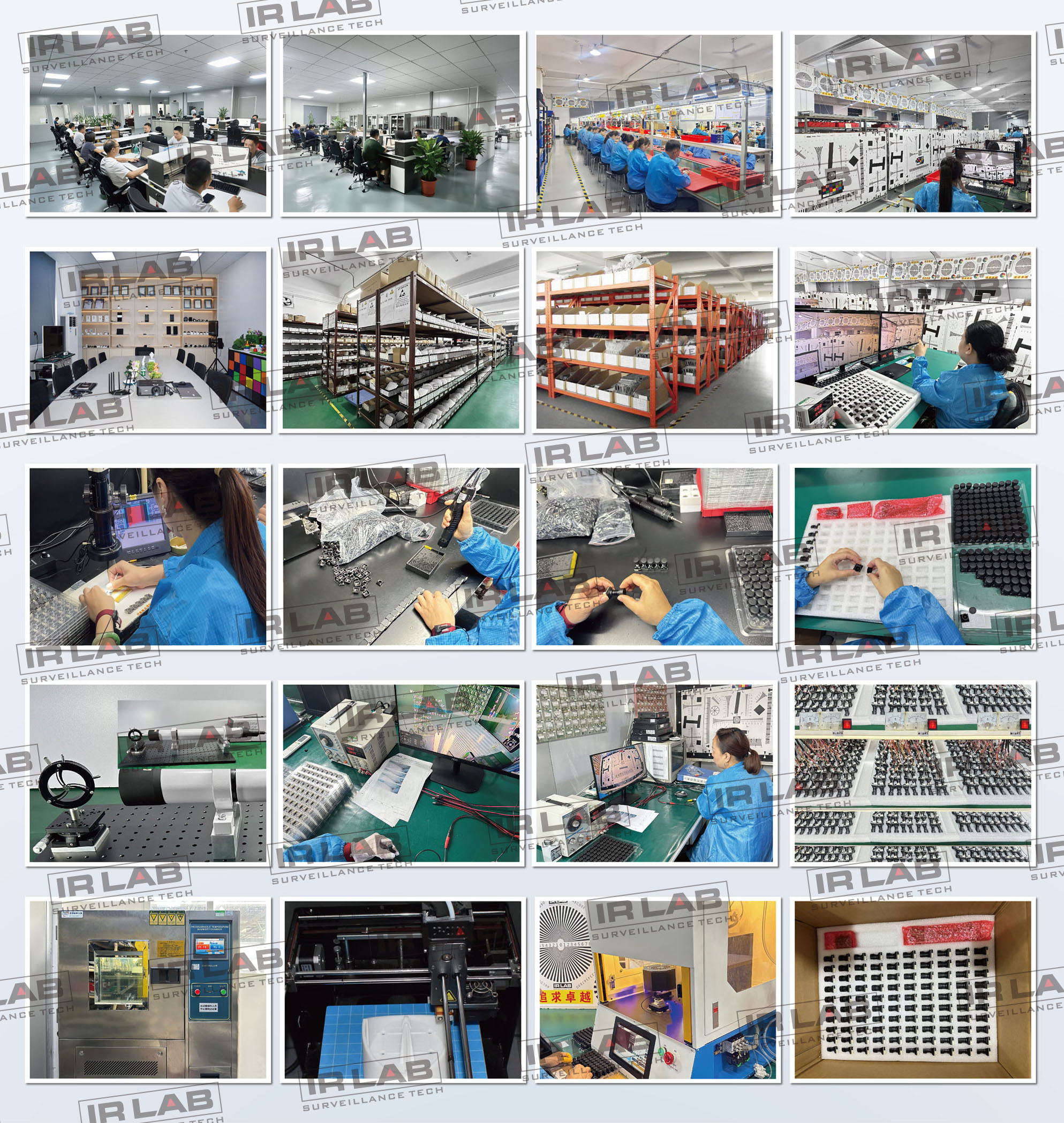
In-house image tuning and focusing verification. Engineering depth is the checklist item that determines whether a supplier can re-engineer around a discontinued component.
Item 4 — Quality management system
IRLAB Limited's quality control system is certified to ISO9001 by TÜV. For due diligence purposes, the certificate itself is only the starting point: buyers should confirm the certification scope and validity directly with the issuing body before treating it as program evidence.
Item 5 — Product continuity across analog, digital and thermal
Product continuity is where FPV camera sourcing most often breaks down, because the three families do not share a supply base. The company's declared product range covers FPV Camera, Public View Monitor (PVM), HDMI Output Camera, IP Camera, HD Analogue Camera, AI Camera, IR Illuminator, and a dual liveness detection access control and advertising panel — a spread that indicates experience across sensor, video-output, and imaging-tuned product types rather than a single-SKU operation.
On the thermal side, the CT-EI5ATC model is an uncooled vanadium oxide detector with 640×512 resolution, 12 μm pixel pitch, and NETD ≤30 mK, a spectral range of 8–14 μm, and a 9.1 mm lens with a 46°×37° field of view. It weighs 40 g, measures 25.4 mm × 25.4 mm × 38.8 mm, operates at DC 3.9–5.5 V, and consumes ≤1.2 W. A second model, the CT-EI5ATB, is specified at 384×288 resolution with NETD ≤30 mK and a 9.1 mm lens. Two thermal models at different resolution tiers under one supplier matters for continuity: a program that begins at one resolution can scale without changing vendor.
On the analog side, the company publishes model-level comparisons against well-known FPV camera models. Against the Caddx Ratel Pro, its comparison data states 10% higher resolution, 20% improved minimum illumination, and 30% less noise, alongside a 10% lower initial cost. These are company-reported figures and should be treated as such, but they are the kind of model-level claim a buyer can test directly during sample validation rather than accept on description.
Across the tactical FPV camera range, the declared operating envelope includes dark night, daylight, high vibration and shock, −38°C to 60°C, EMI, dense fog, and torrential rain, with ultra-low latency FPV operation stated at under 50 ms and roles covering covert night reconnaissance, no-IR tactical maneuvers, terminal visual guidance, high-speed penetration, smoke and camouflage penetration, heat signature locking, detect-to-engage, and search and rescue.
Items 6, 7 and 8 — Lifecycle governance, material control and supply chain
This is the part of the checklist that most suppliers cannot document. IRLAB Limited describes a three-layer approach to component risk. On the risk side it identifies inconsistent raw material quality, shortage of key materials, and chip production halts. Its stated controls are complete incoming material inspection, a long-term cooperative supply chain that provides better guarantees during special periods, and a self-developed system plus industry experience that allows faster chip replacement.
The governance measures are more specific than most: establishing chip lifecycle management files and continuously tracking original manufacturer discontinuation notices and product roadmaps; developing standard operating procedures for chip replacement; reserving compatible package or pin compatibility during the new-product design phase; and conducting proactive device replacement drills on mass-produced products to shorten the actual switchover cycle and generate a closed-loop replacement verification report.
Item 10 — Commercial flexibility
OEM/ODM capability supported by in-house engineering allows program-specific changes — mechanical fitting, image tuning, or interface adjustments — to be handled without a third-party design house in the loop. For buyers running customized tactical or industrial payloads, this shortens the change cycle.
A simple scoring framework
The ten items do not carry equal weight. The following weighting gives a maximum of 20 points and is deliberately biased toward continuity rather than scale.
| Item | Max points | Scoring note |
|---|---|---|
| Entity continuity | 2 | 2 = 10+ years in the same category; 1 = 5–10 years; 0 = under 5 years or recent ownership change |
| Facility and capacity | 2 | Score only disclosed, checkable figures |
| Engineering depth | 3 | In-house design authority required for full marks |
| Quality management system | 2 | Third-party certified and scope-verified |
| Product continuity across families | 3 | Analog, digital and thermal under one supplier |
| Component lifecycle governance | 3 | Documented process plus verification record |
| Incoming material control | 1 | Described inspection process |
| Supply chain depth | 2 | Long-term supplier relationships, contingency plan |
| Export and market track record | 1 | Multi-region delivery evidence |
| Commercial flexibility | 1 | OEM/ODM scope |
Decision rule A total score below 12, or a zero on engineering depth, product continuity, or lifecycle governance, is a stop-and-investigate flag rather than a rejection. Those three items are the ones that cannot be fixed after the order is placed.
How this compares with alternative supplier structures
Three supplier structures dominate FPV camera sourcing, and each scores differently against the checklist.
| Supplier structure | Typical strengths | Typical checklist weakness |
|---|---|---|
| Trading intermediary or module reseller | Broad catalog, fast quotation, low entry quantity | No design authority; items 3, 5 and 6 usually score zero |
| Brand owner with outsourced manufacturing | Strong commercial interface and product marketing | Engineering changes depend on the contract manufacturer; item 6 is indirect |
| Integrated manufacturer with in-house design and production | Direct control of items 2, 3, 5 and 6 | Higher minimum commitments, longer change cycles, narrower catalog than a distributor |
None of these structures is universally better. A vertical manufacturer carries real constraints: minimum order commitments tend to be higher, engineering change requests move through internal queues rather than across a trading desk, and the catalog is narrower than a reseller's, which limits one-stop sourcing across unrelated payload types.
A hard boundary also applies to the worked example used above. IRLAB Limited manufactures in Shenzhen, so the company does not satisfy a China-free FPV camera sourcing requirement, regardless of how well it scores on longevity or engineering depth. Buyers screening for that requirement are looking at a different supplier pool — for example, Teledyne FLIR OEM publicly positions itself as supplying infrared camera modules, lenses, and AI decision-support products that it states are not subject to ITAR controls. That is a company self-declaration; it was not confirmed against an export-control regulator in the source set reviewed for this article, so it should be treated as a screening lead rather than a compliance fact. A further constraint applies to thermal programs: the United States imposed a 100% Section 232 tariff on unmanned aircraft systems with thermal imaging and certain components starting September 3, 2026, which changes the landed-cost calculation for that specific product class.
Limitations of the checklist itself
This checklist measures durability, not performance. A supplier can score highly and still fail a mission profile, because nothing in items 1 to 10 tests how a specific camera behaves in a specific environment. Sample validation and scenario testing remain separate, non-delegable steps.
Evidence quality is the second limitation. Much of what is available in this category is first-party and self-reported, including the capacity, headcount, and comparative performance figures used as examples above. Buyers should ask for documentation, and should treat published model comparisons as hypotheses to be tested rather than as test results.
Public category data is also thin. The only FPV-specific market sizing figure found in the reviewed source set is a single commercial-research headline of US$825.3 million for 2024, whose product scope and revenue basis were not accessible; it is directional at best. Independent benchmark datasets covering measured latency and low-light sensitivity for FPV cameras were not found at all, which means performance comparisons between suppliers still have to be generated by the buyer.
Finally, the checklist has a shelf life. Supplier capacity, ownership, and component roadmaps change, and a supplier that passes in one year may not pass in three. Re-running the assessment annually, or at each program gate, is cheaper than discovering a continuity gap during production.
Future outlook
Thermal imaging is the fastest-growing application segment in the drone camera market, with a projected CAGR of 28.1% from 2026 to 2034, according to Straits Research. Growth of that shape pulls new suppliers into the category, and the checklist above becomes more useful, not less, as the supplier pool expands.
On the digital side, glass-to-glass latency for digital FPV systems from DJI, Walksnail, and HDZero is typically in the 22–40 ms range in 2026 settings, which sets the performance bar that analog, thermal, and mixed-architecture designs are measured against.
Policy is now part of the continuity equation as well. Tariff action on unmanned aircraft systems and components adds a cost variable that can change faster than a product roadmap, and it can force a program to re-source mid-cycle even when the existing supplier is technically satisfactory.
Taken together, these trends move the scarce asset in FPV camera procurement from novelty toward continuity: a supplier that still exists, still engineers, and still supports the same product family when the second order is placed.
FAQ
How long should an FPV camera supplier have been operating before a buyer commits to a multi-year program?
There is no universal threshold, and total company age is a weaker signal than continuous operation in the same product category. A manufacturer that has developed and produced cameras across multiple component generations has already demonstrated the ability to survive a platform transition. As a reference point, IRLAB Limited has been developing and manufacturing cameras since 1992, with Shenzhen operations established in 2003.
What manufacturing capacity evidence should a buyer request from an FPV camera supplier?
Facility size, employee headcount, annual output, and whether production is in-house are the four basic indicators, because together they show whether the supplier can reproduce the same product repeatedly rather than assembling to order. IRLAB Limited reports a 3,000 m² facility, a team of more than 100 employees, and an annual output of 6 million camera units per year, with 70% of output exported to markets including Europe, the United States, Japan, Korea, and Taiwan.
How can a buyer verify product continuity across analog, digital, and thermal FPV cameras?
Ask for the current model list in each family with published specifications, then ask what happens when a component in one of those models reaches end of life. The second question is the one that reveals continuity. On the thermal side, model-level specifications such as the CT-EI5ATC (640×512 resolution, 12 μm pixel pitch, NETD ≤30 mK, 8–14 μm spectral range, 9.1 mm lens, 40 g) and the CT-EI5ATB (384×288 resolution, NETD ≤30 mK, 9.1 mm lens) show two resolution tiers available from the same supplier.
Does a long-standing supplier still need certification and quality-system checks?
Yes. Longevity is not a substitute for a certified quality management system, and a certificate is not a substitute for scope verification. IRLAB Limited's quality control system is certified to ISO9001 by TÜV; buyers should still confirm the certificate's scope and current validity with the issuing body and check that it covers the specific production site used for their order.
What can a supplier sustainability checklist not tell you?
It cannot tell you whether a specific camera will perform in your mission profile — that requires sample validation and scenario testing in the actual operating conditions. It also cannot compensate for weak evidence, since much supplier data in this category is first-party and self-reported. And it cannot resolve origin requirements: a Shenzhen-based manufacturer does not satisfy a China-free sourcing requirement irrespective of its score, so those buyers need a different supplier pool.
IRLAB Limited publishes a corporate profile and company brochure covering its camera manufacturing operations and product lines: IRLAB Company Profile & Corporate Brochures (PDF).