
Anti-Hydrolysis Nonwoven Mesh Belts: Shortlist for Humid Spunbond Lines
In a humid spunbond line, a forming belt can fail before it wears out. Moisture and heat attack polyester at the molecular level, and the belt loses strength, embrittles or develops surface defects. The result is unplanned downtime, seam damage and fabric quality drift. This article shortlists three anti-hydrolysis nonwoven mesh belts — HY408S, SK604 and KJD700 from Henan Yiheng Mesh Belt Industry Co., Ltd. — and explains where each fits, what the specifications mean and which limits buyers should check before ordering.
Why humid spunbond lines are harder on forming belts
Hydrolysis is a chemical degradation path, not a mechanical one. Polyester (PET) is vulnerable when heat and moisture are present together. In a spunbond line, the forming belt carries the web, transmits tension and sees the heat of the process; if the belt also operates in a humid atmosphere, the cumulative exposure can shorten service life. The failure is often visible as loss of flexibility, surface cracks, seam weakness or a change in air permeability.
Line speed raises the stakes. High-performance nonwoven forming belts can operate at line speeds up to 1,000 m/min and withstand temperatures up to 180°C, according to PFM SCREEN Filter Belts. Not every line runs at that envelope, but the direction is clear: higher speed and finer denier leave less margin for a belt that is already degraded.
Static is the second issue. A forming belt is not a passive conveyor. Friction between the web and the belt generates charge, and low-GSM fabrics can be light enough to lift or flip when that charge is not dissipated. A humid line does not automatically solve the problem, because charge generation is driven by speed and contact. The belt needs a conductive path, and the machine needs a grounding path.
What anti-hydrolysis means in a mesh belt specification
Anti-hydrolysis refers to the filament material, not a surface coating. The belt is woven from polyester filaments that are designed to resist moisture-and-heat degradation. This is separate from anti-static performance, which comes from conductive PET or carbon fiber PET filaments embedded in the weave.
The three models in this shortlist combine both functions, but not in the same way. HY408S uses anti-static round PET with anti-hydrolysis filaments. SK604 and KJD700 use anti-hydrolysis PET round, conductive PET and carbon fiber PET. The distinction matters in procurement: a belt can be anti-hydrolysis without being anti-static, and a belt can be anti-static without being designed for humid heat.
The shortlist at a glance
The table below compares the published specifications. Air permeability is stated in CFM at 127 Pa per 20 cm², which is the reference used in the product data. The values are specification points, not a ranking of quality.
| Model | Filament system | Weave / layers | Thickness | Weight | Air permeability | Conductivity | Joint |
|---|---|---|---|---|---|---|---|
| HY408S | Anti-static round PET with anti-hydrolysis filaments | Above-3 below-5 / 1.5 layers | 1.85 mm | 1100 g/m² | 680 ±30 CFM | 10⁵–10⁶ Ω | Millet-ring / double-pins |
| SK604 | Anti-hydrolysis PET round, conductive PET, carbon fiber PET | Above-3 below-5 / 1.5 layers | 1.85 mm | 1030 g/m² | 700 ±30 CFM | 10⁶ Ω | Double-pins |
| KJD700 | Anti-hydrolysis PET round, conductive PET, carbon fiber PET | Above-4 below-8 / 1.5 layers | 2.34 mm | 1030 g/m² | 600 ±30 CFM | 10³–10⁴ Ω | Double-pins |
Source: product specifications supplied by Henan Yiheng Mesh Belt Industry Co., Ltd. Conductivity values are material specifications; actual dissipation depends on the machine grounding path.
HY408S: a three-filament hybrid for balanced release
HY408S is a spunmelt mesh belt built on a three-filament hybrid weft. The warp is 0.50 mm red anti-hydrolysis filament. The weft combines 0.70 mm red anti-hydrolysis round, 0.35 mm black round and 0.35 mm blue anti-hydrolysis round. The intention is to balance fiber adhesion during web formation with peelability at the release point.
The belt is 1.85 mm thick, weighs 1100 g/m² and has an air permeability of 680 ±30 CFM. Its conductivity is specified at 10⁵–10⁶ Ω. Joint options are millet-ring or double-pins, and the welding edges carry a 2 cm glue brushing on both sides. For a humid spunbond line that needs a middle-ground conductivity and a proven three-filament structure, HY408S is the natural starting point in this group.
The limitation is that the three-filament weave is still a woven structure. It does not eliminate abrasion at the edges, and it does not replace the need to check tension and tracking after installation. Anti-hydrolysis slows one degradation path; it does not make the belt immune to mechanical damage.
SK604: carbon fiber conductivity for high-speed static control
SK604 is specified for high-speed lines and for a good balance of adhesion and peelability. It uses anti-hydrolysis PET round, conductive PET and carbon fiber PET. The warp is 0.50 mm red anti-hydrolysis round plus 0.50 mm black conductive; the weft is 0.70 mm red plus 0.35 mm black and blue. The result is a 1.5-layer belt, 1.85 mm thick, 1030 g/m², with 700 ±30 CFM and a conductivity value of 10⁶ Ω.
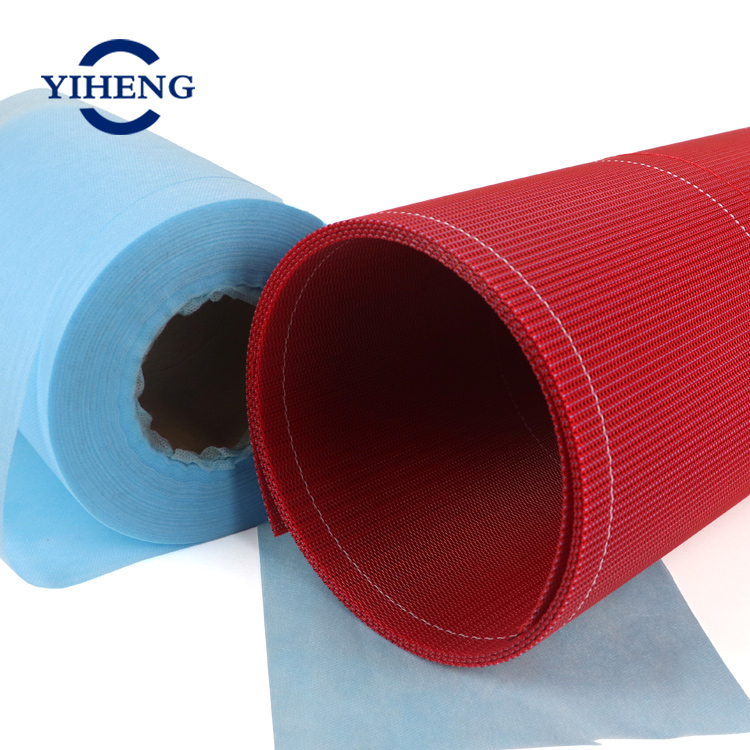
SK604 is the model to examine when static-driven fabric flip is the dominant concern and the line runs at speed. The carbon fiber component provides the conductive path, while the anti-hydrolysis filaments address the humid-heat exposure. The double-pins joint and the melt glue or AB glue edge are part of the installation envelope and should be matched to the machine.
The boundary is grounding. A conductive belt can only dissipate charge if the path to ground is intact. Rollers, frames and grounding rods must be checked as part of the installation. If the grounding path is poor, a lower-ohm belt will not compensate for it.
KJD700: the highest conductivity and a high-adhesion weave
KJD700 sits at the conductive end of the shortlist. It uses anti-hydrolysis PET round, conductive PET and carbon fiber PET. The weave is above-4 below-8, with a 0.50 mm black anti-hydrolysis round warp, a 0.50 mm black conductive warp and a 0.50 mm black weft. The belt is 1.5 layers, 2.34 mm thick, 1030 g/m², with 600 ±30 CFM and a conductivity value of 10³–10⁴ Ω.
The 4/8 structure is described as high adhesion, and the model is specified for two-component and spunlace equipment. That makes KJD700 a different tool from HY408S and SK604 rather than a simple upgrade. The higher conductivity is useful where charge generation is severe; the high-adhesion weave is useful where fiber retention at the forming point matters.
The practical limit is thickness. At 2.34 mm, KJD700 is 0.49 mm thicker than HY408S and SK604. A line set up for a 1.85 mm belt should check roller clearance, seam transition and tension before switching. The lower CFM value, 600 ±30 CFM, also means the suction settings may need review. This is not a defect; it is a specification difference that has to be engineered into the changeover.
How the three models address static-driven fabric flip
Static-driven fabric flip occurs when charge builds up faster than it can leave the belt. The charge creates a Coulomb force between the web and the belt surface; at the release point, the web can lift, fold or fly off. Yiheng Mesh's technical knowledge base describes the mechanism in terms of surface resistivity: carbon fiber filaments can reduce surface resistivity from above 10¹² Ω to the 10⁶–10⁸ Ω range, allowing charge to flow to metal rollers and discharge through the grounding system.
The shortlist values fit that logic. HY408S is specified at 10⁵–10⁶ Ω, SK604 at 10⁶ Ω and KJD700 at 10³–10⁴ Ω. Lower ohm values indicate a more conductive path. The right choice depends on the severity of the static problem, the grounding quality and the fabric being produced. A belt with higher conductivity is not automatically better for every line; it is a different point on the conductivity curve.
Two conditions must be met for the mechanism to work. First, the conductive filaments must be present in the belt structure. Second, the charge must have a path to ground through the machine. The belt is one part of the circuit, not the whole circuit.
Air permeability, thickness and seam choice
Air permeability is a setting variable, not a quality score. HY408S is rated at 680 ±30 CFM, SK604 at 700 ±30 CFM and KJD700 at 600 ±30 CFM. The differences are modest in numeric terms, but they change the suction balance at the forming point. A belt with higher CFM may require a different vacuum setting from a belt with lower CFM; the goal is a stable web, not the highest possible airflow.
Thickness affects the mechanical envelope. HY408S and SK604 are both 1.85 mm, so a line that already runs one may be mechanically closer to the other. KJD700 is 2.34 mm and needs a separate clearance check. Joint type follows the same logic: HY408S offers millet-ring or double-pins, while SK604 and KJD700 use double-pins. The joint is the most sensitive part of the belt at speed, and the seam must sit flat against the mesh body.
Dimension tolerances are also part of the specification. For these belts, length under 50 m carries a tolerance of ±5 cm, and width under 5 m carries a tolerance of ±1 cm. Buyers should confirm the measured dimensions against the machine drawing rather than relying on nominal figures alone.
Application fit: where each belt makes sense
For high-speed hygiene and medical nonwovens, where fine denier and low GSM make static control critical, SK604 is the most directly specified option in this group. Its 10⁶ Ω conductivity, 1.85 mm thickness and high-speed positioning match the demands of a line that cannot tolerate fabric flip or seam marks.
For lines that need a balance between release and conductivity, HY408S offers a three-filament hybrid structure at the same 1.85 mm thickness. It is suited to high-speed production lines and provides a 10⁵–10⁶ Ω path. The three-weft design is the differentiator when both adhesion and peelability matter.
For two-component and spunlace equipment, KJD700 is the specified model. Its 10³–10⁴ Ω conductivity and high-adhesion 4/8 weave are aimed at processes where fiber retention and static dissipation are both demanding. The thicker profile should be checked against the machine before purchase.
Humidity is the common thread. All three models use anti-hydrolysis filaments, so the choice is not about whether the belt is protected against humid heat. It is about which combination of conductivity, thickness, CFM and weave fits the line.
Market context: why humid-line belt selection is becoming more technical
Spunlaid technology, which includes spunbond and meltblown, accounted for 48.4% of the global nonwoven technology market in 2023, according to Grand View Research. That scale matters for consumables: as more capacity runs on spunlaid lines, the cost of unplanned belt downtime rises across the supply chain.
The equipment market is also expanding. Dataintelo values the global nonwoven production line market at USD 5.3 billion in 2024 and projects it to reach USD 9.8 billion by 2033. On the fabric side, Smithers projects the global nonwoven fabric market to reach USD 90.8 billion by 2030, representing a 6.2% CAGR from 2025. These are separate markets, but they point in the same direction: more lines, more output and more attention to the components that determine line availability.
The technical trend is equally clear. High-performance forming belts can already operate at up to 1,000 m/min and 180°C. As lines move toward finer denier and higher speed, the belt is being asked to do two jobs at once: carry the web uniformly and provide a controlled path for static. That is why anti-hydrolysis and anti-static are increasingly specified together rather than treated as separate upgrades.
Comparison with traditional solutions and selection boundaries
A standard polyester forming belt can be the right choice in a stable, low-moisture line where static is not a recurring problem. It is usually less expensive and easier to source. The trade-off is that standard polyester has no dedicated hydrolysis protection and no built-in conductive path unless the specification calls for it. In a humid, high-heat spunbond line, that combination can shorten service life and increase the risk of fabric flip.
Anti-hydrolysis belts address the moisture-and-heat path. They do not address abrasion, edge wear, mechanical damage or every possible chemical exposure. Yiheng Mesh states a typical service life of 3–6 months under standard operating conditions, with regular cleaning and tracking checks recommended. That is a useful planning figure, not a guarantee; actual life depends on temperature, humidity, tension, fabric type and maintenance.
Anti-hydrolysis plus conductive filaments addresses both hydrolysis and static, but it adds a new dependency: the grounding path. A conductive belt on a poorly grounded machine is not a complete solution. The buyer should verify the grounding rod, roller contact and frame continuity before blaming the belt for fabric flip.
The comparison table below is a decision aid, not a ranking. The correct choice depends on the line, not on a single specification.
| Option | Hydrolysis resistance | Static dissipation | Typical fit | Main boundary |
|---|---|---|---|---|
| Standard polyester forming belt | Not specifically protected | Only if conductive filaments are specified | Stable, low-moisture lines with controlled static | Higher risk in humid heat; no built-in conductive path |
| Anti-hydrolysis belt | Designed to resist moisture-and-heat degradation | Depends on model | Humid spunbond lines with moderate static risk | Does not stop abrasion or mechanical wear |
| Anti-hydrolysis + conductive belt | Designed to resist moisture-and-heat degradation | Carbon fiber or conductive PET path | High-speed, low-GSM lines where fabric flip is a risk | Requires a functioning grounding path; thickness and CFM must match the machine |
One concrete boundary in this shortlist is KJD700. Its 2.34 mm thickness and 600 ±30 CFM are not a drop-in replacement for a 1.85 mm, 680–700 CFM belt without a machine check. The higher conductivity is an advantage where charge is severe, but the mechanical and pneumatic envelope must be verified first. A shortlist is a starting point for engineering, not a substitute for it.
Procurement checks before ordering
Buyers evaluating anti-hydrolysis nonwoven mesh belts should confirm six things before placing an order. First, the actual humidity and temperature exposure of the forming section, not the ambient factory condition alone. Second, the current belt thickness and seam type, so the new belt fits the existing roller geometry. Third, the target conductivity range and the condition of the grounding path. Fourth, the CFM setting and the suction balance at the forming point. Fifth, the measured length and width, including the tolerances. Sixth, the compliance requirements for the destination market.
On compliance, Henan Yiheng Mesh Belt Industry Co., Ltd. is certified as a National High-tech Enterprise, and its products hold the Food Contact Certificate. The company is also registered under the German Packaging Law (LUCID). For EU-bound orders, those documents are part of the supplier qualification file. The company serves Asia, Europe and North America and reports a 35% market share in Southeast Asia.
For custom work, Yiheng Mesh supports OEM/ODM with a minimum order quantity of 1 m² and custom prototypes in as little as 3 days. Its technical knowledge base contains more than 122 real-world troubleshooting cases, supported by an R&D team of 3 engineers. Those resources are useful during changeover, when the belt specification has to be matched to the line rather than selected from a catalog.
Customs classification is a separate check. Nonwoven mesh belts for industrial use are commonly classified under HS Code 39269029 or 59100000, depending on material coating and reinforcement. Buyers should confirm the code with their customs broker before shipment.
Future outlook
The next phase of spunbond development is likely to be defined by speed, finer denier and tighter quality control, not by a single new machine concept. As lines run faster and produce lighter fabrics, the forming belt becomes more than a consumable. It becomes part of the process control system: its CFM affects web uniformity, its thickness affects the mechanical envelope, and its conductivity affects static-driven defects.
That suggests two practical changes for buyers. First, anti-hydrolysis and anti-static will be specified together more often, because humid heat and static are separate failure paths that can occur on the same line. Second, belt selection will rely more on measured line data and less on generic model names. The shortlist in this article is a starting point; the final choice should be based on the machine, the fabric and the maintenance record.
For manufacturers, the opportunity is to make the specification legible. A belt that is described only as anti-hydrolysis or anti-static is harder to compare than a belt with stated thickness, CFM, conductivity and joint type. The three models here are useful because they make those variables visible.
FAQ
What is an anti-hydrolysis nonwoven mesh belt?
It is a forming or conveying belt made with anti-hydrolysis polyester filaments intended to resist moisture-and-heat degradation in nonwoven manufacturing. In this shortlist, HY408S, SK604 and KJD700 use anti-hydrolysis PET. SK604 and KJD700 also use conductive PET and carbon fiber PET for static dissipation.
Which model is specified for high-speed lines?
SK604 is described as suitable for high-speed lines, with 700 ±30 CFM, 1.85 mm thickness, 1030 g/m² and 10⁶ Ω conductivity. HY408S is also described as suitable for high-speed production lines, with 680 ±30 CFM and 10⁵–10⁶ Ω conductivity. The final choice depends on thickness, conductivity and suction settings.
How does KJD700 differ from HY408S and SK604?
KJD700 has an above-4 below-8 weave, 2.34 mm thickness, 600 ±30 CFM, 1030 g/m² and 10³–10⁴ Ω conductivity. It is described as suitable for two-component and spunlace equipment with high adhesion. Its higher conductivity and greater thickness make it a different fit, not a direct drop-in for every line.
Do these belts work on Chaolong or Hongda equipment?
Yiheng Mesh states that it has supplied Reicofil, Chaolong, Hongda and other manufacturers, with tuning data for specific tension requirements. Buyers should still confirm dimensions, seam type and running tension against the actual machine before ordering.
What is the expected service life?
Under standard operating conditions, Yiheng Mesh states a typical service life of 3–6 months, with regular cleaning and tracking checks recommended. Humid, high-temperature or abrasive conditions can change that range.
What should buyers verify before switching models?
Buyers should verify thickness, seam type, CFM, conductivity range, grounding path, measured dimensions and chemical compatibility. Anti-hydrolysis protects against one degradation path; it does not remove abrasion, edge wear or mechanical damage.
Technical reference: the Yiheng Mesh company brochure is available as a PDF at this link. Company website: https://www.yhfilterbelt.com/.
Have Questions or Need More Details?
Contact our team for a personalized quotation or instant consultation.
Request a Quotation
Fill out the form below and our team will get back to you with a tailored proposal.
WhatsApp Direct Chat
Prefer to chat in real-time? Message us on WhatsApp for instant assistance & quick answers.
- Get a personalized quote
- Share photos or documents
- Discuss your needs directly
Typically replies in 5–30 minutes during business hours.