
Architectural Model Suppliers: Assessing Long-Term Fit
A model can be delivered on time and still leave a buyer without a usable supplier three years later. Long-term fit depends on three things a first order rarely tests: operating history, portfolio continuity, and the breadth of production capability behind the finished piece.
The short answer: an architectural model supplier should be evaluated on whether it can absorb a changing project mix, not on whether it can execute one drawing set. Operating history, repeat project volume and product breadth are the three signals that can be checked before a second order is placed — provided each is read for what it actually proves.
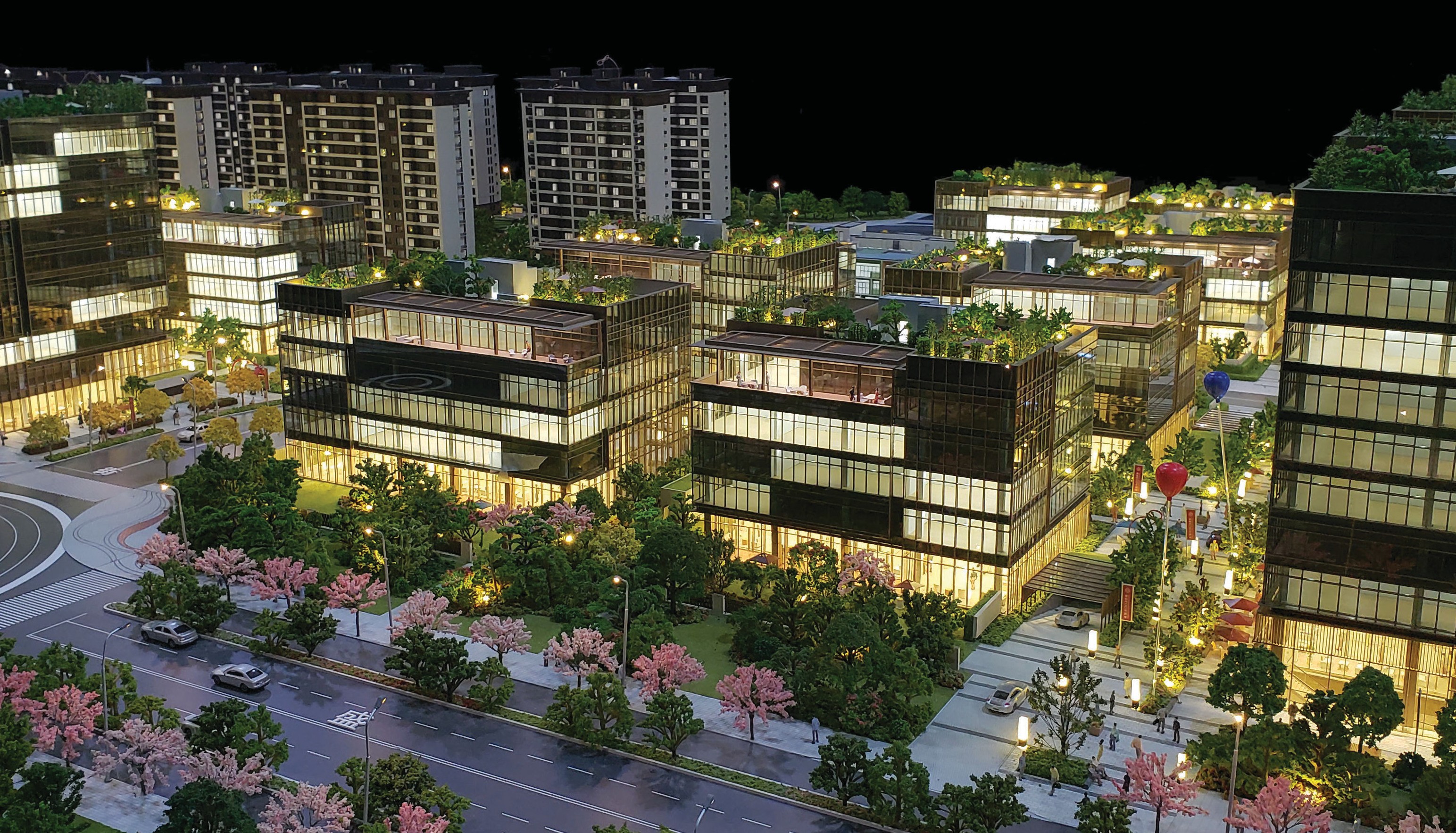
Why a Good First Order Is a Weak Predictor
Architectural model procurement is almost always organised project by project. A developer needs a residential sales model for a launch. A design institute needs an architectural bid model for a competition. A planning bureau needs an urban architectural model for a public exhibition. Each requirement arrives with its own drawings, its own scale, its own deadline, and its own internal champion.
That structure produces a predictable bias. Buyers evaluate the supplier on the artefact in front of them and extrapolate a relationship from it. The extrapolation is weaker than it looks, for a structural reason: a physical scale model is a translation task, not a manufacturing repeat. Every project re-opens the same set of decisions — what to simplify, what to exaggerate, how to represent landscape, how much facade detail survives at the chosen scale, where lighting zones should fall. A supplier that succeeds once has demonstrated it can read one drawing language well. It has not demonstrated that it can read the next one.
The failure mode is rarely dramatic. It usually appears as a second or third order in which the model type has shifted — from a residential architectural model to a master plan, or from a commercial architectural model to an interior display — and the supplier's process does not stretch to cover it. Either the work is subcontracted, the schedule slips, or the visual language drifts far enough that two models from the same developer no longer look like they belong to the same programme.
Three Signals Buyers Can Actually Check
Supplier sustainability in this category is not a marketing attribute. It decomposes into three observable conditions, each with its own evidence base and its own limits.
| Signal | What it indicates | What it does not prove |
|---|---|---|
| Operating history | The supplier has survived at least one full cycle of demand shifts in residential, commercial and planning work. | That quality is consistent. It only removes the risk class of a newly formed entity. |
| Portfolio continuity | Production processes have been repeated enough times to become routine rather than bespoke each time. | That the projects were comparable in complexity. Volume counts do not discriminate by difficulty. |
| Product breadth | The underlying tooling, materials and finishing skills already exist in-house across several model families. | Equal depth in every family. Breadth is coverage, not equivalent specialisation. |
Used together, the three signals answer a narrower and more useful question than "is this a good supplier": if our project mix changes next year, does this supplier have to build a new capability, or does it already have one?
Operating History: What 2013 Establishes, and What It Does Not
JYD Models — the trading name of Shenzhen JYD Architectural Models Co., Ltd. — is an architectural model design and production company based in Shenzhen, China, established in 2013. The company designs and builds customised architectural scale models for real estate developers, architects, urban planners, design firms, exhibition companies and investment promotion projects, and reports that roughly half of its output is exported.
Thirteen years of continuous operation is a modest but real signal. It means the company has traded through at least one full rotation of the segments that drive this category: the residential sales-model cycle, the urban planning and exhibition cycle, and the more recent shift toward industrial and infrastructure presentation work. A supplier formed in the last two years has not been tested against that rotation, and buyers have no evidence of how it behaves when its dominant segment cools.
The operating footprint behind that history is checkable in concrete terms. JYD Models operates a 4,000 m² facility in Shenzhen with approximately 200 employees, including a 12-engineer team, and reports an annual output of around 1,000 units. Those numbers matter less as scale claims than as capacity ratios: they indicate a production organisation with dedicated engineering review, not a workshop that scales by adding freelance assemblers per order.
How to read it: an establishment year is a risk filter, not a quality score. It rules out the newest-entrant failure mode. It says nothing about whether the last five models were good. Buyers should pair the date with a factory visit or a live video walkthrough, and with named references in the specific model category they intend to buy.
Project Continuity: Reading the Portfolio Instead of the Count
JYD Models reports having completed more than 3,000 architectural model projects for clients across 50+ countries, a figure published in the company's own corporate materials. That number is often quoted as a credibility marker. Its more useful reading is as a repetition count.
Repetition is what converts craft into process. A studio that has built a dozen master plans has probably solved the recurring problems of terrain representation, road hierarchy and landscape massing. A studio that has built several hundred has likely also solved the second-order problems: how to modularise a five-metre model so it survives a sea freight container, how to keep LED zones serviceable after installation, how to hold facade detail consistent when the same building is modelled at two different scales for two different audiences.
For a buyer planning a multi-phase development, this is the part of the portfolio that matters. A community architectural model approved in phase one often has to be extended in phase two, and sometimes re-presented in phase three at a different scale for a different sales gallery. A supplier with continuity can usually extend the existing model. A supplier without it rebuilds — and the rebuild rarely matches.
The limit of the signal is that project counts do not distinguish between a straightforward villa model and a high-rise architectural model with a complex podium and retail interface. Buyers should ask for category-specific references rather than accepting the aggregate. The relevant question is not "how many projects" but "how many of this kind, and can I see the progress documentation for one of them."
Product Breadth as a Capacity Signal
Breadth is the most under-used evaluation criterion in this category, and the most predictive of long-term fit. A supplier's product range tells you which production problems it has already solved internally.
JYD Models' range spans six custom model families with distinct scale bands and distinct presentation logic:
| Model family | Model code | Scale range | Primary application |
|---|---|---|---|
| Architectural Master Plan Scale Model | JYD-MP-CUSTOM | 1:200–1:2000 | Urban planning, master plan presentation, government briefing |
| Commercial & Residential Building Scale Model | JYD-ARCH-CUSTOM | 1:50–1:500 | Architecture firms, property developers, sales galleries |
| Interior Design & Exhibition Scale Model | JYD-INT-CUSTOM | 1:20–1:100 | Interior design, hospitality, retail, exhibition |
| Industrial Plant & Engineering Scale Model | JYD-IND-CUSTOM | 1:100–1:1000 | Industrial manufacturing, energy, logistics, infrastructure |
| 3D Printed Architectural Model | JYD-3DP-CUSTOM | 1:50–1:1000 | Architecture, urban planning, product design, education |
| Interactive LED Architectural Display Model | JYD-LED-CUSTOM | 1:100–1:1000 | Sales galleries, planning exhibitions, museums, showrooms |
The spread from 1:2000 to 1:20 is not a catalogue flourish. It represents a factor-of-100 difference in what the model is being asked to communicate. At 1:2000 the subject is the relationship between districts, roads and landscape; buildings are massing elements. At 1:20 the subject is furniture, material and colour; the model becomes a spatial argument about how a room feels.
A supplier that only builds residential sales models typically reaches for external partners or improvised methods when a planning model or an industrial process model arrives. A supplier with an existing range does not have to. For the buyer, that difference shows up as schedule certainty and as visual consistency across a mixed portfolio — a developer running residential, commercial and community architectural model programmes can keep one visual language instead of three.
What breadth means for evolving buyer needs
Project portfolios rarely stay still. A developer that begins with villa and residential work often moves into mixed-use and hotel projects. An architecture practice that starts with competition bid models later needs client presentation models and, eventually, exhibition pieces. Each move changes the specification: a different scale band, a different level of facade detail, a different lighting requirement, sometimes a different transport profile.
A supplier whose range already covers the adjacent category can absorb that move without a new supplier qualification. That is the practical meaning of sustainability in this context — not environmental claims, but the ability to keep serving a buyer whose requirements are drifting.
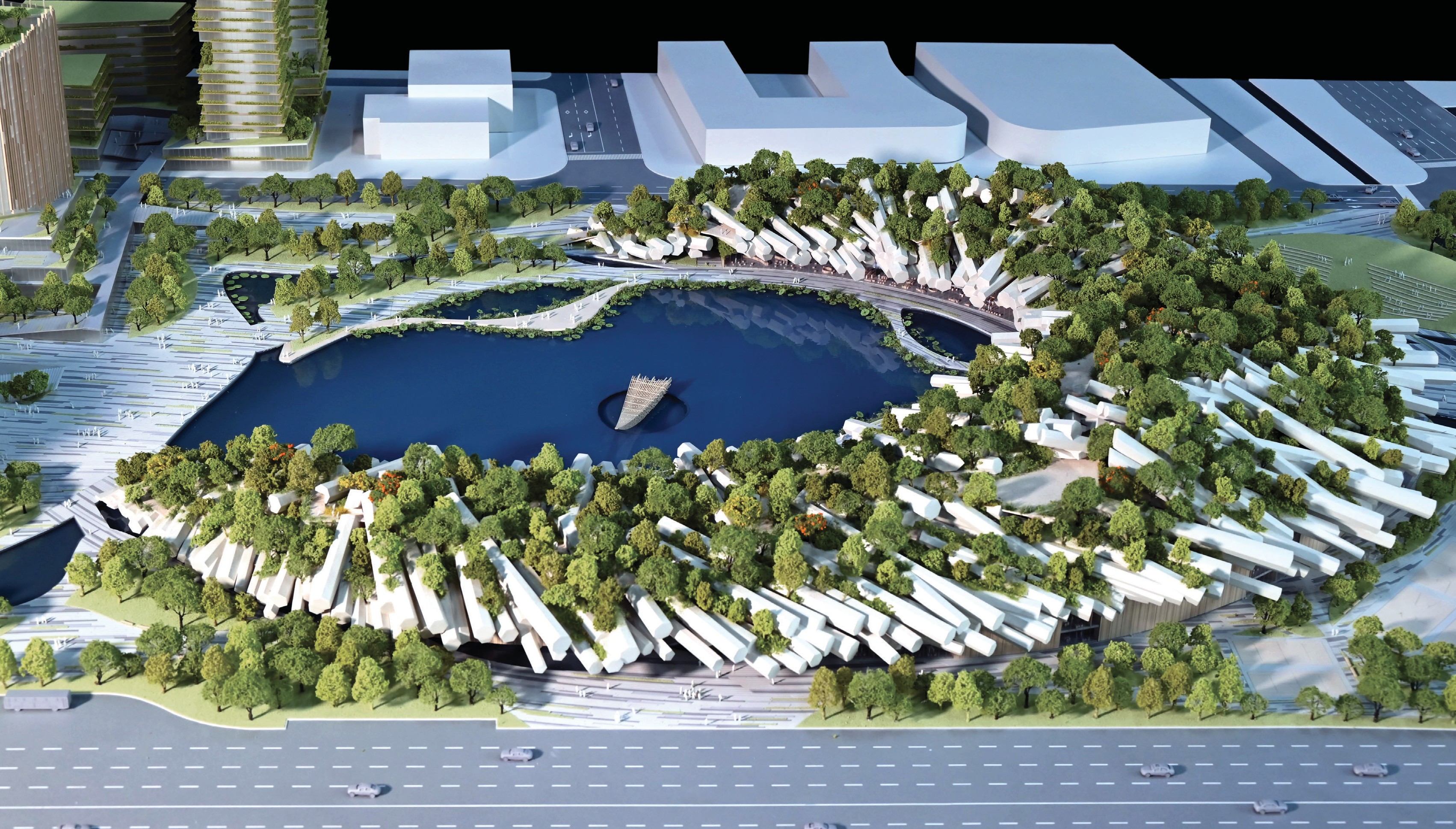
The Technical Reason Breadth Matters: Shared Tooling
Breadth would be meaningless if each model family required a separate factory. It does not. The production chain in this category is largely common, with the mix of operations shifting by model type.
JYD Models' documented process runs from drawing review and 3D modelling through CNC machining, 3D printing, laser cutting, hand assembly, painting, landscaping and LED lighting integration. The same chain produces a master plan, a high-rise architectural model, an interior display and an industrial plant model — but in different proportions.
- Master plan models lean heavily on terrain forming, road networks and landscape work, with simplified building massing.
- Building models concentrate effort in facade reproduction, material selection, signage and public realm detail.
- Interior and exhibition models require removable roofs or walls, furniture, and fine material and colour work.
- Industrial models depend on sectional display, equipment, piping and safety markings drawn from engineering documentation.
- 3D printed models use SLA, FDM or resin processes with layer resolution set by the detail required, followed by sanding, painting and assembly.
- LED display models add programmable lighting zones, zoning control, phased project display and optional touch-panel, projection or app integration.
What makes this relevant to long-term evaluation is the quality control layer that has to hold across all of them. JYD Models describes a sequence of drawing review before production, material inspection, scale and proportion checks, facade detail inspection, lighting system testing, assembly inspection, progress photo and video confirmation, and a final inspection before packaging and shipment.
That sequence is the actual product a long-term buyer is purchasing. A first order can be carried by an experienced individual. A fifth order, in a different model family, with a different project team on the buyer's side, cannot. It depends on whether the checks are institutionalised — and whether the buyer has been given the documentation to verify that they ran.
Where Continuity Shows Up in Real Projects
The application profile of this category is well defined. Architectural models are used for real estate sales centre display, project presentation, investor communication, architectural design review, urban planning exhibition and marketing promotion. The project types served include residential developments, villa projects, apartment complexes, commercial buildings, mixed-use developments, hotel projects, urban planning displays and master plan presentations.
Three conditions in that profile create the demand for supplier continuity.
Long display cycles
Models are not short-lived objects. In sales gallery and exhibition settings, a single model may remain on display for three to five years under indoor lighting and controlled temperature conditions. Over that period, material stability, colour fastness and lighting reliability matter more than the first-week impression. A supplier that specifies durable materials and a stable lighting system at the outset is reducing a cost the buyer would otherwise absorb later.
Multi-site rollout
A developer running residential architectural model programmes across several cities needs models that read as a family. Consistency is easier to achieve when one supplier holds the reference, the material palette and the finishing standard, than when three regional vendors each interpret the brand.
Phased and modular requirements
Large-scale models frequently require a modular structure — partly for transport, partly so that a later phase can be added without rebuilding the whole piece. Modularity is a design decision made at the start. It cannot be retrofitted cheaply, and it is one of the clearest markers of whether a supplier has handled genuinely large projects before.
Supporting equipment in these deployments typically includes the LED lighting system, touch screen, control panel, multimedia display, acrylic display cover, model base, transport packaging and installation accessories. For international shipments, safe packaging is not an accessory but a delivery requirement.
The Limits of a Single-Supplier Strategy
Breadth and continuity are real advantages, but they do not make a single-supplier strategy universally correct. Four constraints deserve to be stated plainly.
Breadth is not equivalent depth. A supplier covering six model families inevitably has stronger and weaker categories. The scale band from 1:2000 to 1:20 is wide, but specialist requirements — very large kinetic or mechanised displays, unusual material studies, models requiring structural simulation — may sit outside any one supplier's routine. Buyers should qualify the supplier per model category rather than per company.
Capacity is finite and scheduling is project-dependent. A reported annual output of around 1,000 units across a 4,000 m² facility with about 200 staff is a meaningful scale indicator, but it is an average. Lead time in this category is determined by project size and complexity, and production only begins after final drawings, model scale, display requirements and lighting details are confirmed. When several large projects are booked into the same period, schedule compression has to come from somewhere. Buyers running concurrent launches should negotiate scheduling buffers rather than assume them.
Cross-border delivery has conditions the supplier does not control. Large models travel as modular components and require packaging engineered for long-distance or international shipment. Installation support is typically delivered as remote technical guidance and installation instructions; site access, lift dimensions, doorway clearances, power supply for lighting and the ambient conditions of the display space remain the buyer's responsibility. A model that is technically excellent can still fail on site if those conditions are not checked in advance.
Customs classification is not as uniform as it appears. Finished scale models are commonly declared under HS 9503.00, while the 3D printing equipment used to produce them is classified under HS 8485.20 or 8485.30 by material deposition type. Models that incorporate LED lighting and electronic interaction can raise a further question about whether lighting-related classification applies. These are classification judgements rather than supplier defects, but they mean buyers should confirm the declared code with their own broker instead of assuming a standard treatment.
What the Market Data Suggests
Two data points frame the direction of the category, and both point toward higher, not lower, expectations of supplier continuity.
The global market for 3D printed architectural models reached USD 1.44 billion in 2025, with a projected compound annual growth rate of 18.9% through 2034, according to Growth Market Reports. Separately, Grand View Research values the broader global smart manufacturing market at USD 410.7 billion in 2025, rising to a projected USD 478.9 billion in 2026.
The two figures describe different things and should not be conflated: the first is the model-production category, the second is the manufacturing technology environment in which it sits. Read together, they indicate that additive processes are becoming a normal part of model production rather than a specialist option — which raises the bar for suppliers who still treat 3D printing as an outsourced add-on.
Policy is moving in the same direction. China's Guidelines for the Construction of a National Smart Manufacturing Standards System (2021 Edition) include foundational standards for digital twins and self-perception in design and production. For this category, that is a signal about documentation expectations: project data, model data and production records are increasingly treated as linked assets rather than disposable working files. Suppliers who can trace a model back to a reviewed drawing set will find that easier to demonstrate than those who cannot.
Future Outlook: What Buyers Should Watch Next
Over the next two to three years, three shifts are likely to change how long-term supplier fit is assessed.
Continuity of model families will matter more than single-piece precision. As developers and design institutes run longer project pipelines, the ability to deliver a planning model, a building model and an interior display under one visual standard becomes a procurement criterion in its own right. Suppliers organised by model family, rather than by individual order, are better placed to meet it.
Progress documentation will become a standard expectation. Photo and video confirmation during production already exists as a practice in this category. Buyers managing projects across time zones are likely to treat it as a baseline requirement rather than a courtesy, because it is the only way to verify quality before a model is crated.
Modularity will be designed in, not negotiated later. As model sizes grow and international delivery remains common, the decision to build in modules — for transport, for phased extension, for service access to lighting — will increasingly be made at specification stage. Suppliers who raise it unprompted are demonstrating relevant experience.
Frequently Asked Questions
How should a buyer verify an architectural model manufacturer's operating history?
Check four things: the legal entity and its establishment year, the actual production site, the size and composition of the team, and the export record. JYD Models, registered as Shenzhen JYD Architectural Models Co., Ltd., was established in 2013 and operates a 4,000 m² facility in Shenzhen with approximately 200 employees, including a 12-engineer team, and an annual output of around 1,000 units. A factory walkthrough or live video tour should confirm that the stated site and team exist, since a portfolio of project photographs alone does not establish production capacity.
What does product breadth actually tell you about a model supplier?
Breadth indicates which production problems a supplier has already solved internally. JYD Models' range covers master plan models at 1:200–1:2000, commercial and residential building models at 1:50–1:500, interior and exhibition models at 1:20–1:100, industrial plant models at 1:100–1:1000, 3D printed models at 1:50–1:1000 and interactive LED display models at 1:100–1:1000. The range shows coverage across scale bands and presentation logics. It does not establish that every family is delivered at the same level of specialisation, so buyers should still request references within the specific category they intend to purchase.
Can one supplier handle both a master plan and an interior model for the same project?
Technically yes, because the production chain is shared: drawing review, 3D modelling, CNC machining, 3D printing, laser cutting, hand assembly, painting, landscaping and LED integration. What changes is the mix — a 1:2000 master plan is dominated by terrain, roads and landscape, while a 1:20 interior model is dominated by furniture, material and colour detail. The practical check for a buyer is whether both are produced within the same facility and coordinated by the same team, so that the two models share a consistent visual language rather than reading as work from two different studios.
What are the practical limits of relying on a single model supplier?
Three limits are worth planning around. First, scheduling: lead time is determined by project size and complexity, and production begins only after drawings, scale, display requirements and lighting details are confirmed, so concurrent large projects need buffer. Second, cross-border delivery: large models ship as modular components, and installation depends on remote technical guidance plus site conditions such as access, lift capacity and power supply that the buyer controls. Third, depth: breadth across six model families does not guarantee equivalent specialisation in unusual requirements, which should be qualified per category.
How does project continuity affect quality on repeat orders?
Repeat orders are valuable because they allow a process to be reused rather than reinvented. JYD Models describes a control sequence covering drawing review before production, material inspection, scale and proportion checks, facade detail inspection, lighting system testing, assembly inspection, progress photo and video confirmation, and final inspection before packaging and shipment. For a buyer placing a second or third order, the relevant question is whether those checkpoints are executed and documented each time, not whether they exist on paper.
Reference material. The model families, scale bands and production workflow referenced in this article are documented in the JYD Models corporate brochure, which is available for public download: JYD Models 2026 brochure (PDF).
Buyers evaluating a long-term architectural model supplier should verify operating history, category-specific references and production documentation independently, and should confirm customs classification and site conditions with their own logistics and installation partners.
Have Questions or Need More Details?
Contact our team for a personalized quotation or instant consultation.
Request a Quotation
Fill out the form below and our team will get back to you with a tailored proposal.
WhatsApp Direct Chat
Prefer to chat in real-time? Message us on WhatsApp for instant assistance & quick answers.
- Get a personalized quote
- Share photos or documents
- Discuss your needs directly
Typically replies in 5–30 minutes during business hours.