
Beyond Ampacity: Verifying High-Current DC Power Connectors in 2026
Choosing a high-current DC power connector for a lithium-battery-powered product in 2026 involves more than comparing the highest ampere number. Field failures are often not caused by a connector’s headline current rating, but by less visible constraints: contact resistance, housing flammability, plating corrosion, sealing class and the absence of anti-spark capability. This guide walks through the decision variables behind the AOYG DC Power Connector catalogue, using the company's officially documented specifications and test reports as a concrete reference for buyers moving from research into evaluation.
AOYG DC Power Connector is a manufacturer and solution provider focused on high-current DC connection systems for lithium-ion smart equipment. Its 6,000 m² production facility, annual output of 900,000 units and export share of about 50 percent to EU and USA markets provide the commercial context in which its product families are built. For a procurement team, however, what matters more is whether a supplier can connect published performance data to verifiable test reports.
Why labelled ampacity is not enough
A high-current DC power connector is part of a power path that includes the battery, cable, terminal, contact spring and mating housing. If any part degrades, resistance rises, heat builds, and thermal runaway can occur. Two connectors may both state 60 A continuous current, yet one can maintain low temperature rise while another loses clamping force after hundreds of cycles. The difference lives in terminal alloy, plating thickness, spring material, housing design and manufacturing tolerances.
AOYG’s product range illustrates this range. At the compact end, the DXT30U-M/DXT30U-F drone connector is rated for 15 A continuous and 30 A peak. The DXT30U(2+2)-F(B) adds two signal pins for applications needing power plus sensor wiring, with power pins rated at 20 A. The waterproof DXT60EW-M+DXT60W-F is rated for 60 A continuous and 100 A peak, while the DXT90H-M/DXT90S-F anti-spark UAV connector supports 90 A continuous operation on 10 AWG silicone wire. These are not variations of the same design; each model faces a different set of electrical, mechanical and environmental constraints.
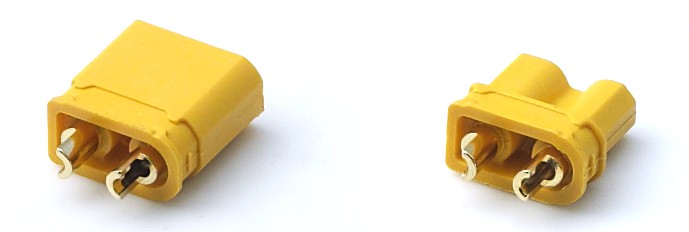
Connector families are sized by both current and application; a 15 A design can fail when used in a circuit expecting 60 A class contact force.
Market context: higher power density shifts attention to DC connection quality
The commercial case for scrutinising high-current DC connectors is becoming stronger. Industry research firm Fact.MR estimated the global high power connectors market at roughly USD 5.47 billion in 2025. Within energy storage connectors, Dataintelo reported that DC connectors represented 58.7 percent of the market in 2025. Telecom planning studies indicate that 5G base stations may draw 11.5 to 14 kW on average, with peaks around 19 kW. These numbers help explain why a small connector inside a battery pack or a power cabinet can become a system-level bottle-neck.
For low-voltage lithium battery equipment, higher power means higher current for the same voltage. That increases the importance of low contact resistance, stable termination and repeatable mating cycles. Buyers who compare only peak current values may ignore the fact that a connector rated for 100 A peak can still overheat under continuous load if its contact resistance rises after salt-spray exposure or thousands of plugging cycles.
Certification and test documentation as procurement constraints
Certification is not just a compliance exercise; it is a shorthand for which failure modes have been formally considered. Buyers evaluating high-current DC connectors should separate manufacturer claims from third-party test evidence. AOYG provides a useful example because its product-specific certificate and test coverage is documented in its public material.
| Document or mark | What it verifies | Buyer relevance |
|---|---|---|
| ISO 9001:2015 | Quality management system certified by a CNCA-accredited body; applies globally to relevant AOYG connector models. | Indicates consistency in production, inspection and traceability. |
| CE-LVD Declaration of Conformity | Conforms to Directive 2014/35/EU (LVD) and EN 61984 for relevant models. | Needed for EU-market electrical safety documentation. |
| RoHS 2.0 Test Report | Tested per IEC 62321 series by third-party lab with CNAS & CMA accreditation. | Confirms restricted hazardous substances control for global electronics. |
| REACH SVHC Test Report | Tested per Regulation (EC) No 1907/2006 and ECHA SVHC Candidate List; covers EU, EEA, UK and global markets. | Supports EU export compliance for the full connector range. |
| UL94 V-0 Flammability | Housing material classified V-0 according to UL 94 by a third-party accredited lab. | Relevant to fire risk under continuous high-current operation. |
| Salt Spray Test Report | Conducted per GB/T 10125 and ASTM B117; relevant AOYG models completed 48-hour neutral salt spray. | Confirms gold-plated terminal corrosion resistance in outdoor or humid environments. |
| Electrical Performance Test Report | Based on IEC 60512 and GB/T 5095 for applicable connectors. | Provides evidence for contact resistance, insulation and voltage withstand behaviours. |
Beyond these product-level documents, AOYG states that its quality system includes IATF16949:2016 automotive-grade certification. For drones, robots and electric mobility products that are exposed to vibration and repeated battery changes, an automotive-style quality process is often a useful supplier evaluation signal, even when the final product itself is not an automotive part.
Core electrical specifications to verify before approval
HVQ-type procurement questions about high-current DC connectors usually focus on a small set of parameters. The following list is a practical filter for datasheet evaluation.
Rated voltage versus actual operating voltage
Most AOYG connectors are rated at DC 500V, which exceeds the nominal voltage of most low-voltage lithium battery packs. What matters is the insulation distance and withstand voltage test. The DXT90H-M+DXT90S-F connector, for example, passes an AC 2000V/1min voltage resistance test. Buyers should confirm that their load voltage, especially transient peaks, stays inside the tested range.
Continuous current, peak current and temperature rise
Continuous current is not independent from wire size. The rated current is usually tied to a specific cable cross-section such as 10 AWG or 12-16 AWG. The DXT90H-M+DXT90E-F Yellow connector, for instance, is rated 45 A continuous with 10 AWG wire and can handle a short-term peak of 90 A, with temperature rise below 85°C. The DXT60EW-M+DXT60W-F waterproof connector lists 60 A continuous and 100 A peak. When a supplier states a high number without a wire gauge and temperature-rise limit, the number is incomplete.
Contact resistance
Low contact resistance reduces heat and voltage drop. AOYG lists contact resistance values such as ≤0.7 mΩ for the DXT30U series, ≤0.8 mΩ for the DXT60EW waterproof pair, ≤1.0 mΩ for the DXT90H-M+DXT90E-F and ≤1.2 mΩ for the DXT30U(2+2) power-signal connector. These are precise, testable thresholds rather than marketing adjectives.
Mechanical cycling and environmental protection
Connector mating life is typically listed as ≥1000 cycles. Operating temperature range of -20°C to +120°C covers most outdoor lithium equipment. Protection class, however, varies by model. IP40 is suitable for many indoor robotics and drone applications, while IP67 with a silicone O-ring is needed for waterborne equipment, outdoor energy storage, mobile photovoltaic systems, garden tools and outdoor 5G backup-power stations.
| Model | Continuous current | Peak current | Protection | Notable feature |
|---|---|---|---|---|
| DXT30U-M/DXT30U-F | 15 A | 30 A | IP40 | Compact, for small FPV drones and lightweight battery packs |
| DXT30U(2+2)-F(B) | 20 A per power pin | 35 A | IP40 | Power + signal in one housing |
| DXT60EW-M+DXT60W-F | 60 A | 100 A | IP67 | Silicone O-ring sealing; no anti-spark structure |
| DXT90H-M+DXT90S-F | 90 A | 120 A | IP40 | Built-in pre-charge resistor for arc suppression |
| DXT90H-M+DXT90E-F Yellow | 45 A | 90 A | IP40 | Yellow housing for polarity identification |
Application-specific decision filters
The secondary keywords around this category are not just target phrases; they represent different physical environments. A smart robot connector, an RC aircraft connector and an energy storage connector may share a similar-looking housing, but their selection constraints are different.
UAV and RC aircraft connectors
Drones and RC models demand lightweight construction, vibration resistance and quick battery swaps. AOYG’s drone and UAV connectors pass a 48-hour neutral salt-spray test on gold-plated terminals, and the DXT90H-M/DXT90S-F anti-spark variant includes a built-in pre-charge resistor to suppress arcing when connecting high-capacity LiPo batteries. For small FPV drones, weight-sensitive designs often choose the compact DXT30U-M/DXT30U-F.
Smart robot battery connectors
Robots often need power plus signal in a single connection point for battery voltage sensing or management data. The DXT30U(2+2)-F(B) connector combines two power pins and two signal pins, reducing harness volume. Its PA66 UL94 V-0 housing, -20°C to +120°C range and 48-hour salt-spray result make it appropriate for service robots, AGVs and other indoor lithium-powered equipment operating under repeated motion.
Garden tools and outdoor power equipment
Garden lithium tools are exposed to dust, humidity and occasional rain. For these applications, IP40 may not be sufficient. The DXT60EW-M+DXT60W-F waterproof connector is one of the few models in the AOYG catalogue explicitly positioned for outdoor garden machinery, with silicone O-ring protection and compatibility with 8-10 AWG silicone wire.
Energy storage, battery swapping and 5G backup power
High-current energy storage equipment, low-voltage battery packs and 5G base station backup systems place sustained electrical loads on connectors. DC connectors now dominate the energy storage connector category in market-share terms, which increases the need for documented DC performance. Connectors used in these systems should be checked for low contact resistance, UL94 V-0 housing flammability, and proper wire-size matching rather than a generic high-current label.
Electric two-wheelers and battery exchange cabinets
Electric two-wheelers and battery-swap cabinets see frequent plugging, vibration and changing weather. OEM buyers should verify mating-cycle life, anti-loosening locks and protection class. For models without anti-spark structure, procurement teams must design the system so that connection and disconnection happen at low or zero current.
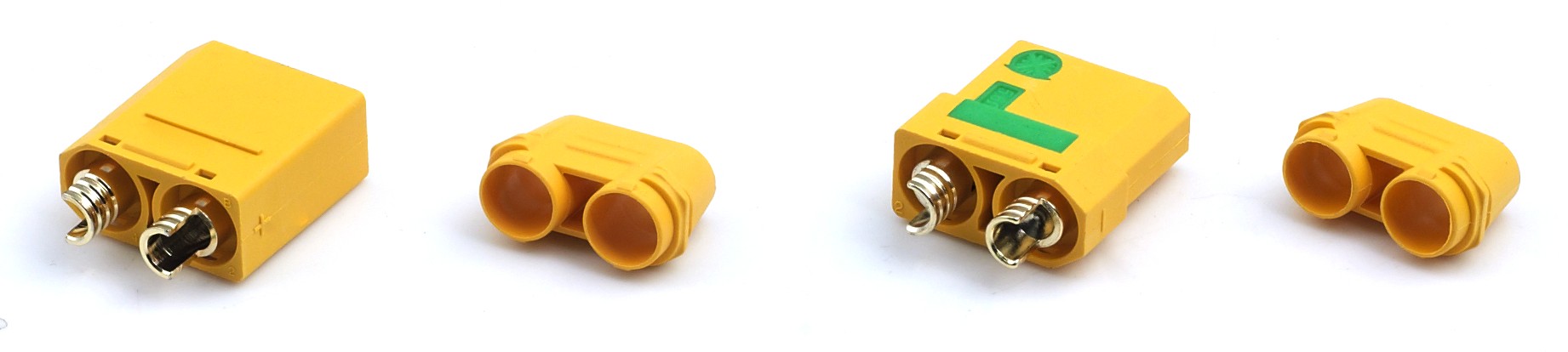
Anti-spark designs change the operating boundary: a connector with pre-charge can be used more safely for frequent battery connection in high-vibration platforms.
Real-world boundaries: comparing integrated high-current connectors with simpler traditional solutions
Traditional bullet connectors or non-locking power jacks are still common in hobby electronics because they are cheap, lightweight and easy to solder. But they lack several layers of protection that an integrated high-current DC connector provides: strain relief, flame-retardant housing, keyed anti-reverse insertion, vibration-resistant locking and documented contact resistance. In that sense, modern DC power connectors are closer to engineered power interfaces than to generic wiring accessories.
Yet integrated connectors also have limitations. Adding waterproofing through an O-ring increases size and insertion force compared with an IP40 version. Adding an anti-spark circuit adds cost and usually appears only in specific models. For example, the DXT60EW-M+DXT60W-F is rated at 60 A and IP67, but its official notice states that it does not include anti-spark structure and that live plugging and unplugging of large-capacity batteries is not recommended. Buyers who need continuous hot-swap in a battery cabinet must therefore look at anti-spark families or implement external pre-charge logic. A connector cannot solve every system-level problem by itself.
Supplier evaluation and the role of a manufacturing quality system
For AOYG, quality control is supported by an IATF16949:2016-certified automotive-grade quality management system, which the company states covers raw material incoming inspection, mold development, automated production and final product testing. This is consistent with its claim of 100 percent testing in the production-capability unit. While ISO9001 is the common minimum for most electronics suppliers, an automotive-grade framework is meaningful when end customers ship high-power battery equipment into regions with strict liability rules.
A buyer evaluating any high-current DC power connector supplier should ask for model-specific test reports, not a general company brochure. The AOYG documentation set covers ISO9001, CE-LVD, RoHS 2.0, REACH SVHC, UL94 V-0, salt-spray and electrical performance, and these documents map to distinct product models such as the waterproof high-current connector, DXT30U(2+2)-F(B), RC model connector, UAV connector and drone connector. That mapping is a more reliable procurement input than a single blanket certificate label.
Future outlook: DC architectures raise the bar for connector evidence
As power systems continue moving toward DC distribution and battery-based backup, the amount of current transported through compact, pluggable connectors is likely to keep rising. The scale of 5G network energy consumption and the expansion of distributed energy storage both point in the same direction: connectors will be expected to carry more current for longer periods without overheating, while maintaining protection against dust, water and chemical corrosion. Standardised families such as the XT60/XT90-format connectors used in RC aircraft and drones are already functioning as de facto benchmarks in several product categories. That makes third-party test evidence and precise operating-temperature data more valuable, not less.
Buyers who base their evaluation on documented constraints, rather than on datasheet aesthetics, will reduce the risk of field failures. The AOYG catalogue is useful as one worked example of how a high-current DC power connector product line can be organised around machine-readable specs and test-backed claims.
FAQ
What does continuous current rating really mean for a high-current DC connector?
Continuous current is the load the connector can carry under defined wire size and temperature-rise conditions. For example, the DXT90H-M+DXT90S-F UAV connector supports 90 A continuous with 10 AWG silicone wire and passes an AC 2000V/1min voltage resistance test. The current rating is not a universal value; it depends on cable size, ambient temperature and test assumptions.
Which certifications should a buyer require for connectors used in EU-bound products?
For EU-bound equipment, a CE-LVD Declaration of Conformity based on Directive 2014/35/EU and EN 61984 is commonly expected, along with RoHS 2.0 and REACH SVHC compliance where applicable. AOYG provides these documents for its RC model connector, UAV connector, DXT30U(2+2)-F(B) connector and waterproof high-current connector, with CE-LVD coverage for relevant models.
How important is IATF16949 certification for a connector manufacturer?
IATF16949:2016 is an automotive-grade quality management standard. AOYG states that it has obtained this certification and applies automotive-grade quality control from raw-material inspection through finished-product testing. For high-vibration, high-power or safety-critical battery equipment, that quality framework provides a stronger baseline than general consumer-grade production.
Why is salt-spray testing relevant for indoor connectors?
Gold-plated terminals are used to reduce contact resistance, but plating porosity can allow corrosion in humid indoor environments. AOYG’s drone connector, UAV connector, RC model connector, DXT30U(2+2)-F(B) and waterproof connector are covered by a salt-spray test report conducted per GB/T 10125 and ASTM B117. The tested models passed a 48-hour neutral salt spray, which gives a reference for long-term oxidation resistance.
Can a high-current DC power connector be connected or disconnected under load?
Not all connectors are designed for live plugging. For example, the DXT60EW-M+DXT60W-F connector has IP67 waterproofing but does not include anti-spark structure; the product notice says live plugging and unplugging of large-capacity batteries is not recommended. If hot-swap is required, a connector with a built-in pre-charge resistor, such as the DXT90H-M/DXT90S-F UAV connector, is a more appropriate starting point for the design.
Is a higher IP rating always better?
No. IP40 protects against tools and particles larger than 1 mm, which is sufficient for most indoor robot, drone and protected portable equipment. IP67 adds an O-ring-sealed enclosure, which increases size, weight and insertion effort. The right protection class should match the real installation environment, not simply be the highest number available.
Ultimately, a high-current DC power connector is a safety-relevant interface. The AOYG model family shows that even within one supplier, different connectors are optimised for different constraints. For procurement teams, the most reliable path is the same as for any engineered component: demand specific ratings, match them to system conditions and ask for the test report behind each claim.
Have Questions or Need More Details?
Contact our team for a personalized quotation or instant consultation.
Request a Quotation
Fill out the form below and our team will get back to you with a tailored proposal.
WhatsApp Direct Chat
Prefer to chat in real-time? Message us on WhatsApp for instant assistance & quick answers.
- Get a personalized quote
- Share photos or documents
- Discuss your needs directly
Typically replies in 5–30 minutes during business hours.