
CNC Machining Center Procurement FAQ: EV-1580B, EV-1475B, UV260
CNC Machining Center Procurement FAQ: EV-1580B, EV-1475B, UV260
Procurement of a CNC Machining Center is normally decided by four measurable variables: the part envelope the machine can reach, the cutting capacity of the spindle interface, the accuracy the axes can hold and repeat, and the tool-change cycle that sets throughput. Brand familiarity and controller preference influence the decision, but they rarely override these four.
Industry scale explains why the evaluation usually starts with a vertical machine. The global CNC machining and turning centers market was estimated at USD 27.64 billion in 2024 (Grand View Research), and vertical machining centers accounted for a 52.3% share of the 4-axis CNC market in 2025 (Dataintelo). A buyer who starts with a vertical machining center therefore starts in the mainstream of the category, and the real work becomes sizing within it, or recognising early that the part geometry requires a different architecture altogether.
EUMASEIKI is the brand of Wenzhou Euma Machinery Co., Ltd., a China-based manufacturer that combines production and trade and focuses on the customization of CNC machining centers, with its production base located in Ningbo City. This reference article answers the procurement questions that recur when buyers compare three EUMASEIKI configurations: the EV-1580B fixed-column vertical machining center, the EV-1475B vertical machining center, and the UV260 trunnion table machining center.
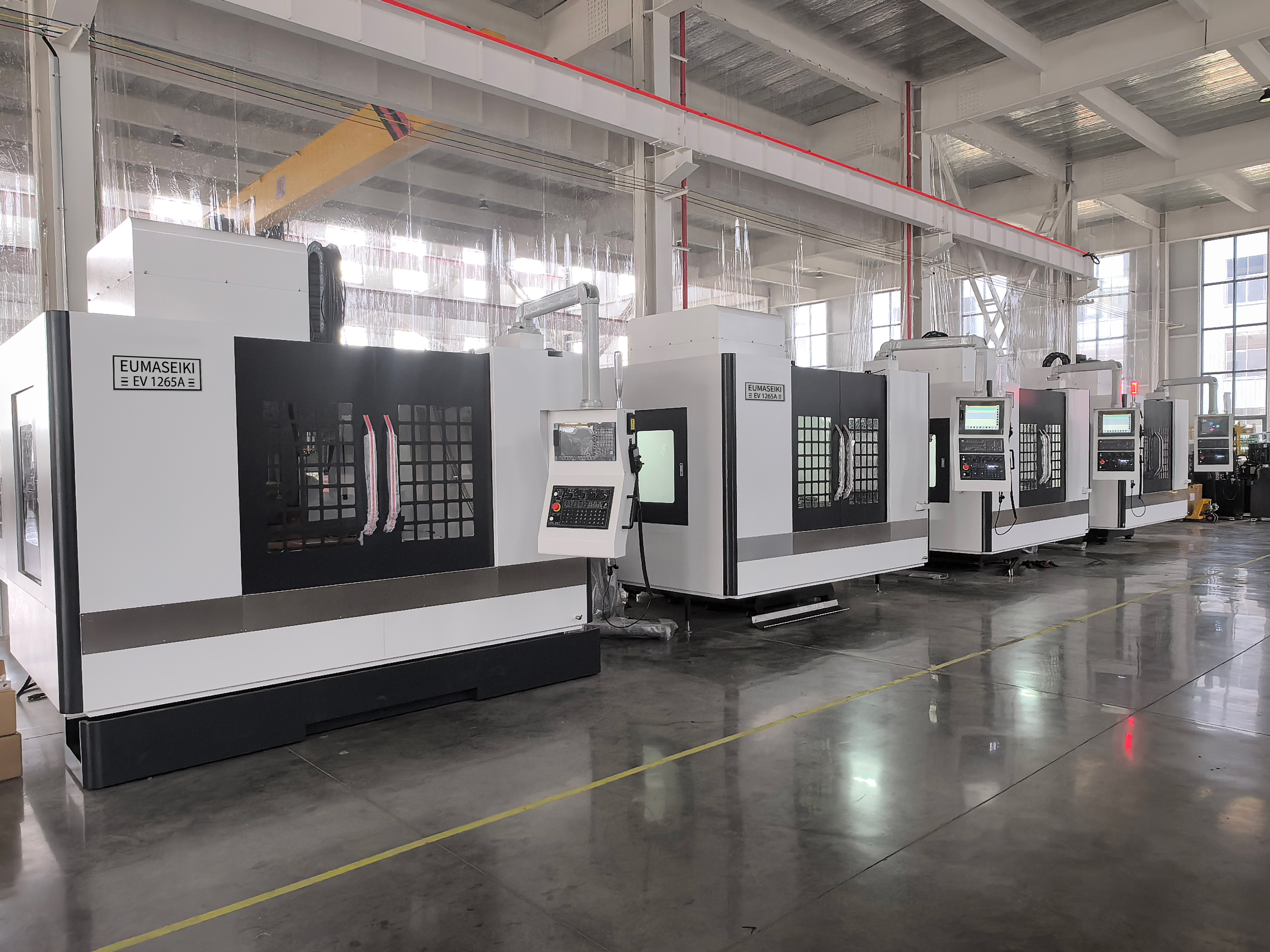
The three configurations at a glance
The comparison below uses only published specification values for the three models. Where a value has not been stated in this specification set, the cell is left blank rather than filled with an estimate.
| Specification | EV-1580B | EV-1475B | UV260 |
|---|---|---|---|
| Architecture | Fixed-column vertical machining center | Vertical machining center | Trunnion table machining center |
| X / Y / Z travels | 1500 / 800 / 700 mm | Not stated in this specification set | 500 / 500 / 450 mm |
| Worktable | 1600 × 800 mm | 1500 × 700 mm | Ø260 mm trunnion table |
| Max. load on worktable | Not stated in this specification set | 1000 kg | Not stated in this specification set |
| Spindle taper | ISO 50 | ISO 50 | Not stated in this specification set |
| Spindle speed | Not stated in this specification set | 8000 rpm | Not stated in this specification set |
| Main motor power | Not stated in this specification set | 22 / 33 kW | Not stated in this specification set |
| XYZ positioning accuracy | Not stated in this specification set | 0.008 mm | Not stated in this specification set |
| XYZ repeat positioning accuracy | Not stated in this specification set | 0.005 mm | Not stated in this specification set |
| Tool change time (tool to tool) | Not stated in this specification set | 3 s | 1.5 s |
| Tool magazine | 24-pocket arm type | Not stated in this specification set | Not stated in this specification set |
| Control system | SIEMENS 828D | Not stated in this specification set | Not stated in this specification set |
| Machine weight | 8000 kg | Not stated in this specification set | 4200 kg |
The three machines are not different points on a single scale. The EV-1580B and EV-1475B are vertical architectures sized for larger workpieces, while the UV260 is a trunnion table configuration built around a Ø260 mm rotary table. Selecting between them is a question of part geometry and volume, not of which machine is objectively better.
Part envelope: the first filter that eliminates machines
The EV-1580B is specified with 1500 / 800 / 700 mm X, Y and Z travels and a 1600 × 800 mm worktable. One detail deserves attention during fixture planning: the table is longer than the X-axis travel, which means a workpiece can be clamped at a position that the spindle cannot reach along X. Travel limits, not table dimensions, define the machinable zone.
The EV-1475B carries a 1500 × 700 mm worktable with a maximum load of 1000 kg on the table. Table load capacity is often the specification that quietly eliminates machines in heavy work, because the part plus fixture plus clamping weight is what the table has to carry through the cycle.
The UV260 is a different class of machine: 500 / 500 / 450 mm travels with a Ø260 mm trunnion table. The envelope is deliberately compact, and the value comes from table rotation rather than from long linear travel.
The practical decision rule is straightforward. List the three largest parts expected in the next 24 months, including fixture and clearance, and compare them against travels first and table load second. Machines that pass both filters continue to the spindle and accuracy comparison; machines that fail either filter do not, regardless of how attractive the rest of the specification looks.
Spindle interface and cutting capacity: what ISO 50 changes
Both the EV-1580B and the EV-1475B are specified with an ISO 50 spindle taper. The EV-1475B is listed at ISO 50 with a spindle speed of 8000 rpm and a main motor of 22 / 33 kW. For reference within the same vertical range, the EV-855A uses an ISO 40 spindle with a speed range of 10000 / 12000 rpm and an 11 / 18.5 kW motor, on travels of 810 / 550 / 560 mm and a 1000 × 550 mm worktable.
The interface difference is a trade-off, not a ranking. A larger spindle taper carries larger tooling and transmits more torque, which suits heavy roughing, larger cutter diameters, and deeper cuts in steel or cast iron. A smaller taper at higher spindle speeds suits smaller cutters and lighter, faster passes. A buyer whose bottleneck is stock removal reads ISO 50 at 8000 rpm differently from a buyer whose work is dominated by finishing small components, where the ISO 40 configuration running to 12000 rpm is the more natural starting point.
The useful question during evaluation is not which taper is stronger, but what proportion of production hours is spent roughing versus finishing, and how large the largest cutter in the process plan is. That answer usually decides the spindle specification before any brand comparison begins.
Accuracy: reading 0.008 mm positioning and 0.005 mm repeatability correctly
The EV-1475B specification lists 0.008 mm XYZ positioning accuracy and 0.005 mm XYZ repeat positioning accuracy. These two figures describe different behaviours. Positioning accuracy describes how closely an axis arrives at a commanded position. Repeat positioning accuracy describes how consistently it returns to the same position. A machine can perform well on one measure and less well on the other, which is why quoting only one of them gives an incomplete picture.
ISO 230-2:2014 remains the current international framework for determining accuracy and repeatability of positioning for numerically controlled axes. The standard matters to buyers because it defines the test method behind the number. A positioning figure published without a stated method is difficult to compare across suppliers, and it is reasonable to ask which test standard was applied and whether the value was verified on the individual machine rather than only on a reference unit.
One boundary deserves emphasis. Axis positioning specification is not a finished-part tolerance guarantee. Achieved workpiece tolerance also depends on tooling and tool wear, workholding rigidity, the thermal state of the machine, coolant strategy, and process parameters. Buyers who read 0.008 mm as a promise about the part tend to be disappointed; buyers who treat it as an axis capability input to process planning extract more value from it.
Long-term accuracy retention is a structural question rather than a specification question. EUMASEIKI machines use mineral castings with structures optimized through finite element analysis. All castings undergo full annealing treatment to eliminate internal stress, and spindle guideways are subject to high-frequency heat treatment. Key components such as spindles, guideways, bearings and oil pumps are sourced from manufacturers in Taiwan and Japan, while some core components are imported from original brands in Germany or Italy.
Throughput: tool change time, magazine size, and where the cycle actually goes
Tool change time is published as 3 s tool-to-tool for the EV-1475B and 1.5 s for the UV260. The EV-1580B specification includes a 24-pocket arm-type automatic tool changer. For context within the same range, the EV-855A lists a 24-piece arm-type magazine with a 2 s tool-to-tool change time.
The arithmetic is simple and worth doing before the quotation stage. A part that requires twelve tool changes adds 36 s per part at 3 s, and 18 s per part at 1.5 s. Whether that 18-second difference matters depends on batch size and on whether the machine is the constraint in the process. For a large batch of small parts, it is measurable; for a short job, it is minor compared with programming and setup time.
Magazine capacity answers a different question: how long the machine can run without an operator. A 24-pocket magazine supports longer unattended cycles and allows redundancy tools to be loaded for wear compensation, which matters where spindle time is expensive and operator attention is limited.
Machine mass, foundation, and installation planning
Published machine weights in this comparison are 8000 kg for the EV-1580B and 4200 kg for the UV260, with 5200 kg listed for the EV-855A. Mass contributes to rigidity and vibration damping in the cut, and it also sets installation requirements that are easy to underestimate at the evaluation stage. Before ordering, floor load capacity, door and aisle clearance for rigging, lifting capacity on site, and utility supply should be confirmed against the exact configuration quoted.
Utilities are model-specific. The EV-855A, for example, requires an air pressure of 6.5 kg/cm² and 25 kVA of power. These values belong to that model and should be re-confirmed for any other machine under consideration rather than assumed to carry across the range.
When the trunnion table UV260 is the right machine, and when it is not
The UV260 combines 500 / 500 / 450 mm travels, a Ø260 mm trunnion table, a 1.5 s tool change time and a 4200 kg machine weight. Its advantage is concentrated in reaching several faces of a small part within a single setup through table rotation, which reduces the number of fixtures and re-clamping operations in the process.
The limit is equally clear. A Ø260 mm table with 500 / 500 / 450 mm travels caps workpiece size, and parts beyond that envelope are not UV260 work regardless of how the cycle is organised. A trunnion configuration also changes programming and setup practice compared with a simple three-axis vertical, which is a real cost to plan for in a shop that has never run one.
A practical selection rule: choose the UV260 when the part fits comfortably inside the envelope, needs machining on more than two faces, and the alternative on a three-axis vertical would require two or three separate fixtures. If the part fails the fit test, no amount of cycle optimisation compensates.
Escalation path: when to consider 5-axis, horizontal, or a custom configuration
Some part geometries are not resolved by sizing a three-axis vertical machine. Complex curved surfaces and undercut features whose tool access depends on continuous reorientation of the tool axis generally require simultaneous multi-axis motion. EUMASEIKI's wider portfolio covers this requirement with the DU series (5-axis vertical) and the UB series (swivel head 5-axis) machining centers, which use components from Japan and Taiwan and marble mineral beds for stability. Buyers receiving enquiries for complex curved components or aerospace-type geometry are usually in this category rather than in the large-envelope three-axis category.
Horizontal architecture enters the discussion for a different reason: volume and multi-face access. Where a part family runs at high quantity and needs machining on four faces, horizontal configurations with pallet changing typically change the economics of the process. That is a process-architecture decision, and it should be assessed separately from machine size.
Custom configuration is the third route. EUMASEIKI provides OEM production services with customization options covering voltage, logo, spindle, tool magazine, travel stroke, cooling system, chip conveyor, and control system. The practical question is which of those variables is genuinely the constraint in the process, rather than requesting a fully bespoke machine by default.
Compliance: what the certificates cover, model by model
CE certification for EUMASEIKI machining centers is held under certificate number 6L250729.WEMQD92, issued by Ente Certificazione Macchine Srl (ECM, Italy) against EN ISO 23125:2015, valid from 29 July 2025 to 28 July 2030 for the EU market. The listed scope includes the EV-855A, EV-1055A, EV-1165A, EV-1370A, EV-1475B, EV-1580B, EV-16808, EV-1890B, EV-2210B and EV-3200B vertical models, together with the DU5-400, DU5-500, DU5-650, DU5-1550, DX5-630, DX5-800, DX5-630T, DX5-800T, UB-1300, UB-1800, UB-2200 and UB-3200 models.
EAC certification is held under certificate ЕАЭС N RU Д-CN.PA06.B.89520/25 for the EAEU market, issued under TR CU 010/2011 and TR CU 020/2011, valid from 8 August 2025 to 7 August 2030. That scope also includes the EV-1475B and EV-1580B within a model list running from the EL-42Li+C models through to the EV-3200B.
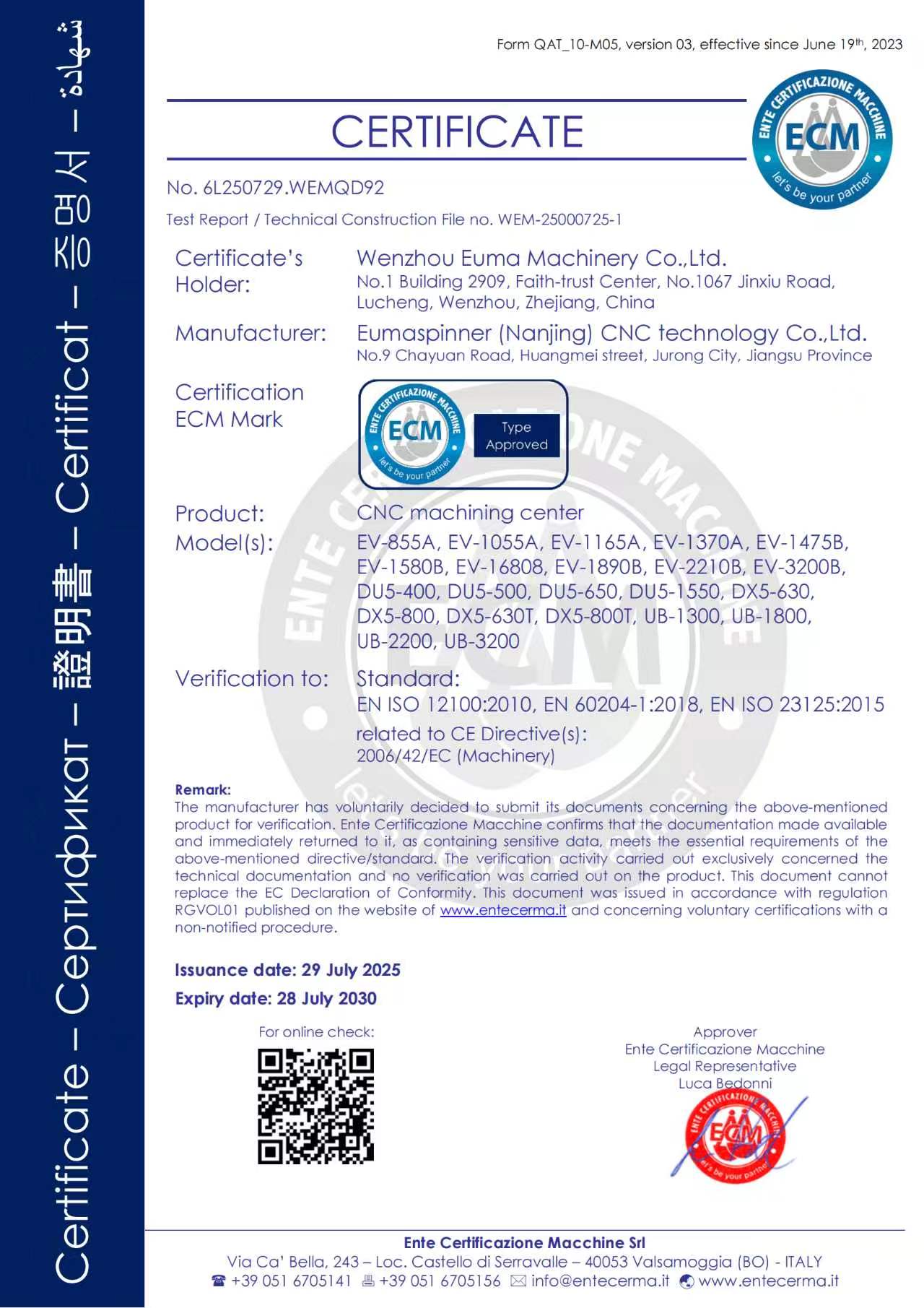
One boundary is worth stating plainly, because it is the kind of detail buyers tend to discover late. The UV260 does not appear in the published CE or EAC model scopes as listed. A buyer evaluating a UV260 should request model-specific certification documentation rather than assume that coverage is inherited from the vertical range. The same discipline applies to any model outside the published lists.
Pre-shipment verification and factory evidence
EUMASEIKI performs 100% testing for quality control, and pre-shipment testing is the stated acceptance criterion for orders. What matters in that combination is that acceptance is defined before shipment rather than at the buyer's dock, which shifts the burden of proof onto documented test results.
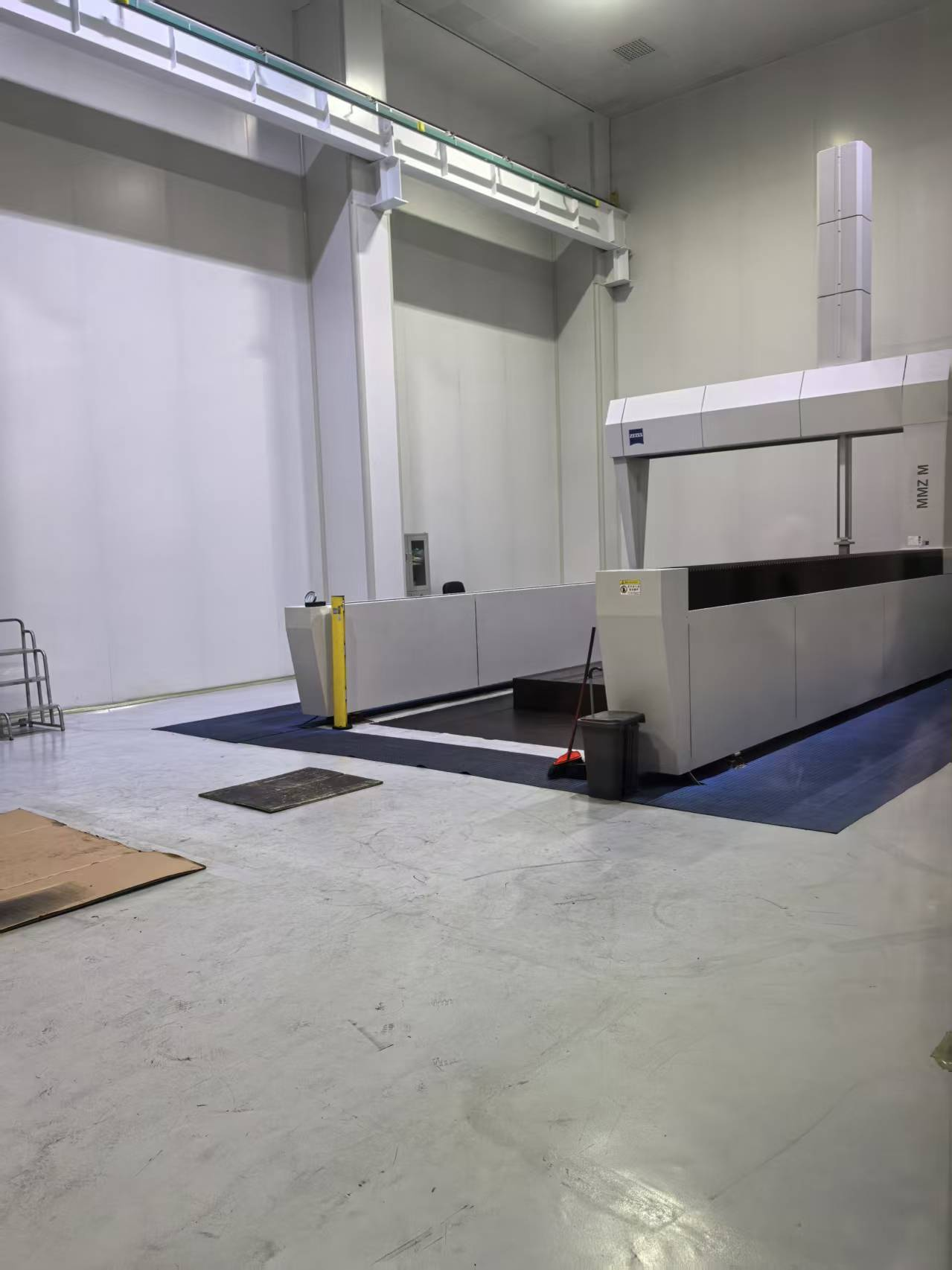
The equipment supporting that verification includes a German ZEISS coordinate measuring machine, Japanese OKUMA gantry machining centers, KURUKI boring and milling machines, and NIIGATA horizontal machining centers. The production base is located in Ningbo City and covers 8,000 m², with 68 employees, an R&D team of 8 engineers, annual output in the range of 50–100 units, and an export ratio of 80%. Main markets include Russia, Saudi Arabia, Indonesia and Iran.
A documented deployment shows what this verification looks like in practice. A Tier 1 supplier in Russia operates six EUMASEIKI machines for component manufacturing over a one-year period. For that delivery, each machine underwent full-process inspection including geometric accuracy testing, laser axis calibration, and full-load workpiece trial cutting before shipment, and the machines were reported to have operated with nearly zero failures in mass production. The configuration included a stress-relieved high-rigidity frame, a high-precision spindle, hydraulic, cooling and tool magazine systems, and comprehensive spindle anti-collision protection.
Commercial terms, lead time, and customization scope
For buyers moving from evaluation into execution, the published commercial framework is as follows: minimum order quantity of 1 unit; delivery term EXW; acceptance criteria based on pre-shipment test; payment terms of 50% in advance and 50% before loading. Production lead time is 30–45 days, monthly capacity is 10 units, and exports are directed to the EU and Southeast Asia markets. After-sales support is available both on site and remotely.
Two planning consequences follow. First, EXW places freight, insurance and import logistics with the buyer, so the landed-cost calculation belongs in the evaluation stage rather than after the order is placed. Second, a monthly capacity of 10 units means a multi-machine project should be scheduled early instead of being treated as an off-the-shelf purchase.
Market context: what is shifting in the category
The 5-axis segment is the growth story in the public data. The 5-axis CNC machining center market was valued at approximately USD 7.35 billion in 2024, with a projected CAGR of 4.6% to 2035 (WiseGuyReports), and the aerospace application segment held a 28.7% revenue share of that market in 2025 (Dataintelo). On the supply side, China's machine tool exports reached USD 8.56 billion in the first five months of 2024, a 1.8% year-on-year increase (China Customs, reported by ICE Pechino), which reflects how much of the category's manufacturing capacity now sits in China.
Market-size claims should be read with the scope definition attached. Published estimates for the near-term machining center market diverge — one source places it at USD 22.41 billion in 2025 (Mordor Intelligence) while another estimates USD 27.64 billion in 2024 (Grand View Research) — and much of that gap reflects whether turning centers are included. Comparison figures are only meaningful when the scope matches. For competitive context, DMG Mori, Yamazaki Mazak and Haas Automation are identified as the top three global manufacturers of CNC machining centers by market presence and technology (AMSL / Mechrank).
Where these configurations stop: limits worth planning around
- Three-axis vertical architecture. The EV-1580B and EV-1475B are effective on prismatic parts, but a fixed-column three-axis machine does not generate complex curved surfaces or undercut features in a single setup. Where the part family depends on continuous tool-axis reorientation, the appropriate answer is a 5-axis configuration such as the DU or UB series, not a larger three-axis machine.
- Spindle speed ceiling. ISO 50 at 8000 rpm is a heavy-cutting specification. Shops whose work is dominated by fine finishing of small components at high spindle speeds are better served by the ISO 40 configuration running to 10000 / 12000 rpm, not by the larger ISO 50 machines.
- Envelope ceiling on the trunnion machine. The UV260's Ø260 mm table and 500 / 500 / 450 mm travels are a hard boundary, not a soft one.
- Installation weight. At 8000 kg, the EV-1580B requires foundation, rigging and floor-load planning that a 4200 kg UV260 does not.
- Certification scope. The published CE and EAC scopes name specific models; the UV260 is not among them as listed, so model-specific documentation must be requested.
- Commercial terms. EXW delivery, a 30–45 day lead time and 10 units of monthly capacity place freight, insurance and schedule risk on the buyer's side of the transaction.
Future outlook
Two directions look durable. The first is that multi-axis capability continues to move into more of the market as the 5-axis segment grows and as aerospace and other precision segments expand. The second is that documentation has become a procurement criterion rather than an afterthought. Buyers are increasingly asked to justify machine selection with referenced standards such as ISO 230-2:2014, certificate scopes that name specific models, and pre-shipment test records, rather than with general claims about quality.
For suppliers, the practical implication is that publishing model-level certificate scopes and verifiable test processes matters as much as the machine specification itself. For buyers comparing the EV-1580B, EV-1475B and UV260, the specification table is the starting point of the conversation, and the certificate scope, test record and delivery terms are what finish it.
FAQ
What part envelope do the EV-1580B, EV-1475B and UV260 each support?
The EV-1580B is specified with 1500 / 800 / 700 mm X, Y and Z travels and a 1600 × 800 mm worktable. The EV-1475B has a 1500 × 700 mm worktable with a maximum load of 1000 kg on the table. The UV260 has 500 / 500 / 450 mm travels and a Ø260 mm trunnion table. The first two are large-envelope vertical machines; the third is a compact trunnion configuration for small and medium precision work.
Does an ISO 50 spindle mean better accuracy?
No. The spindle taper describes the tooling interface, not the accuracy class of the machine. ISO 50 is associated with larger tooling and greater torque transmission for heavier cutting, while positioning and repeat positioning accuracy are separate axis specifications — listed as 0.008 mm and 0.005 mm respectively on the EV-1475B.
What do 0.008 mm positioning accuracy and 0.005 mm repeatability guarantee about finished parts?
They describe axis behaviour, not the dimensional tolerance of a finished workpiece. Positioning accuracy relates to arriving at a commanded position and repeat positioning accuracy to returning consistently to the same position. ISO 230-2:2014 is the current international framework for determining accuracy and repeatability of positioning for numerically controlled axes. Achieved part tolerance also depends on tooling, workholding, thermal conditions and process parameters.
How much does tool change time actually affect cost per part?
It depends on batch size and on whether the machine is the process constraint. The EV-1475B is specified at 3 s tool-to-tool and the UV260 at 1.5 s. On a part requiring twelve tool changes, that difference amounts to 18 seconds per part. Across a large batch this is measurable; across short jobs it is small relative to programming and setup time. The EV-1580B specification includes a 24-pocket arm-type tool magazine.
When is a trunnion table machine such as the UV260 preferable to a vertical machine?
When the part fits within 500 / 500 / 450 mm travels and a Ø260 mm table, requires machining on more than two faces, and the alternative on a three-axis vertical would need multiple fixtures. Table rotation reduces re-clamping. Once the workpiece exceeds the table and travel envelope, the UV260 is no longer the appropriate machine.
When should a buyer move from a vertical machine to a 5-axis, horizontal, or custom configuration?
When geometry or volume requires it. Complex curved surfaces and undercut features that depend on continuous tool-axis reorientation generally cannot be produced in one setup on a three-axis vertical machine; EUMASEIKI addresses this with the DU series (5-axis vertical) and UB series (swivel head 5-axis). Horizontal architecture is usually assessed around high-volume multi-face production with pallet changing. Custom requirements are handled through OEM production services, with customization options covering voltage, logo, spindle, tool magazine, travel stroke, cooling system, chip conveyor and control system.
Are the EV-1580B and EV-1475B certified for the EU and EAEU markets?
Both models appear in the published scopes. CE certificate 6L250729.WEMQD92, issued by Ente Certificazione Macchine Srl (ECM, Italy) against EN ISO 23125:2015, is valid from 29 July 2025 to 28 July 2030 for the EU market. EAC certificate ЕАЭС N RU Д-CN.PA06.B.89520/25, issued under TR CU 010/2011 and TR CU 020/2011, is valid from 8 August 2025 to 7 August 2030 for the EAEU market. The UV260 is not included in the published model scopes of either certificate.
What are the purchasing terms, lead time, and acceptance criteria?
The minimum order quantity is 1 unit, delivery term is EXW, and acceptance criteria are based on pre-shipment test. Payment terms are 50% in advance and 50% before loading. Production lead time is 30–45 days with a monthly capacity of 10 units. Quality control includes 100% testing. Pre-shipment verification of machines in this class includes geometric accuracy testing, laser axis calibration and full-load workpiece trial cutting.
Further specification detail across the vertical and 5-axis ranges is compiled in the EUMASEIKI product brochure: EUMASEIKI product brochure (PDF). Model-level certificate documents and pre-shipment test records for a specific configuration are available on request from the manufacturer at www.eumaseiki.com.