
Cable Extrusion Process Control: Key Variables Behind Insulation and Sheath Quality
Extrusion is one of the critical process steps in wire and cable manufacturing. It determines how insulation and sheath layers are formed around a conductor or cable core, directly influencing electrical performance, dimensional consistency and long-term product reliability. In modern cable production, the quality of an extruded layer depends not only on polymer selection, but also on the control of a series of interconnected process variables, including conductor preheating, temperature profile, screw speed, line speed, melt pressure and cooling conditions.
Why Quality Risk Is Rising
Extrusion defects are not limited to visible surface problems. A rough surface, small void or excessive eccentricity can affect dielectric performance, mechanical protection or local stress distribution within the cable. Some process-related defects may not be immediately apparent during routine inspection, yet they can become more significant under bending, thermal cycling, electrical stress or moisture exposure.
The economic relevance of extrusion process control is closely linked to the scale of the wire and cable industry. The global wire and cable market was estimated at USD 267.8 billion in 2024, with a projected CAGR of 7.3% through 2034, according to Global Market Insights. In China, the market generated approximately USD 41.1 billion in revenue in 2025 and is projected to reach USD 56.2 billion by 2033, according to Grand View Research. At this scale, improvements in process stability can influence material consumption, energy use and the amount of non-conforming output generated during production.
The Process Variables That Define Extrusion Quality
Consistent extrusion quality depends on several interacting variables. Operators and process engineers need to monitor these parameters together rather than treating them as isolated setpoints. Conductor temperature, extrusion temperature, screw speed, line speed, melt pressure, tooling condition and cooling behaviour can each influence the final geometry and performance of the insulation or sheath.
Conductor Preheating
The conductor entering the extrusion line is often cooler than the polymer melt surrounding it. When the temperature difference is significant, it can influence polymer flow and the conditions at the conductor–insulation interface. Appropriate preheating helps reduce this temperature difference, supports more stable melt distribution at the die and can improve bonding between the conductor and insulation. It also affects the subsequent cooling behaviour of the extruded layer, which can influence residual stress within the insulation.
Extrusion Temperature Profile
The barrel temperature profile controls how the compound moves from solid feedstock toward a homogeneous melt. Different compounds require different temperature profiles according to their melting behaviour, formulation and thermal stability.
If the temperature profile is too aggressive, the polymer may degrade near the screw or die. If it is too low, incomplete melting or unstable flow may occur. A controlled and stable temperature profile helps maintain consistent melt behaviour, which is important for controlling cable diameter and insulation or sheath wall thickness.
Screw Speed and Line Speed Matching
Screw speed influences the output rate of the extruder, while line speed determines how quickly the conductor or cable moves through the extrusion line. These two parameters need to remain appropriately balanced to maintain the target insulation or sheath thickness.
When line speed increases while screw output remains unchanged, the extruded layer generally becomes thinner. Conversely, increasing screw output without a corresponding change in line speed can increase layer thickness and material consumption. Although modern extrusion equipment can coordinate these parameters automatically, product changes and start-up conditions still require careful adjustment.
Melt Pressure and Melt Temperature
Barrel temperature is measured at the machine wall, while melt temperature represents the actual thermal condition of the polymer moving through the extrusion system. Melt temperature influences viscosity, cooling behaviour and thermal stability.
Melt pressure reflects the resistance encountered as the polymer moves through the screw, breaker plate and die. Stable pressure generally indicates relatively consistent material feeding and flow conditions. Pressure fluctuations can be associated with feeding irregularities, screw wear, filter restriction or tooling problems.
Monitoring melt pressure together with melt temperature therefore provides useful information about process stability before the material reaches the die.
Insulation Eccentricity
Eccentricity describes uneven insulation-wall distribution around the conductor. A cable with excessive eccentricity may have a thinner wall on one side and a thicker wall on the opposite side. The thinner section can reduce the available electrical insulation margin, while excessive thickness increases material consumption.
Possible causes include incorrect die centering, tooling wear, uneven polymer flow, conductor tension variation and non-uniform cooling. Online eccentricity measurement can help identify these deviations during production, allowing operators to investigate tooling alignment or process conditions before a larger quantity of cable becomes non-conforming.
Sheath Thickness Consistency
For cable sheaths, an important quality parameter is wall-thickness consistency along the cable length and around its circumference. Variation can result from changes in screw output, line speed, melt temperature or die clearance.
From a production perspective, excessive average thickness increases polymer consumption. From an application perspective, significant thickness variation can influence flexibility, dimensions and installation behaviour. The practical objective is therefore to maintain the required sheath thickness within specification while avoiding unnecessary material use.
Cooling System and Dimensional Stability
The polymer leaves the die in a hot and deformable state, and cooling plays an important role in establishing its final dimensions. A typical extrusion line uses a water-cooling section or trough to remove heat from the newly extruded insulation or sheath.
Uneven or poorly controlled cooling can contribute to ovality, surface irregularities or residual stress. Insufficient cooling can also allow the material to deform before reaching the take-up system. Cooling behaviour varies between polymer types because different materials have different crystallisation and solidification characteristics.
Stable water temperature, consistent water flow and appropriate cable positioning through the cooling section therefore form part of overall dimensional control.
Material-Specific Process Requirements
No single extrusion strategy fits all cable compounds. PVC, XLPE, LSZH and rubber have different thermal, rheological and curing characteristics, so extrusion conditions need to be adjusted according to the material formulation and cable application.
| Compound | Main process requirement | Quality risk when control fails |
|---|---|---|
| PVC | Stable temperature, controlled shear and appropriate material preparation | Rough surface, thermal degradation, reduced mechanical performance |
| XLPE | Controlled extrusion and cross-linking temperature, clean material | Uneven cross-linking, voids, reduced thermal and mechanical performance |
| LSZH | Controlled shear and temperature, appropriate moisture management and clean transitions | Rough surface, degradation, discolouration |
| Rubber | Controlled extrusion, curing temperature and residence time | Incomplete curing, dimensional instability, reduced mechanical performance |
PVC is sensitive to excessive heat and shear, making stable temperature control and consistent material preparation important during extrusion. XLPE requires additional control because its final properties depend on the cross-linking process, where temperature and residence time influence the resulting material performance. LSZH compounds can exhibit different flow behaviour because of their filler systems, increasing the importance of appropriate shear, temperature and moisture control. Rubber compounds require particular attention to extrusion and curing conditions because their final properties depend on controlled vulcanization or curing.
These differences mean that extrusion parameters should not simply be transferred from one compound to another. Material formulation, thermal behaviour, tooling, cooling conditions and production speed all need to be considered when establishing a stable process window.
Common Extrusion Defects and Their Root Causes
Many extrusion defects can be associated with a limited number of process disturbances. Identifying the relationship between a visible defect and its potential process causes helps production teams investigate the underlying condition rather than addressing only the immediate symptom.
| Defect | Typical process connection | Impact |
|---|---|---|
| Rough surface | Polymer flow instability, moisture, overheating | Appearance issues, reduced surface quality |
| Bubbles or voids | Moisture, volatiles, entrapped air | Reduced dielectric and mechanical strength |
| Eccentricity | Die alignment, tool wear, tension imbalance, cooling | Thin wall risk, higher material usage |
| Dimensional fluctuation | Screw and line speed mismatch, pressure surging | Out-of-tolerance cable, rejects |
| Material degradation | Excessive heat, long residence, high shear | Discolouration, brittleness, performance loss |
Online Inspection and Production Control
Online inspection allows cable manufacturers to identify extrusion deviations while production is still running. Instead of relying only on finished-product sampling, operators can monitor key parameters such as outer diameter, wall thickness, eccentricity, melt pressure and melt temperature.
These measurements can provide early indications of process instability. Changes in diameter may be associated with screw and line speed conditions, while eccentricity can be influenced by tooling alignment, conductor tension or cooling. Detecting such changes earlier can help reduce the amount of non-conforming cable produced.
Online inspection does not replace broader quality control. Measurement equipment still requires proper calibration, positioning and maintenance, while periodic verification remains necessary. The most effective approach is to combine continuous measurement with process knowledge and operator judgement, using measurement results to support timely investigation and adjustment.
Traditional Sampling Versus Continuous Measurement
Traditional extrusion quality control relies on periodic sampling to check dimensions, surface condition and specified product properties. It remains useful for verification, but it only reflects production conditions at selected points.
Continuous measurement provides earlier visibility into changes in diameter, wall thickness or eccentricity. This allows operators to identify process drift while production is still running and potentially reduce the amount of non-conforming cable.
The two methods are complementary rather than interchangeable. Continuous monitoring supports process adjustment, while periodic sampling provides independent verification. For manufacturers evaluating extrusion quality-control technologies, the combination of both approaches is increasingly relevant when comparing production equipment and measurement solutions.
Market Trend: The Shift Toward Repeatable Extrusion Processes
As cable specifications become more demanding, manufacturers are placing greater emphasis on repeatable extrusion processes. Stable diameter, wall thickness, material properties and lower scrap rates depend on consistent control of equipment, materials and operating conditions.
This trend is also reflected in major international wire and cable industry events. The Düsseldorf-based wire event covers wire and cable manufacturing machinery, process technology, materials, measuring and control technology, and testing engineering, providing an international setting for industry professionals to review developments in production and process control.
In China, wire China covers related areas including processing machinery, materials, measuring and testing technologies. Its 2026 edition is scheduled for September 21–24 at the Shanghai New International Expo Centre.
For extrusion manufacturers, the relevance is practical: changes in materials, tooling, measurement and process conditions increasingly need to be considered together rather than as isolated equipment decisions.
How an Industry Trade Fair Supports Technology Selection
For manufacturers evaluating extrusion technology, equipment selection involves more than the extruder itself. Screw and die design, material handling, cooling, measurement and testing can all influence final cable quality. Reviewing these areas together can help engineers understand how different process components work within the same production line.
The international wire event in Düsseldorf covers wire and cable manufacturing machinery, process technology, materials, measuring and control technology, and testing engineering. This reflects the broader industry need to evaluate production equipment and quality-control technologies as connected parts of the manufacturing process.
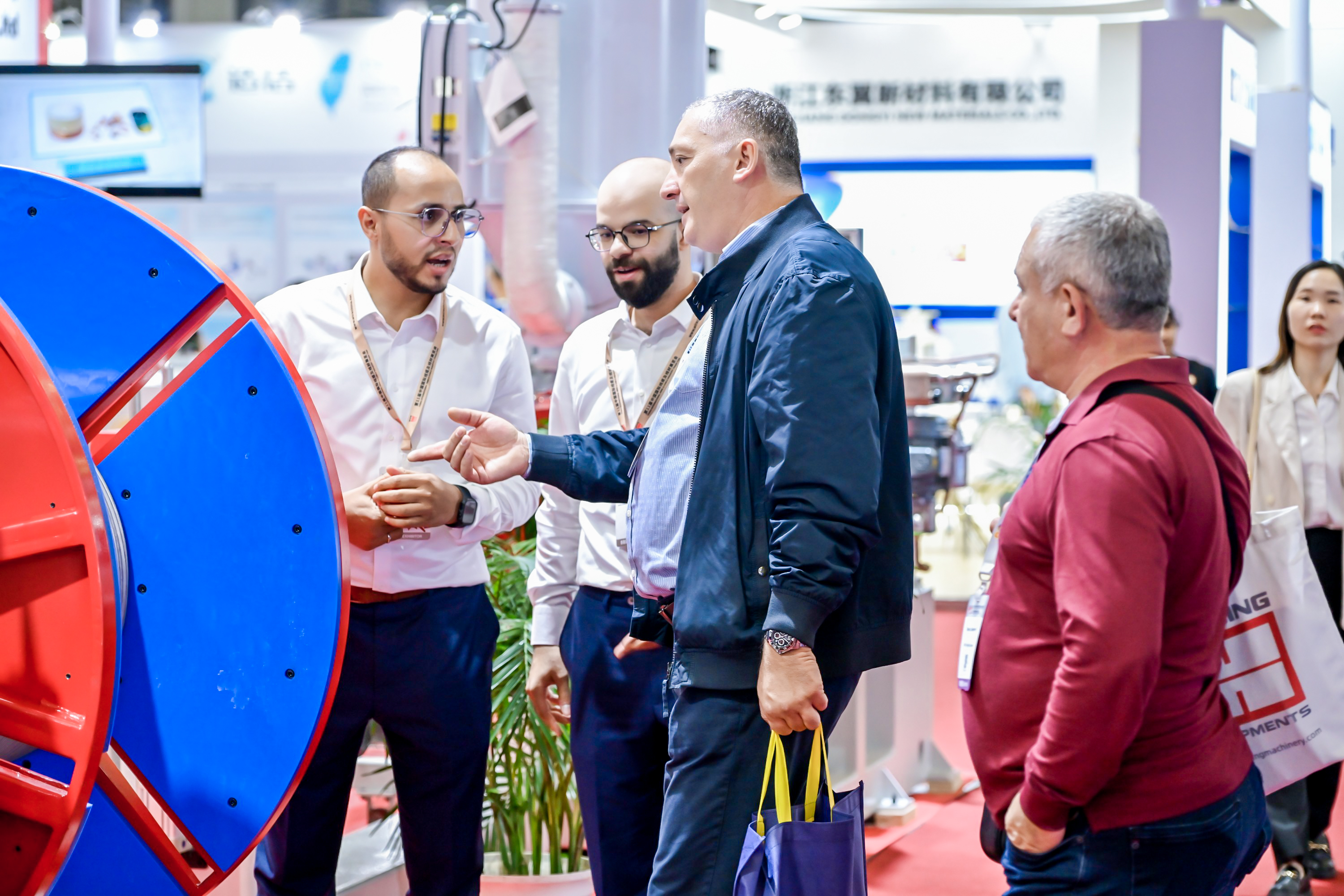
In China, wire China provides an industry setting for examining relevant machinery, materials, and measuring and testing technologies. wire China 2024 covered an exhibition area of 80,500 square meters, bringing together 1,080 exhibitors from around the world and 41,857 professional visitors from 90 countries and regions.
For extrusion manufacturers, these industry events provide opportunities to review machinery, materials, measuring and testing technologies, while technical discussions can help industry participants better understand current approaches to extrusion and process control.
Future Outlook
Cable extrusion is likely to move toward tighter and more repeatable process control as manufacturers face more demanding specifications, thinner insulation layers and greater pressure to reduce material waste. Stable control of melt temperature, pressure, line speed, tooling and cooling conditions will remain important, while continuous measurement can provide earlier indications of process deviation.
Future development will also depend on closer coordination between materials, tooling and measurement technologies. Different compounds may require different temperature profiles, die configurations and cooling conditions, making process knowledge an important part of equipment evaluation and production optimisation.
Industry events provide one setting for this technical exchange. The international wire event in Düsseldorf covers machinery, process technology, materials, measuring and control technology, and testing engineering, reflecting the range of technologies involved in modern wire and cable production. In China, wire China provides an industry setting for manufacturers and suppliers to review related machinery, materials, measuring and testing technologies.
For cable manufacturers, the long-term objective is not simply higher extrusion speed. It is a more repeatable process that maintains product geometry and material performance while controlling material consumption, energy use and production waste.
wire China 2026 is scheduled for September 21–24, 2026, at the Shanghai New International Expo Centre. According to the current plan, the event is expected to bring together more than 1,100 exhibitors and more than 40,000 professional visitors, with more than 60 specialised conferences and forums planned. Visitor pre-registration is available at https://dwz.cn/DYkFpGQd, with further event information available on the official wire China website at https://www.wirechina.net/. A downloadable event brochure can be accessed here: wire China 2026 check-in brochure.
Frequently Asked Questions
What are the most important variables in cable extrusion?
Key variables include conductor preheating, temperature profile, screw speed, line speed, melt pressure, melt temperature, tooling condition and cooling. Their combined stability determines extrusion consistency.
Why is insulation eccentricity important?
Eccentricity means that the insulation is not evenly distributed around the conductor. Excessive eccentricity can create a thin insulation area while increasing material use on the opposite side.
Can online inspection replace sampling?
No. Online inspection provides continuous process information, while sampling remains useful for verification and quality assessment. Combining both approaches provides broader process control.
Why do different cable compounds require different extrusion conditions?
PVC, XLPE, LSZH and rubber have different thermal and rheological characteristics. Temperature, shear, residence time and cooling conditions therefore need to be adjusted according to the material.
What should manufacturers consider when selecting extrusion technology?
Manufacturers should consider the target cable specification, material characteristics, screw and die configuration, cooling requirements, measurement technology and production conditions. Equipment selection should be based on the actual requirements of the intended products.
What role can industry events play in extrusion technology evaluation?
Industry events such as wire in Düsseldorf and wire China provide professional settings where manufacturers can review machinery, materials, measurement and testing technologies and exchange technical information with industry participants.
When and where will wire China 2026 be held?
wire China 2026 is scheduled for September 21–24, 2026, at the Shanghai New International Expo Centre. The published 2026 plan lists more than 1,100 exhibitors, more than 40,000 expected professional visitors and more than 60 specialized conferences and forums.
Have Questions or Need More Details?
Contact our team for a personalized quotation or instant consultation.
Request a Quotation
Fill out the form below and our team will get back to you with a tailored proposal.
WhatsApp Direct Chat
Prefer to chat in real-time? Message us on WhatsApp for instant assistance & quick answers.
- Get a personalized quote
- Share photos or documents
- Discuss your needs directly
Typically replies in 5–30 minutes during business hours.