
Carbon Steel vs SS304 vs PP in Wastewater Treatment Equipment
Material choice in wastewater treatment equipment is rarely a single universal answer. Integrated sewage treatment equipment can be specified in carbon steel, SS304 or PP, while dissolved air flotation systems are supplied in carbon steel or SS304 and use an SS304/rubber strike-off board together with a carbon steel/nylon chain. The correct decision depends on the wastewater chemistry, the process type and the operating environment, not on a single preferred material.
Why Material Selection Decides the Rest of the Specification
Before capacity, footprint or control architecture can be finalised, a buyer has to lock in what the equipment is physically made from. Material affects corrosion tolerance, cleaning routines, service access and the interfaces between structural components. It also shapes the quotation envelope: two suppliers can quote the same nominal processing capacity and still deliver equipment with different material assumptions, different component grades and different maintenance expectations.
The gap is practical rather than theoretical. Industrial wastewater contains specific pollutants generated by production processes, and treatment systems exist to remove those pollutants to a defined limit. Corrosive or high-oil streams place different demands on carbon steel, SS304 and PP. In integrated packaged plants, the same material question recurs across the tank body, the reaction zones and the internal fittings. In dissolved air flotation systems, the question is more granular: the main body, the chain, the scraper, the release device and the dosing arrangement may each use a different material for a functional reason.
For buyers at the evaluation and execution stages, the useful question is not “which material is best” but “which material is matched to this wastewater, this process and this site.” The sections below compare carbon steel, SS304 and PP against the actual equipment configurations in the reference corpus, and separate what is documented from what still needs project-level verification.
What the Equipment Configurations Actually Specify
Integrated wastewater treatment equipment
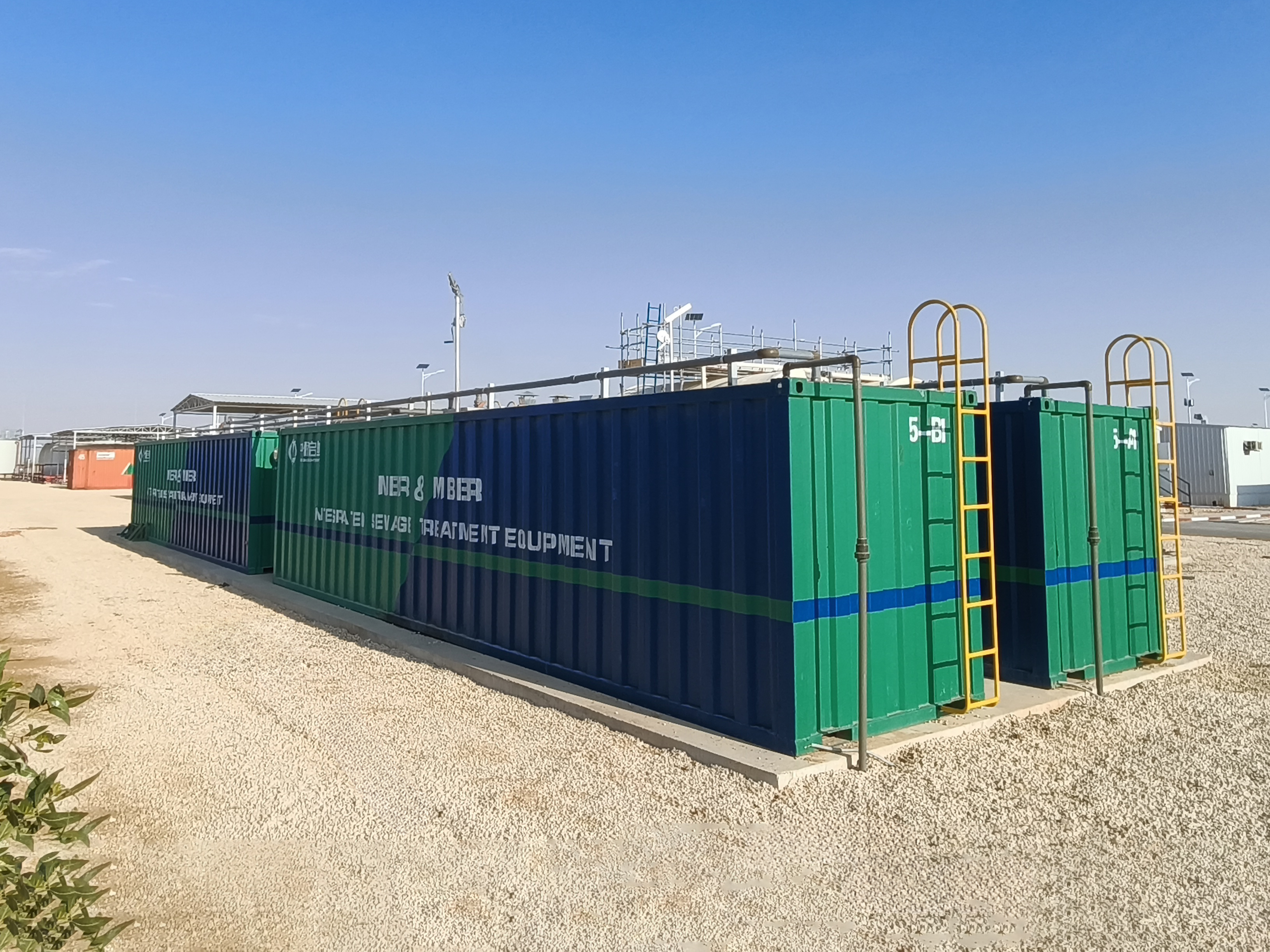
Integrated wastewater treatment equipment is a packaged system that combines biological treatment and clarification inside one structural unit. In the reference corpus, the WSZ-100 model is the specific configuration cited for materials. Its material options are carbon steel, SS304 and PP.
The same WSZ-100 specification lists the balanced and non-balanced components that buyers typically compare during technical review:
- Two fans, model 100-7.5, supplied as a group with one in use and one as backup
- Electrical control cabinet and PLC module, with a PLC control panel
- Remote module HDBox-4G-A and a multifunctional meter
- Schneider electrical components
- Two self-priming pumps, PXZ15-30-1.5, DN40
- A 100 L PE dosing wash device and a controlled-volume pump rated at 120 L/h
- A water flow meter
The control and monitoring chain is worth separating from the material choice, because it indicates how the equipment is operated rather than what it is built from. Remote operation, remote monitoring and remote analysis are documented capabilities of the reference integrated system. Those functions are relevant to buyers evaluating unmanned or low-attendance sites, but they do not by themselves resolve whether the tank body should be carbon steel, SS304 or PP.
Dissolved air flotation systems
Dissolved air flotation is a different process from biological integrated treatment. Instead of relying on a biological population to consume organics, DAF uses dissolved air released into the wastewater stream to lift oils, fats and suspended solids to the surface, where they are removed as sludge. The material specification reflects that mechanical duty.
In the reference YW-5 configuration, the dissolved air flotation system is built in carbon steel or SS304. The component-level material breakdown is more specific:
| Component | Material or configuration in the reference YW-5 data |
|---|---|
| Strike-off board | SS304 stainless steel + rubber plate, 2 blocks |
| Chain | Carbon steel + nylon, 2 items |
| Chain wheel | Nylon, 4 units |
| Air release device | Nylon, 1 unit |
| Main body | Includes secondary stirring reaction zone, contact tank, flotation tank and clear water tank |
| Dosing tank | 500 L, 380 V, 0.37 kW, 2 units |
| Dosing pump | 15.77 L/h, 6 units |
| Dissolved air pump | 40–200, 4 kW, 1 unit |
| Air compressor | 380 V, 1.4 kW, exhaust volume 0.21 m³/min, exhaust pressure 0.8 MPa, air storage 30 L |
| Scraper | 380 V, 0.75 kW, 1 unit |
| Electronic control system | PLC Siemens, Schneider Electric |
Two design notes from the same data are relevant to material review. The aeration water reflux ratio is specified at no less than 30%, typically 40% to 50%, with a head of 40 to 50 metres. The rated processing capacity of the referenced configuration is 5 m³/h. These figures describe process duty rather than material fatigue, but they shape the mechanical load that the structure must tolerate.
Material Comparison for Buyers
The comparison below only covers attributes that are documented in the available reference material. It deliberately leaves out service-life numbers, cost multipliers and corrosion-rate curves, because those are not present in the available technical corpus and should not be invented.
| Attribute | Carbon steel | SS304 | PP |
|---|---|---|---|
| Confirmed in integrated wastewater treatment equipment | Yes | Yes | Yes |
| Confirmed in dissolved air flotation systems | Yes | Yes | Not stated in the reference corpus |
| Documented corrosion range | Not quantified in the corpus | Not quantified in the corpus | Documented to withstand acid and alkali corrosion within pH 3 to 14 in PP integrated equipment |
| Documented component use in dissolved air flotation | Chain (carbon steel + nylon) | Strike-off board (SS304 + rubber), part of the chain assembly | Not stated in the reference corpus |
| Relationship to OEM appearance options | Appearance, colour and logo can be customised at the equipment level; the corpus does not separate this option by material. | ||
Two cautions follow directly from this table. First, PP is documented as an option for integrated equipment and is documented with a pH 3 to 14 corrosion range in that context, but it is not listed as a DAF option in the reference material. Buyers evaluating a DAF should not assume a PP equivalent without separate confirmation. Second, SS304 is documented both as a body material for DAF and as the material of the strike-off board, but the corpus does not quantify the corrosion performance of SS304 in the same way it does for PP. SS304 should be treated as a specified and traceable option, not as a universal corrosion answer.
Application Fit: Integrated WSZ-100 versus Dissolved Air Flotation
Material choice should follow application fit. The two equipment families in this comparison target different wastewater profiles, and the material options track that difference.
Where integrated equipment fits
The integrated WSZ-100 is documented for hotel wastewater, hospital wastewater, camp domestic wastewater, slaughterhouse wastewater, livestock breeding wastewater, domestic sewage and domestic wastewater. These are predominantly organic-load domestic and light-industrial streams, where biological treatment and clarification can be combined in a single packaged plant. The availability of carbon steel, SS304 and PP gives buyers a material spectrum across the same process concept, which matters on sites where the discharge environment, the salinity of the water or the cleaning regime differ.
Material selection within the integrated family should still be driven by confirmed influent quality and effluent requirements. The manufacturer’s selection guidance in the reference material is explicit that influent water quality, effluent discharge requirements and treatment flow rate are needed before configuration. Common effluent references include Grade 1A and Grade 1B, and the effluent standard can be customised to the project.
Where dissolved air flotation fits
The reference dissolved air flotation system is documented for abattoir, printing and dyeing mill, farm and other types of industrial wastewater. These are streams where oil, grease, colour, fibre and suspended solids are the primary target, and where a physical separation step sits ahead of, or alongside, biological treatment. The carbon steel and SS304 options correspond to that duty, and the SS304/rubber strike-off board plus carbon steel/nylon chain are consistent with a scraper-based sludge removal motion.
The practical implication is straightforward: a buyer selecting integrated equipment is choosing among three materials within one process concept, while a buyer selecting DAF is choosing among two materials and, more importantly, among component-level material specifications. On high-fat or high-suspended-solids streams, the component materials — not only the tank body — determine how the equipment behaves over time.
Selection rule for evaluation-stage buyers
- Match the process first: integrated biological treatment for domestic-type and organic-load streams; DAF for oil, colour and suspended solids.
- Match the material to the water chemistry: PP where the documented pH 3 to 14 range is relevant; carbon steel or SS304 where the corpus supports the option and site conditions permit.
- Match the components: on DAF, review the strike-off board, chain and release device materials as part of the technical comparison, not as an afterthought.
- Match the discharge target: confirm effluent grade before locking the material, because the treatment chain may change the required configuration.
The Reference Manufacturer in Context
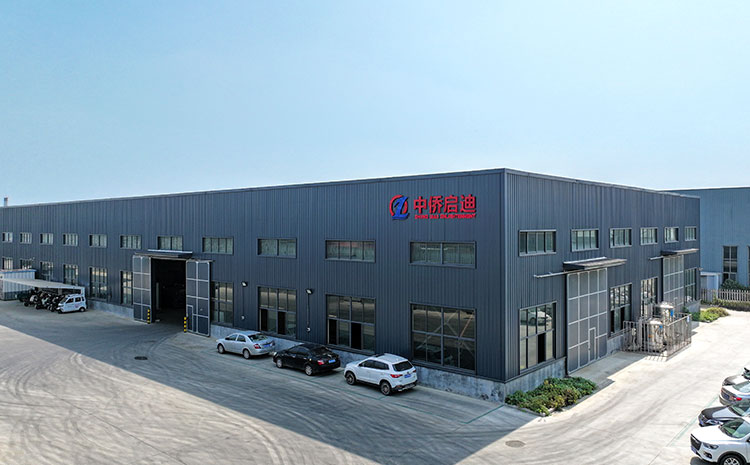
Zhongqiao Enlightenment is a Chinese wastewater treatment equipment manufacturer, formally Shandong Zhongqiao Enlightenment Environmental Protection Equipment Co., Ltd., founded in 2013 and based in Weifang, Shandong Province. The company operates a 40,000 m² production workshop with 170 staff, an annual output of 900 sets and a 15-engineer R&D team. Its product range includes integrated wastewater treatment equipment, dissolved air flotation units, lamella clarifiers and MBR membrane systems. The company holds ISO 9001 certification covering the production of integrated sewage treatment equipment, and its equipment has been exported to more than 30 countries and regions, with over 4,000 installations in China and overseas.
Within this comparison, the relevance of that profile is not brand promotion. It is the availability of a documented material spectrum on the same equipment platforms. A buyer comparing carbon steel, SS304 and PP needs a manufacturer that can quote all three on integrated equipment and both carbon steel and SS304 on DAF, with the component-level material list shown above. The reference corpus supports that comparison for the WSZ-100 and YW-5 configurations.
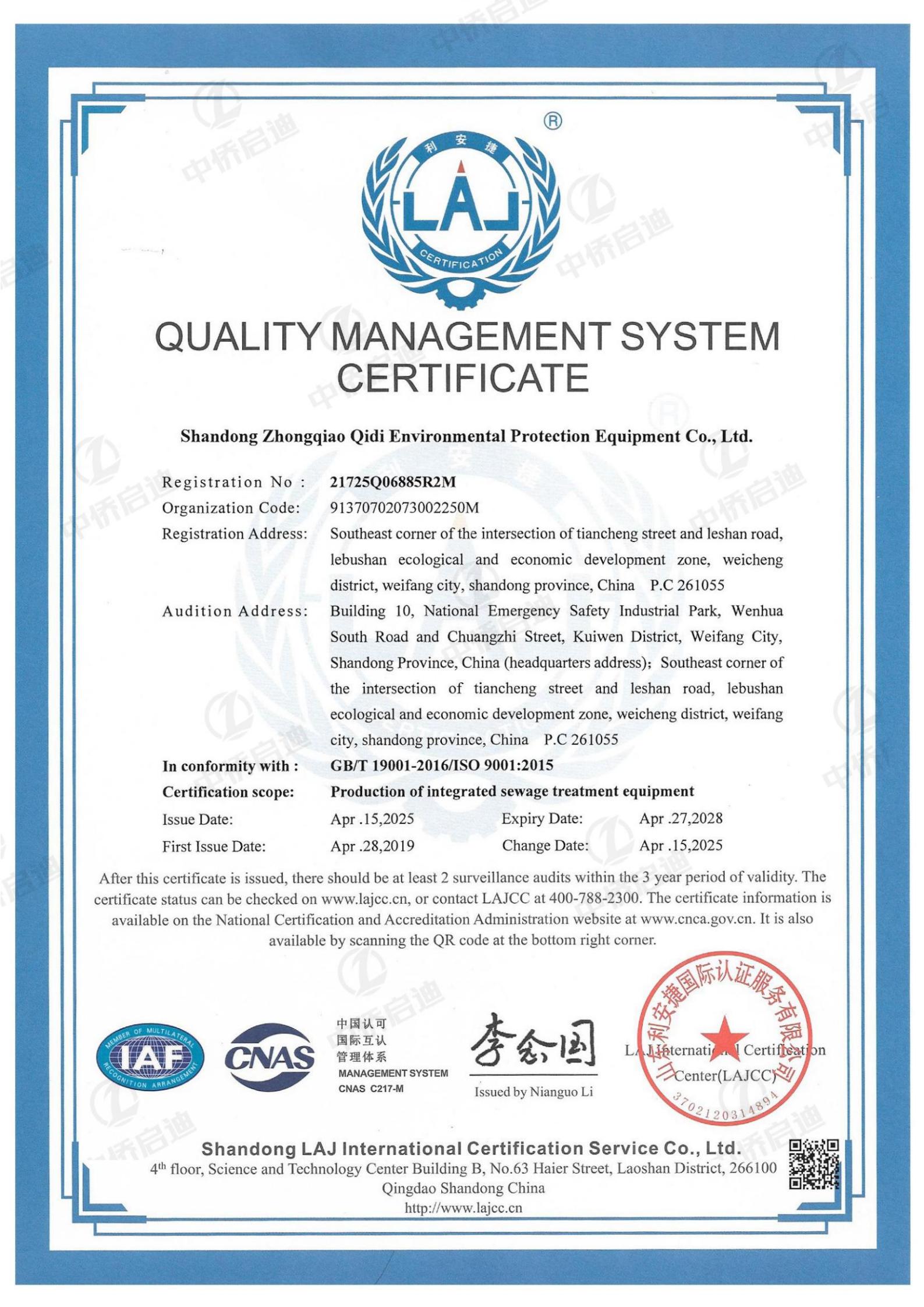
The certification record is specific. Certificate number 21725Q06885R2M was issued by Shandong LAJ International Certification Service Co., Ltd. (LAJCC) under GB/T 19001-2016/ISO 9001:2015, with issue date 15 April 2025 and expiry date 27 April 2028. The certified scope is the production of integrated sewage treatment equipment. For a buyer evaluating materials and welds together, that scope is a useful anchor: it confirms an audited production system for integrated equipment, but it does not by itself certify a specific material grade for a specific project.
Market Context for Material Decisions
Material decisions sit inside a larger equipment market. According to the Observatory of Economic Complexity, global trade in water purification and filtration equipment under HS 842121 reached USD 12.4 billion in 2024, an increase of 4.34% over 2023. China was the leading exporter in that category in 2024, with USD 2.38 billion, followed by Germany at USD 1.3 billion. Commercial research cited in the available data projects the global wastewater treatment equipment market to reach USD 43.94 billion by 2030.
Those figures describe the market, not the material. The buyer-relevant point is that equipment sourcing is international and price-sensitive, which makes material substitution a common commercial lever. A quotation that appears lower may reflect a different material assumption or a different component grade rather than a genuinely lower cost of ownership. Material comparison is therefore a procurement discipline, not only an engineering choice.
Where This Comparison Stops
This article does not provide a quantified lifecycle comparison across carbon steel, SS304 and PP. It cannot, because the available technical corpus does not contain service-life curves, corrosion rates by water chemistry, maintenance intervals or total-cost-of-ownership models for each material. Buyers who require those numbers should request project-specific test reports and material certificates rather than rely on general material rankings.
Three further limits apply. First, PP is documented for integrated equipment with a pH 3 to 14 corrosion range, but that claim originates from the manufacturer and should be verified against third-party test data on corrosive industrial streams. Second, the DAF material options are carbon steel and SS304 in the reference corpus; PP is not listed as a DAF body option, so a PP DAF should not be assumed. Third, carbon steel is documented as a body material and as a chain component, but the corpus does not quantify its coating system, its corrosion allowance or its expected service interval. Those details must be confirmed at the quotation stage.
OEM and Customisation Considerations
Material choice interacts with OEM and private-label production, because appearance, colour and logo can be customised and the equipment can be produced for export markets including the Middle East, Russia, Central Asia and Southeast Asia. The documented production parameters are a monthly capacity of 100 units, a lead time of 30 to 45 days, a minimum order quantity of one unit, 100% testing and after-sales support through on-site installation guidance or remote technical support.
For a buyer at the execution stage, those parameters matter more than general brand claims. A 30 to 45 day customisation window applies to modular integrated equipment, and it should be built into project schedules rather than assumed as an off-the-shelf delivery. The 100% test requirement is a useful check point: it confirms that each unit is tested before shipment, which is particularly relevant when material grades differ between orders.
Future Outlook
Two trends are visible from the reference material and the available market data. The first is continued material diversification within the same equipment platform. The WSZ-100 already offers carbon steel, SS304 and PP on the same process concept, and buyers increasingly compare materials rather than accepting a single default. The second is remote operability. The documented remote operation, remote monitoring and remote analysis capability shifts attention from material alone to the full operating system, because a plant that is monitored remotely depends more heavily on predictable component behaviour.
Neither trend changes the underlying rule. Material selection remains a project-specific decision that should be verified against influent quality, effluent requirements and site conditions. The most useful advance for buyers would be more transparent, comparable material performance data across carbon steel, SS304 and PP, rather than a single “best” material claim.
Frequently Asked Questions
What materials can integrated wastewater treatment equipment be supplied in?
Integrated wastewater treatment equipment in the reference configuration, the WSZ-100, can be supplied in carbon steel, SS304 or PP. The same model is documented for hotel wastewater, hospital wastewater, camp domestic wastewater, slaughterhouse wastewater, livestock breeding wastewater, domestic sewage and domestic wastewater.
What materials are used in dissolved air flotation systems?
Dissolved air flotation systems in the reference YW-5 configuration use carbon steel or SS304 for the main body. The component list includes an SS304 stainless steel strike-off board with a rubber plate, a carbon steel plus nylon chain, nylon chain wheels and a nylon air release device.
Which parameters should buyers confirm before purchasing wastewater treatment equipment?
Buyers should confirm daily treatment capacity, influent water quality indicators, effluent discharge standard, equipment material, floor space, power supply, sludge treatment method, on-site installation conditions, delivery cycle and after-sales maintenance. Supplier qualification, equipment material and acceptance criteria should also be verified before order placement.
Can the effluent standard of integrated wastewater treatment equipment be customised?
The effluent standard of the equipment can be customised on demand. Common national standards referenced in the available material include Grade 1A and Grade 1B, which can meet municipal discharge and water reuse scenarios. Influent water quality and local discharge requirements should be provided before selection so the equipment can be designed against the required indicators.
How long does customisation of modular integrated equipment take?
Customisation of modular integrated equipment takes 30 to 45 days. The processing volume, water quality test reports and discharge requirements need to be confirmed before production. The referenced comparison notes that civil-engineering sewage treatment stations take at least one-third longer to construct than modular integrated equipment.
Reference document: the manufacturer’s public brochure is available for download at Zhongqiao Enlightenment brochure (13th edition).
Have Questions or Need More Details?
Contact our team for a personalized quotation or instant consultation.
Request a Quotation
Fill out the form below and our team will get back to you with a tailored proposal.
WhatsApp Direct Chat
Prefer to chat in real-time? Message us on WhatsApp for instant assistance & quick answers.
- Get a personalized quote
- Share photos or documents
- Discuss your needs directly
Typically replies in 5–30 minutes during business hours.