
Certification and Specs Checklist for High-Current DC Power Connectors
Industry Reference · Procurement Intelligence
What a High-Current DC Power Connector Needs to Prove Before You Specify It
The high-current DC power connector has become a critical interface in battery-powered systems, from drones and robots to energy storage cabinets and electric two-wheelers. The global high power connectors market was valued at approximately USD 5.47 billion in 2025, while DC connectors represented 58.7% of the total energy storage connector market in the same year, reflecting a sustained industry shift toward DC architectures in low-voltage battery applications.
For engineering teams and procurement specialists evaluating connector suppliers, the practical challenge is no longer finding a product with a high amp rating. The real question is: which parameters, certifications, and design constraints should govern the specification decision? This article examines the technical characteristics of high-current DC connectors across representative models from AOYG DC Power Connector, a manufacturer specializing in high-current DC connection systems for lithium-ion smart devices, and translates those facts into a procurement-oriented evaluation framework.
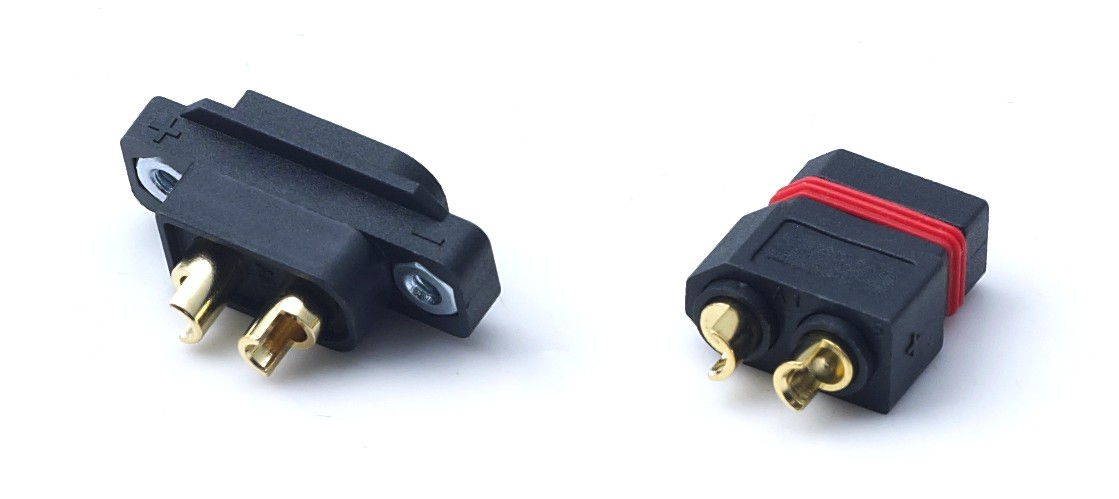
IP67-rated waterproof high-current DC connector designed for outdoor lithium-powered equipment.
Why Certification Matters in High-Current DC Connector Selection
Certification serves multiple functions in connector procurement: it reduces technical risk, supports regulatory compliance for global export, and provides an auditable baseline for quality consistency. For buyers moving from prototype to mass production, certification documents are often the difference between a supplier that can support market entry and one that cannot.
AOYG DC Power Connector, a manufacturer operating a 6,000 m² facility with approximately 100 employees and an annual output of 900,000 units, positions its quality system around IATF16949:2016 automotive-grade quality management certification. This is a meaningful signal: the IATF16949 standard imposes stricter requirements for process control, traceability, and defect prevention than general commercial quality management systems. For connector applications in drones, robots, and energy storage systems — where vibration, temperature variation, and repeated mating are normal operating conditions — automotive-grade process discipline aligns well with the technical demands of the application environment.
In addition to the automotive-grade quality system, the company's core connector products carry a defined set of third-party test reports and declarations. These include an ISO 9001:2015 certificate issued by a CNCA-accredited Certification Body, a CE-LVD Declaration of Conformity based on Directive 2014/35/EU (LVD) and EN 61984 for EU market access, and a UL94 V-0 flammability test report covering North America, EU, Australia, and global electrical and electronic markets. Chemical compliance is addressed through RoHS 2.0 test reports based on the IEC 62321 series and REACH SVHC test reports under Regulation (EC) No 1907/2006, both issued by third-party laboratories with CNAS, CMA, and ISO17025 accreditation.
The implication for buyers is straightforward: verification documents can be traced to named standards and accredited laboratories. When a supplier provides certification coverage that explicitly names the applicable standard, the issuing authority, and the market scope, the qualification process becomes more objective and less dependent on marketing claims.
Electrical Parameters That Define Real-World Performance
Rated voltage and continuous current are the first parameters buyers typically examine, but they are insufficient as standalone selection criteria. Contact resistance, temperature rise, and mating cycle life determine how the connector behaves under sustained load, and these parameters vary meaningfully across product families.
Consider the DXT60EW-M+DXT60W-F waterproof high-current connector. It is rated for DC 500V and 60A continuous current, with a peak rating of 100A. The terminal uses Φ5mm H62 brass with gold plating, and contact resistance is specified at ≤0.8mΩ. The housing is PA66 UL94 V-0 flame-retardant nylon, with a silicone O-ring providing IP67 protection. The operating temperature range is -20°C to +120°C, and the mating cycle rating is ≥1000 cycles. This model fits 8-10AWG silicone wire and is aimed at waterborne unmanned equipment, outdoor mobile photovoltaic energy storage, marine lithium battery systems, outdoor communication backup power, and outdoor garden machinery.
At the higher end of the current range, the DXT90H-M / DXT90S-F UAV connector supports 90A continuous operating current (with 10AWG wire and temperature rise ≤85°C) and a 120A peak rating, using a 4.5mm gold-plated banana terminal. The DXT90S-F female variant includes a built-in high-power precharge resistor, with a two-stage contact design that suppresses electric arc when connecting LiPo batteries. This is a functional differentiator: in drone applications where battery swapping is frequent, an anti-spark structure directly reduces terminal burn-out risk and extends connector service life.
For lighter applications, the DXT30U-M / DXT30U-F drone connector offers a compact form factor with a 15A continuous current rating and 30A peak current. The Φ2mm gold-plated terminal achieves a low contact resistance of ≤0.7mΩ, and the 18AWG silicone wire recommendation reflects its design for mini FPV drones, small UAVs, RC models, portable lithium battery packs, and educational robots.
A significant trend in this product category is the integration of power and signal lines into a single connector. The DXT30U(2+2)-F(B) connector combines 2 power pins and 2 signal pins, supporting 20A continuous current on power pins and 1A on signal pins, with a peak of 35A. This reduces harness quantity and saves internal device space for UAVs, robots, and smart devices with BMS connections. The 2+2 composite design is particularly relevant for equipment manufacturers seeking to simplify assembly and reduce failure points in space-constrained battery packs.
Key Electrical Parameters Across Representative Models
| Model | Rated Voltage | Continuous / Peak Current | Contact Resistance | Protection | Key Design Feature |
|---|---|---|---|---|---|
| DXT60EW-M+DXT60W-F | DC 500V | 60A / 100A | ≤0.8mΩ | IP67 | Silicone O-ring seal; waterproof |
| DXT90H-M / DXT90S-F | DC 500V | 90A / 120A | Not specified | IP40 | Anti-spark precharge resistor |
| DXT90H-M+DXT90E-F Yellow | DC 500V | 45A / 90A | ≤1.0mΩ | IP40 | Yellow housing for circuit identification |
| DXT30U-M / DXT30U-F | DC 500V | 15A / 30A | ≤0.7mΩ | IP40 | Compact; lightweight for FPV |
| DXT30U(2+2)-F(B) | DC 500V | 20A / 35A (power pins) | ≤1.2mΩ | IP40 | 2+2 power-signal combo |
Material and Environmental Durability Requirements
Housing material and terminal plating directly affect how a connector performs in humid, corrosive, or temperature-fluctuating environments. Across the models referenced above, the housing material is consistently PA66 nylon with UL94 V-0 flame-retardant classification, and terminals are gold-plated H62 brass with beryllium copper spring contacts on certain models. The combination of gold plating and beryllium copper springs supports stable clamping force over repeated mating cycles, which is important for maintaining consistent contact resistance over time.
Salt spray testing provides a measurable reference for corrosion resistance. The drone connector (DXT30U-M/DXT30U-F), UAV connector (DXT90H-M/DXT90S-F), RC model electric vehicle connector (DXT90H-M+DXT90E-F Yellow), DXT30U(2+2)-F(B), and DXT60EW-M+DXT60W-F have all passed a 48-hour neutral salt spray test conducted in accordance with GB/T 10125 and ASTM B117 standards. The Salt Spray Test Report is issued by a third-party laboratory with CNAS, CMA, and ISO17025 accreditation. For outdoor applications — such as solar street light energy storage modules, marine battery systems, or outdoor 5G base station backup power — this data point has direct relevance to expected service life in humid or saline atmospheres.
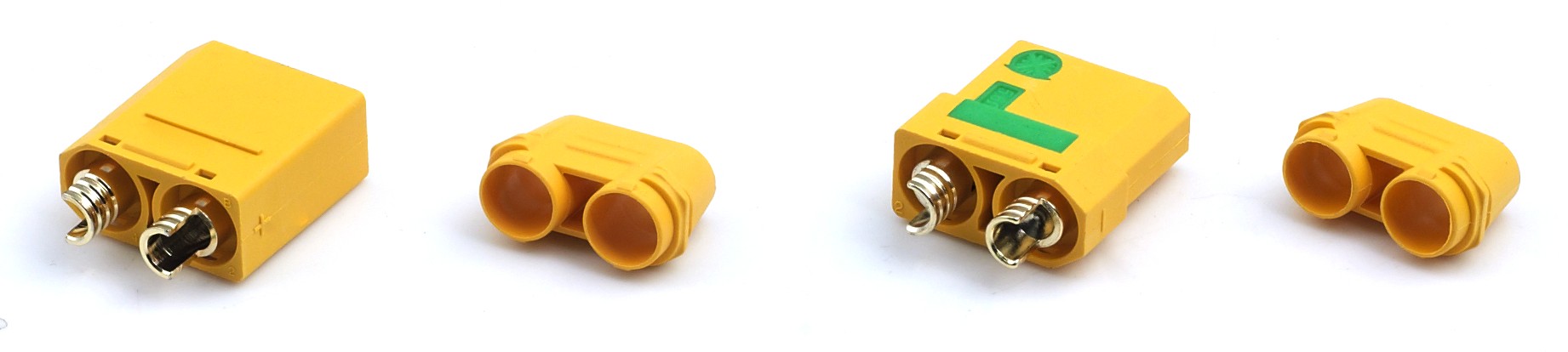
Anti-spark UAV connector pair with built-in precharge resistor for safe LiPo battery connection.
Application-Driven Selection: Matching Connector Class to Operating Environment
Selecting the right high-current DC connector requires mapping the connector's design intent to the operating conditions of the target application. The following categories illustrate how different application environments impose different requirements.
UAV, Drone, and RC Model Applications
These applications demand lightweight construction, vibration resistance, and reliable locking to prevent accidental disconnection during flight. The DXT30U-M/DXT30U-F drone connector is designed for small FPV drones and lightweight UAVs, where weight reduction is critical. The DXT90H-M/DXT90S-F UAV connector targets agricultural drones and multi-rotor UAVs, where continuous high-current discharge and repeated battery swaps require both high ampacity and anti-spark protection. The DXT90H-M male connector features a reinforced structure to maintain stable contact under continuous vibration, addressing the common failure mode of power loss caused by loose connections. All three drone-series connectors are dimensionally compatible with the industry-standard XT30/XT90 families, which facilitates design-in without major structural modification — a practical advantage documented in the application notes for these models.
Energy Storage and Electric Two-Wheeler Applications
Low-voltage lithium battery energy storage systems, battery swap cabinets, and electric two-wheelers operate under sustained high-current loads and require connectors that support modular battery connection and disconnection. The DXT60EW-M+DXT60W-F waterproof connector is relevant for outdoor portable energy storage and solar energy storage systems where moisture ingress is a risk. The DXT30U(2+2) power-signal combo connector is suited to smart robot battery packs and BMS integration, where simultaneous power delivery and sensing signal transmission reduce wiring complexity. The applicable industry scope for these connectors explicitly includes two-wheeler EV, battery swap cabinet, portable energy storage, garden lithium power tools, smart robots, and electric amusement equipment.
Outdoor Waterproof Equipment
For equipment operating in rain-splash, high-humidity, or muddy environments, IP65/IP67 protection becomes a defining specification rather than an optional feature. The DXT60EW-M+DXT60W-F achieves IP67 through a silicone O-ring seal, making it applicable to waterborne unmanned equipment, marine lithium battery systems, outdoor communication backup power, and outdoor garden machinery. It is important to note that the IP67 rating addresses ingress protection only; it does not imply anti-spark capability. The manufacturer explicitly states that this model does not have an anti-spark structure and that live plugging and unplugging of large-capacity batteries is not recommended.
Comparison with Traditional Connection Approaches
For decades, many low-voltage lithium-powered systems relied on general-purpose terminal blocks, bare wire connections, or automotive-style connectors adapted from other applications. The shift toward purpose-built high-current DC connectors reflects several measurable improvements.
- Defined electrical ratings: Purpose-designed connectors specify rated voltage, continuous current, peak current, and contact resistance, enabling engineers to validate performance against application requirements rather than relying on trial and error.
- Repeatable mating reliability: Connectors with a rated mating cycle of ≥1000 times, anti-keying structures, and secure locking mechanisms reduce the risk of loose connections in vibration-intensive environments such as drones and robots.
- Material traceability: Gold-plated terminals, PA66 UL94 V-0 housings, and documented salt spray test results provide a more auditable basis for quality assurance than generic terminal blocks.
- Modular design: Composite power-signal connectors and pre-wired harness options reduce assembly time and wiring errors in battery pack production.
A necessary caveat should be stated plainly: purpose-built connectors such as these are optimized for specific current ranges, wire gauges, and operating conditions. They do not replace industrial-grade connector families designed for grid-scale energy storage, high-voltage traction systems, or applications requiring hermetic sealing and extreme chemical resistance. A 90A-rated drone connector, for example, is not a substitute for a 300A+ industrial battery connector in a grid storage rack. Likewise, IP40-rated connectors remain unsuitable for submerged or continuously wet installations, regardless of their current rating. Buyers should treat these products as high-performance solutions within a defined application envelope, not as universal substitutes for all power connection requirements.
Procurement Considerations: OEM/ODM Customization and Supplier Capability
For manufacturers integrating connectors into their own products, the ability to customize connectors to specific design constraints can be as important as the electrical specifications themselves. AOYG offers OEM and ODM services covering customized size, current specification, pin position, wiring structure, and logo printing. The company supports customized production according to customer drawings, samples, and technical parameters, with a reported monthly capacity of 8,000 units and a lead time of 30-45 days. A 100% testing rate is applied to every produced unit, and export markets include Europe, America, and Southeast Asia.
Customization capability carries procurement implications beyond the unit cost. A supplier that can adapt pin configuration or cable length reduces the need for additional harness components and simplifies assembly. However, MOQ and lead time constraints apply: the stated MOQ is 2 units for sample or small-batch validation, which is a reasonable entry point for prototyping, but production-scale pricing and lead times will vary with configuration complexity. Buyers should clarify whether the 30-45 day lead time applies to standard configurations or only to new tooling development.
Market Context: Where High-Current DC Connectors Are Heading
Dataintelo's 2025 market analysis identifies DC connectors as representing 58.7% of the total energy storage connector market, a share driven by higher voltage requirements in storage systems. Industry compatibility data further suggests that XT60 and XT90 connectors remain the de facto non-proprietary standards for medium-to-high-power RC aircraft and drones in 2026, which reinforces the value of dimensionally compatible designs like the DXT30 and DXT90 series.
Another structural trend comes from the telecom infrastructure side. 5G base stations consume roughly 2-3 times more power than 4G predecessors, with typical draws of 11.5 to 14 kW, peaking around 19 kW. This rising power demand pushes backup power systems toward higher-capacity DC architectures, which in turn increases the need for low-voltage, high-current DC connectors with reliable performance under continuous load — the same category the DXT60EW-M+DXT60W-F addresses for outdoor 5G base station standby power.
For suppliers and buyers alike, the implication is that high-current DC connectors are moving from a commodity accessory to a performance-critical component in the new energy value chain. As equipment densities rise and operating environments become more demanding, the connectors that survive are likely to be those backed by documented test data, credible certification, and consistent manufacturing quality systems.
Limitations and Design Boundaries
An objective assessment of these connectors requires acknowledging constraints that could affect application suitability:
- No anti-spark protection on waterproof models: The DXT60EW-M+DXT60W-F does not include an anti-spark structure. Live connection of large-capacity batteries can generate an electric arc, so this connector is best suited to applications where the circuit is de-energized before mating, or where an external pre-charge mechanism is used.
- Protection grade varies by model: While the DXT60EW-M+DXT60W-F achieves IP67, the drone, UAV, and RC model connectors are rated IP40. These IP40-rated products are not intended for continuous water exposure, despite the higher current ratings.
- Environmental parameters are design targets: The -20°C to +120°C operating temperature range and ≥1000 mating cycles are laboratory-validated design targets, not guarantees of performance under every combination of environmental stress. Real-world service life depends on the specifics of the application, including current load, ambient temperature, mating frequency, and maintenance practices.
- Wire gauge recommendations matter: Current ratings are tied to specific wire sizes. For instance, the DXT90H-M/DXT90S-F's 90A continuous current rating is validated with 10AWG silicone wire. Using thinner wire will increase resistance and temperature rise, potentially compromising safety.
Future Outlook
Three developments are worth monitoring for buyers and engineers involved in DC connector procurement. First, the integration of signal and power in composite connectors is likely to accelerate, driven by the growing electronic intelligence of battery packs, robots, and energy storage systems. The 2+2 power-signal configuration is an early example of a broader trend toward reducing harness weight and connection points. Second, the rise of higher-density energy storage and the power demands of 5G infrastructure will push continuous current ratings and thermal management requirements upward, making contact resistance and temperature rise even more central to connector selection. Third, the standardization of XT60/XT90-style interfaces creates a compatibility ecosystem that benefits manufacturers and end users alike; suppliers that maintain dimensional interoperability while differentiating on material quality, anti-spark design, and waterproofing are better positioned to meet evolving market expectations.
Frequently Asked Questions
Do you have IATF16949 certification? What is your quality control standard?
Yes. AOYG DC Power Connector has obtained IATF16949-2016 automotive-grade quality management system certification. All production processes follow automotive-grade quality standards, with full-process quality control from raw material incoming inspection, precision mold development, automated production, and finished product testing. The system covers standardized control at every step, with full lifecycle quality traceability from raw materials to finished products.
What is the flame retardant grade of the plastic housing? Is it fireproof, melt-resistant and high voltage resistant?
The housing uses PA66 flame-retardant engineering plastic certified to UL94 V-0. Under the UL 94 Standard for Safety of Flammability of Plastic Materials, V-0 is the highest vertical burn rating, indicating the material self-extinguishes within a short time after ignition. The high-temperature nylon housing does not soften or deform under continuous high-current operation up to the rated operating temperature of +120°C, and passes a withstand voltage test of AC 2000V for 1 minute on applicable models such as the DXT90H-M/DXT90S-F UAV connector.
Can you provide technical support for product matching and debugging?
The manufacturer reports that its technical team provides free model selection guidance, product adaptation analysis, and assembly solution suggestions. Support includes sample debugging and optimization rectification to help customers complete the mating and integration of the connector with their specific equipment.
Which certifications apply to the high-current DC power connector for EU export?
The following product families are covered by a CE-LVD Declaration of Conformity based on Directive 2014/35/EU (LVD) and EN 61984, issued by the Manufacturer/EU Authorised Representative: the Waterproof High Current Connector (DXT60EW-M+DXT60W-F), the DXT30U(2+2)-F(B) Female Connector, the RC Model Electric Vehicle Connector (DXT90H-M+DXT90E-F Yellow), and the UAV Connector (DXT90H-M/DXT90S-F). All high-current DC connectors offered by the company are also covered by the REACH SVHC Test Report under Regulation (EC) No 1907/2006 and the ECHA SVHC Candidate List, applicable to the EU, EEA, UK, and global overseas markets.
What is the difference between the DXT90H-M / DXT90S-F anti-spark UAV connector and the DXT60EW-M+DXT60W-F waterproof connector?
The DXT90H-M / DXT90S-F is designed for high-current UAV and drone battery connections, with 90A continuous / 120A peak capacity and a built-in precharge resistor in the DXT90S-F female that reduces electric arc during connection. It is rated IP40 and dimensionally compatible with standard XT90 connectors. The DXT60EW-M+DXT60W-F is an IP67 waterproof connector rated for 60A continuous / 100A peak, designed for outdoor equipment exposed to rain and humidity. It does not include an anti-spark structure; live plugging and unplugging of large-capacity batteries is not recommended for this model.
Have Questions or Need More Details?
Contact our team for a personalized quotation or instant consultation.
Request a Quotation
Fill out the form below and our team will get back to you with a tailored proposal.
WhatsApp Direct Chat
Prefer to chat in real-time? Message us on WhatsApp for instant assistance & quick answers.
- Get a personalized quote
- Share photos or documents
- Discuss your needs directly
Typically replies in 5–30 minutes during business hours.