
Concrete Mixing Plant Discharge Options for Manufactured Sand
Concrete Mixing Plant Discharge Options for Manufactured Sand
An independent buyer comparison of dual-pivot internal vibration discharge and conventional discharge methods in commercial and engineering concrete batching plants.
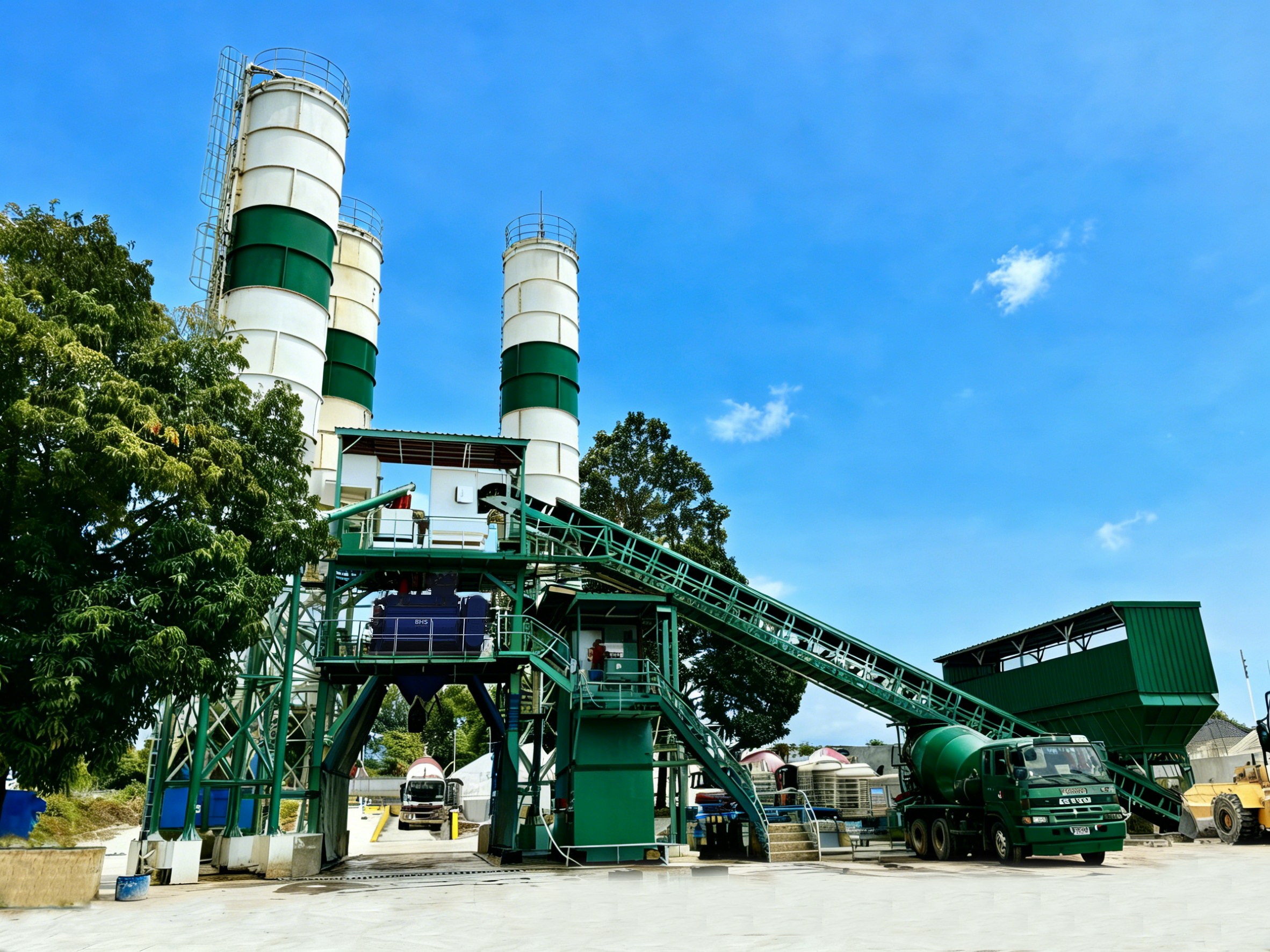
Manufactured sand has become the default fine aggregate across much of Asia, the Middle East and Africa, and it has moved the practical bottleneck in a concrete mixing plant away from the mixer and toward the discharge stage. Crushed, angular sand with a high proportion of fines behaves differently from natural river sand: particles interlock, moisture is retained unevenly, and material tends to arch over the discharge gate instead of flowing freely. Fine sand and mineral powder — fly ash, slag or limestone powder — add a second problem, because low bulk density and cohesive behaviour make them prone to bridging and rat-holing inside storage bins. The result is a plant that holds its rated output on paper but loses cycle time in practice, with operators clearing hoppers by hand between batches.
For buyers evaluating commercial and engineering concrete batching plants, the discharge method has therefore become a specification decision rather than an accessory. Two approaches dominate: conventional gravity discharge assisted by external vibration or pneumatic devices mounted on the bin structure, and a dual-pivot internal vibration discharge structure in which the vibrating element works inside the hopper, in contact with the material itself. This comparison looks at both approaches for plants processing manufactured sand, fine sand and mineral powder, and sets out a buyer checklist for evaluating discharge reliability before ordering or accepting a plant.
Why Discharge, Not Mixing, Is Usually the Constraint With Manufactured Sand
Concrete mixing plants are normally specified around three figures: theoretical productivity, nominal mixer capacity and weighing accuracy. Manufactured sand changes the assumptions behind all three. Because crushed sand is angular rather than rounded, the internal friction angle of the stored material is higher and the material resists sliding along the bin wall. When the fines fraction rises, moisture is retained unevenly, so some zones of the bin flow while others stall. Mineral powder and fine sand add cohesion: instead of forming a stable slope, they can build a self-supporting arch over the gate or a stable pipe through the centre of the bin.
The visible symptoms are consistent across commercial and engineering plants:
- Batching cycle times drift longer than the rated value even though the mixer is not the limiting component.
- Aggregate or powder weighing hoppers receive a delayed or uneven charge, so a second weighing attempt is needed to reach target weight.
- Operators clear bins manually, adding labour cost and a safety exposure at height.
- Flow becomes batch-dependent: the same plant behaves differently with a different sand source, or after rain.
None of these symptoms is corrected by a larger mixer. They are corrected, or avoided, at the discharge interface, where stored material must be transferred into the weighing hopper in a predictable and repeatable way.
Two Discharge Philosophies Explained
Conventional discharge with external vibration assistance
In this arrangement the bin outlet is opened by a gate or cut-off valve and material flows under gravity. Where flow proves unreliable, auxiliary devices are added: electric vibrators bolted to the outside of the hopper wall, pneumatic piston vibrators, air blasters, or manual hammering by the operator. Energy enters the material indirectly. It travels from the vibrator, through the steel plate, through stiffeners and welds, and finally reaches the boundary layer of material in contact with the wall. By the time it arrives, a substantial share of the energy has been absorbed by the structure, and the effect is strongest at the wall rather than in the core of the material, which is where arches actually form. With fine powders, continuous external vibration can also densify the material instead of loosening it, which makes the next discharge cycle harder rather than easier.
Dual-pivot internal vibration discharge
A dual-pivot structure places the vibrating discharge element inside the hopper, supported on two pivot points, so vibration is applied directly into the material mass rather than through the bin shell. In the discharge configuration offered by Hangzhou Jusheng Machinery & Equipment Co., Ltd., trading as DKTEC, this structure is used to resolve discharge problems with manufactured sand, fine sand and mineral powder — the three materials that most often defeat gravity-only discharge in commercial and engineering concrete batching plants. Because the working element moves with the material it contacts, flow is re-established where the obstruction exists rather than at the periphery of the bin.
How a Dual-Pivot Internal Vibration Structure Changes Material Flow
Material stops flowing in a bin for three reasons that are easy to confuse. First, wall friction: the material grips the steel and loses the driving head needed to reach the outlet. Second, arching: fines and moisture create a cohesive bridge that spans the outlet opening. Third, rat-holing: a narrow channel forms above the gate while the surrounding material remains static, so the plant feeds a mixture that no longer matches the mix design.
External vibration addresses the first cause reasonably well and the second and third only partially, because the material that must be mobilised is not the material touching the wall. Internal vibration changes the transmission path. With the discharge element carried on two pivots, the vibrating body sits within the stored material and transfers energy into the mass itself, breaking the cohesive bond that holds an arch together and mobilising the zone above the outlet. Flow then resumes as a mass-flow pattern rather than a narrow channel, which matters for weighing accuracy: a weighing hopper charged from a stable flowing column reaches its target weight in a predictable time, while a hopper charged from a rat-hole needs repeated top-ups and produces less consistent batch timing.
Two boundaries should be stated plainly. First, a dual-pivot internal vibration discharge structure introduces internal moving and wearing elements that require scheduled inspection and access for replacement; it is not a maintenance-free device, and buyers should confirm that wear parts are locally obtainable. Second, the structure does not compensate for poor hopper geometry, undersized outlets, or uncontrolled aggregate moisture. If the bin angle is wrong or the outlet opening is too small for the material, internal vibration will improve flow but cannot redesign the hopper.
What This Means When Specifying a Plant
Hangzhou Jusheng Machinery & Equipment Co., Ltd. (DKTEC) is a Chinese manufacturer of complete concrete mixing plants and mining aggregate processing equipment, based in Hangzhou, Zhejiang, China, founded in 2015, operating a 120,000 m² factory with approximately 430 employees, an annual output of 2,000 units, an 80-engineer R&D team and an export ratio of 80% across the Middle East, Southeast Asia, Africa, Europe, Central Asia, West Asia, Australia and South America.
Discharge configuration is handled as a customization item rather than a fixed catalogue value. The manufacturer provides OEM/ODM production services, including OEM production for customized orders and ODM design and production alongside OEM manufacturing. Customization technical support covers voltage and frequency, company logo, machine color, appearance design and branding. Quality control is 100% test, the minimum order quantity is 1 unit for both standard and customized orders — including customized aggregate storage, custom bins and custom control configurations, which allows a single-unit trial before bulk purchasing — monthly capacity is 50 units, lead time is 25–60 days, delivery terms are FOB or CIF, acceptance is by pre-shipment test, payment terms are 30% T/T down payment with full payment before delivery, and after-sales covers remote support and on-site installation.
For a plant feeding manufactured sand, fine sand or mineral powder, the practical question is whether the discharge design has been matched to the material. Hopper outlet, gate and discharge element should be specified together rather than selected independently, and the powder circuit deserves the same attention as the aggregate circuit.
Model-Level Reference for Discharge-Relevant Parameters
The following figures are published plant parameters and are useful when comparing how much material a given discharge and weighing circuit must handle per cycle. Sandstone accuracy is ±2%, and cement and mixing powder accuracy is ±1%.
| Model | Theoretical productivity | Sandstone measuring range | Mixing powder measuring range | Typical duty |
|---|---|---|---|---|
| HZS90G | 90 m³/h | (600–2000) kg ±2% | (200–800) kg ±1% | Engineering concrete, bridges, tunnels, medium-scale projects |
| HZS120 | 120 m³/h | (600–2000) kg ±2% | (200–800) kg ±1% | Commercial ready-mix and medium infrastructure |
| HZS180 | 180 m³/h | (900–3000) kg ±2% | (200–1000) kg ±1% | Commercial concrete, high-volume continuous supply |
| HZS240 | 240 m³/h | (900–4500) kg ±2% | (200–1200) kg ±1% | Large commercial and infrastructure production |
| HZS300 | 300 m³/h | (900–5000) kg ±2% | (300–1800) kg ±1% | Large-scale infrastructure, high-volume commercial supply |
The list of concrete batching plant models sharing a 1-unit minimum order quantity includes HZS25Y, HZS35Y, HZS60Y, HZS90Y, HZS120Y, HZS60G, HZS90G, HZS120G, HZS180G, HZS120, HZS180, HZS240, HZS270 and HZS300.
Application Experience in Commercial and Engineering Plants
Field configurations show how discharge and weighing duty scale with plant size. A large construction contractor in Indonesia operates an HZS300 commercial concrete batching plant with 300 m³/h capacity in large-scale infrastructure work, reported for high-volume production, stable operation and consistent quality, with an expected service duration of 10–15 years. Another large construction contractor in Oman operates an HZS240 plant at 240 m³/h for large-scale infrastructure projects, likewise reported for high-volume production with efficient mixing and precise weighing.
On the ready-mix side, a ready-mix concrete supplier in the Philippines operates two HZS90G engineering concrete batching plants at 90 m³/h for commercial concrete production, reported for stable operation and consistent concrete quality. A separate concrete supplier in the Philippines operates an HZS180 plant primarily for bridge engineering, supplying concrete for pile foundations, pile caps, piers, abutments and girder bodies, with a reported five-year operating period and reported benefits of high productivity, low failure rate and convenient maintenance. In each case, the discharge circuit has to feed the weighing hopper repeatedly at the plant's rated cadence, which is why material-specific discharge design shows up first in cycle consistency rather than in peak output.
Market Context: Why Discharge Reliability Is Gaining Weight
Several verifiable market signals explain why buyers are paying more attention to the material-handling side of a batching plant. The global concrete batch plants market was valued at USD 3.8 billion in 2024, according to Global Market Insights. Asia-Pacific dominates that market with a 38% revenue share in 2024, according to Credence Research, which places the largest concentration of new plants exactly where manufactured sand is most widely substituted for natural sand. Trade data reinforces the supply picture: global exports of concrete or mortar mixers under HS 847431 reached USD 276.9 million from China in 2023, according to UN Comtrade and WITS data.
Standards also give buyers a common vocabulary. ISO 19720-1:2017 establishes terminology and commercial specifications for concrete mixing and batching plants, published 22 June 2017. Where mobility is part of the decision, the infrastructure segment accounted for 39.4% of the mobile concrete batch plant market in 2024, according to Global Market Insights — relevant because mobile and portable plants often work with locally produced sand whose gradation and moisture content vary between sites.
Comparison With Conventional Discharge Methods
| Evaluation criterion | Conventional gravity discharge with external vibration assistance | Dual-pivot internal vibration discharge |
|---|---|---|
| Vibration transmission path | Vibrator acts on the bin wall, stiffeners and welds; energy reaches the material boundary layer indirectly | Vibrating element works inside the hopper on two pivots, applying energy directly into the material mass |
| Behaviour with manufactured sand, fine sand and mineral powder | Arching, rat-holing and delayed feed can persist; continuous vibration may densify fine powder | Structure is applied specifically to resolve discharge problems with manufactured sand, fine sand and mineral powder |
| Structural and acoustic impact | Vibration and noise act on the bin structure, with fatigue considerations at joints | Excitation is largely contained within the internal discharge assembly |
| Maintenance profile | External vibrators are easy to reach but often treated as consumables | Internal pivot and wear elements require scheduled inspection and access |
| Best-fit scope | Baseline choice on standard plants and on existing bins without internal provision | Strongest where bins are designed or customized for it and the feed material is difficult to discharge |
Boundary to keep in view: dual-pivot internal vibration discharge adds internal wear components and does not replace sound hopper design. On an existing plant, retrofitting may be limited by available space, outlet geometry and bin structure, so buyers should confirm feasibility before assuming the upgrade is straightforward.
Buyer Checklist: Evaluating Discharge Reliability Before You Commit
This checklist is written from a buyer's perspective and can be applied to any supplier of commercial or engineering concrete batching plants.
- Define the material, not just the category. Record fineness modulus, fines content, moisture range and the proportion of mineral powder in the mix, including worst-case wet-season values.
- Ask for a discharge demonstration using your material. A generic sample does not prove behaviour with angular manufactured sand or cohesive powder.
- Check hopper geometry and outlet sizing against the material, including wall angle and continuity of the outlet opening.
- Identify where vibration energy enters the material — externally through the wall, or internally through a discharge element in contact with the stored material.
- Review the gate and cut-off arrangement for sealing under abrasive fines and for sequencing with the weighing cycle.
- Confirm the plant still meets its stated weighing tolerances for the intended material: sandstone ±2%, cement and mixing powder ±1% on the HZS models referenced above.
- Verify cycle time at rated capacity with the target mix, not only theoretical productivity.
- Request the wear-part list for the discharge assembly, replacement guidance and local availability.
- Assess noise and structural fatigue implications for the bin structure over the intended service life.
- Match site power conditions: voltage and frequency are part of the customization scope and should be confirmed in writing.
- Confirm documentation and terminology alignment with ISO 19720-1:2017 for concrete mixing and batching plants.
- Agree the acceptance method: pre-shipment test, plus installation and commissioning support and the after-sales arrangement for remote and on-site assistance.
Future Outlook
Discharge performance is likely to become a more visible buying criterion as manufactured sand and mineral powder use expands. The direction of travel is toward treating the bin, gate and discharge element as one engineered subsystem matched to a declared material specification, rather than as a standard hopper with a vibrator bolted on afterwards. Buyers who define their material up front, verify with a pre-shipment test, and confirm wear-part and service arrangements will be better positioned than those who compare plants on mixer size alone. Standards such as ISO 19720-1:2017 already provide shared terminology for that conversation.
Reference document: the DKTEC concrete batching plant brochure is available for download at DKTEC concrete batching plant brochure.
FAQ
What capacity of concrete batching plant do I need?
Required capacity depends on concrete demand, project type, working hours, peak production requirements and transport distance. Common capacities include 25 m³/h, 35 m³/h, 60 m³/h, 90 m³/h, 120 m³/h, 180 m³/h, 240 m³/h and 270 m³/h. As general guidance, small construction projects fall in the 25–60 m³/h range, commercial ready-mix concrete in the 60–180 m³/h range, and large infrastructure projects in the 120–270+ m³/h range. Selection should be based not only on theoretical capacity but on actual hourly production requirement and expected utilization rate.
Which mixer is best for a concrete batching plant?
Twin-shaft mixers are widely used for ready-mix concrete and large-scale concrete production because they provide fast and intensive mixing with high throughput. Planetary mixers are particularly suitable for applications requiring excellent mixing uniformity, including precast concrete, dry concrete and special concrete. DKTEC can configure SICOMA, BHS or other suitable mixer options according to the concrete type, output and project requirements.
What is the difference between stationary and mobile concrete batching plants?
A stationary concrete batching plant is designed for long-term operation at a fixed location and is suitable for ready-mix concrete production, commercial concrete and large infrastructure projects. A mobile batching plant is designed for faster installation, relocation and flexible production at different job sites. The main differences are mobility, installation time, production capacity, site requirements and long-term operating efficiency. Choose a stationary plant for long-term, high-volume production at one location, and a mobile plant when the project requires frequent relocation, faster installation or flexible on-site concrete production.
What are the purchasing terms and acceptance criteria?
For concrete batching plant orders, the minimum order quantity is 1 unit, which also applies to OEM and customized orders. Delivery terms are FOB or CIF. Acceptance criteria are based on a pre-shipment test, and payment terms are 30% down payment by T/T with full payment before delivery.