
Custom Nonwoven Forming Belts: What Capability Looks Like Beyond the Catalog
Once nonwoven buyers move from evaluation to execution, the central question shifts from “which belt number” to “which manufacturer can engineer a belt to this line, this process and this product mix.” Understanding OEM/ODM capability is now a practical procurement step for spunbond, meltblown, spunmelt and spunlace producers.
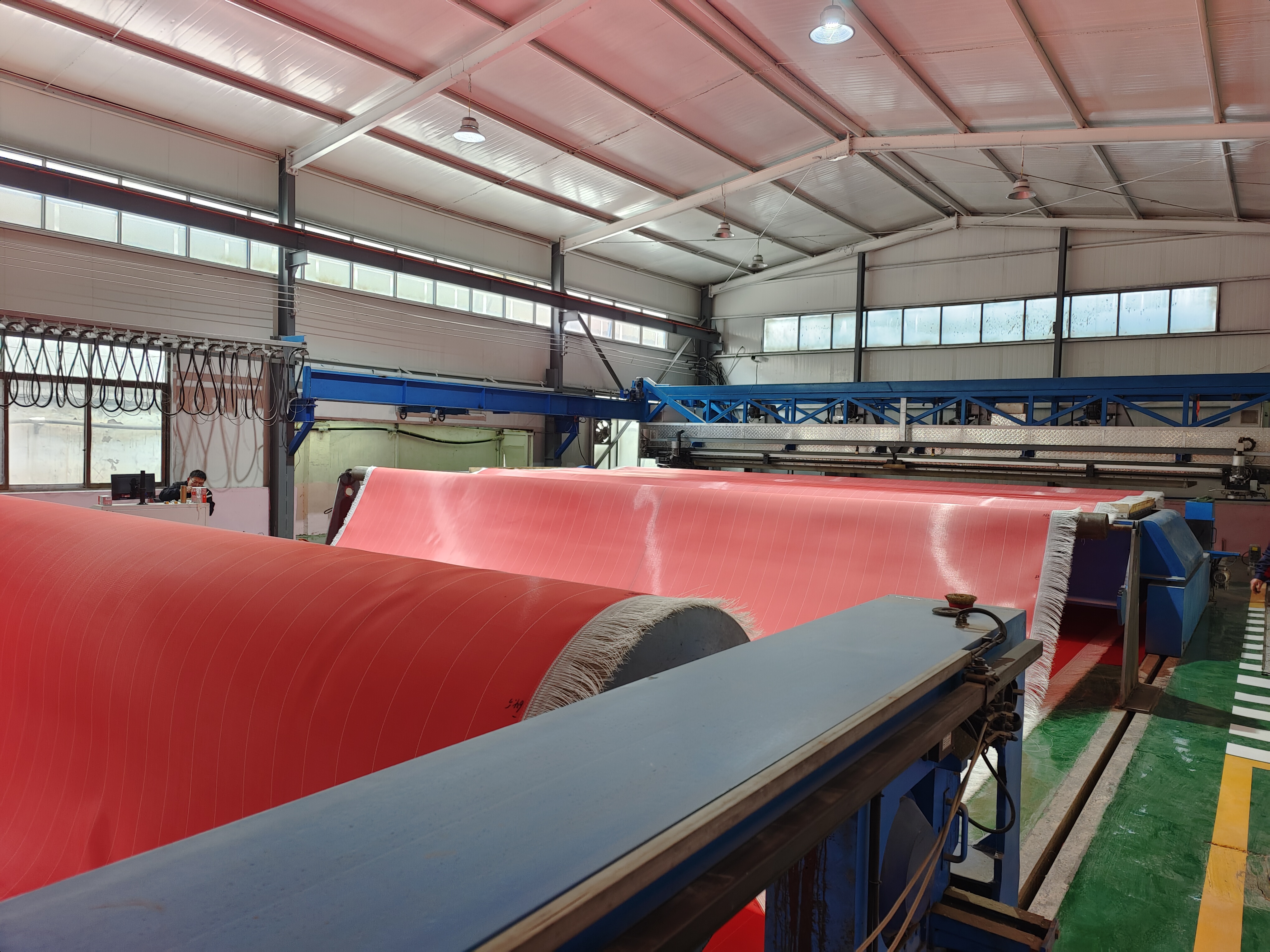
Forming fabrics are process components: their value depends on how precisely they are built and verified for the target line. Photo: Production floor of Henan Yiheng Mesh Belt Industry Co., Ltd.
Forming belts are process parameters, not just spare parts
A nonwoven forming belt performs a dual role that is easy to underestimate. It is a mechanical conveyor that carries the web, and it is also the boundary layer where air flow, fibre deposition, drainage and release dynamics are decided. In spunbond, meltblown, spunmelt, airlaid and spunlace lines, small differences in surface geometry, permeability and conductivity translate directly into visible differences in web formation, first-grade yield and uptime.
For that reason, purchasing decisions that remain at the level of “catalog spec” often leave value on the table. A technically capable supplier treats the belt as an engineered element of the forming section: it customizes the fabric for a specific machine layout, fibre denier, line speed and environmental condition.
What does OEM/ODM capability mean for nonwoven mesh belts?
In the nonwoven sector, a manufacturer with genuine OEM/ODM capability is not simply offering made-to-measure dimensions. It is able to adjust the forming fabric across multiple technical variables that influence how the web is formed. Based on current supplier capabilities documented for Henan Yiheng Mesh Belt Industry Co., Ltd., customization typically covers the following variables:
- Mesh count and opening size — controlling how much fibre can penetrate or remain on the surface.
- Air permeability (CFM) — managing suction distribution and fibre lay-down behaviour.
- Belt width and length — matching exact machine dimensions with controlled dimensional tolerances.
- Material type — PET, PA or anti-static variants depending on process chemistry and environment.
- Thickness and weight — affecting fabric support, seam behaviour and air flow resistance.
- Yarn geometry — round vs flat yarn influences mesh marking and contact pressure distribution.
- Colour and edge treatment — anti-static fibre identification, visual inspection contrast, and edge sealing method.
These variables are not independent. For example, changing from round yarn to flat yarn alters the contact area of the support surface; increasing weft density tightens the gaps that can trap ultra-fine fibres; adding conductive monofilaments reduces surface resistivity; and the seam technology must be chosen in parallel with the running speed of the line.
Why precision control matters more than the base polymer
The functional difference between a good and a problematic forming fabric is often not the raw polyester but the consistency of its final structure. Air permeability deviation is one of the clearest examples. In air-laid type forming, the mesh behaves as a porous medium that distributes negative pressure across the web-forming zone. If local CFM values vary, suction becomes uneven, fibre clusters gather in higher-flow zones, and the resulting fabric can develop cloudy spots or inconsistent basis weight.
For this reason, more demanding suppliers specify permeability as a narrow band rather than a vague range. Several forming fabric models from Henan Yiheng, for example, carry tolerances such as 680±30 CFM or 750±30 CFM at 127Pa — a level of control that is achieved through weaving consistency and heat-setting discipline. In its own manufacturing record, Henan Yiheng states that air permeability fluctuations are kept within ±5%.
Product-level files also show a clear material logic. For fine-denier hygiene fabrics, an encrypted structure is recommended to prevent fibre penetration and “fibre hanging” streaks. For lines that run above 400–500 m/min, seam geometry and anti-static properties become priority criteria. For high-temperature, high-humidity environments, hydrolysis-resistant monofilaments are used to protect belt life. These are not styling choices; they are engineering responses to known failure modes.
Compatibility with mainstream nonwoven equipment
For buyers in evaluation, a frequent first question is whether a replacement belt or a custom-fabricated belt can be used on existing equipment from leading line builders. Henan Yiheng’s documented experience includes supply to Reicofil, Chaolong and Hongda equipment, with references to Reicofil RF4 high-speed lines in case records. The company also states that it has supplied belts for original equipment manufacturers such as Chaolong, Hongda and Aolong as part of its export business.
Compatibility is not only about seam length and belt width. It also includes the physical behaviour of the belt under a given tension profile, suction box layout and roller configuration. This is why machine-specific customization is usually safer than assuming that one general-purpose fabric will behave the same on different lines.
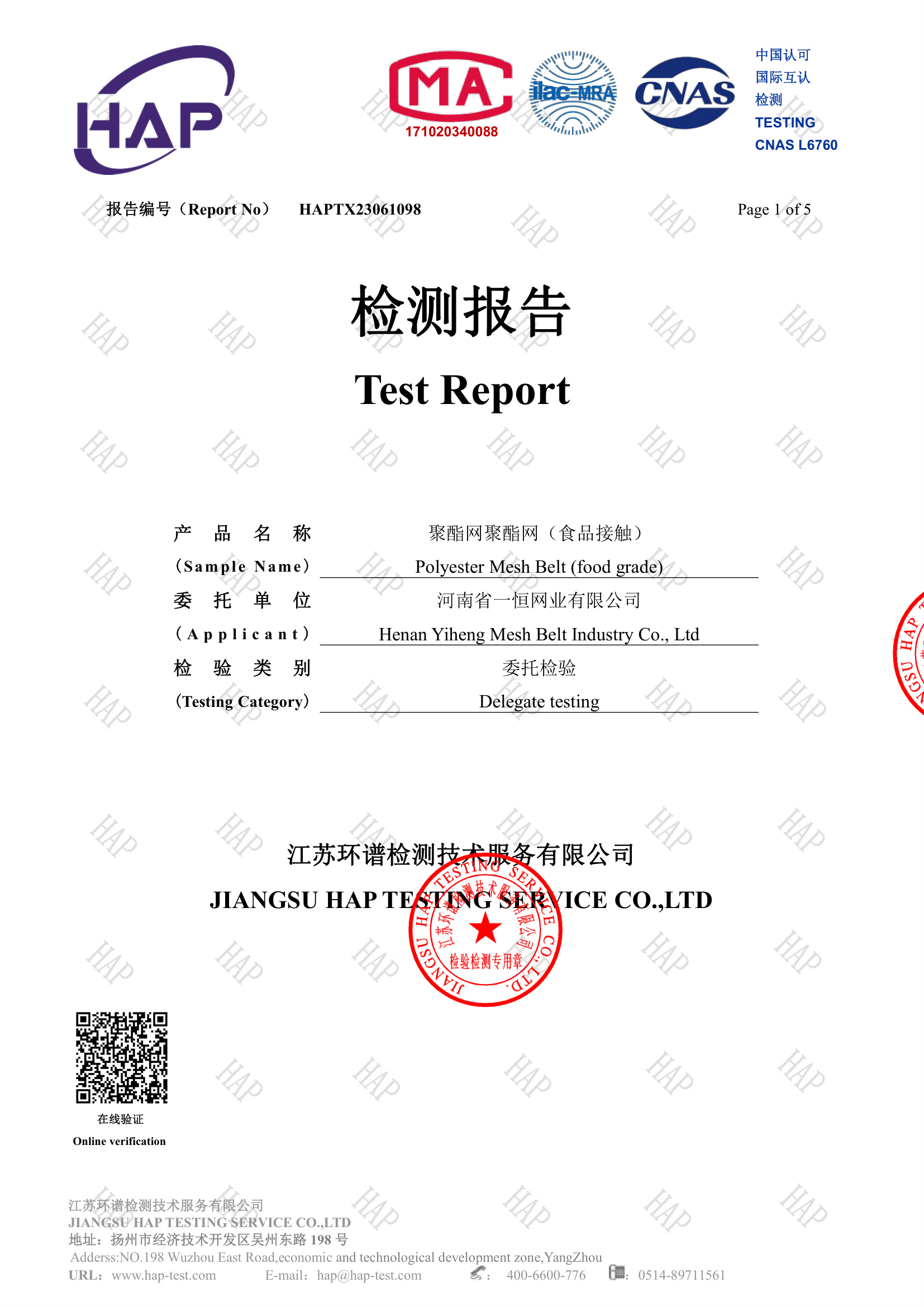
Certification documents are increasingly part of forming-fabric sourcing evidence. The food-contact test report for polyester mesh belt is one documented compliance item.
Supplier capability evidence: factory, inspection and certification
Henan Yiheng Mesh Belt Industry Co., Ltd. is a National High-tech Enterprise based in Henan, China. Its company profile records a 4,237 m² manufacturing facility, 41 employees and an annual output of 150,000 m² of industrial mesh products. The factory is supported by three R&D engineers and exports about 62% of its production, with main markets in Asia, Europe and North America.
From a buyer’s perspective, the more decision-relevant evidence lies in the company’s operational capabilities and third-party checks:
- OEM/ODM production is documented for mesh count, opening size, air permeability (CFM), width, length, material type (PET/PA/anti-static), thickness, colour and edge treatment.
- Monthly capacity is recorded at 30,000 m² in the supplier capability unit, supported by weaving and heat-setting equipment described as high-position warping and ultra-wide looms.
- Quality control includes 100% pre-shipment inspection, and on-site third-party inspection by BV/SGS is stated as available.
- Lead time for production is listed as 15–30 days, with a MOQ of 2 m² for custom orders.
- After-sales support includes remote technical support, installation guidance and free sample testing.
Documented compliance adds another layer of verifiability. Henan Yiheng holds a food-grade test report for polyester mesh belt, issued by Jiangsu HAP Testing Service Co., Ltd. under certificate number HAPTX23061098, based on standard GB 4806.7-2016 for food contact materials. The company also holds a LUCID registration (DE2857625357145) under the German Packaging Act, covering retail, grouped and shipment packaging placed on the German market. An Intertek supplier assessment report with certificate number 493944221_P+T, valid from 2026-07-09 to 2027-07-09, further documents the production and trading capability.
Technical solutions across process scenarios
A capability-led supplier should be able to map specific product models to process problems, not simply sell the fastest or most expensive fabric. In the documented Henan Yiheng range, several model families show this logic:
- Mark-free fabrics for premium surfaces — The KJD700 flat-yarn series is positioned for applications where mesh marks are unacceptable, such as dark or high-end packaging nonwovens. Flat yarn provides a larger support contact area and more uniform pressure distribution than round yarn.
- Encrypted fabrics for ultra-fine denier — For products below approximately 1.2–1.5 denier, fiber hanging and streaks are common risks. The HY4106 and SK604 encrypted series use tighter weave structures and controlled CFM to reduce the spaces where fine fibres can be trapped.
- High-speed anti-static series — The SK604 series integrates conductive carbon-fibre yarns and is described as suitable for high-speed lines. For even higher static dissipation requirements, KJD700 is documented with very low conductivity values in the range of 10³–10⁴ Ω.
- Spunlace and airlaid structures — A separate set of model numbers covers spunlace mesh and airlaid mesh, with lower mesh counts and higher air-flow ranges for processes that depend on water or air through-put.
These model groups give buyers a better starting point than a generic mesh table. Instead of asking “what mesh number do you sell,” the buyer can ask “which fabric structure is documented for my process condition.”
Case evidence from different production environments
Henan Yiheng’s case records include several application examples that show how belt selection is connected to measurable production outcomes. These figures are supplier-reported, but they are specific enough to be investigated during supplier qualification.
Spunlace wet wipes and medical dressing production in Germany. A wet wipe and medical dressing supplier with 12 spunlace lines used Yiheng mesh belts for wet wipes and facial mask substrate production over one year. The reported result was 15% higher productivity, 4% higher first-grade yield and 30% lower maintenance cost. Models associated with this case include 06702, 05602, 29254, 09502 and 60188 — a mix of airlaid and spunlace mesh structures. The highlight cited was high water permeability, zero mesh marks and hydrolysis resistance.
High-speed spunbond in Switzerland. A nonwoven fabric manufacturer running eight Reicofil RF4 high-speed lines used SK604 and KJD700 belts for baby diaper and sanitary napkin materials. Reported outcomes over one year were 10% higher capacity, 5% higher first-grade yield and 30% lower maintenance cost. In this context, wear resistance and dimensional stability are the logical technical requirements because high-speed diaper lines place continuous mechanical stress on the forming surface.
Reifenhauser line in the United States. A smaller purchase of 200 m² of belt for a Reifenhauser line was reported to achieve uniform web formation, zero mesh marks and easy release, with an estimated saving of US$2,000 per year. Although the absolute value is modest, the case illustrates that even small trial orders can generate useful line-level evidence before wider rollout.
These examples also demonstrate that selection is not about one universal fabric. The German case leans on high air/water permeability; the Swiss case demands wear resistance and dimensional stability at high speed; the US case shows that even a relatively low-volume custom order can be used as a low-risk trial step.
Comparison with standard product selection — and where limitations remain
It is important to be clear about the boundary between custom-engineered fabrics and standard catalog meshes. A standard nonwoven mesh belt remains a practical and economically rational choice for many lines. The risk is not standardization itself; it is applying a standard fabric to a process condition that requires a different surface geometry, conductivity level or permeability range.
The documented comparison points are useful here:
- Round yarn vs flat yarn. Round yarn offers strong support but smaller contact points, which can translate into mesh marks. Flat yarn provides a smoother surface and more uniform pressure, reducing visible grid impressions.
- Standard polyester vs anti-static polyester. Standard mesh can attract fabric in dry or winter conditions because charge accumulates on the surface. Anti-static mesh contains conductive yarns that actively dissipate static charge.
- Spiral seam vs High-Low Loop seam. Spiral seams are cost-effective, easier to thread and suitable for lower-speed, standard products. High-Low Loop seams are engineered to match the thickness of the mesh body, reducing “roller jumping” and making them appropriate for high-speed lines above roughly 400–450 m/min.
- Standard polyester vs hydrolysis-resistant polyester. In hot, humid environments, standard polyester can degrade through hydrolysis. Hydrolysis-resistant materials are designed to maintain strength retention under such conditions.
There are also limits to what a custom belt alone can solve. Henan Yiheng’s own troubleshooting knowledge base makes this clear. For example, fabric flipping can still occur even with an anti-static belt if the equipment-side grounding system is faulty or the grounding rod is insufficient. Belt tracking failure can lead to seam burst if tension bolts are severely imbalanced or if the line is sped up too quickly after installation. Cleaning with a heat gun at excessive concentrated temperature can cause local thermal shrinkage of polyester yarns. These examples show that a custom belt is one component of a production system; installation procedure, machine maintenance and operator discipline remain equally important.
Sourcing and execution parameters for custom mesh belts
For buyers at the execution stage, the commercial terms of a custom mesh belt order are as important as the technical specification. Documentation for Henan Yiheng’s procurement support lists several parameters that can be used as a benchmark when comparing suppliers:
| Parameter | Documented position | Sourcing relevance |
|---|---|---|
| Custom production | OEM/ODM supported | Confirms the supplier can build to line specification rather than only sell stock items. |
| MOQ | 2 m² | Allows trials and upgrades without committing to full production volume. |
| Lead time | 15–30 days | Relevant for planned downtime windows and production scheduling. |
| Quality control | 100% pre-shipment inspection; BV/SGS on-site inspection available | Reduces risk of dimensional or permeability deviation. |
| Export regions | EU, North America, Southeast Asia, Middle East, Russia, South America | Relevant for logistics, documentation and compliance planning. |
| After-sales | Remote technical support, installation guidance, free sample testing | Supports execution alignment for plants with limited internal belt specialists. |
Market context: what is driving forming-belt capability demand
Several published market indicators help explain why OEM/ODM capability is becoming more relevant. The nonwoven production line market was valued at USD 5.3 billion in 2024 and is projected to reach USD 9.8 billion by 2033, according to a Dataintelo report. At the fabric level, Smithers projects the global nonwoven fabric market will reach USD 90.8 billion by 2030, representing a CAGR of 6.2% from 2025. Grand View Research reported that spunlaid technology, including spunbond and meltblown, accounted for 48.4% of the global nonwoven technology market in 2023.
All three signals point in the same direction: production capacity is expanding, spunmelt processes dominate the technology mix, and fabric output is shifting toward higher-value hygiene, medical and packaging applications. These categories are also the ones most sensitive to web uniformity, mesh marks and static control — which are exactly the properties that custom forming-fabric design can influence.
Another practical layer is customs and trade classification. Nonwoven mesh belts used for industrial conveying or forming have appeared under HS codes such as 3926.90.29 or 5910.00.00, depending on material structure and whether the belt is classified as a plastics article or as a technical textile conveyor product. Buyers sourcing internationally should confirm the correct classification for their specific fabric construction rather than assuming that a single HS code applies to all mesh belt variants.
Execution priorities for the next belt order
For teams moving from vendor selection to actual implementation, the following priorities are supported by the documentation reviewed for this article:
- Define the process envelope first. Document line speed, fibre denier, ambient humidity, suction configuration and seam requirements before requesting a quote.
- Ask for model-to-problem mapping. The supplier should recommend a specific structure, not only a permeability value. For example, KJD700 for mark-sensitive products, SK604 for high speed and static risk, or an encrypted HY4106 variant for fine-denier processes.
- Confirm seam technology. If line speed exceeds roughly 400–450 m/min, request High-Low Loop seam technology and check that the seam thickness is consistent with the mesh body.
- Verify CFM tolerance. A specification like 680±30 CFM or 750±30 CFM is more actionable than a single nominal value.
- Check compliance documents. For EU/Germany exports, LUCID registration and food-contact certification are relevant compliance evidence for packaging and hygiene applications.
- Use a low-volume trial. With an MOQ of 2 m² or documented examples of 200 m² trial orders, it is possible to generate line-level evidence before broader adoption.
Future outlook: component-level transparency will become a differentiator
Compared with the volume of data available on nonwoven fabric markets, component-level information about forming belts remains limited. Public data rarely separates the mesh-belt replacement segment from the wider machinery market. For buyers, that information gap makes supplier-provided technical evidence more valuable, not less. Belts will increasingly be selected not by brand popularity alone but by the quality of the weave spec, seam test, CFM tolerance and material documentation provided at the quotation stage.
As nonwoven lines run faster and products move toward thinner, more uniform and more functional webs, the forming belt will continue to be treated less like a commodity filter cloth and more like a precision process component. Manufacturers that can demonstrate real customization capability — not just custom cutting — will be easier to qualify.
For procurement teams that prefer to review a structured overview of the manufacturer’s product scope and service framework, Henan Yiheng Mesh Belt Industry Co., Ltd. publishes a company profile document that is openly accessible for reference: Henan Yiheng Mesh Belt Company Profile (PDF).
FAQ
Which machines can use a nonwoven mesh belt from Henan Yiheng?
Henan Yiheng states compatibility across mainstream spunbond, meltblown and spunmelt equipment. The company reports successful supply for Reicofil, Chaolong and Hongda equipment, including reference cases on Reicofil RF4 high-speed lines. Belt selection should still be based on the specific machine width, tension profile, seam type and speed range.
What compliance documentation is available for EU or German deliveries?
Henan Yiheng holds a food-grade test report for polyester mesh belt under certificate number HAPTX23061098, issued by Jiangsu HAP Testing Service based on GB 4806.7-2016. The company is also registered under the German Packaging Act (LUCID registration DE2857625357145). These documents support hygiene-sensitive and EU-bound applications, but buyers should confirm scope of coverage for each delivery.
What service life can be expected under normal operating conditions?
For Henan Yiheng mesh belts, the documented expectation under standard operating conditions is typically 3–6 months, with the company noting that its high-wear-resistant materials may outperform ordinary polyester mesh in some applications. Regular cleaning, tracking checks and correct tension settings are cited as important factors for extending service life.
Can a custom mesh belt solve static-related release problems?
An anti-static belt with integrated conductive yarns can actively dissipate frictional charges, but equipment-side grounding is also required. Henan Yiheng’s risk guidance notes that even with an anti-static belt installed, fabric flipping may continue if the grounding rod is insufficient or connection quality is poor. Solving static problems therefore requires treating the belt and the machine ground as one system.
Is it possible to run a small trial before committing to a full belt order?
Yes. Henan Yiheng documents a minimum order quantity of 2 m², and its case history includes a 200 m² order used on a Reifenhauser line. A low-volume trial allows the buyer to test release, web uniformity and seam behaviour before scaling to additional lines.
What is the difference between a spiral seam and a High-Low Loop seam?
A spiral seam is generally cost-effective and easier to thread, making it suitable for lower-speed, standard products. A High-Low Loop seam is designed so that seam loops interlock without increasing total thickness, reducing mechanical impact at the rollers. It is therefore preferred for high-speed lines, especially above roughly 400–450 m/min.
Have Questions or Need More Details?
Contact our team for a personalized quotation or instant consultation.
Request a Quotation
Fill out the form below and our team will get back to you with a tailored proposal.
WhatsApp Direct Chat
Prefer to chat in real-time? Message us on WhatsApp for instant assistance & quick answers.
- Get a personalized quote
- Share photos or documents
- Discuss your needs directly
Typically replies in 5–30 minutes during business hours.