
Custom Video Wall Controllers: An Integrator's Checklist
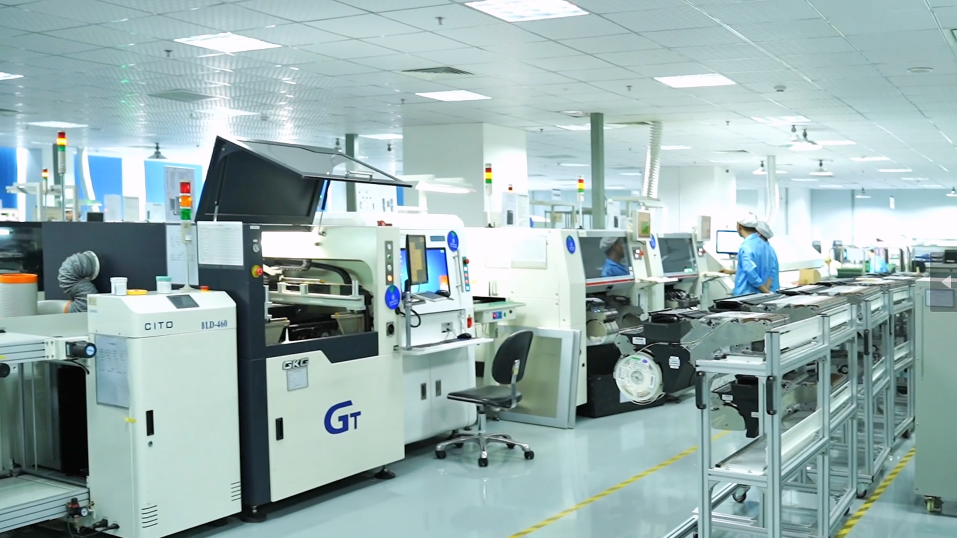
SMT line inside the production facility — the first checkpoint when a project requires non-standard I/O boards.
Custom Video Wall Controllers: An Integrator's Checklist
A video wall controller is the processing layer that takes one or more video sources and maps them, pixel by pixel, onto an array of displays — LCD panels, LED cabinets or projectors. Source selection is usually easy to compare on paper: resolution, channel count, interface type. The question that decides whether a project actually ships is different. Can the supplier build the input/output count, interface mix, mechanical format and control integration that this particular site requires — and prove it before shipment?
This reference looks at customization and integration capability in video wall controllers, using published specifications from Shenzhen Bitvisus Technology Ltd. (Bitvisus), a Shenzhen-based manufacturer of video wall controllers and 4K/8K image-processing hardware, together with third-party market data. It is written for system integrators, project contractors, OEM buyers and technical procurement teams working between evaluation and execution.
Why the standard catalogue often stops short of the site
Video wall projects are rarely delivered exactly as a product page describes them. The constraints usually appear in three places.
Physical format. Control rooms, security monitoring centres and broadcast galleries are rack-based environments. A 2U or 7U chassis may fit the room, or it may not; the difference between a desktop box and a rack-mount video wall controller is often a deal-breaker in an existing cabinet layout.
Signal architecture. Sites mix sources — operator PCs, NVR and VMS platforms, media players, graphics cards, cameras. They also mix output targets — 1080p LCD walls, 4K panels, projectors, LED cabinets. Where the source count and the output count do not match any standard SKU, the integrator either accepts a compromise or asks the manufacturer to build to the drawing.
Control and workflow. A controller that cannot be driven from a third-party central control system, or that cannot switch sources without a visible black frame, forces operators to change how they work. Seamless switching, picture-in-picture, window roaming, integrated KVM and editable output resolution are workflow features, not decorative ones.
There is commercial weight behind this. According to Statifacts market data, control room applications account for roughly 50% of video wall processor market contribution — a segment where rack format, continuous operation and control integration are the primary purchase criteria, not display size.
What customization capability should actually include
Customization is often marketed as a single word. In practice it breaks into three layers, and a serious supplier should be able to describe all three.
Hardware layer. Input/output channel count is adjusted through modular cards rather than a fixed backplane, and interface types are selected at the card level — HDMI, DisplayPort or SDI depending on the source environment. Chassis appearance and dimensions can also be adapted when a project has a fixed mounting space.
Software and firmware layer. Control UI can carry OEM branding; the controller can be developed for integration with a central control system; function modules and firmware features can be modified; output resolution can be customized. On the processing side, the FPGA image-processing algorithm itself is a customization surface, which matters when a site needs a non-standard tiling geometry or a non-standard pixel clock.
System layer. The chassis must accept the right mix of cards, the control card must expose the right protocols, and the whole assembly has to be tested as a system rather than as a collection of boards. The Bitvisus BIT-VWC-MD3636Ma illustrates the modular principle: a 7U chassis that accepts up to 9 input cards (36 HDMI 2.0 inputs) and up to 9 output cards (36 HDMI 2.0 outputs), with a 600 MHz pixel clock and a choice of RS232, web interface, button board, remote control or WEB API as the control path.
Two related functions deserve attention because they are frequently requested and frequently misunderstood. Editable resolution lets a user set a non-standard output resolution so that irregular splicing structures do not show stretched images or black borders. Seamless switching uses frame-buffer synchronization so that source changes produce no black screen, flicker or visible delay — the difference between a wall that operators trust during an incident and one they work around.
Documented platform capability for custom builds
Bitvisus states that it operates a self-owned 2,000 square metre standardized workshop with integrated SMT, assembly and aging test lines, an independent QC lab, a monthly production capacity of 8,000 units and an annual capacity of 100,000 units. Its stated production services cover OEM, ODM customization, R&D design, manufacturing and supply chain management. The company reports a 10+ years audio-video R&D team, 15 years of industry technology accumulation, a self-developed FPGA image-processing algorithm using pure hardware parallel processing with zero latency, and native 8K UHD support across a continuously updated 4K/8K product line.
For evaluation purposes, the practical question is which of those capabilities maps onto a real project requirement. The table below lists representative controllers and the specification points that most often decide a customization conversation.
| Model | Format | Inputs | Outputs | Control |
|---|---|---|---|---|
| BIT-VWC-8K60-404Max | 2U, 220 V, 40 W | 5-channel 8K60 card: 2x HDMI 2.1, 2x DP 2.1, 1x USB Type-C; up to 2400 MHz pixel clock; HDCP 2.2/2.3 | 4x HDMI 2.0 at 3840x2160@60Hz or 3840x2400@60Hz | RS232, LAN web interface, Type-C debug/firmware |
| BIT-VWC-MD3636Ma | 7U modular, AC 100-240 V, 240 W | Up to 9 cards / 36x HDMI 2.0; 600 MHz pixel clock (custom resolutions below 300 MHz) | Up to 9 cards / 36x HDMI 2.0; 600 MHz pixel clock | RS232, web, button board, remote control, WEB API |
| BIT-VWC-8K60Y-115Pro | Desktop, DC 12 V 5 A, 48 W | 1x HDMI 2.1, 1x DP 1.4; 1200 MHz pixel clock; HDCP 2.2 | 15x HDMI 1.4 at 1920x1200@60Hz / 1920x1080@60Hz | RS232, web interface |
| BIT-VWC-218Pro | Desktop, DC 12 V 5 A, 48 W | 2x HDMI 2.0, 2x DP 1.2; 600 MHz pixel clock; HDCP 2.0 | 18x HDMI 1.3, up to 1920x1200@60Hz | RS232, web interface |
| BIT-VWC-409R | Compact, DC 12 V 2 A, 12 W | 3x HDMI 1.4, 1x HDMI 2.0, 1x DP 1.2; HDCP 2.2 | 9x HDMI 1.3 at 1920x1080@60Hz | IR remote, RS232, PC software |
Representative models and specification points as published by the manufacturer. All listed products carry a one-year after-sales service term.
Integration and control: the part integrators verify first
For a video wall controller with remote management, the control surface is as important as the video path. On the Bitvisus platform, RS232 is provided for interfacing with a central control unit, the LAN port supports a web interface for configuration from a browser, and the MD3636Ma adds WEB API for software-driven control. The 8K60-404Max exposes a Type-C debug port used for online firmware upgrades — relevant when a custom firmware feature has to be deployed to units already in the field.
Workflow features that commonly appear in tender documents include seamless switching between sources, picture-in-picture and picture-out-of-picture, cross-screen window roaming, integrated KVM so that one keyboard and mouse set can manage multiple hosts in a server room or control room, 90/180/270-degree rotation for portrait splicing, power-down memory so that the wall returns to its previous layout after a power event, and multi-device cascade when the required output count exceeds a single chassis.
One architectural point deserves an honest note. AV-over-IP adoption reached 73% of new video wall controller installations in early 2026, according to a GCG Enterprise Solution buyer's guide citing AVIXA data. That shift does not remove the need for hardware processing, but it changes how signal transport is planned. On the hardware side, Bitvisus addresses long cable runs with extenders rather than by converting the controller itself into an IP-input device: the BIT-Ex-HDBT-150 extender carries 1080p over CAT6E up to 150 metres and supports two-way RS232 and IR transparent transmission, which lets a controller sit in the rack while displays sit far away. Fiber transmission distance and single-mode/multi-mode specifications for fiber extenders are not publicly disclosed, so those parameters should be confirmed with the supplier during design rather than assumed from the catalogue.
Application fit: control room, security monitoring, conference room
Video wall controller for control room. The typical configuration documented for government command and dispatch centres is a 3x3 or 2x4 LCD video wall driven by a controller plus matrix switcher and central control system, with multi-signal split-screen display, cross-screen linkage and picture roaming, and continuous 7x24 operation. The BIT-VWC-409R, a rotation splicing processor, is listed for this category with a 40 nm chip and a full hardware real-time processing architecture described as ultra-fast without delay, supporting up to nine screens in one splicing group, four simultaneous signals to the wall, and parallel connection of multiple devices.
Video wall controller for security monitoring. Monitoring rooms typically need many inputs and fast switching rather than extreme resolution: multiple camera or VMS feeds, split display, patrol monitoring and alarm linkage, running continuously. Documented reference configurations pair an 8-in 9-out multi-view controller with a 3x3 or 4x4 monitoring wall, video matrix, recording storage and alarm platform. Seamless switching matters here because operators change feeds constantly under time pressure.
Video wall controller for conference room. Meeting rooms tend to need 4K60 image quality, multi-picture split, low-latency transmission and a 2x2 or 1x3 layout, often with an HDMI extender between the table position and the displays. A 4K video wall controller such as the BIT-VWC-218Pro, with two HDMI 2.0 and two DP 1.2 inputs feeding up to eighteen HDMI outputs, fits this class of requirement, while the 8K60 models are the relevant option when an 8K source is already part of the room design.
Two documented project references show how the same platform is adapted in practice. In a Shenzhen immersive painting exhibition, twelve Bitvisus controllers each drove nine industrial 1080p projectors in a 3x3 arrangement, with each 3x3 group achieving 5760x3240 and multiple groups recombined to a final composite image exceeding 16K. In a Romanian building projection mapping project, a single PC output was split through two multi-screen processors and six HDBaseT receivers across roughly 120 metres of transmission to drive six projectors, with a total resolution of 11520x1200.
Market signals worth weighing before a build decision
Third-party figures help frame how long a custom configuration is likely to remain current. Dataintelo estimates the global video wall controllers market at approximately USD 2.25 billion in 2025, projected to reach USD 4.4 billion by 2034, a CAGR of 7.8% over the 2025-2034 period. The same research notes that legacy 4U hardware video wall processors lost 18% of market share in 2025 as users shifted toward AV-over-IP and software orchestration.
Those two figures together describe a bifurcated market: overall demand keeps growing, while the share held by fixed, large-chassis, hardware-only processors is under pressure. The practical implication for a custom build is to insist on a control interface that a software layer can call — web API, RS232 or an equivalent protocol — rather than relying only on a local front-panel workflow.
Two caveats are worth stating plainly. First, published market size estimates for this category vary widely — from roughly USD 0.55 billion to USD 2.25 billion — depending on whether "controller" is defined strictly as processor hardware or as the total display-management solution including software and integration services. Second, for cross-border procurement, video wall controllers are commonly classified under HS code 85437099 or 85437042, which affects duty and documentation rather than product capability. Buyers specifying control-room layouts may also want to reference ISO 11064, the primary international standard governing control-room ergonomics, since it influences operator sightlines and wall geometry.
Standard versus custom: where the trade-offs sit
Customization has a cost, and buyers should price it explicitly rather than treat it as a free option. The comparison below uses the manufacturer's published commercial terms.
| Dimension | Standard model | OEM private label | Custom development |
|---|---|---|---|
| Minimum order quantity | 1 unit | 10 units | 100 units |
| Lead time | Stock items 3-7 days | Project-dependent | 2-3 months |
| Interface / function changes | Fixed configuration | Branding and limited port adjustment | FPGA, card, firmware and chassis level |
| Commercial profile | Shortest lead time, lower unit cost | Balanced | Longer development cycle, higher MOQ |
The real limitation is not price alone; it is timing and engineering attention. A custom order quoted at 2-3 months of lead time will not rescue a project that is already inside its commissioning window, and custom development starting at 100 units is not a route for a single-site retrofit. For those cases the standard range — with MOQ of one unit and stock delivery of 3-7 days, or an OEM private-label order at 10 units — usually delivers the same result with a smaller commercial footprint.
Three technical boundaries are also worth recording before a specification is frozen. First, an 8K source does not mean 8K at every panel: the BIT-VWC-8K60Y-115Pro accepts 8K60 input but distributes it across fifteen HDMI 1.4 outputs at 1920x1200@60Hz or 1920x1080@60Hz, and the 8K60-404Max outputs at up to 3840x2160@60Hz per port. Second, on the 8K60-404Max input card, the lower-cost DP 1.4 board path uses DSC to carry 8K at 60 fps, which is a design decision with consequences for the source equipment. Third, mechanical planning is real: the 8K60-404Max occupies 2U at 5.1 kg, while the MD3636Ma occupies 7U at 13.5 kg and 240 W at full 9-in/9-out loading — figures that belong in the rack and power budget, not in a footnote.
Certification scope is the fourth boundary, and it is the one most often missed. The published declarations cover a defined product scope: RoHS declaration CTC118K0401302RC, FCC supplier's declaration CTC118K0401302FC and CE-EMC declaration CTC118K0401302EC, all issued on 2026-05-11 and covering the modular multi-screen splicing matrix processor (220 V input, for MSE/VWC/MV series), with lead model BIT-VWC-MD1212Ma. A parallel set of declarations covers the 12 V-input multi-screen splicing processor, with lead model BIT-MSE-8K60D-104Pro. Where a project changes interfaces, power input or chassis beyond the declared scope, the buyer should confirm with the supplier which declaration applies to the delivered configuration.
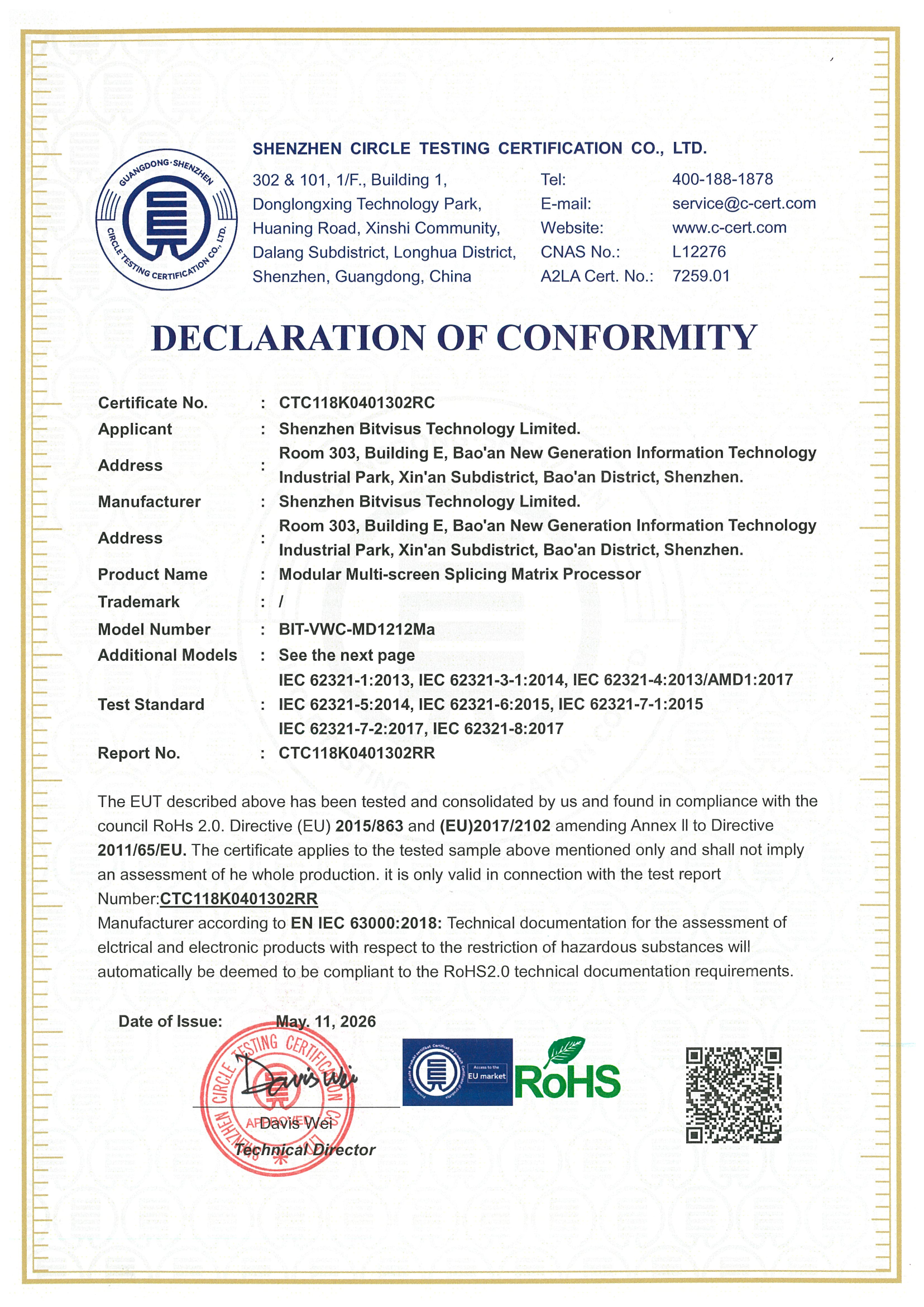
RoHS declaration CTC118K0401302RC, issued 2026-05-11 by Shenzhen Circle Testing Certification Co., Ltd., listing the declared scope and lead model.
A verification checklist before release to production
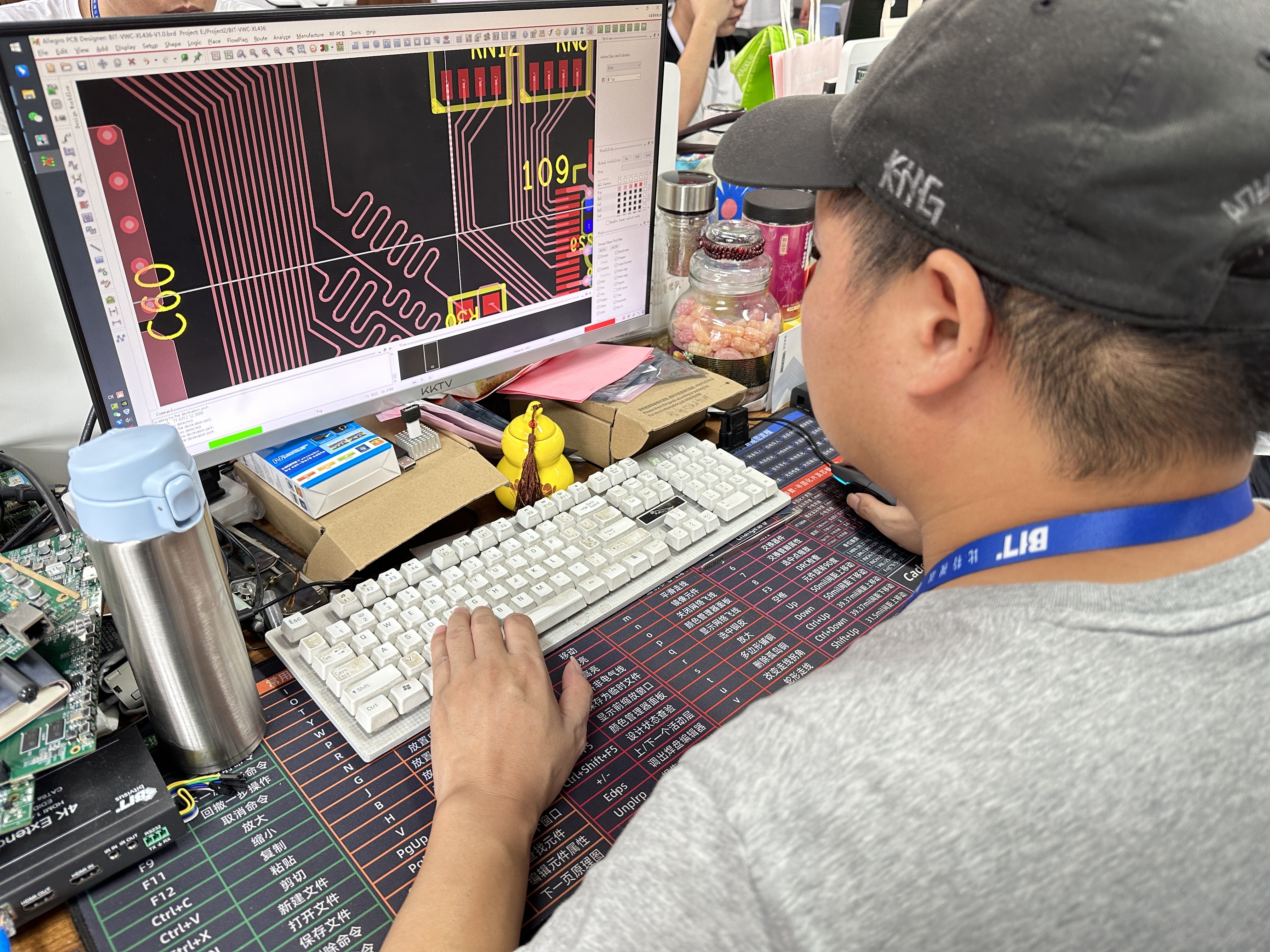
Testing lab bench where finished controllers run through functional and aging checks before shipment.
Because a custom unit is only as good as the test it passes, the manufacturing and quality process should be part of the evaluation, not a post-purchase discovery. Bitvisus documents a three-level QC system: 100% inspection of core components on incoming material, single-board function tests at semi-finished stage, and a 7x24-hour full-channel power aging test on finished goods. Acceptance is described as pre-shipment test, and delivery can be arranged under FOB, CIF, EXW, DAP, DDP, DPU, FCA or CIP terms.
A practical pre-order checklist that follows from this documentation:
- Confirm the exact input count, output count and interface mix against the modular card list, not against a headline specification.
- Confirm which control protocols the site's central control system uses — RS232, web interface, WEB API, or a combination.
- Confirm the maximum output resolution and pixel clock required per port, including any non-standard resolution.
- Confirm rack space, weight and power draw for the chassis in its final loaded configuration.
- Confirm which conformity declaration covers the delivered configuration.
- Confirm the after-sales terms in writing: one-year warranty, 7x24 technical support, multilingual documentation, remote debugging, spare parts replacement and localized technical training.
Future outlook
Two forces are likely to shape the next planning cycle. On the video path, 8K sources and larger tiling geometries will keep pushing controllers toward higher pixel clocks and modular card counts rather than toward fixed-channel boxes. On the control path, remote management, web APIs and software orchestration will continue to absorb functions that used to sit on a front panel — which is why the coexistence of RS232, a web interface and a documented API on current hardware matters more than any single switching feature.
For manufacturers, the differentiator is less about claiming a capability than about showing the test bench, the declaration scope and the lead-time terms behind it. Bitvisus states that its 4K and 8K product lines are continuously upgraded and that its FPGA image-processing algorithm runs as pure hardware parallel processing with zero latency; how those claims translate into a specific project still depends on configuration, testing and documentation — all of which are verifiable before an order is placed.
FAQ
What video input and output interfaces are supported?
Mainstream Bitvisus models use HDMI and DisplayPort inputs with HDMI outputs, and support HDCP. The BIT-VWC-8K60-404Max accepts 2x HDMI 2.1, 2x DP 2.1 and 1x USB Type-C on a five-channel 8K60 input card with HDCP 2.2/2.3, and outputs 4x HDMI 2.0. The BIT-VWC-MD3636Ma is a modular chassis accepting HDMI 2.0 cards on both input and output sides. Interface choice at card level — HDMI, DP or SDI — is part of the documented customization scope, so the correct answer for a given project depends on the configured card set.
Do the controllers support modular expansion and long-distance transmission?
Modular expansion is supported through card-based chassis: the BIT-VWC-MD3636Ma accepts up to 9 input cards and 9 output cards, up to 36 HDMI 2.0 channels in each direction, and multiple devices can be cascaded or run in parallel where a single chassis does not provide enough outputs. For long-distance runs, the manufacturer's product line includes HDBaseT and fiber extenders — the BIT-Ex-HDBT-150 carries 1080p over CAT6E up to 150 metres with two-way RS232 and IR transparent transmission. Fiber transmission distance and single-mode/multi-mode specifications are not publicly disclosed, and should be confirmed with the supplier for the specific distance in a project.
What processing architecture is used, and can the hardware run 7x24?
Bitvisus controllers are based on self-developed FPGA image processors and HD processing chips, with the stated R&D background of more than 10 years in FPGA image processing. The BIT-VWC-409R is documented as using a 40 nm chip with a full hardware real-time processing architecture; the platform also offers industrial-grade modular chassis designed for continuous long-hour operation in control rooms and engineering displays. Whether a given model is appropriate for 7x24 operation depends on the chassis and thermal design selected, so operating-hour requirements should be stated during configuration rather than assumed.
What does OEM/ODM customization include, and what are the order thresholds?
Documented customization covers three layers: hardware (input/output channel count through modular cards, interface type selection including HDMI/DP/SDI, chassis appearance and size), software and firmware (control UI OEM branding, central control system integration development, function module and firmware feature customization, resolution customization, FPGA image-processing algorithm work), and system-level configuration. Published minimum order quantities are 1 unit for standard models, 10 units for OEM private label, and 100 units for custom development, with standard stock items shipping in 3-7 days and custom orders quoted at 2-3 months.
Which certifications cover these controllers, and what warranty applies?
Published declarations include a RoHS declaration of conformity (CTC118K0401302RC, EU), an FCC supplier's declaration of conformity (CTC118K0401302FC, US) and a CE-EMC declaration of conformity (CTC118K0401302EC, EU), issued on 2026-05-11 by Shenzhen Circle Testing Certification Co., Ltd. Their stated scope is the modular multi-screen splicing matrix processor (220 V input, for MSE/VWC/MV series), with lead model BIT-VWC-MD1212Ma; a parallel set covers the 12 V-input multi-screen splicing processor with lead model BIT-MSE-8K60D-104Pro. The listed products carry a one-year after-sales service term, and the stated after-sales package includes 7x24 technical support, multilingual technical documentation, free remote debugging, fast spare parts replacement and localized technical training. Buyers changing interfaces, power input or chassis should confirm which declaration applies to the delivered configuration.
What are the main application scenarios for these controllers?
Documented application categories include government command and dispatch centres, exhibition and immersive projection venues, enterprise and government conference rooms, commercial media and advertising screens, smart education, security monitoring centres, broadcast and studio environments, and industrial monitoring or smart-manufacturing dashboards. Typical configurations range from a 2x2 or 1x3 meeting-room display driven by a single 4K60 controller to a 3x3 or 4x4 monitoring wall, or a multi-controller projection installation where each unit drives a group of projectors.
A downloadable product brochure covering the current Bitvisus video wall controller and image-processing range is available here.