
DC Motor Fit by Application: Matching Pancake, Hub and BLDC Drives to Project Conditions
Selecting a DC motor for a specific product programme is rarely just a matter of rated power. For mobility aids, medical equipment, scrubber dryers and light electric vehicles, the real question is whether the drive architecture—hub motor, pancake motor or BLDC—fits the duty cycle, load range, environmental conditions and certification requirements of the project. This article looks at how project-level fit is evaluated, and what evidence matters when suppliers are asked to adapt motor platforms to real application conditions.
Why Project Fit Matters More Than Rated Power
A motor with the correct wattage can still fail in the field if it is matched only on paper. In applications such as electric wheelchairs, hospital transport beds, shopping carts and floor scrubbers, the decisive factors are often the frequency of start-stop cycles, the duty pattern (24/7 operation), humidity exposure, and the need for reliable braking at low speed. A 36V motor rated at 300W may be technically adequate for a wheelchair drive, but if the system does not include an electromagnetic brake for parking safety, or if the shaft configuration does not match the wheel assembly, the project will face integration delays and potential field failures.
The opportunity for equipment manufacturers is clear: a motor platform that supports systematic customisation—voltage, power, speed, torque, shaft geometry, braking type and even logo marking—can reduce the engineering effort required to bring a new mobility or medical device to market.
Common Disconnects Between Motor Specifications and End-Use Conditions
- Underestimating duty cycle: Many specifiers choose power ratings for continuous duty, but applications like electric scooters and shopping carts operate in frequent start-stop, high-load, and humid conditions, often running 24/7. The motor must be designed for intermittent overload and repeated acceleration.
- Overlooking brake requirements: For wheel drives carrying people or patients, electromagnetic brakes (EMB) are not optional. They must hold the wheel on inclines and stop the vehicle in a controlled safety distance.
- Ignoring environmental exposure: Condensation, humidity and indoor/outdoor transitions require proper sealing, grounding and electromagnetic compatibility (EMI) protection. Some hub motor models are available with IP54 protection; others rely on the system design to manage moisture exposure.
- Forgetting interface constraints: Axle length, double/single shaft output, wheel diameter and controller compatibility are frequently the real bottlenecks in project adaptation.
Brand Solution: Wuxi Speedup Power Co.,Ltd
Wuxi Speedup Power Co.,Ltd is a professional DC motor manufacturer based in Wuxi, Jiangsu, China, focused on printed armature/pancake motors, BLDC motors and hub motors for industrial and civil equipment. The company operates a 10,000 m² facility with a monthly production capacity of 30,000 units and exports approximately 90% of its output, mainly to the European Union and the United States. It has accumulated more than 16 years of industry experience and holds RoHS, UL, EMC, and ISO9000-2008 certifications.
For project-based buyers, three capabilities are particularly relevant:
- Custom OEM/ODM: Voltage, power, speed, torque, shaft design and logo can be adapted. MOQ is 1 unit, which means prototyping and pilot runs are practical.
- Production and quality control: Lead time is 30–45 working days, and every unit is 100% tested before shipment.
- After-sales support: Official warranty, remote fault diagnosis, installation guidance, spare parts supply, repair/replacement, and lifetime online technical support.
Technical Explanation: Three Motor Architectures for Different Fit Profiles
Wheel hub motors
Hub motors integrate the motor into the wheel itself, eliminating the need for external transmission components. Wuxi Speedup manufactures both brushed and brushless hub motors in diameters from 170mm (6.5 inches) to 305mm (12 inches). These motors use outer rotor construction and rare earth NdFeB permanent magnets, which contribute to high efficiency and long service life.
Reduction ratios range from 1:4.5 to 1:40, allowing the motor to deliver low output speed and high torque. For example:
- The 6.5-inch brushless hub motor (SA05-6) operates at 24V, 200W, 150RPM, and 15Nm, with a 1:4.5 gear ratio and EABS electronic braking.
- The 8-inch brushless hub motor (1DY-E5S) operates at 36V, 300W, 150RPM, and 20Nm, with a 1:20 ratio and electromagnetic brake.
- The 12-inch wheelchair hub motor (6DY-A4) is a brushed DC motor at 24V, 200W, 70RPM, with a 1:40 ratio, built-in electromagnetic clutch and support for manual clutch.
- The magnesium alloy integrated wheel motor (6DY-A1) delivers 28Nm at 65RPM and includes a folding brake clutch lever for improved climbing capability.
Nearly all hub motors in this catalogue support a load range of 80–300kg, which covers electric wheelchairs, scooters, shopping carts, hospital beds and light AGV/robot platforms.
Pancake (printed armature) motors
Pancake motors use a flat printed winding/armature disc, which gives the motor a very compact axial length. Disc diameters range from 120mm to 152mm, with thicknesses from 17mm to 37mm. These motors offer high power-to-volume ratio and high linearity, and are typically used where space is constrained but smooth, controllable output is needed. Examples include the 150SN-A (36V, 300W, 3500RPM) for floor washing machines and the 150SN-B (24V, 350W, 3000RPM) for burnishers.
Pancake BLDC motors
The direct-drive BLDC pancake series, such as model DD03, runs at 24V, 100W, and 250RPM in an external rotor format. This configuration provides large torque at low speed without a gearbox, which is a useful fit for brush drive systems that require steady low-speed rotation and quiet operation.
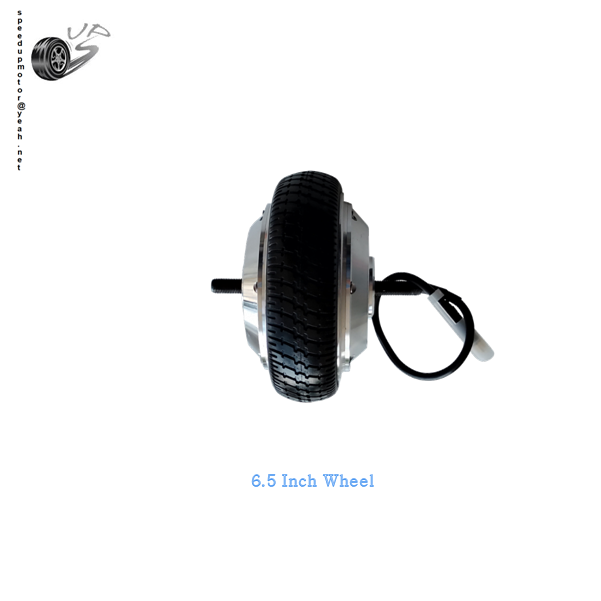
Figure 1: 6.5-inch solid tyre geared brushless hub motor (model SA05-6), one of the compact hub motors used for wheelchair assistance and medical mobility devices.
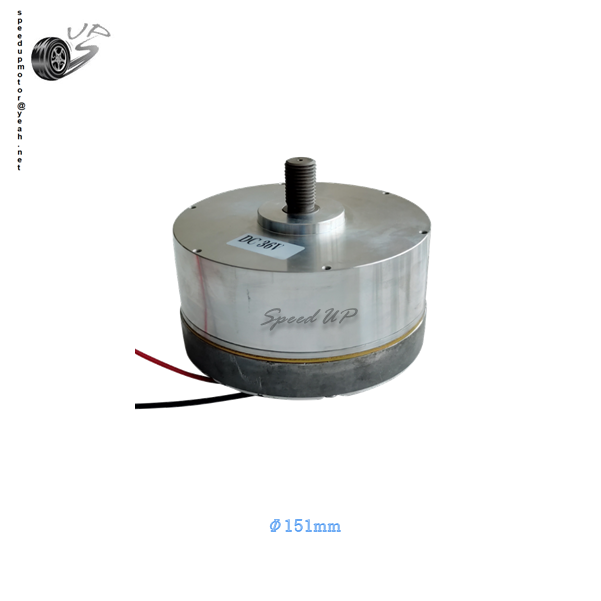
Figure 2: Geared pancake motor (model 150SN-G2, 36V, 500W, 240RPM) with integrated gearbox, suited for compact drive stations.
How to Map Motor Choice to Project Conditions
A practical approach is to evaluate the following five parameters before selecting a motor supplier:
| Parameter | Project Question | Relevant Wuxi Speedup Options |
|---|---|---|
| Load range | What is the gross vehicle/instrument weight? | Hub motors rated for 80–300kg; pancake motors for fixed brush drives |
| Speed vs torque | Is the application low-speed high-torque or high-speed low-torque? | Reduction ratios 1:4.5 to 1:40 for hub motors; direct-drive BLDC for low-speed torque |
| Braking | Does the equipment require parking/holding brake? | EMB electromagnetic brake, EABS electronic brake, manual clutch options |
| Environment | Will the motor face humidity, condensation or outdoor exposure? | IP54 rated models; EMI grounding and condensation protection in system design |
| Integration interface | Custom shaft, axle length, wheel size, controller protocol | Custom shaft/dual-shaft output, custom plates, operating voltages/frequencies |
Application / Use Cases from Project Experience
Electric scooters and shopping carts (US, ES, DE)
Operating conditions include indoor/outdoor low-to-medium speed, frequent start-stop high-load scenarios, and humid environments. The wheel drive runs 24/7 and requires matched gearboxes, electromagnetic brakes, motor controllers and wheel assemblies. Special requirements include condensation protection, EMI grounding, brake debugging and safety distance control, and custom shafts with dual-shaft output options.
One electric cart factory in Europe ordered 30,000 units for shopping cart wheel drive and reported stable operation over a 10-year relationship. An electric scooter factory ordered 2,000 units for wheel drive, highlighting the importance of low-speed high torque and electromagnetic braking for safe operation.
Medical equipment and hospital beds (DE, CZ, NL, US, GB)
Hospital transport bed drive wheels operate under the same indoor/outdoor, frequent start-stop and humid conditions, also on a 24/7 basis. The matching bill of materials includes high-strength reduction gearboxes, EMB brakes, controllers and wheel assemblies.
A medical bed factory in the Czech Republic ordered 3,000 units for bed wheel drive, with more than 10 years of stable operation. A medical equipment manufacturer in Germany, the UK and the US ordered 4,000 units for assist-driving devices, emphasising low-speed high torque in a small wheel format.
Electric wheelchairs (NL, DE, AU, DK, US)
Wheelchair drive wheels benefit from built-in electromagnetic brakes with manual clutch support, plus reliable low-speed commutation performance.
A wheelchair factory supplied 3,000 units over 10 years, citing stable operation and the convenience of integrated brake and clutch functionality.
Floor scrubber dryers (DE, CH, NL, GB, IT)
For floor cleaning machine brush drives, compact pancake motors provide low noise, small size and high output torque. A floor cleaning and drying machine manufacturer ordered 15,000 units over 10 years for scrubber brush drive, with stable operation and consistently high output.
Market Trend Analysis: Where Motor Demand Is Headed
Multiple publicly verified data points support the growth of the DC motor categories discussed here:
- The global brushless DC (BLDC) motor market was estimated at USD 20,990.5 million in 2024 (Grand View Research).
- China accounted for approximately 39.8% of the global BLDC motor market revenue in 2024 (Grand View Research).
- The global electric wheelchair market was estimated at USD 4.49 billion in 2024 and is projected to reach USD 9.05 billion by 2030 (Grand View Research).
- The global motors for medical devices market was valued at USD 4.25 billion in 2024 (MarketsandMarkets).
- The global automotive wheel hub motor market is estimated to reach USD 8.8 billion by 2035, with a CAGR of 5.2% (Market Research Future).
These figures point in the same direction: electrification is penetrating smaller, lighter and more medically oriented vehicles where wheel-integrated drives are a natural fit. In particular, the projected expansion of the electric wheelchair market implies sustained demand for low-speed, high-torque hub motors with brake systems. Similarly, the medical device motor market growth supports investment in compact, certifiable drive components.
At the same time, the Chinese BLDC motor supply base is well-positioned to serve this demand, given the country's significant share of global BLDC production. For European and North American buyers, working with a Chinese manufacturer that understands EU/USA certification and export requirements is an important practical consideration.
Wheel Hub Motors vs Traditional Central Drive Configurations
Traditional electric drive systems typically place the motor at the centre of the vehicle and transfer torque to the wheel through a chain, belt or drive shaft. An integrated wheel hub motor removes the transmission path entirely, which simplifies assembly and reduces moving parts.
Advantages of the integrated hub motor approach
- Space efficiency: The motor shares the wheel volume, leaving more room for batteries, controllers and payload.
- Simplified assembly: A powered wheel is effectively a module: bolt it on, connect the power cable, and the drive is ready.
- Independent wheel control: With one motor per wheel, traction control and differential steering become simpler in software.
- Lower transmission loss: No chain or belt losses, resulting in cleaner power transfer.
Limitations and boundaries
An honest assessment must include the constraints of hub motor architecture. First, an integrated motor adds unsprung mass, which can affect ride comfort on rough terrain. Second, the motor is structurally coupled to the wheel, so tyre wear or wheel damage may require servicing the entire wheel-motor assembly. Third, the practical load window for the hub motors discussed here is 80–300kg; they are not intended for heavy-duty industrial vehicles. For high-speed or heavy-load applications, a central drive with conventional suspension and transmission remains a more appropriate architecture. These boundaries are not flaws; they define the fit envelope for the product family.
Future Outlook: Project-Level Adaptation as the New Competitive Baseline
As mobility devices, medical aids and service robots proliferate, off-the-shelf motors with generic specifications will become less common. Buyers are increasingly asking suppliers to adapt a proven motor platform to a specific operating profile: a custom shaft for a hospital bed, an IP54-rated hub motor for a humid scooter environment, an EMB brake for a wheelchair that must hold position on a slope.
Wuxi Speedup Power has positioned its production and engineering process around this type of project fit. With a 10,000 m² factory, a 30,000-unit monthly capacity, a 30–45 working day lead time, and optional OEM/ODM from a single unit, the company is configured to support pilot development as well as series production. The combination of printed pancake motors for compact brush drives and hub motors for wheel drives gives project teams a practical choice set rather than a single architecture.
For the wider industry, the direction is clear: motor suppliers that can document real application experience—over years and thousands of units—will be better positioned than those that only publish theoretical performance curves.
FAQ
1. How do I choose a motor for a small electric wheelchair that needs low speed and high torque?
For a compact wheelchair drive, a small-diameter hub motor is usually the most practical choice. Wuxi Speedup offers a 6.5-inch brushless hub motor (model SA05-6) rated at 24V, 200W, 150RPM and 15Nm, with a 170mm solid tyre and 1:4.5 gear ratio, using EABS electronic braking. For a larger wheelchair or one requiring an electromagnetic parking brake, the 12-inch brushed hub motor (6DY-A4) at 24V, 200W, 70RPM with a 1:40 ratio and built-in electromagnetic clutch is a commonly specified option. The company's 10-year supply relationship with wheelchair factories, with quantities of 3,000 units, supports the reliability of this configuration.
2. What brake options are available for hub motors used in mobility devices?
Two main brake types are available. Electromagnetic brakes (EMB) are used on models such as the 1DY-E5S, 1DY-E5A, 6DY-A4 and 6DY-A1; they provide holding torque and are suitable for parking on slopes and for safety stops. Electronic brakes (EABS) are used on brushless models such as the SA05-6 and SA06. Some models also support a manual clutch, allowing the wheelchair to be pushed manually when the motor is not powered.
3. What customisation options are available for project-specific motor requirements?
Wuxi Speedup supports OEM and ODM production. Customisation options include operating voltage (e.g. 24V/36V/48V), power, speed, torque, shaft/axle size and profile, single or double shaft output, performance curves, special OEM configurations, and logo marking. The minimum order quantity is 1 unit, making both prototyping and volume production practical. Production lead time is 30–45 working days.
4. Are the motors certified for medical and EU applications?
Many of the hub and pancake motor models are listed with CE, EMC and RoHS certification/approval. Wuxi Speedup Power also holds UL and ISO9000-2008 certifications as a company. Buyers should confirm the specific certificate needed for their target market with the supplier during the RFQ stage.
5. What load range can these wheel hub motors support?
The wheel hub motors in this family are designed for a load range of 80–300kg. This covers electric wheelchairs, mobility scooters, electric shopping carts, hospital transport beds and similar light-to-medium mobility equipment. Applications exceeding 300kg would typically need a different motor platform.
6. Can these hub motors handle frequent start-stop and humid conditions?
Yes. The electric scooter/shopping cart application scenario involves indoor/outdoor use at low-to-medium speed, frequent start-stop high-load operation, and humid environments, running 24/7. Wuxi Speedup has supplied electric cart factories with 30,000 units and electric scooter factories with 2,000 units for such duty, with 10-year stable operation reported. Condensation protection and EMI grounding should be addressed at the system design level.
7. What is the difference between choosing a brushed hub motor and a brushless hub motor?
Brushless hub motors (e.g. SA05-6, SA06, 1DY-E5S) use an outer-rotor design with rare earth NdFeB magnets, offering high efficiency, quiet and smooth operation, and long service life. They typically use EABS electronic braking and are well-suited to AGV/robot platforms, scooter drives and wheelchair assistance. Brushed hub motors (e.g. 1DY-E5A, 6DY-A4, 6DY-A1) use printed armature technology, provide high starting torque, and often integrate an electromagnetic brake with manual clutch — which is preferred for wheelchair and medical bed applications where parking safety and manual push capability are important.
8. What after-sales support is provided for OEM projects?
After-sales support includes an official quality warranty, remote fault diagnosis and technical guidance, free installation and commissioning instructions, original spare parts supply, professional repair and replacement service, and lifetime online technical support. This applies globally, including EU and USA export projects.