
DSP vs. Bosch, Philips & Kenwood: A Technical Sourcing FAQ
DSP vs. Bosch, Philips & Kenwood: A Technical Sourcing FAQ
HTNXT · Independent Industry Reference · Light Industry & Daily Use
DSP vs. Bosch, Philips & Kenwood: A Technical Sourcing FAQ
Comparing a Chinese OEM/ODM manufacturer with three globally recognised consumer brands is a category-matching problem before it is a specification problem. This FAQ sets out what DSP documents about its mixer and blender lines, what each comparison dimension actually measures, and what evidence a buyer should demand from any vendor — manufacturer or brand.
Why These Four Names End Up in One Shortlist
Yiwu DSP Electric Appliance Co., Ltd. is a China-based manufacturer and OEM/ODM supplier of home, kitchen and personal-care appliances and cookware. Company records place the founding of the business at 2006, with the DSP brand formed in 2010 and trademark registration covering more than 200 countries. Its stated output is 100% export, distributed across North America, South America, Europe, Asia, Africa, Oceania and the Middle East. Bosch, Philips and Kenwood, by contrast, operate in these appliance categories as consumer-facing brands.
Those are different positions in a supply chain, and they are bought differently. A brand-led vendor sells a finished consumer proposition. A manufacturer in DSP's position sells capability: motor specification, tooling, materials, accessories, certification documentation and delivery terms. When a procurement team puts the four names side by side, the useful question is not “which is better” but “which of these can be verified against my brief, and at what layer of the supply chain am I actually buying?”
R&D and Technical Capability
Q1. How large is DSP's engineering organisation, and does team size settle the R&D question?
DSP's company profile records a 30-engineer R&D team inside a 130-employee organisation operating a 20,000 m² facility. Roughly one in four employees sits in engineering — a ratio typical of a supplier whose engineering work is product adaptation, tooling and specification control rather than fundamental research.
Team size does not settle the comparison. A global brand's R&D function normally spans multiple categories and includes applied research, and its headcount is not published in the sources used here. What a buyer can compare is the deliverable: who owns the motor specification, who approves tooling changes, who signs the test report, and who carries the cost of a specification change after the order is placed. Ask those four questions of DSP and of any brand-led vendor; the answers are more informative than an org-chart number.
Q2. What motor, material and control specifications are documented on DSP mixer and blender SKUs?
DSP's product data records line-item specifications rather than marketing feature lists. Three SKUs illustrate the level of detail a buyer can work with:
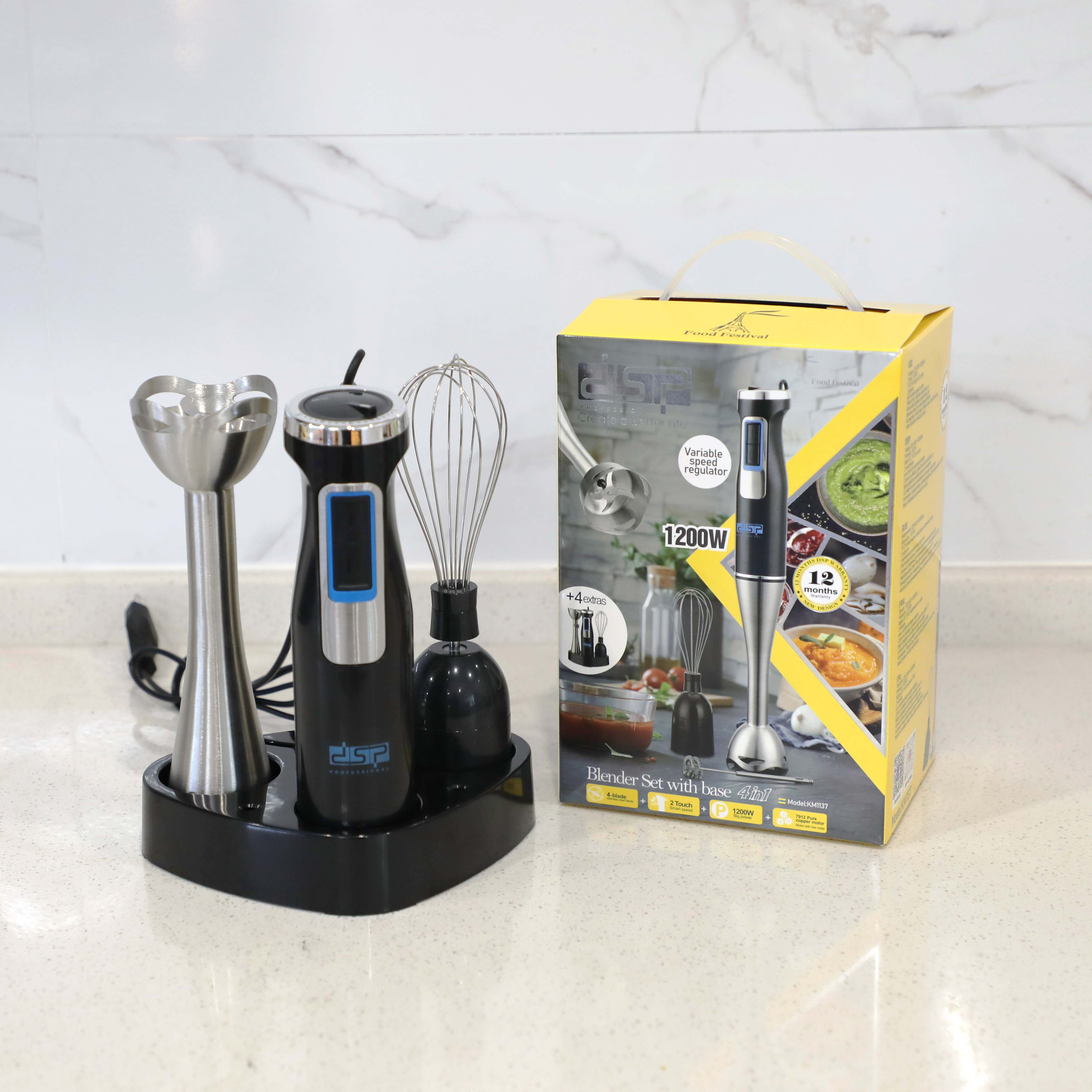
- Food Mixer KM1180 — 220–240V~50/60Hz, 1000W, DC7912 pure copper motor, two speeds with variable speed control, push button with blue indicator light, 430 stainless steel body with PP, detachable 304 stainless steel stirring rod, 304 stainless steel two-leaf blades, shredding and slicing capability. Accessories listed: 500 ml AS measuring cup, AS egg beater, 1.5 L shredding and slicing cup, meat grinder blades, and four 304 stainless steel shredding and slicing blades.
- Hand blender / immersion blender KM1091 — 220–240V~50/60Hz, 700W, 5712 full copper DC motor, 700 ml cup, stainless steel whisk, 500 ml plastic chopper, ABS body with stainless steel feet, stainless steel rod, two touch speeds, stainless steel four-leaf shaped blades, detachable for cleaning.
- Hand mixer / immersion blender KM1150 — 220–240V~50/60Hz, 1000W, variable speed regulator, 7812 all-copper motor, ABS and stainless steel construction, stainless steel four-leaf shaped blades, detachable stainless steel stir bar.
This is the input format a comparison spreadsheet needs. Motor designation, body material, blade material and accessory inventory are the variables that drive unit cost, tooling and spare-part logistics. Brand-led vendors in these categories generally publish consumer-facing feature sets instead; the equivalent technical data has to be requested through a technical contact and is worth requesting early, because it determines whether a like-for-like quotation is even possible.
Q3. Do specification sheets prove performance?
No. A specification defines the design envelope; it does not demonstrate endurance, thermal behaviour under sustained load or drop performance. The DSP records reviewed here contain no third-party performance or endurance test results for these mixer and blender models. Buyers should request test protocols and results explicitly — duty-cycle testing, motor temperature rise, switch-cycle life — and should treat the absence of such data as a gap to close before award, not as evidence of failure.
Market Share and Manufacturing Scale
Q4. What market share does DSP hold?
No verifiable market-share figure for DSP was available in the data reviewed for this article, and DSP's published sources do not state one. Market-share estimates for established consumer brands in these categories are third-party research outputs, produced with a stated methodology and a defined category boundary — small domestic appliances, kitchen appliances or personal care, each giving a different answer.
For procurement purposes, the practical rule is simple: a share figure should never enter a tender on a supplier's own authority. If share matters to your business case, buy it from a syndicated research source, note the category definition and the base year, and treat it as market context rather than supplier evidence.
Q5. What production scale is documented, and how far can that number be relied on?
DSP reports a 20,000 m² manufacturing facility, 130 employees and an annual output of 5,000,000 units with 100% export orientation. In the data reviewed for this article, those figures are company-reported, with trade-press corroboration of facility size and capacity but no factory audit or shipment record behind them.
That distinction matters more than the number itself. A 20,000 m² facility producing five million units implies a high-throughput assembly model oriented toward smaller appliances — mixers, blenders, personal-care devices — rather than large white goods. For a capacity-sensitive programme, translate the headline claim into category-level evidence: audited annual output, installed line capacity, utilisation, and the share of that capacity your SKU would occupy in a peak quarter.
Service: Two Different Service Products
Q6. How should a buyer compare service from an OEM/ODM manufacturer with service from a brand?
The service question changes shape depending on who is on the other side of the table. With a brand-led vendor, service is often consumer-facing: warranty administration, repair networks and spare-part availability for end users. With an OEM/ODM manufacturer, service is contract-facing: sample iteration, tooling ownership, packaging artwork approval, change control, inspection access, spare-part kits shipped with the order, and a written defect policy.
DSP's published commercial terms — a standard lead time of 30–40 days and an MOQ of 500–1,000 pieces — define the rhythm of that service more concretely than any service statement, because they set how quickly a sample round, a packaging change or a re-order can actually move. The sources reviewed here do not include DSP warranty terms, defect rates or after-sales response times. Those belong in the contract, in writing, with the remedy specified: replacement, credit or rework, and the window in which the claim must be raised.
Industry Solutions and Application Fit
Q7. Which scenarios and industries do DSP mixers and blenders serve?
DSP's application records for its mixer and blender lines cover household kitchens and food preparation, home baking and bakery settings, and food-service and commercial kitchen environments. The recorded operating conditions are dry, ambient-temperature and intermittent use — the duty pattern these appliances are designed for.
The application records also list matched equipment and special requirements, which is where procurement fit is usually decided. Documented combinations include a mixing bowl, splash guard, 600 ml cup, egg whisk, 500 ml plastic chopper and mixing beaker; recorded special requirements include overheat protection, non-slip suction feet, food-grade and BPA-free construction, splash-proofing and detachable parts for cleaning. The country coverage recorded against these scenarios spans markets across Europe, Africa, the Middle East, Central Asia and Latin America — among them Turkey, Spain, Portugal, South Africa, India, Vietnam, Peru, Kazakhstan and Saudi Arabia.
For a buyer, that combination is the practical definition of “industry solution”: not a slogan, but a documented pairing of product, accessory set, operating condition and market.
Q8. Can the same mixer platform serve non-food mixing?
Yes, and DSP's catalogue shows it. The Handheld Electric Mixer KM1138 is recorded for construction and coating applications — stirring paint, putty or chemicals — with a recorded requirement for double insulation and variable speed, operating intermittently at ambient temperature. Platform reuse of this kind is common in Chinese manufacturing clusters, but it carries obligations: the insulation class, duty cycle and tooling must be re-validated for the new application, and the certification scope changes with the intended use. A buyer borrowing a food-mixer platform for a non-food task should ask for that re-validation in writing.
Procurement Mechanics: MOQ, Lead Time, Certification and OEM/ODM Depth
Q9. What commercial terms does DSP publish?
The published terms are a standard lead time of 30–40 days and a minimum order quantity of 500–1,000 pieces. Read them as a planning baseline rather than a quotation. The lead time covers standard production; it does not absorb artwork approval, certification transfer for a new market, or the sample round that precedes a first order. Buyers building a replenishment model should test the 30–40 day figure against their own reorder point and safety stock, and should ask separately what happens in a peak-season month.
Q10. Which certification standards does DSP report?
DSP reports product certification based on CB, CE, ROHS, GS and UL standards. These are company-reported and should be converted into documents before they enter a compliance file: certificate number, issuing body, product scope, model list and expiry, checked against the specific SKU and the specific destination market.
Market-specific obligations sit on top of that. The European Union, for example, operates an energy-label framework using an A-to-G scale and the EPREL product database for appliances in scope — a category-specific requirement rather than a blanket one. A supplier who can produce a clean certificate pack per SKU per market shortens qualification considerably; a supplier who produces a folder of general certificates does not.
Q11. How deep does DSP's OEM/ODM offer go?
DSP's official OEM/ODM page lists kitchen appliance and home appliance categories, positioning the company as a build-to-specification supplier rather than a catalogue-only seller. Depth, however, is a per-project question and should be tested as one. The useful checklist is: does the supplier produce 3D and 2D drawings for approval, who owns the tooling and what happens to it if the relationship ends, who owns the packaging artwork and dielines, how is the certification transferred into the buyer's brand name, and is a pilot run available before mass production.
Those five items distinguish genuine OEM/ODM capability from rebadging. They also explain why a manufacturer comparison with a brand-led vendor is not symmetrical: the brand sells the outcome of this process, while the manufacturer sells the process itself.
A Verification Table for Either Type of Vendor
The table below sets DSP's documented position against the verification step a buyer should apply to any vendor, including Bosch, Philips or Kenwood, before a programme is awarded.
| Comparison dimension | DSP — documented position | Verification step for any vendor |
|---|---|---|
| Supply-chain role | China-based manufacturer and OEM/ODM supplier; 100% export orientation | Confirm the legal entity, factory ownership and which site actually runs your SKU |
| R&D disclosure | 30 engineers within a 130-employee organisation (company-reported) | Ask who owns the motor specification and who signs the test report |
| Market share | No verifiable share figure in the reviewed sources | Use syndicated research with a stated category definition; never accept supplier-reported share |
| Production scale | 20,000 m² facility; 5,000,000 units annual output (company-reported) | Request audited output, line capacity and utilisation for your category |
| Service interface | Contract-facing: sampling, tooling, packaging approval, change control | Put warranty, defect rate, spare parts and response time into the contract |
| Certification | Reports certification based on CB, CE, ROHS, GS and UL standards | Request certificate numbers, issuing bodies and model scope per SKU per market |
| MOQ and lead time | 500–1,000 pieces; 30–40 days standard lead time | Model the lead time against your replenishment cycle, not against the quotation |
| Portfolio breadth | Home, kitchen and personal-care appliances plus cookware | Test depth per SKU, not at portfolio level |
Where This Comparison Stops Being Useful
Three boundaries deserve to be stated plainly, because a sourcing FAQ that only lists strengths is a sales document.
- Commercial and financial data are missing. No revenue figure, no audited capacity record and no market-share estimate for DSP appear in the sources reviewed here. Where a business case depends on supplier financial stability, that evidence has to be purchased separately.
- Specification coverage is partial. Line-item specifications in this record cover a small number of mixer and blender SKUs. DSP's wider portfolio — vacuum cleaners, ovens, microwaves, coffee machines, toasters, air fryers, food processors, cookers, washing machines, cleaners, pans and grooming products — is documented at category level only, which is enough for discovery and not enough for a technical comparison.
- Brand equity cannot be substituted. Consumer pull, retail listings, premium positioning and end-user trust belong to brand owners. An OEM/ODM manufacturer can build the product to that standard, but it does not transfer the brand premium with the carton. Buyers whose business model depends on consumer recognition are buying something a manufacturer comparison cannot measure.
There is also an entity-clarity caution worth flagging. Regulatory records exist for an unrelated US-based entity using similar initials in the cosmetics and skin-care segment. Any due-diligence file should name the counterparty precisely as Yiwu DSP Electric Appliance Co., Ltd. rather than resolving “DSP” from a search result.
Future Outlook
Appliance sourcing is moving toward documentation-first evaluation. Regulators are publishing more product data than they did a decade ago — the EU energy-label framework and the EPREL database are the clearest example for appliances in scope — and buyers are learning to ask for SKU-level evidence earlier in the process, before samples rather than after.
For manufacturers in DSP's position, that shift is an advantage where documentation is already line-item: motor designation, body and blade material, accessory inventory and application records are exactly the inputs a regulated, audit-driven buyer needs. It is a disadvantage where documentation stops at portfolio level. The suppliers who will shorten qualification cycles are those who can answer a technical question with a model number, a material grade and a certificate scope — and who can say plainly which questions they cannot yet answer.
For brand-led vendors, the corresponding pressure is transparency about where and how a product is made, since that is what a compliance-driven buyer now asks for first.
Have Questions or Need More Details?
Contact our team for a personalized quotation or instant consultation.
Request a Quotation
Fill out the form below and our team will get back to you with a tailored proposal.
WhatsApp Direct Chat
Prefer to chat in real-time? Message us on WhatsApp for instant assistance & quick answers.
- Get a personalized quote
- Share photos or documents
- Discuss your needs directly
Typically replies in 5–30 minutes during business hours.