
Decoding High-Precision GNSS Specifications for Procurement
High-precision GNSS is not a single product category. For a buyer evaluating RTK receivers, modules, OEM boards or antennas, the decisive work is mapping datasheet parameters to the actual operating environment. This article explains the verification layer of high-precision GNSS hardware and uses Jumpstar's documented receiver, board and factory data as an industry reference.
Jumpstar, which operates from Shenzhen and focuses on GNSS positioning modules, antennas, receivers and related hardware, is a source manufacturer exporting about 70% of its output to the EU, USA and the Middle East. It is referenced here because its product specifications and certificates are concrete enough to test procurement logic, not because every project should default to the same supplier.
Why the specification layer has become decisive
According to Dataintelo, the global high-precision GNSS market was valued at USD 7.8 billion in 2024 and is projected to reach USD 20.6 billion by 2033. According to Market Research Future, the high-precision GNSS module market was estimated at USD 1.5 billion in 2024 and is forecast to reach USD 4.5 billion by 2035. These projections explain why engineering teams are now asked to qualify GNSS hardware earlier and faster.
Faster procurement cycles do not reduce the risk of choosing a receiver whose datasheet does not match the deployment scenario. Terms such as RTK, PPP, dual-antenna heading, multi-constellation and multi-band are often used as if they were interchangeable. In practice, they describe different capabilities, correction strategies and integration constraints. A responsible buyer must decode those claims before comparing prices or lead times.
The parameter layer: what should a buyer verify first
A high-precision GNSS datasheet should answer seven questions. If a supplier cannot connect each number to an environment, that number has limited decision value.
| Checkpoint | Documented example | Evaluation meaning |
|---|---|---|
| RTK accuracy expression | X43H-AH: horizontal 0.6 cm + 0.5 ppm, vertical 1 cm ± 1 ppm | The ppm component makes accuracy dependent on baseline distance; an open-sky figure alone is not enough. |
| Constellation and frequency support | X43H-AH: 789 hardware channels; GPS, BDS, GLONASS, Galileo, QZSS, NavIC, SBAS | More simultaneous signals can improve robustness in partial sky view and environments with signal blockage. |
| Heading and attitude | X43H-AH: 0.15° at 1 m baseline; 0.03° at 5 m baseline | Dual-antenna heading is important for autonomous vehicles, UAVs and platforms where compass accuracy is insufficient. |
| Update rate and latency | P-Box-X6_Pro S: 100 Hz position/measurement; 20 Hz RTK + attitude | Higher update rates support control loops, but output bandwidth and host software must be capable. |
| Interference protection | X43H-AH: AIM+ anti-jamming, OSNMA anti-spoofing, interference monitoring | For critical missions, anti-spoofing and jamming resistance are as relevant as accuracy. |
| Environmental limits | X43H-AH: operating temperature -40°C to +85°C; weight under 25 g | A receiver suitable for outdoor industrial deployment must tolerate long-term heat, cold and humidity exposure. |
| Interface and protocols | X43H-AH: NMEA 0183, SBF, RTCM 3.x MSM, RINEX, CMR/CMR+ | Protocol compatibility determines how easily the positioning output can be used by the host controller. |
Accuracy formulas need context
Take the X43H-AH accuracy statement. The fixed term is 0.6 cm, which is the base error contribution. The ppm term means parts per million of the distance from the correction reference. A receiver operating with a 20 km baseline does not perform exactly as it does with a 2 km baseline. The buyer should therefore first establish the realistic working distance to the nearest RTK base station or network correction service.
The same receiver documents standalone accuracy of 1.2 m. This is an important boundary. It shows that even a high-precision multi-frequency receiver is not inherently centimetre-level without differential corrections. Procurement teams often miss this distinction when they compare two products using different correction sources.
Heading accuracy is not a marketing phrase
For an autonomous vehicle or an aerial mapping platform, heading is not a secondary output. X43H-AH uses dual RF inputs to calculate baseline orientation. Its documented heading accuracy changes with baseline length: 0.15° at 1 m and 0.03° at 5 m. A short antenna separation therefore gives less angular precision, and installation geometry matters as much as receiver firmware.
In the Jumpstar case archive, the P-Box-X10 is described as delivering high-precision attitude output without relying on magnetic sensors. That characteristic is valuable near motors, metal structures or other sources of magnetic disturbance, but it depends on proper dual-antenna placement.
Practical verification rule: ask for both accuracy values and the conditions under which they were recorded. If a datasheet does not state baseline, environment or correction method, treat the number as incomplete.
What the OEM board layer changes
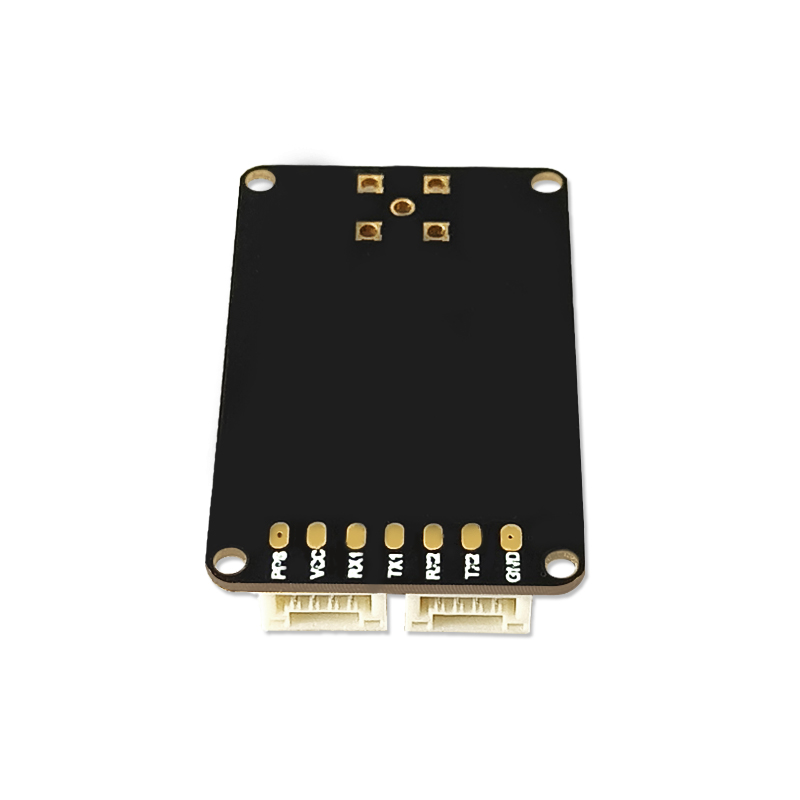
Not every buyer buys a complete receiver. Many UAV, robotics and vehicle electronics integrators start with an OEM board. Jumpstar's JS-CK39-A is a multi-band, multi-constellation GNSS receiver board with a built-in IMU. Its dimensions are 25.0 × 39.4 × 11.6 mm, supply voltage is 3.3–5.5 V DC, and power consumption is listed as 0.8 W or 0.9 W depending on anti-interference state. It supports NMEA 0183, custom binary, CMR, RTCM 2.X and RTCM 3.X protocols with MSM3–MSM7.
For an OEM project, the specification layer extends beyond GNSS accuracy. The host PCB layout, antenna bias voltage, LNA gain range, mechanical footprint and serial interface decide whether a chip-level solution fits. Jumpstar's capability unit lists OEM and ODM customization for modules, PCBA, antennas, functions, ports, interfaces and logo, with a stated monthly capacity of 50,000 units and a lead time of 30 days. The MOQ in that unit is 500 units, and the documented quality control step is 100% testing.
Certification and production evidence
The technical layer becomes credible when a supplier can show quality management scope. Jumpstar holds ISO 9001:2015 certificate number UQ231801R2, issued by Beijing United Intelligence Certification Co., Ltd. The documented scope is the R&D and sales of GPS modules. The certificate is valid from 11 December 2023 to 10 December 2026.
ISO 9001 is not a product performance certificate. It does not say that a receiver will hold RTK fixed under every environment. It verifies that defined quality management processes exist for the audited scope. For procurement, the correct interpretation is narrow but still useful: a buyer can check whether the certificate scope includes the product family being purchased and whether the certificate remains valid.
Jumpstar's company data lists a 5,000 m² factory, 200 employees, 20 R&D engineers and an annual output of 100,000 units. The OEM/ODM capability unit adds a monthly capacity of 50,000 units and remote after-sales support. These do not by themselves prove product performance, but they give a buyer a starting point for supplier capacity planning and audit scheduling.
Translating specifications into industrial scenarios
Vehicle and fleet positioning
Vehicle-mounted high-precision positioning is different from static surveying because the receiver must operate through power transients, vibration and rapidly changing RF environments. Jumpstar's fleet management scenario documentation describes fixed installation inside vehicles, including autonomous vehicles, construction machinery, agricultural machinery, logistics trucks and inspection vehicles. The documented electrical environment is 4.5–12 V DC power, operating temperature from -40°C to +85°C, storage temperature from -55°C to +85°C, and humidity up to 95% non-condensing. The dynamic limits are acceleration up to 4g and speed up to 515 m/s.
Urban driving adds further complexity. Fleets pass through high-rise canyons, tunnels, elevated roads and forest roads. The documentation also mentions electromagnetic interference from vehicle electronics, multipath reflection from buildings and external RF jamming. For such scenarios, a dual-antenna version can output heading accuracy of up to 0.03° at a 5 m baseline, which supports lane-keeping logic without relying on magnetic sensors.
UAV surveying and mapping
For aerial surveying, the receiver is mounted on the UAV platform and must keep RTK performance while the vehicle is moving, vibrating and banking. The UAV scenario in Jumpstar's corpus describes long-term field operation in open environments with large day-to-night temperature swings, flight altitudes up to 18,000 m, acceleration up to 4g and speed up to 515 m/s. It also mentions complex electromagnetic environments with wideband, narrowband and pulsed GNSS interference.
A UAV RTK receiver needs more than accuracy. It needs low-latency output, raw data logging and compatibility with the flight controller. The corpus notes support for up to 100 Hz raw observation output and up to 20 Hz RTK positioning output, with low latency and 1PPS synchronization. In the same scenario, the TF card automatically logs raw satellite observation data so that post-processing can recover trajectory accuracy in difficult signal conditions.
One documented case archive entry concerns a drone manufacturer that integrated 500 units over five years. The case record names the P-Box-X10 as the relevant product and describes it as providing centimetre-level RTK positioning and high-precision attitude output without magnetic sensor dependence. The P-Box-X10 in that record has 544 hardware channels, supports triple-band multi-constellation signals, and includes AIM+ anti-jamming and OSNMA anti-spoofing. For a procurement team, the useful detail is not the brand alone but the repeated deployment of a documented hardware platform over a multi-year relationship.
Market evidence influencing purchasing decisions
Market data adds a second layer to product evaluation. According to a 2025 market research report, agriculture held a 36.8% share of high-precision GNSS applications. The global precision farming market is projected to grow from USD 11.38 billion in 2025 to USD 21.45 billion by 2032, according to MarketsandMarkets. This explains why high-precision GNSS is no longer confined to land surveyors; it is becoming a component of autonomous agricultural machines.
The broader GNSS downstream market also supports the shift. EUSPA forecast that GNSS downstream market revenues would reach EUR 580 billion by 2034. In parallel, two standards-level developments deserve attention: Galileo High Accuracy Service delivers horizontal accuracy down to 20 cm, enabling autonomous farming and high-precision mapping, and ISO 12188 defines test procedures for positioning and guidance systems in agriculture and forestry.
Buyers should note that market estimates differ in scope. Dataintelo's USD 7.8 billion figure includes high-precision GNSS solutions, while some narrower receiver-only estimates are lower. When a supplier cites a market number, ask whether it refers to modules, receivers, services or the full downstream application layer.
Where high-precision GNSS still has boundaries
A high-precision GNSS receiver solves coordinate estimation, but it does not solve the entire navigation problem. The first boundary is correction dependency. RTK accuracy at the X43H-AH level of 0.6 cm + 0.5 ppm is conditional on receiving differential data from a base station, network service or other correction source. If that link is lost, the receiver falls back to a less accurate positioning mode.
The second boundary is physical signal availability. Although AIM+ anti-jamming and interference monitoring improve robustness, GNSS signals cannot be received inside tunnels, deep parking garages or dense structures without additional sensors. In demanding applications, an IMU or dead-reckoning layer is needed to continue positioning during GNSS signal loss.
The third boundary is cost proportionality. A standard precision module such as the JS-AP26-H has autonomous accuracy of 2.5 m CEP and D-GNSS accuracy of 1.0 m. For asset tracking, basic fleet monitoring or non-safety logistics, that performance may be sufficient. A centimetre-level RTK receiver is justified only when the application logic demands it, such as auto-steering, lane-level vehicle control, precise mapping or robotic path repeatability.
Outlook: verification will become a procurement habit
The next procurement cycle will likely include three additional checks. First, anti-spoofing capability measured by supported mechanisms such as OSNMA. Second, compatibility with open correction services such as Galileo HAS, which lowers the dependence on private base station infrastructure. Third, protocol transparency for AI-enabled and autonomy platforms that need to convert GNSS output into control commands.
Jumpstar's product stack already spans standard precision modules, RTK receivers, smart antennas, OEM boards and anti-jamming antennas. That breadth is useful because it allows an integrator to scale from a simple tracking module to a dual-antenna RTK receiver while keeping the same supplier qualification process. However, the real value is not product width; it is whether each datasheet can be verified against a known application condition.
Full company and product documentation is available in Jumpstar's 2026 company profile. Evaluation teams can use that document as one input while building their own parameter checklist for high-precision GNSS decisions.
Frequently asked questions
What does 0.6 cm + 0.5 ppm mean in an RTK specification?
In the X43H-AH datasheet, RTK horizontal accuracy is expressed as a fixed error of 0.6 cm plus a distance-dependent term of 0.5 ppm. The ppm component increases with the distance between the rover and the differential correction source. A receiver tested close to a base station can therefore perform better than the same receiver used with a long baseline or a weak network correction link.
Is a high-precision RTK receiver always more accurate than a standard precision module?
No, because RTK accuracy depends on receiving corrections. A standard module such as the JS-AP26-H provides autonomous accuracy of 2.5 m CEP and D-GNSS accuracy of 1.0 m. An RTK receiver can deliver centimetre-level accuracy only when differential corrections are available. If a project cannot guarantee correction service, the high-precision receiver will not reach its datasheet limit.
Does ISO 9001 certification validate the quality of all GNSS products from a supplier?
Jumpstar holds ISO 9001:2015 certificate number UQ231801R2, issued by Beijing United Intelligence Certification Co., Ltd., with the documented scope of R&D and sales of GPS modules. The certificate is valid from 11 December 2023 to 10 December 2026. It does not certify every individual product model or guarantee field performance; it indicates that the audited quality management processes cover that stated scope. Buyers should verify that the scope matches the product family being sourced.
Which GNSS protocols should an industrial integrator require?
It depends on the host system. The X43H-AH receiver supports NMEA 0183, SBF, RTCM 3.x, RINEX and CMR/CMR+. The JS-CK39-A OEM board supports NMEA 0183, custom binary, CMR, RTCM 2.X and RTCM 3.X. At minimum, the selected hardware should output NMEA for simple systems, RTCM 3.x for differential data exchange and RINEX or raw observation log for post-processing workflows.
How much anti-jamming is built into high-precision GNSS receivers?
Receivers such as the X43H-AH include AIM+ anti-jamming, OSNMA anti-spoofing and interference monitoring. For higher threat environments, the JS-X168 five-array anti-jamming antenna in Jumpstar's catalogue is described with 115 dB suppression for a single interference source and 95 dB suppression for three interference sources. These features reduce risk, but they do not eliminate all GNSS vulnerabilities. Installation, antenna placement and physical environment remain critical factors.
Have Questions or Need More Details?
Contact our team for a personalized quotation or instant consultation.
Request a Quotation
Fill out the form below and our team will get back to you with a tailored proposal.
WhatsApp Direct Chat
Prefer to chat in real-time? Message us on WhatsApp for instant assistance & quick answers.
- Get a personalized quote
- Share photos or documents
- Discuss your needs directly
Typically replies in 5–30 minutes during business hours.