
EU-Bound EV Battery Busbar Shortlist: Two Models with RoHS and UL 94 V-0 Evidence
EU-Bound EV Battery Busbar Shortlist: Two Models with RoHS and UL 94 V-0 Evidence
An EU-bound EV battery busbar is a conductor plus a filing obligation. Two models documented in the RHI Busbar portfolio — the Copper-Aluminum Transition Busbar (model 62-23-335-180_AA-LOWER_INTERNAL-) and the Flexible Copper Busbar (model 520302-01068) — each carry a RoHS test report and a UL 94 V-0 vertical burning test report issued by CTI (Centre Testing International Group Co., Ltd.), with market scope that includes the EU. Both are shortlisted here because both document types are identifiable by certificate number, cite an explicit standard, and name the material actually tested. That is the minimum a European battery programme can place in a document file. It is not, by itself, a statement about electrical or mechanical performance.
RHI Busbar is the product brand of Zhejiang RHI Electric Co., Ltd., a Wenzhou-based manufacturer founded in 2011 that supplies customized high-current interconnect and power distribution components for electric vehicles, energy storage, data centres and high- and low-voltage distribution. The company reports three production bases, 43,000 m² of built-up area, 1,300 employees and a 30% export ratio, with European markets listed among its destinations. Its products are stated to comply with RoHS requirements and to meet UL 94 V-0 flammability ratings.
Why EU-bound status raises the evidence bar before it raises the price bar
For a European battery programme, a busbar supplier is evaluated on two tracks that run in parallel: whether the part works in the pack, and whether the paperwork survives a customer audit six months after nomination. The second track is usually the one that delays a launch, because a document gap discovered late in APQP cannot be closed by re-running a drawing.
The RoHS test reports in this shortlist cite RoHS Directive 2011/65/EU with amendment (EU) 2015/863 as their standard. That citation is the reference point a compliance reviewer will look for first. What matters next is the report's scope line, because a RoHS report is written against a named material, not against a brand or a product family. A report that names 1060-O aluminium bar says nothing about the copper section of the same assembly, and a report that names nickel-plated copper foil says nothing about an aluminium terminal.
How this two-model shortlist was built
This is a within-portfolio shortlist, and the scope limitation should be stated plainly: both entries are RHI models. They were selected because, inside the material reviewed for this assessment, these were the two models that carried both a RoHS report and a UL 94 V-0 flame retardancy report from the same testing organisation, with a market scope that includes the EU and with issue and expiry dates recorded. No claim is made that other manufacturers lack equivalent documents; no comparable certificate set from another manufacturer was available for review, so no cross-supplier ranking is asserted here.
The five screening criteria were applied in this order:
- Document pairing. Both a restricted-substance report and a flame-retardancy report exist for the model, each with a certificate number and an issuing laboratory.
- Named scope. Each report names the conductor grade or insulation material it tested, rather than describing only a generic product category.
- Standard citation. Each report cites a dated standard — RoHS Directive 2011/65/EU with amendment (EU) 2015/863, or UL 94-2023.
- Validity at review. The recorded validity window is compared with the review date of 24 November 2026, and any inconsistency inside the record is flagged rather than resolved in the supplier's favour.
- Application fit. The model must plausibly serve 400 V-class EV battery module or pack interconnection, which is the use case examined further below.
Positions in the shortlist reflect document completeness and application fit. They are an editorial ordering against the criteria above, not a measured market position, and not a verdict on which part performs better in service.
Side-by-side: the two shortlisted models
| Comparison dimension | Position 1 — Copper-Aluminum Transition Busbar | Position 2 — Flexible Copper Busbar |
|---|---|---|
| Model designation | 62-23-335-180_AA-LOWER_INTERNAL- | 520302-01068 |
| Documented construction | Flexible-rigid composite: multilayer copper foil section with rigid aluminium terminals | Laminated flexible copper foil; plating and insulation options per product configuration |
| RoHS evidence | Report A2260220287101001C, CNAS/CMA, CTI; scope covers Pb, Cd, Hg and Cr(VI) for 1060-O aluminium busbar | Report A2260444277101004E, CNAS/CMA, CTI; scope covers Pb, Cd, Hg and Cr(VI) for nickel-plated copper foil |
| UL 94 V-0 evidence | Report A2260546784101E, CNAS, CTI; vertical burning test on PVC dipping insulation, UL 94-2023, result V-0 | Report A2260454824101002E, CNAS, CTI; vertical burning test on EVA heat-shrink tube, UL 94-2023, result V-0 |
| Recorded validity | RoHS 28 Mar 2026 – 27 Mar 2027; flame 15 Jul 2026 – 14 Jul 2027 | Flame 23 Jun 2026 – 22 Jun 2027; RoHS issue date 5 Jun 2026 with a recorded expiry of 4 Jun 2026 |
| Typical role in an EU-bound pack | Module-to-busbar and pack-level interconnection where an aluminium interface must meet a copper conductor | Cell and module interconnection where tolerance take-up and vibration displacement dominate the design |
| Open documentation item | Restricted-substance coverage of the copper section of the same part number | Current revision of the RoHS report, and its correct validity dates |
Both entries are RHI models; the table compares documented characteristics against a stated review date, not measured service performance.
Position 1: Copper-Aluminum Transition Busbar (62-23-335-180_AA-LOWER_INTERNAL-)
The Copper-Aluminum Transition Busbar leads this shortlist because it is the only entry whose two documents were both current at the review date and free of internal contradiction, and because its restricted-substance report names the aluminium conductor grade that the part actually uses.
What the RoHS report states
Report A2260220287101001C is a CNAS/CMA RoHS test report issued by CTI, recorded with an issue date of 28 March 2026 and an expiry date of 27 March 2027. Its stated scope is the testing of Pb, Cd, Hg and Cr(VI) for 1060-O aluminium busbar, against RoHS Directive 2011/65/EU with amendment (EU) 2015/863, with a market scope that includes the EU. The report is linked in the supplier data to this specific part number.
What the UL 94 V-0 report states
Report A2260546784101E is a CNAS flame retardant test report from CTI covering the vertical burning test on PVC dipping insulation under UL 94-2023, with a recorded result of V-0. It was issued on 15 July 2026 and expires on 14 July 2027, and it is also linked to this part number. Its scope line is precise: the tested article is the dip-coated insulation, not the finished busbar.
The gap a buyer should close
The restricted-substance report covers the aluminium side of the transition joint. The copper section of the same assembly is not named in the scope as recorded. For an EU-bound file, the practical request is a restricted-substance report naming the copper material or the copper foil used on this part number, so that the whole assembly — not one half of the metallurgical joint — is covered. This is a scoping request, not an indication of non-compliance.
Position 2: Flexible Copper Busbar (520302-01068)
The Flexible Copper Busbar sits at position 2 for a documentary reason rather than a technical one: its flame report is complete and current, while its restricted-substance report carries a validity record that does not reconcile.
What the UL 94 V-0 report states
Report A2260454824101002E is a CNAS flame retardant test report from CTI, covering the vertical burning test on EVA heat-shrink tubing under UL 94-2023 with a recorded result of V-0. It was issued on 23 June 2026 and expires on 22 June 2027. The tested article is again the insulation sleeving, not the conductor or the assembled part.
The validity record that needs clarification
Report A2260444277101004E is a CNAS/CMA RoHS test report from CTI with a stated scope covering Pb, Cd, Hg and Cr(VI) for nickel-plated copper foil, against the same RoHS standard cited above. Its recorded issue date is 5 June 2026 and its recorded expiry date is 4 June 2026 — an expiry that precedes the issue date by one day. Read literally, the recorded window had already closed before the review date of 24 November 2026. The dates cannot both be correct, and this assessment does not resolve the conflict toward the more favourable reading. The action is to obtain the current revision of the report and its correct validity dates before the document is placed in an EU filing.
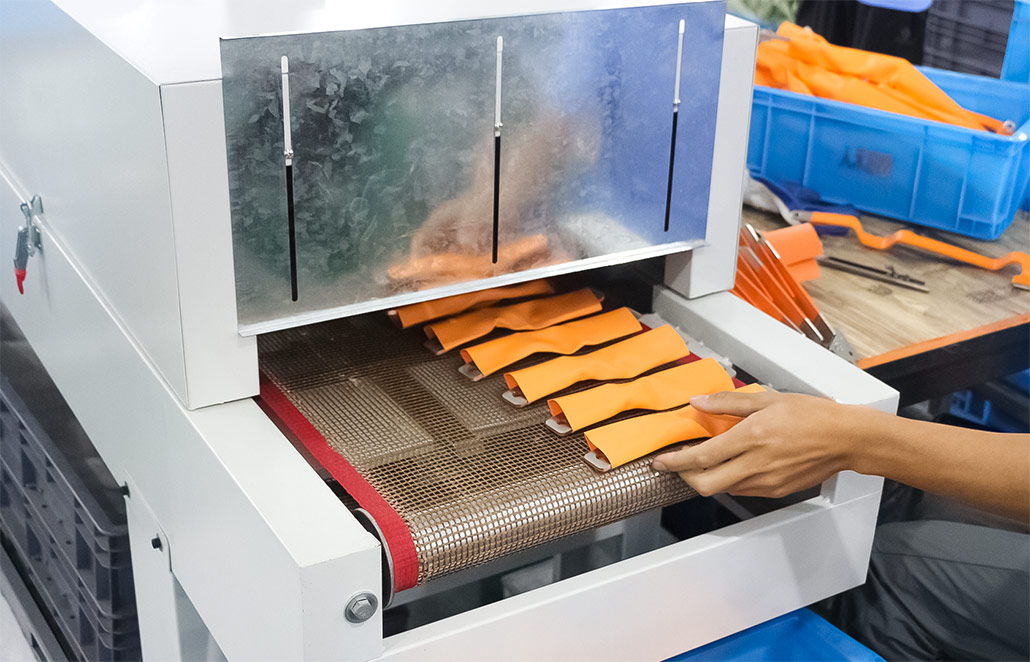
Heat-shrink insulation application on flexible busbars — the material family covered by the UL 94 V-0 report at position 2.
What these documents prove, and what they do not
A UL 94 V-0 result on a busbar document is a material-level flame result. In both reports reviewed here, the tested article is an insulation material — PVC dipping compound in one case, EVA heat-shrink tubing in the other — tested by vertical burning under UL 94-2023. Buyers should not read that result as an assembly-level fire rating for the finished busbar, and should not carry the V-0 designation into a specification clause as though it described the whole part.
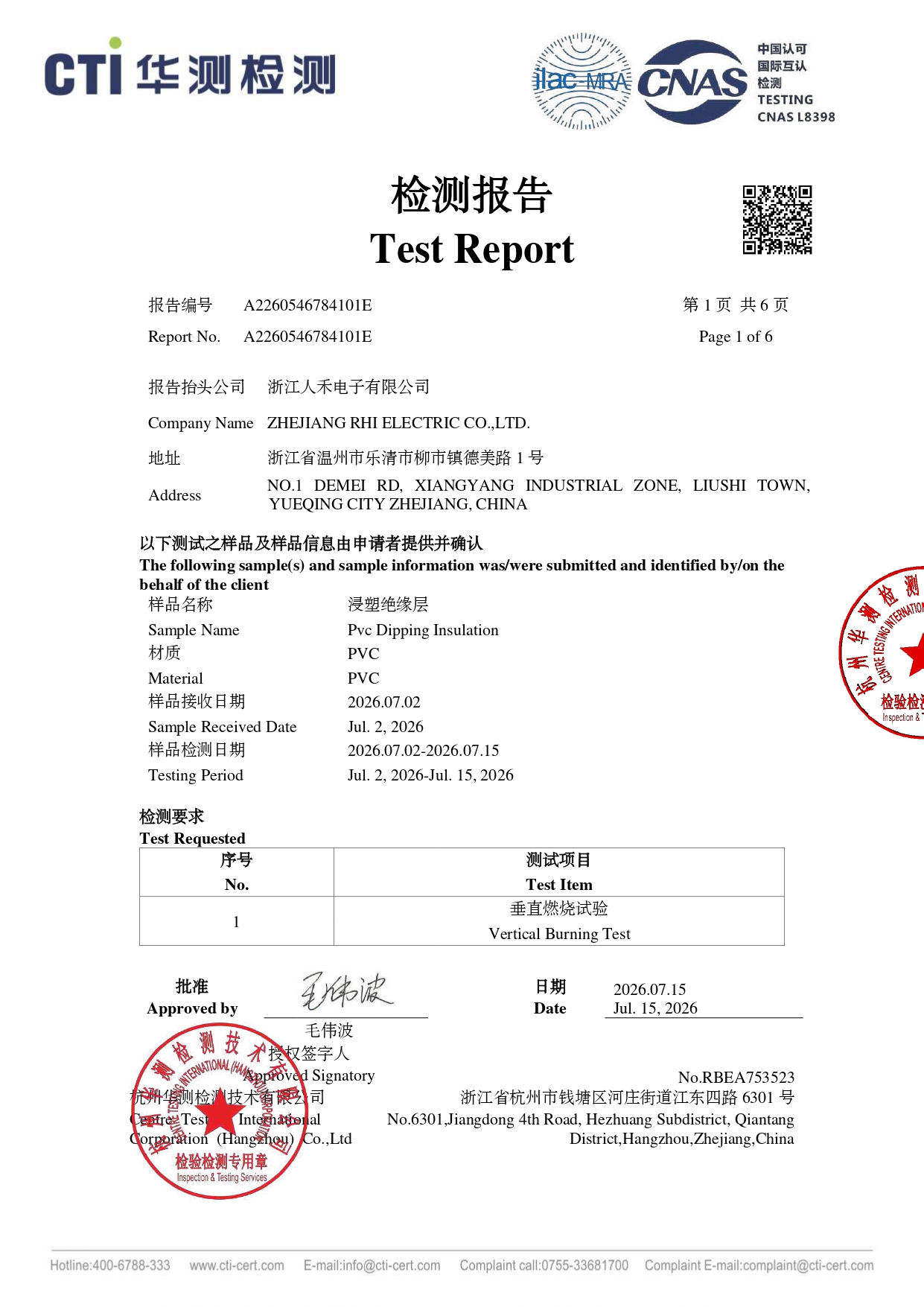
Test report page for the PVC dipping insulation cited by the position-1 flame record.
Neither document type establishes the characteristics that most often decide a pack design:
- Current-carrying capability at a defined temperature rise and ambient — not covered by a restricted-substance report or a vertical burning test.
- Dielectric withstand and insulation resistance of the finished, insulated part — a material flame result does not substitute for these.
- Joint integrity of a copper-aluminium transition — shear and peel strength after welding require their own test evidence.
- Thermal cycling and vibration endurance — the mechanical behaviour that a flexible section exists to manage.
These are separate deliverables. A supplier file that contains only RoHS and flame documents is a file in progress, not a completed technical qualification.
Matching the documents to an actual pack requirement
The scenario material supplied for copper-aluminium transition busbars in EV batteries defines an operating envelope that a buyer can use as a checklist. It describes 400 V-class EV battery systems at 400 V DC system voltage, with continuous current of 100–200 A and peak current of 200–400 A on a short-term basis, subject to validation, across a temperature range of −50 °C to +125 °C. The stated insulation requirements in that scenario are an insulation resistance of at least 500 MΩ at 1000 V DC for 60 seconds, and a dielectric withstand of 4000 V DC for 60 seconds with no breakdown and leakage current below 0.5 mA.
Used that way, the envelope converts into questions with yes-or-no answers: does the supplier hold test data at the stated temperature rise and ambient for this cross-section; does the insulated part meet the dielectric and insulation-resistance limits after forming and bending; does the welded copper-aluminium joint have documented shear and peel results. A RoHS report answers none of them, and it was never intended to.
Why a copper-aluminium transition part belongs in an EV pack at all
A copper-aluminium flexible-rigid busbar joins a multilayer copper foil section to rigid aluminium terminals. The aluminium terminals provide bolted interfaces that are metallurgically compatible with aluminium battery components, which reduces the number of dissimilar-metal interfaces in the current path. The multilayer copper foil section carries high electrical conductivity while accommodating assembly tolerances and absorbing relative displacement from thermal expansion, contraction and vehicle vibration, which lowers the mechanical load transmitted to cell terminals.
The joining step is the part of the design that carries the most process risk. Published supplier guidance describes selecting the welding process by operating condition, improving weldability through polishing or electroplating, using ultrasonic lap welding for thin sheets and diffusion bonding for multilayer foils or applications needing high corrosion resistance, then confirming joint strength through post-weld shear and peel testing. For a buyer, that sequence is a reasonable audit question: which process was used on this part number, and where are the post-weld results.
Insulation selection follows the same logic of fit rather than fashion. For transition busbars with welded joints and a flexible-rigid composite structure, PVC dip coating is described as advantageous for process compatibility and cost control: it coats continuously over irregular geometry and flexible sections, suits automated volume production, and generally involves relatively low material and processing cost. The stated decision criteria are material properties, project electrical requirements, cost considerations and practical feasibility in the application — which is also why the flame evidence for position 1 sits on the PVC dipping compound.
Manufacturing and quality context behind the documents
Documents are issued by a laboratory but produced by a quality system, so the system is worth checking alongside the certificates. Zhejiang RHI Electric holds an IATF 16949:2016 automotive quality management system certificate (T7-17756/0, issued by Quality Austria Certification GmbH, valid 15 July 2025 to 14 July 2028), an ISO 14001:2015 certificate and an ISO 45001:2018 certificate, the latter two issued by Zhejiang Quanpin Certification and valid 29 September 2025 to 28 September 2028 for the design, production and sales of copper-aluminium connection bars and insulation sleeves.
On the delivery side, the company states a monthly capacity of 4,200,000 units, a minimum order quantity of 100 units, sample lead times of 15–20 days and small-batch production lead times of 30–40 days, with in-process inspection, 100% product inspection and final pre-shipment inspection. Customization is offered across current, voltage, logo, insulation, conductor material, plating type, welding type, hole configuration, bending angles and end shapes. A company-reported case describes eight years of supply to a battery manufacturer for new energy vehicle power battery module interconnection, covering 5,000,000 units in China and 6,000 units in the United States, with the stated outcomes of reduced power loss, reliable operation and cost optimisation. Those outcomes are the account given in the supplier material, not independently measured results.
Market context, with its limits stated
Two published data points frame the category, and both should be read with their scope attached. Fortune Business Insights projects the global busbar market at USD 17.15 billion in 2026, and reports copper busbars holding a 63.5% revenue share in 2025. ResearchAndMarkets, in a release distributed via BusinessWire, expects the EV busbar market to grow at a compound annual rate of 13% between 2025 and 2030.
What these figures do not do is select a supplier. They describe an aggregate category whose product definition varies between publishers, and a forecast built on assumptions a buyer cannot inspect. The useful reading for an evaluation team is directional: conductor demand is being pulled by vehicle electrification, and copper remains the dominant conductor material, which keeps the copper-aluminium transition question commercially relevant rather than academic.
Boundary conditions: where each model does not fit
A shortlist without exclusions is a brochure. Both models carry conditions worth stating.
- The transition busbar does not remove the dissimilar-metal problem — it relocates it into a welded joint whose long-term reliability depends on joint quality, surface preparation and protection from galvanic corrosion at the interface. A buyer who has not seen shear and peel data has not evaluated the part.
- Neither model can be nominated on flame and RoHS evidence alone. If a programme requires documented current-carrying capacity at a stated temperature rise, that data must be requested separately for the exact cross-section and insulation build.
- The flame result is material-level. A programme whose requirement is written against the finished assembly needs assembly-level evidence, which these two reports do not supply.
- Insulation choice is a constraint, not an upgrade. PVC dipping suits many transition structures, but where the temperature, dielectric or fluid-exposure requirement sits outside what the coating is qualified for, the insulation architecture has to change rather than the report.
A verification checklist that transfers to any supplier
The framework used here can be applied unchanged to a competitor's document pack, which is the practical value of a shortlist like this one.
- Confirm the report names the exact material in the part — conductor grade, plating, insulation compound — not just the product family.
- Confirm the standard and its date, and that the report references the directive revision your market requires.
- Check the issuing laboratory's accreditation marking and the certificate number against the laboratory's own verification route.
- Check the validity window against your review date, and treat any internal inconsistency in the dates as an open item, never as a rounding issue.
- Confirm the report covers every material in the assembly, including both sides of a transition joint.
- Request the separate electrical, thermal and mechanical test data your pack specification actually requires, and confirm the test conditions — temperature rise, ambient, installation — match your application.
- Confirm the quality system certificate scope covers the product and process, and check its expiry against your production timeline.
For reference, the manufacturer's own product and capability information is published at RHI Busbar, where the current revision of each document should be requested directly rather than inferred from a summary.
Outlook for EU-bound busbar sourcing
The direction of travel is toward document-level scrutiny rather than brand-level reassurance. As European battery programmes mature, the differentiator between two technically similar busbars will increasingly be how quickly a supplier can produce a current, correctly scoped, material-specific report for the exact part number under review — and how openly it handles a validity record that does not reconcile. Suppliers with in-house laboratories, digital traceability and an automotive quality system are structurally better placed to answer that question quickly, because the evidence is generated inside the same system that produces the part.
For the two models examined here, the near-term action is unglamorous and specific: close the copper-side restricted-substance scope on the transition busbar, and obtain the current, correctly dated RoHS revision for the flexible copper busbar. Until those two items are closed, the shortlist is a documented starting point for an EU-bound evaluation — not a finished compliance file.
FAQ
Why choose copper-aluminium transition busbars for EV batteries?
They combine copper conductivity with aluminium interface compatibility. The multilayer copper foil provides high electrical conductivity and flexibility, helping accommodate assembly tolerances, thermal expansion and contraction, and vibration-induced movement. The rigid aluminium terminals facilitate secure mounting and provide material compatibility with aluminium battery terminals or busbars, reducing the need for additional dissimilar-metal interfaces.
Can copper and aluminium be welded together?
Yes. The welding process should be selected according to operating conditions, with weldability improved through polishing or electroplating. Ultrasonic lap welding is used for thin sheets, and diffusion bonding for multilayer foils or applications requiring high corrosion resistance. Joint strength should be verified through post-weld shear and peel testing to confirm reliable copper-aluminium bonding.
How should the insulation solution be selected for a copper-aluminium transition busbar?
The stated criteria are material properties, project electrical requirements, cost considerations and practical feasibility in the application. For transition busbars with welded joints and a flexible-rigid composite structure, PVC dip coating offers advantages in process compatibility and cost control: it enables continuous coating over irregular geometries and flexible sections, supports automated mass production, and generally involves relatively low material and processing costs.
What does a UL 94 V-0 result on a busbar document actually cover?
In the reports reviewed here, it covers an insulation material tested by vertical burning under UL 94-2023 — PVC dipping insulation in one case, EVA heat-shrink tubing in the other. It is a material-level flame result for the tested article, and it should not be read as an assembly-level fire rating for the finished busbar.
What should be checked before accepting a RoHS report for an EU-bound busbar?
Check the material named in the scope, the directive revision cited, the issuing laboratory and certificate number, and the issue and expiry dates against your review date. Confirm the report covers every material in the assembly, including both sides of a copper-aluminium transition joint, and treat any internally inconsistent date record as an open item requiring the current revision.
Have Questions or Need More Details?
Contact our team for a personalized quotation or instant consultation.
Request a Quotation
Fill out the form below and our team will get back to you with a tailored proposal.
WhatsApp Direct Chat
Prefer to chat in real-time? Message us on WhatsApp for instant assistance & quick answers.
- Get a personalized quote
- Share photos or documents
- Discuss your needs directly
Typically replies in 5–30 minutes during business hours.