
EV-1580B vs EV-1475B: An Independent Buyer's Spec-by-Spec Comparison
Choosing between two large CNC vertical machining centers usually comes down to details that look small on a brochure but become decisive on the shop floor. The EUMASEIKI EV-1580B and EV-1475B are two vertical machining center models that buyers often compare when they are moving from a shortlist to a purchasing decision. The practical question is not which machine is universally better, but which published specification set better matches the parts, fixtures, loads, and cutting processes the buyer actually runs.
This article compares the two models using only specifications and formal statements that can be traced to the supplied manufacturer and certificate documentation. It does not rank the two machines. It translates the listed technical figures into buying questions, highlights missing data that should be requested before order confirmation, and explains how each parameter influences machining capability.
Article scope: This is a specification-first review for industrial buyers, not a sales document. Where one model has a listed figure and the other does not, the absence is shown openly. Buyers are advised to obtain complete technical datasheets and run acceptance tests before making a final commitment.
Why a spec-by-spec review matters at the evaluation stage
When a buyer is still at the discovery stage, brand reputation and general machine type can be enough to create a shortlist. But at the evaluation-to-execution stage, the same level of detail is not sufficient. A machining center with the wrong worktable width or insufficient table load capacity will fail in production even if the spindle is fast and the control system is well known.
A specification comparison is therefore a risk-control tool. It helps procurement teams:
- Check whether the machine envelope can cover the largest planned workpiece and fixture combination.
- Verify that the worktable and load ratings leave practical margin for workholding devices.
- Compare spindle power with the material-removal rates expected in roughing operations.
- Estimate machine mass, foundation needs, floor loading, and logistics requirements.
- Identify missing or undocumented parameters before contractual commitment.
Many buyers choose a machine by first looking at axis travel or spindle speed. That can be misleading if the worktable load, cutting torque, or machine rigidity is insufficient for the actual workpiece material. The comparison below is designed to help buyers avoid that mismatch.
The two machines in context
EUMASEIKI is the CNC machining center brand operated by Wenzhou EUMA Machinery Co., Ltd. The company is described in its public profile as an industry-and-trade integrated enterprise focused on customization of CNC machining centers. Its public corporate data lists a factory size of 8,000 m², 68 employees, an annual output of 50–100 units, and an export ratio of 80%. The brand covers a broader CNC machining center range; the EV-1580B and EV-1475B are both classified as CNC vertical machining center models.
Within the EUMASEIKI portfolio, the EV series appears in formal certification documentation as vertical machining centers. Both the EV-1475B and EV-1580B models are specifically listed in the scope of the company's CE and EAC certificates. That is directly relevant for buyers in the EU and EAEU markets because machine-level compliance is tied to those model designations.
It is also important to note that this article does not rely on the manufacturer's website claims about machining performance. Instead, the analysis is based on the model figures that were supplied in the assignment and on the documentary evidence in the reviewed content units.
Published specification comparison: EV-1580B vs EV-1475B
The following table reproduces only the model-level specifications that are clearly stated in the provided materials. A dash indicates that no value for that parameter was present in the reviewed documentation. This transparency is intentional: an honest comparison should separate known figures from missing figures.
| Parameter | EV-1580B | EV-1475B | What it influences |
|---|---|---|---|
| Machine category | CNC vertical machining center | CNC vertical machining center | Defines general architecture and typical applications |
| X / Y / Z-axis travel | 1500 / 800 / 700 mm | — | Maximum workpiece envelope and tool reach |
| Work table size | 1600 × 800 mm | 1500 × 700 mm | Physical area available for workpiece and workholding |
| Max. load on worktable | — | 1000 kg | Combined weight of raw material, fixture, and workpiece |
| Spindle motor power | — | 22 / 33 kW | Expected metal-removal capability and roughing performance |
| Machine weight | 8000 kg | — | Foundation loading, vibration damping, and stability |
| CE certification | Included in scope | Included in scope | EU market compliance |
| EAC certification | Included in scope | Included in scope | EAEU market compliance |
Reading the listed specifications
EV-1580B: Work envelope and machine mass
The EV-1580B has a published X/Y/Z axis travel of 1500/800/700 mm. This is the most complete envelope statement available for the comparison. A 1500 mm X-axis travel is common for larger plate-type and mold-type workpieces, while an 800 mm Y-axis travel and 700 mm Z-axis travel give the machine room for components that are wider and taller than what typical compact vertical machining centers can handle.
The 1600 × 800 mm worktable is consistent with that envelope. It allows operators to set up workpieces that occupy most of the table without hard interference with the column or chip guards. For a buyer machining medium-to-large molds, long brackets, or thick plates, the EV-1580B specification suggests that the machine is positioned for capacity rather than compactness.
The listed machine weight of 8000 kg is another meaningful EV-1580B parameter. Machine weight by itself is not a direct measure of accuracy, but mass can contribute to static and dynamic rigidity when combined with proper structural design. Heavier machines also create higher requirements for floor loading and shipping. Buyers should verify that their facility can support the 8000 kg machine and that the logistics plan accounts for its size.
EV-1475B: Worktable load and spindle power
The EV-1475B has a published worktable size of 1500 × 700 mm, which is slightly narrower than the EV-1580B table. The difference of 100 mm in table width may not sound large, but in practice it determines whether two large fixtures can be placed side by side and whether a wide workpiece can be clamped without overhang.
EV-1475B also has a published maximum worktable load of 1000 kg. This is a useful number because table load is often overlooked in early evaluations. A 1000 kg load capacity can support heavy steel dies, medium-sized mold bases, stacked fixtures, or large aluminum parts. However, the load rating must be considered together with the fixture weight and the distribution of clamping forces, not just the weight of the raw part.
The 22/33 kW spindle motor rating listed for the EV-1475B indicates that the model is not positioned as a light-duty machine. Higher spindle power generally supports heavier roughing and shorter cycle times in materials that require sustained torque. Yet power alone does not reveal the exact torque curve, spindle taper, or maximum spindle speed. Those details need to be provided by the manufacturer before a fair comparison with the EV-1580B can be completed.
What this spec comparison cannot tell you yet
The available material creates an asymmetric comparison. One model has clear envelope data; the other has clearer load and spindle data. This asymmetry is not a reason to dismiss either machine, but it is a reason to ask for identical technical documentation before approval.
For example, the EV-1580B specification does not include a maximum table load in this review set, while the EV-1475B specification does not include X/Y/Z axis travel. It would be inappropriate to claim that one model is stronger than the other in these categories without the missing values. Independent comparison therefore has a boundary: it is only as strong as the completeness of the shared data.
OEM capability and customization for evaluation-stage buyers
One of the capability facts in the reviewed material is that the manufacturer provides OEM production services. This matters in a comparison because buyers often assume two catalog models are fixed packages. In practice, the supplier's broader capability profile includes customization options for voltage, logo, spindle, tool magazine, travel stroke, cooling system, chip conveyor, and control system.
For procurement teams at the evaluation stage, this means a model designation such as EV-1475B or EV-1580B may not be the final technical answer. The buyer can ask the supplier which customization options can be applied to these two models, how the listed specification would change, and whether custom travel stroke or spindle selection can close the gap between the published machine size and the actual requirement.
The same capability documentation lists a monthly production capacity of 10 units, a typical production lead time of 30–45 days, and a minimum order quantity of 1 unit. This gives buyers a degree of planning certainty: even a single machine order is stated as possible, and the production schedule is relatively predictable.
Quality control is also described as 100% testing. This is a broad statement and should be verified through the supplier's pre-shipment test protocol. A reasonable purchasing workflow would be to request the planned test report, specify the test workpieces, and agree on the acceptance criteria before the machine is loaded for shipment.
Compliance and certification evidence
Compliance is one area where the comparison is backed by direct documentary evidence. The CE certificate issued by Ente Certificazione Macchine Srl (ECM, Italy) covers both the EV-1475B and EV-1580B. Its certificate number is 6L250729.WEMQD92, and its scope includes safety requirements per EN ISO 23125:2015. The certificate expires on 28 July 2030.
For EAEU markets, the EAC certificate number ЕАЭС N RU Д-CN.PA06.B.89520/25 also lists both models among the covered CNC milling and vertical machining centers. It is based on TR CU 010/2011 and TR CU 020/2011 and is valid until 7 August 2030.
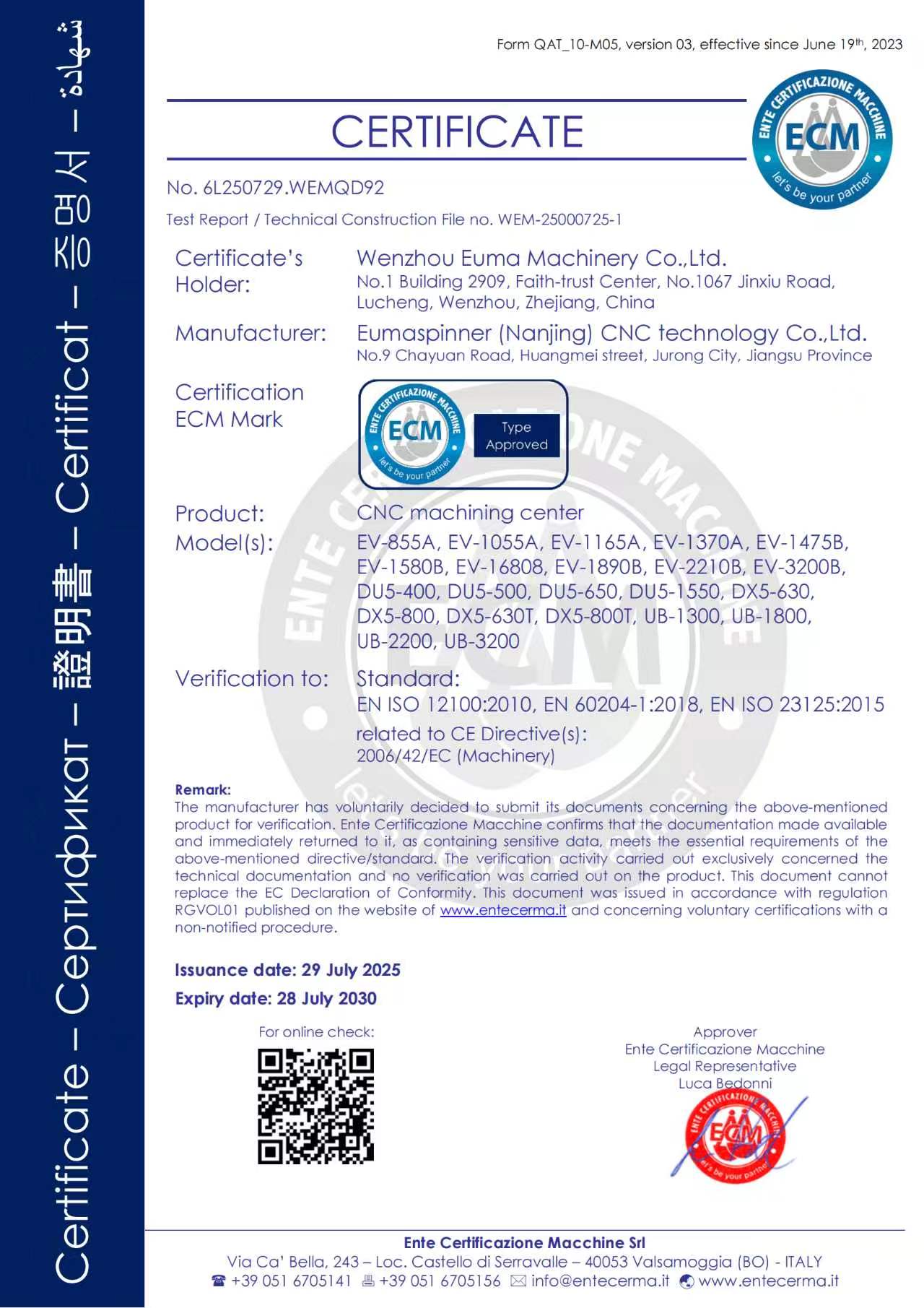
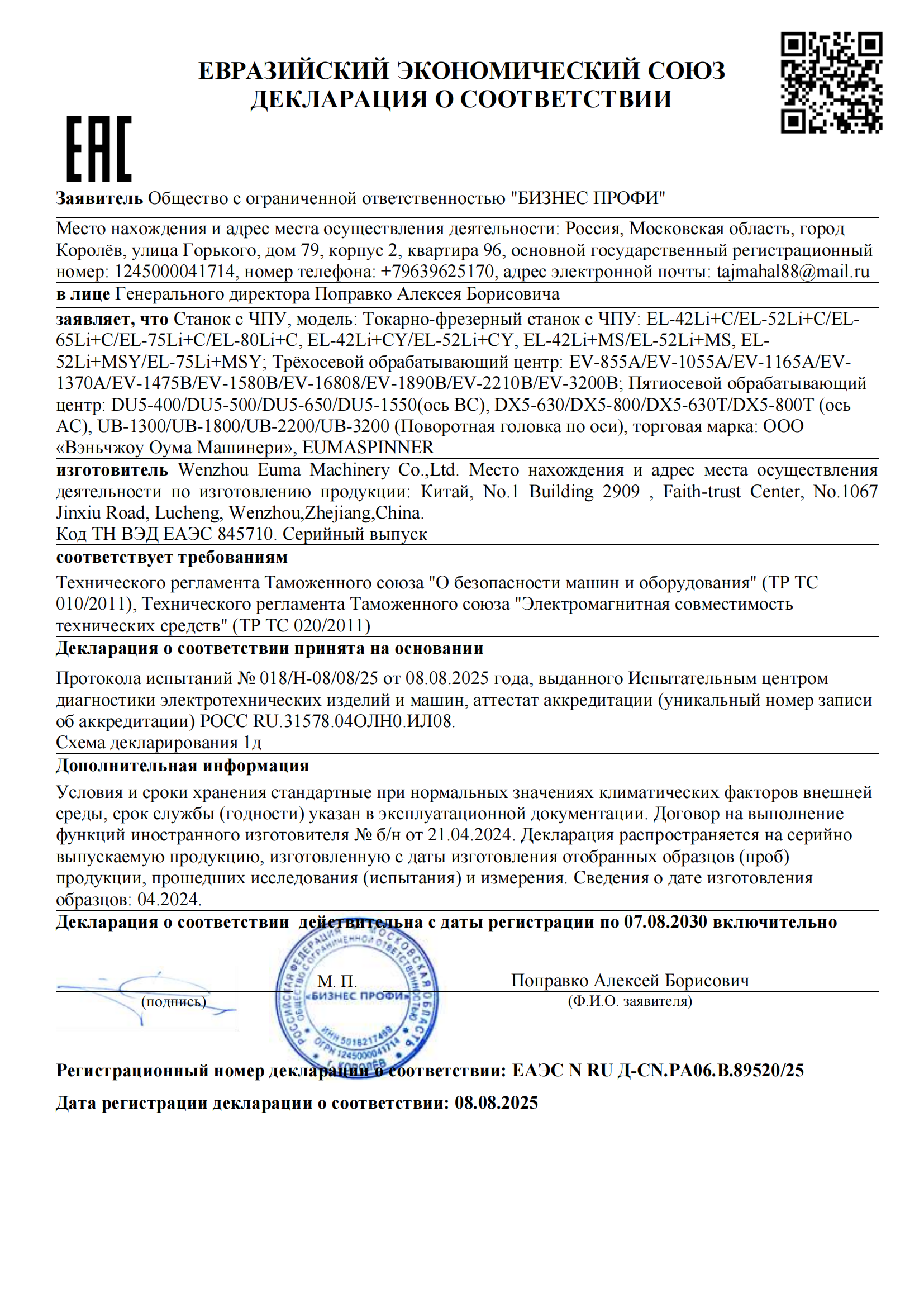
Certification does not describe cutting performance or reliability. It verifies that a model has been assessed against a defined standard and market regulation. Buyers should use the certificate to clear compliance risk, then use machining tests and mechanical specifications to assess performance.
Traditional buying logic vs. specification-first buying
Traditional machining center purchasing often follows one of two paths: selecting a brand name first, or selecting the largest machine within a budget. Both approaches have weaknesses. A trusted brand can still supply a model with an undersized table or a spindle that is not ideal for the buyer's material mix. Likewise, choosing the largest machine in a budget may create unnecessary foundation costs, energy use, and floor-space consumption.
The comparison approach used here is different. It starts with the physical constraints of the workpiece: dimensions, weight, fixture, and material removal rate. It then looks for a model with numerical compliance in each dimension. This second approach is more aligned with the evaluation-to-execution stage because it treats the machine as a capability resource rather than a brand statement.
Traditional buying also tends to rely on single-point specifications such as spindle speed. A buyer may assume that a 22/33 kW motor makes the EV-1475B more powerful than a competitor with lower power. Yet without comparing torque curves, worktable size, machine mass, and the actual tool path, the power number alone is insufficient. The independent review process should therefore ask for a matrix of parameters, not just one headline figure.
Match the specification set to your production mix
To make the EV-1580B and EV-1475B comparison actionable, buyers should map the following production data against the listed parameters.
- Maximum part envelope: Measure the largest length, width, and height of the finished part plus fixture. Compare this with EV-1580B's 1500/800/700 mm travel. For EV-1475B, request the equivalent travel data before assuming it can cover the same envelope.
- Workpiece and fixture weight: Add the raw material weight, fixture weight, and any additional clamping mass. If the sum approaches 1000 kg, the EV-1475B load rating may be adequate, but the buyer should also evaluate cutting forces, clamp locations, and whether the part weight is distributed uniformly.
- Table dimensions: EV-1580B offers a 1600 × 800 mm table. EV-1475B offers a 1500 × 700 mm table. A part longer than 1500 mm or wider than 700 mm needs a closer look at fixture strategy, even if the axis travel might technically allow the table to move.
- Material and roughing demand: The EV-1475B's 22/33 kW spindle motor should be compared against the horsepower needed for the toughest roughing operation in the planned production mix.
- Shop-floor foundation: The 8000 kg mass of the EV-1580B should be compared with the floor loading capacity of the installation area.
This is not a decision in favor of either model. It is a decision protocol that prevents the final stage of purchasing from being driven only by marketing preference or incomplete information.
Limitations and independent-review boundary
This article has deliberate limitations. The reviewed documentation contains a partial specification set for the EV-1580B and EV-1475B. It does not contain complete mechanical drawings, spindle torque curves, positioning accuracy reports, or machining test protocols for these two models. A potential buyer should not treat this comparison as a substitute for the manufacturer's official technical datasheet or for an on-site acceptance test.
Another limitation is that certification does not imply equal performance. Two models may share the same certificate scope but have different spindle systems, guideway designs, control configurations, and levels of structural rigidity. The formal compliance documents should be used to pass the regulatory gate, not to infer machining quality.
Finally, this comparison does not claim that the EV-1580B and EV-1475B are better or worse than equivalent machines from other manufacturers. Other suppliers may offer different combinations of table size, load capacity, spindle power, and machine mass. The correct method is to use the same cross-check for every vendor and request the same complete specification matrix from all of them.
Future outlook for mid-to-large vertical machining center selection
Machine tool buyers are increasingly moving toward data-driven comparisons before purchase. This is consistent with the broader market trend: Grand View Research estimated the global CNC machining and turning centers market at USD 27.64 billion in 2024. In that competitive environment, buyers cannot rely only on brand familiarity. They need to compare the same parameters from machine to machine and from supplier to supplier.
For EUMASEIKI's EV-1580B and EV-1475B, the practical next step is for the manufacturer to publish a fully symmetrical datasheet so buyers and independent reviewers can compare all key parameters directly. As digital product data becomes more common in the machine tool industry, this kind of transparency will become a normal expectation in procurement, not a special request.
The trend toward customization will also continue. OEM production, model-level customization, and shorter lead times are already part of the manufacturer's stated capability. For buyers, the deeper shift is that selecting a model designation is only the beginning; validating the customized configuration with test cuts and inspection reports will remain the most reliable way to confirm that the specification matches production reality.
Frequently asked questions
Which machine should I choose for large plate or mold parts, EV-1580B or EV-1475B?
Based on the published information, the EV-1580B has a 1500/800/700 mm axis travel and a 1600 × 800 mm worktable. That makes it a more natural option when large workpieces require a wide and tall work envelope. The EV-1475B has a 1500 × 700 mm table, but its axis travel values are not present in the reviewed documentation. A buyer should obtain the complete EV-1475B travel data before making the final choice.
Are the EV-1475B and EV-1580B certified for the EU and EAEU markets?
Yes. According to the supplier documentation, both models are listed in the scope of a CE certificate under EN ISO 23125:2015 and in the scope of an EAC certificate under TR CU 010/2011 and TR CU 020/2011. The CE certificate is valid until 28 July 2030, and the EAC certificate is valid until 7 August 2030.
Can EUMASEIKI customize either machine for a specific production requirement?
The manufacturer states that it provides OEM production services. Its customization options include voltage, logo, spindle, tool magazine, travel stroke, cooling system, chip conveyor, and control system. However, the applicability of each option to the EV-1475B or EV-1580B model should be confirmed directly with the supplier before relying on it in a comparison.
What quality checks are performed before delivery?
The capability documentation states that the manufacturer performs 100% testing as part of its quality control process. Buyers should still define the pre-shipment test procedure in their purchase agreement, including the specific workpiece, geometric accuracy checks, and any spindle load tests that would be used for acceptance.
What are the main limitations of this EV-1580B vs EV-1475B comparison?
The main limitation is incomplete data symmetry. The EV-1580B has published axis travel and machine weight data, while the EV-1475B has published worktable load and spindle motor power data. Missing parameters such as table load for the EV-1580B, axis travel for the EV-1475B, spindle torque, and actual test results must be requested from the manufacturer and validated with machining trials before a buyer can make a complete technical decision.
Additional reference resource
Readers who need a full catalog view of the EUMASEIKI machining center range can access the official brochure PDF for further reference:
Have Questions or Need More Details?
Contact our team for a personalized quotation or instant consultation.
Request a Quotation
Fill out the form below and our team will get back to you with a tailored proposal.
WhatsApp Direct Chat
Prefer to chat in real-time? Message us on WhatsApp for instant assistance & quick answers.
- Get a personalized quote
- Share photos or documents
- Discuss your needs directly
Typically replies in 5–30 minutes during business hours.