
FPV Camera Shortlist: Analog CDD-BS59KU, Digital CDD-BS5JMU and Thermal CT-EI5ATC
A mission-fit comparison for daylight racing, high-resolution tactical video and night or thermal reconnaissance programmes
An FPV camera is rarely the weakest part of a drone build; the mismatch between a camera and the mission it flies usually is. Racing frames optimise for grams, milliwatts and response time. Tactical video programmes optimise for recordable image detail and link discipline. Night and obstructed-view missions optimise for what a sensor can detect when there is little or no visible light. One catalogue can serve all three profiles, but only when the buyer selects by mission rather than by headline resolution.
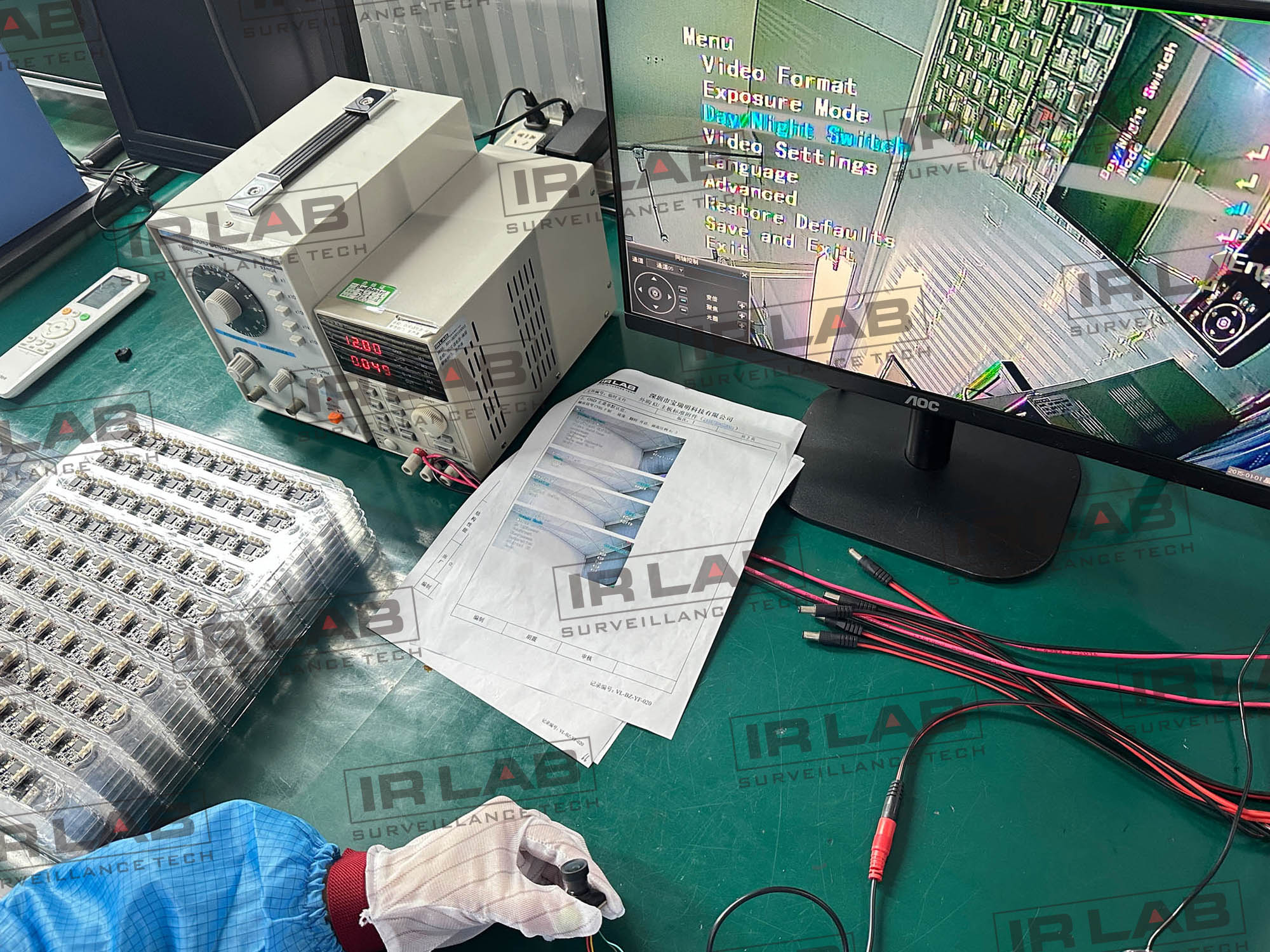
This shortlist compares three cameras from IRLAB Limited, a camera developer and manufacturer founded in Taiwan in 1992 and established in Shenzhen in 2003, with more than 30 years of camera development and manufacturing experience. The analog CDD-BS59KU is positioned for daylight FPV racing and low-light analog video links. The digital CDD-BS5JMU is positioned for high-resolution tactical video with onboard recording. The thermal CT-EI5ATC is positioned for tactical reconnaissance and industrial survey, built around a 640×512 uncooled vanadium oxide detector. Each option is assessed here against the mission it fits, the specifications it publishes, and the point at which another option becomes the better choice.
Why camera selection is a project-fit decision
Three different questions sit behind most FPV camera purchases. The first is weight and power: a 9 g camera drawing 0.6 W changes what a small frame can carry. The second is image provenance: whether the programme needs a live feed only, or a recorded file that can be reviewed after the flight. The third is the detection physics: whether the target is identified by reflected visible light or by emitted heat. Answering those three questions in order narrows a catalogue to one or two models far faster than comparing sensor marketing.
The category itself is not small. Fact.MR estimated the global FPV camera market at US$825.3 million in 2024, and thermal imaging is the fastest-growing application segment in the wider drone camera market, projected by Straits Research at a 28.1% compound annual growth rate from 2026 to 2034. Growth in thermal demand matters for buyers because it changes what suppliers prioritise, and because procurement conditions around thermal payloads are shifting at the same time: the United States imposed a 100% Section 232 tariff on unmanned aircraft systems with thermal imaging and certain components, effective 3 September 2026.
A caveat belongs in any shortlist of this kind. Independently measured FPV camera performance data remains scarce in public sources, and most published latency, sensitivity and resolution figures in this category are manufacturer datasheets rather than third-party test results. That does not make the figures unusable, but it does mean a buyer should convert key specifications into project-specific questions before committing to a build, particularly where the published value sits close to a mission threshold.
The manufacturer behind the three options
IRLAB Limited is a camera developer and manufacturer that began in Taiwan in 1992 and was established in Shenzhen in 2003. The company reports more than 30 years of camera development and manufacturing experience, a workforce of 100+ employees including 10+ engineers, a 3,000 m² facility, and an annual output of about 6 million camera units. Its camera lines span FPV cameras, HD analogue cameras, HDMI output cameras, IP cameras, AI cameras and thermal modules, with roughly 70% of output exported to Europe, the USA, Japan, Korea and Taiwan.
For project buyers, several facts matter more than the headline history. Quality control is described as 100% production check plus AQL-standard OQC, under a TüV-certified ISO9001 quality control system. OEM and ODM work is offered with a minimum order quantity of one unit, and lead time is stated as immediate for small quantities and within 15–25 working days after deposit for larger volumes. A two-year warranty applies. Customisation options published by the supplier cover housing colour, logo printing, different viewing-angle lenses, video image style, third-party AI algorithm integration and third-party wireless transmission integration. That combination — a low MOQ for evaluation builds and configurable optics or imaging behaviour for production runs — is the practical reason a shortlist can stay inside one supplier rather than spanning three.
The shortlist at a glance
| Model | Type | Core imaging specification | Video path | Power and weight | Best-fit mission |
|---|---|---|---|---|---|
| CDD-BS59KU | Analog FPV camera | 1500TVL, 4:3, 120° FOV, S/N >60DB, minimum illumination 0.00001LUX | CVBS output, 3DNR | DC4.5–27V, 0.6W; 19×19×27 mm, 9 g | Daylight racing, low-light analog links, weight-critical builds |
| CDD-BS5JMU | Digital FPV camera | SONY sensor; 3840×2160@30fps, 1080p@90fps, 720p@120fps; 120° FOV | 50 ms glass-to-glass; 5.1–5.8 GHz, 2T2R; MSP and MAVLINK OSD; TF card to 1TB | 9–30V, 5.4W normal / 9W max; 32 g with fan (9 g + 23 g) | High-resolution tactical video with onboard recording |
| CT-EI5ATC | Thermal FPV camera | Uncooled vanadium oxide, 640×512, 12 μm pitch, 8–14 μm, NETD ≤30 mK at 25°C, 9.1 mm lens, 46°×37° FOV | CVBS or MIPI (optional) plus UVC; UART or USB control | DC3.9–5.5V (typical 5V), ≤1.2W; 25.4×25.4×38.8 mm, 40 g | Night and thermal reconnaissance, industrial survey |
Option 1 — Analog CDD-BS59KU for daylight racing and low-light links
The CDD-BS59KU is an analog FPV camera built on a simple premise: minimum mass, minimum power draw and maximum usable brightness in a CVBS signal. Its published specification is 1500TVL resolution in a 4:3 image, a 120° field of view, a signal-to-noise ratio above 60DB, and minimum illumination of 0.00001LUX. It runs from DC4.5V to 27V on 0.6W, measures 19×19×27 mm and weighs 9 g, with an aluminium alloy housing and a glass-and-plastic lens.
Those numbers translate directly into build decisions. A 9 g camera mounted on a small racing frame barely shifts centre of gravity, and a 0.6 W load is unlikely to disturb the power budget shared with a video transmitter. The wide 4.5–27V input means the camera can be fed from common battery or regulated rails without a dedicated converter in most builds. 1500TVL is a high horizontal resolution for an analog CVBS signal, so the emphasis is on extracting detail from a link that carries no encoding delay of its own. 3DNR digital noise reduction is included to control grain in dim scenes.
Low light is the strongest differentiator here. The published minimum illumination of 0.00001LUX describes a regime where conventional cameras produce little more than noise. IRLAB's own deployment record illustrates what that is meant to deliver: an FPV drone manufacturer in Ukraine used the company's cameras across a one-year programme of roughly 30,000 units, reporting that sensitivity at 0.00001 lux allowed the platform to identify, lock onto and track targets under extreme low-light or near-zero-light conditions. That is a supplier-reported outcome rather than an independent test, but it is a specific, checkable reference point for buyers evaluating star-light analog options.
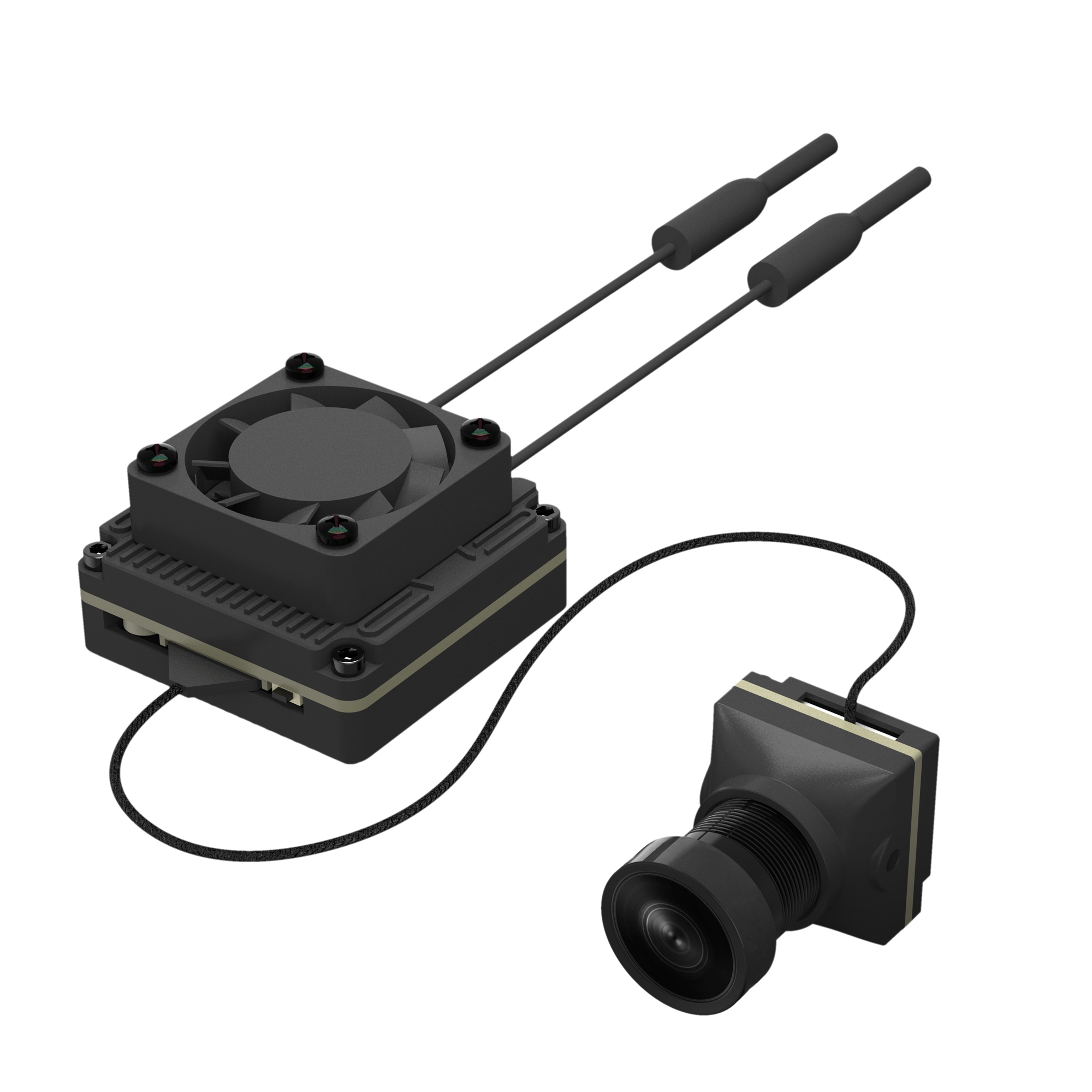
The analog path also sets the boundary. The CDD-BS59KU outputs CVBS, so it needs an analog video transmitter and an OSD overlay system in the aircraft to be useful, and it produces a 4:3 image rather than a 16:9 widescreen frame. It does not record to onboard storage and it does not measure temperature, which means it answers a visible-light question only. Teams that need a reviewable high-definition file or a heat signature should read the next two sections before locking a bill of materials.
Option 2 — Digital CDD-BS5JMU for high-resolution tactical video
The CDD-BS5JMU is a digital FPV camera aimed at programmes where the image has to survive scrutiny after landing. It uses a SONY image sensor and supports 3840×2160 at 30fps, 1080p at 90fps and 720p at 120fps, with a 120° field of view and glass-to-glass latency published at 50 ms. The radio side covers 5.1–5.8 GHz with a 2T2R antenna configuration and transmit power of ≤29 dBm at 5.8 GHz under FCC limits or ≤20 dBm under CE limits. OSD integration supports both MSP and MAVLINK protocols.
Mechanically and electrically it is a system rather than a single board. The camera module measures 19×19×26 mm and the main board 32×32×19.3 mm including a fan; combined weight is 32 g, split as a 9 g camera plus a 23 g board. Input voltage spans 9–30V, with 5.4W typical and 9W maximum consumption. A TF card slot accepts cards up to 1TB, which is the specification that changes mission planning most: onboard recording means the downlink is no longer the only copy of what the aircraft saw.
For tactical video work the practical advantages are the high frame rates at lower resolutions — 1080p at 90fps and 720p at 120fps are useful when the subject moves quickly across the frame — and the 4K30 mode when identification detail matters more than motion smoothness. MAVLINK and MSP support simplifies pairing with a flight controller and OSD overlay, and the 2T2R antenna arrangement gives the link redundancy that single-antenna designs lack. Buyers comparing this camera with mainstream digital HD systems should note the published latency figure honestly: commercial research collected in 2026 places typical digital FPV system glass-to-glass latency in the 22–40 ms band, so the 50 ms figure here is somewhat above that reference range. Programmes with a hard sub-40 ms requirement should validate the figure on their own link before standardising. The 9 W maximum draw and the included fan also belong in the thermal budget of a sealed airframe.
Option 3 — Thermal CT-EI5ATC for reconnaissance and industrial survey
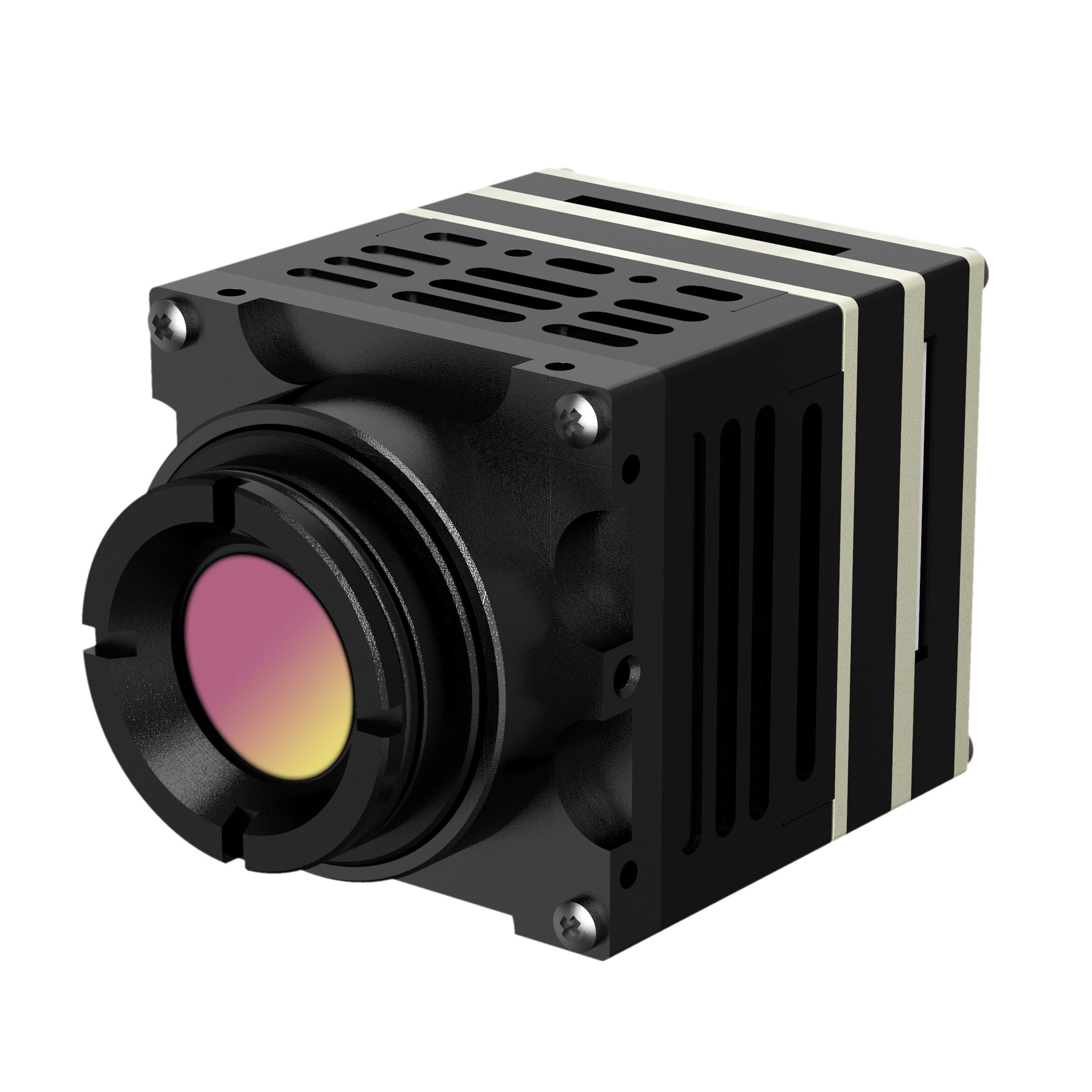
The CT-EI5ATC answers a different question entirely: what is present when visible light is absent, insufficient or obscured. It uses an uncooled vanadium oxide detector with 640×512 resolution and a 12 μm pixel pitch, operating in the 8–14 μm long-wave infrared band with NETD of ≤30 mK at 25°C. The 9.1 mm lens yields a 46°×37° field of view. Video output is CVBS or MIPI (MIPI optional) plus UVC, control runs over UART or USB, and the module accepts DC3.9–5.5V at typical 5V with ≤1.2W consumption. Dimensions are 25.4×25.4×38.8 mm including the lens, weight is 40 g, and the operating temperature range is published as -20°C to 60°C with storage from -45°C to 65°C.
The NETD figure is the one worth understanding. A noise-equivalent temperature difference of ≤30 mK at 25°C describes the smallest temperature contrast the detector can resolve against its own noise floor, so a lower value means fainter thermal differences remain visible — relevant for spotting a person against cool ground, a warm bearing in machinery, or a heat plume in a survey. The 640×512 array and 12 μm pitch give the resolution needed to make those differences legible at the ranges typical of tactical reconnaissance and industrial inspection work.
Application fit is broad because the physics is broad. IRLAB lists this thermal family against military and defence work, tactical reconnaissance, border patrol, mining and heavy industry, public security and law enforcement, emergency rescue, fire service, wildlife conservation and RC modelling, as well as SAR and industrial survey drone roles. In each case the camera is doing detection rather than cinematic imaging: it produces a thermal map of the scene and leaves the interpretation to the operator or to downstream analytics. Where a programme intends to add automated detection or tracking, IRLAB's published customisation list includes third-party AI algorithm integration and third-party wireless transmission integration — an OEM conversation rather than an off-the-shelf purchase.
Matching each camera to the mission
The three cameras are not competitors within one decision; they sit at three points on a mission map. The sequence below is the one a project team can apply directly.
| Mission profile | Recommended option | Why it fits | What to verify first |
|---|---|---|---|
| Daylight FPV racing, weight-critical freestyle | CDD-BS59KU | 9 g, 0.6W, DC4.5–27V input, 120° FOV, 1500TVL | VTX and OSD overlay compatibility; 4:3 frame preference |
| Low-light and near-zero-light analog reconnaissance | CDD-BS59KU | 0.00001LUX minimum illumination, S/N >60DB, 3DNR | Night footage from the intended VTX chain |
| Tactical video requiring recorded high-resolution evidence | CDD-BS5JMU | 4K30 recording to 1TB TF, 1080p90 / 720p120, MSP and MAVLINK OSD | Measured latency on the target link; 9W peak thermal budget |
| Night, smoke or camouflage-penetrating detection | CT-EI5ATC | 640×512 LWIR detector, NETD ≤30 mK, independent of visible light | Operating temperature against mission ambient; 46°×37° FOV coverage |
| Industrial survey and inspection | CT-EI5ATC | Thermal resolution for equipment and heat-plume inspection, ≤1.2W draw | Frame rate and output format required by the analytics pipeline |
Where each option stops — the limits that decide a build
A shortlist without boundaries is a brochure. Each of these cameras has a defined edge.
Analog versus digital latency and detail. The CDD-BS59KU carries an analog CVBS signal with no encoding stage of its own, which is why analog links remain attractive for response-critical flying, but the signal is 4:3 and it requires a separate transmitter plus OSD overlay hardware. It cannot deliver a 4K recorded file. The CDD-BS5JMU delivers that file, but publishes 50 ms glass-to-glass latency against a 22–40 ms reference range for mainstream digital systems, and draws up to 9 W. Choosing between them is a choice between a lean analog chain and a recordable digital chain, not a choice between better and worse.
Thermal versus low-light analog. A star-light analog camera with 0.00001LUX sensitivity still depends on there being some photons. A thermal detector at 640×512 with NETD ≤30 mK works from emitted heat and remains effective in total darkness, smoke and camouflage conditions where a visible-light sensor is blind. The trade is field of view and mass: the thermal unit covers 46°×37° against 120° on the other two, and weighs 40 g rather than 9 g.
The temperature envelope. The CT-EI5ATC publishes an operating range of -20°C to 60°C. Tactical scenario material collected by IRLAB describes ambient conditions from -38°C to 60°C, together with high vibration, shock and EMI. Buyers flying that lower extreme should treat the gap as a qualification question for the supplier rather than an assumption. Note also that the analog CDD-BS59KU and digital CDD-BS5JMU product data do not list an operating temperature range at all, so cold-soak and heat-soak evidence should be requested explicitly for those models.
Origin and documentation. IRLAB's history begins in Taiwan in 1992 with manufacturing established in Shenzhen in 2003. Buyers pursuing China-free sourcing claims for a tactical programme should ask for documentary origin evidence covering the camera and its imaging components, because origin claims in this category are frequently partial and public verification data is thin.
Procurement checks before a project order
Once the mission profile points to one model, the commercial checks are straightforward. Minimum order quantity is one unit, which allows a sample build to be validated before volume commitment. Small quantities ship immediately; larger orders are quoted at 15–25 working days after deposit. Quality control is 100% production check plus AQL-standard OQC under a TüV-certified ISO9001 system, and the warranty period is two years. Customisation relevant to project fit includes housing colour, logo printing, alternative viewing-angle lenses, video image style tuning, third-party AI algorithm integration and third-party wireless transmission integration.
The most useful document a buyer can request is a requirement-by-requirement matrix mapping the published specification against the mission threshold — latency against link budget, minimum illumination against expected scene light, NETD against the temperature contrast of the target, weight and volume against airframe capacity, and operating temperature against the deployment envelope. Where a published value sits close to the threshold, ask for a sample and test on the actual airframe.
Future outlook
Three forces are shaping how these choices will be made over the next few years. Thermal demand is the fastest-moving part of the payload market, with a projected 28.1% CAGR for the thermal segment between 2026 and 2034, which pulls suppliers toward higher detector resolution and lower NETD at the module level. Trade policy is moving in the opposite direction for some buyers: the 100% US Section 232 tariff on unmanned aircraft systems with thermal imaging and certain components, effective 3 September 2026, changes the landed cost calculus for thermal-equipped programmes and makes sourcing documentation a procurement deliverable rather than an afterthought. And on the analog side, low-light sensitivity and low mass remain difficult to replace for response-critical flying, which is why a 9 g 1500TVL camera with 0.00001LUX sensitivity still earns a place on a 2026 shortlist next to 4K digital and 640×512 thermal options.
The practical conclusion is that shortlists should be built per mission, not per supplier. A racing team, a tactical video programme and an industrial survey operator can all source from the same manufacturer while needing three different cameras, and the specification sheets — not the marketing positioning — are what separate them.
FAQ
What should a buyer compare first when shortlisting an FPV camera for a specific project?
Compare the mission threshold before the resolution. The four figures that eliminate options fastest are latency (glass-to-glass), mass and power draw, field of view, and the video path — analog CVBS, a digital 5.8 GHz link, or thermal CVBS/MIPI output. Sensitivity or thermal contrast then follows, because it determines whether the camera can detect the target in the conditions the mission actually flies in.
Which of the three cameras fits a daylight FPV racing build?
The analog CDD-BS59KU. Its published specification is 1500TVL resolution in 4:3, 120° field of view, minimum illumination 0.00001LUX, S/N ratio above 60DB, DC4.5–27V input at 0.6W, and 9 g weight in a 19×19×27 mm aluminium housing. The low mass, low draw and wide input voltage range suit small racing frames, and the CVBS output pairs with a standard analog video transmitter and OSD overlay system.
Which camera suits a tactical drone programme that needs high-resolution video and recorded evidence?
The digital CDD-BS5JMU. It uses a SONY image sensor and supports 3840×2160 at 30fps, 1080p at 90fps and 720p at 120fps with a 120° field of view, publishes 50 ms glass-to-glass latency, operates across 5.1–5.8 GHz with a 2T2R antenna configuration, and records to a TF card slot that accepts cards up to 1TB. OSD integration supports MSP and MAVLINK, input voltage is 9–30V, and total weight with fan is 32 g.
When is a thermal FPV camera a better fit than a low-light analog camera?
When detection depends on heat rather than reflected light. The CT-EI5ATC uses an uncooled vanadium oxide detector at 640×512 resolution with NETD ≤30 mK at 25°C in the 8–14 μm band, so it produces an image in total darkness, smoke or camouflage conditions. A star-light analog camera such as the CDD-BS59KU depends on the presence of some visible light, even at 0.00001LUX sensitivity, and produces a visible-light image rather than a thermal one.
Can the analog CDD-BS59KU be used for night missions?
Yes, within the limits of a visible-light sensor. Its published minimum illumination is 0.00001LUX, and IRLAB reports a one-year deployment with an FPV drone manufacturer in Ukraine covering roughly 30,000 units, in which that sensitivity level supported target identification and tracking in near-zero-light conditions. Because the output is CVBS in 4:3 and the camera does not record or measure temperature, night work that requires a recorded file or heat-based detection moves to the digital or thermal options.
What integration constraints should a team check before selecting the thermal CT-EI5ATC?
Four points dominate. The published operating temperature range is -20°C to 60°C, which does not cover the -38°C lower bound referenced in tactical scenario requirements. The 9.1 mm lens produces a 46°×37° field of view, narrower than the 120° coverage of the analog and digital cameras. The module needs DC3.9–5.5V at typical 5V with ≤1.2W and weighs 40 g at 25.4×25.4×38.8 mm including the lens. And it is a module rather than a complete imaging system: video is CVBS or MIPI (optional) plus UVC, with control over UART or USB, so airframe and ground-station integration has to be planned.
How does the supplier's scale and history affect project fit?
IRLAB Limited was founded in Taiwan in 1992, was established in Shenzhen in 2003, and reports more than 30 years of camera development and manufacturing experience with 100+ employees including 10+ engineers and a 3,000 m² facility. Practically, that supports evaluation builds at a one-unit minimum order, lead times of 15–25 working days after deposit for larger volumes, 100% production check plus AQL-standard OQC under a TüV-certified ISO9001 system, a two-year warranty, and OEM/ODM customisation of housing colour, logo, lens viewing angle, video image style, third-party AI algorithm integration and third-party wireless transmission integration.
For buyers who need the full manufacturing and capability background behind these three models, IRLAB Limited publishes a company profile and corporate brochure for public download: IRLAB Company Profile & Corporate Brochures (PDF).
Have Questions or Need More Details?
Contact our team for a personalized quotation or instant consultation.
Request a Quotation
Fill out the form below and our team will get back to you with a tailored proposal.
WhatsApp Direct Chat
Prefer to chat in real-time? Message us on WhatsApp for instant assistance & quick answers.
- Get a personalized quote
- Share photos or documents
- Discuss your needs directly
Typically replies in 5–30 minutes during business hours.