
Filler Wire vs Standard Loop Polyester Mesh Belts: A Decision Framework
Filler Wire vs Standard Loop Polyester Mesh Belts: A Decision Framework
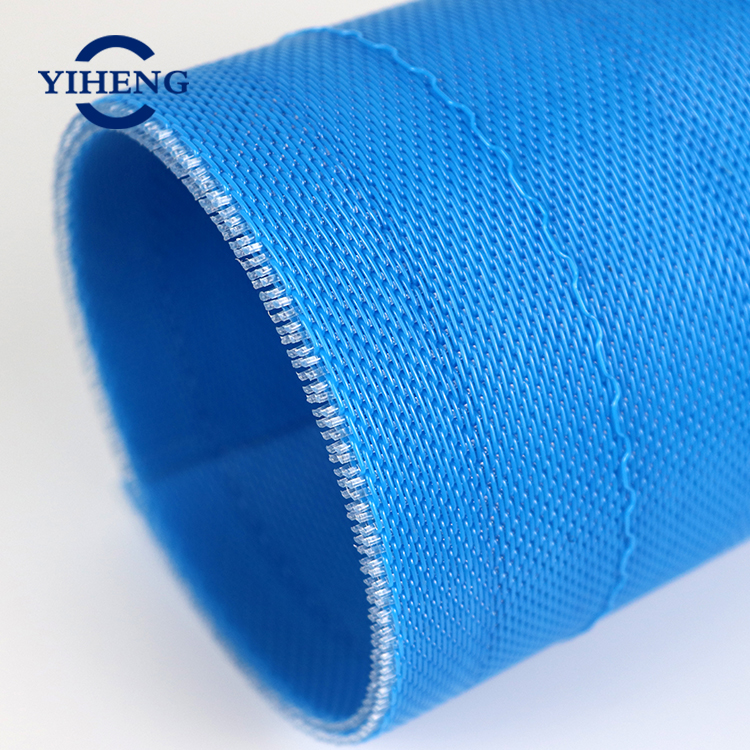
A polyester mesh belt can carry the same polymer specification, the same nominal material and the same supplier name, yet behave as a completely different component once it is installed on a machine. Within a single published catalogue, a standard medium-loop spiral belt passes 18,300 m³/㎡/h of air. The same medium-loop structure closed with flat wire fillers passes 10,700–12,000 ±500 m³/㎡/h. A denser small-loop filler-wire belt drops to 7,300 ±500 m³/㎡/h. All three are sold as polyester mesh belts. Only one of them matches the duty the machine was designed for.
This article sets out a buyer-side decision framework for choosing between standard loop and filler-wire polyester mesh belts, using published model specifications rather than material claims. It is written for procurement teams, process engineers and maintenance managers who are in the awareness-to-research stage: they know the belt is a consumable that affects output quality, but they have not yet narrowed the specification.
Why Belt Structure Outranks the Material Spec
Material specification settles chemical compatibility and temperature limits. It does not settle what the belt actually does inside the process: how much water drains per square metre per hour, how easily hot air passes through the sheet, which particle fraction is retained, or whether the belt tracks cleanly around small rollers. Those behaviours come from geometry — ring wire diameter, loop distance, filler wire cross-section and the heat-setting process used to stabilise the finished fabric.
Polyester (PET) became the default material for these belts because it balances tensile strength, hydrolysis resistance and cost. The commercial weight behind that choice is visible in market data: polyester is the largest material segment in the global conveyor belt market with a 28.4% share in 2025 (Straits Research, Conveyor Belt Market report, 2026). That figure describes the material category, not the specification decision. Inside the polyester category, the spread in airflow performance between structures is far wider than the spread between polyester and most alternative polymers.
Spiral mesh belts are built on two structural families:
- Standard loop spiral belts — formed from interlocking ring wires. The open channel between adjacent loops controls how much air and water pass through the fabric.
- Filler-wire spiral belts — the same loop structure, with flat polyester wires threaded through the loop gaps. The channel remains, but its open area is reduced, so flow is restricted and filtration becomes finer.
Everything that follows in a selection process flows from that single mechanical difference.
Published Specifications Across the Two Families
The table below consolidates verified model data for spiral mesh belts in standard loop and filler-wire configurations. It is the factual base for the decision framework that follows.
| Configuration | Structure | Thickness | Air Permeability | Strength at Break | Loop / Filler Detail |
|---|---|---|---|---|---|
| Medium Loop (standard) | Polyester spiral mesh | 2.32 mm | 18,300 m³/㎡/h | ≥2000 N/cm | Loop distance 6.50 mm |
| Small Loop (standard) | Polyester spiral mesh | 1.90 mm | 17,500 m³/㎡/h | ≥2000 N/cm | Loop distance 5.20 mm |
| Medium Loop-Filler Wire | Polyester spiral mesh + flat wire filler | 2.32 mm | 10,700–12,000 ±500 m³/㎡/h | ≥2000 N/cm | Filler 0.68×3 mm / 0.68×4 mm; threading 0.90 mm; ring wire 0.68 mm |
| Small Loop-Filler Wire | Polyester spiral mesh + flat wire filler | 1.90 mm | 7,300 ±500 m³/㎡/h | ≥2000 N/cm | Filler 0.65×1.65 mm flat wire; threading 0.80 mm |
| Large Loop-Filler Wire | Polyester spiral mesh + flat wire filler | 2.95 mm | 9,000–13,700 ±500 m³/㎡/h | ≥2300 N/cm | Filler 0.90×3 / 0.90×4 / 0.90×5 mm; threading 1.00 mm; ring wire 0.90 mm |
One comparison in this table deserves particular attention. Medium Loop and Medium Loop-Filler Wire share an identical 2.32 mm thickness. Only the filler changes. Yet air permeability falls from 18,300 m³/㎡/h to a 10,700–12,000 ±500 m³/㎡/h band — roughly a one-third reduction in open flow area. That is the cleanest evidence that filler wire is a performance decision, not a cosmetic or premium-tier decision.
Air Permeability as the First Filter in the Decision
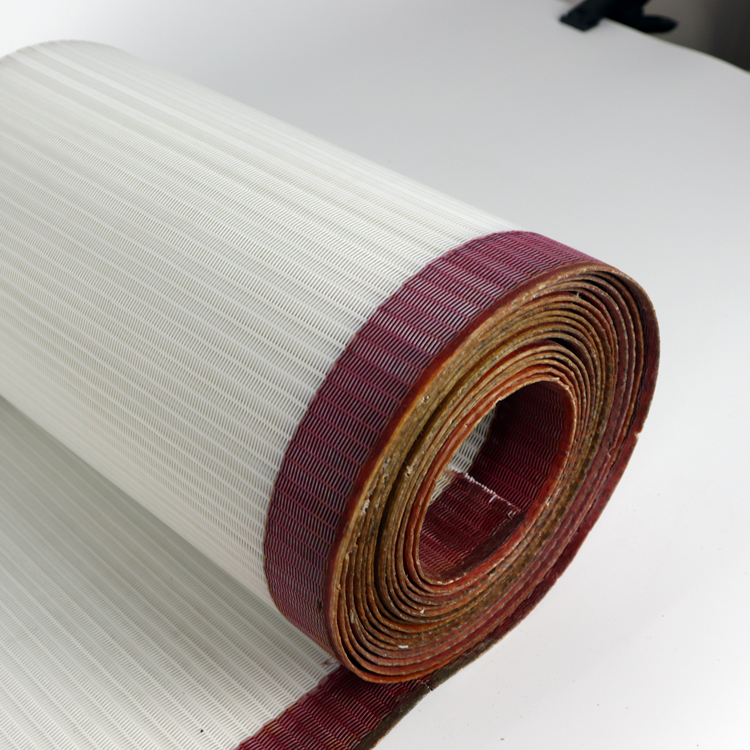
Before comparing models, a buyer should fix the airflow target. In most plants this number already exists: it sits in the machine manual, in the vacuum box specification, in the fan duty or in the drying section design. Air permeability is measured in m³/㎡/h and describes how much air passes a square metre of fabric in an hour under stated conditions.
Air permeability simultaneously serves two opposing process goals. In dewatering and filtration, lower permeability produces finer retention and a drier cake. In drying, higher permeability produces faster, more even heat penetration. There is therefore no universally superior permeability figure — only a figure that matches the duty. A belt filter press that cannot reach filtrate clarity is often suffering from a belt specified too open for its solids load, not from a material defect.
Practical rule: write the target permeability band first, then screen models against it. Selecting a belt first and adjusting the process afterwards is the most common cause of a changed consumable that never delivers the expected result.
Filtration Fineness and Cake Dryness
On a belt filter press, the belt carries sludge flocs through a gravity drainage zone and then through a mechanical pressure zone. Finer filtration requires a narrower flow path so that more of the fine fraction is retained while water still passes. Flat wire fillers exist precisely to create that narrower path.
The most compact configuration in the range, Small Loop-Filler Wire, uses a 0.65×1.65 mm flat wire filler to reach a denser mesh structure and a published permeability of 7,300 ±500 m³/㎡/h. It is built for applications where maximum solids retention and filtrate clarity matter more than throughput: belt filter presses, papermaking pulp washing, meltblown non-woven equipment, fabric pre-shrinking machines and latex wire drying and conveying.
Medium Loop-Filler Wire sits one step broader. With 0.68×3 mm or 0.68×4 mm fillers, it delivers 10,700–12,000 ±500 m³/㎡/h depending on the filler selected, keeping the same ≥2000 N/cm break strength and the same 2.32 mm profile as the standard medium loop. Large Loop-Filler Wire covers the widest band, 9,000–13,700 ±500 m³/㎡/h, with 0.90×3, 0.90×4 or 0.90×5 fillers, and raises break strength to ≥2300 N/cm for heavy-duty pressing.
Drying Airflow and Heat Penetration
The logic reverses in drying duty. Medium Loop standard, at 18,300 m³/㎡/h with a 6.50 mm loop distance, is a drying-oriented configuration: hot air must pass through the belt and contact the web. Closing that same structure with filler wire reduces permeability to roughly 10,700–12,000 m³/㎡/h and, at equal fan power, slows the drying rate.
This means a filler-wire belt specified for a dryer section is not a neutral upgrade. It is a trade: better web support and finer particle control in exchange for reduced thermal throughput. Buyers running fabric pre-shrinking or latex wire drying lines should confirm which of those two outcomes the line is limited by before choosing between the 18,300 m³/㎡/h standard medium loop and a filler-wire alternative.
Thickness, Loop Distance and Machine Compatibility
Machine fit is usually the constraint that eliminates options before performance is even discussed. Three dimensions must be reconciled against the machine drawing:
- Belt thickness. The range spans 1.90 mm (Small Loop and Small Loop-Filler Wire), 2.32 mm (Medium Loop family) and 2.95 mm (Large Loop-Filler Wire). A 1.90 mm belt suits machines with tight roller spacing; a 2.95 mm belt is engineered for high-tension, heavy-load positions.
- Loop distance and bending behaviour. A 6.50 mm loop distance bends on a larger radius than a 5.20 mm loop. Where roller diameters are small or the return path is short, a fine-loop belt runs more cleanly.
- Joint type. Spiral mesh belts are available with endless or self-ring joints. A joint that does not match the machine's tracking system produces edge wear and off-tracking that is often misattributed to belt quality.
Smooth-surface construction also matters here. These belts are described as allowing arbitrary disassembly and assembly, which simplifies installation, seam changes and routine maintenance — a practical advantage on lines where a full belt replacement is a multi-hour stoppage.
Break Strength and Tension Load
Published break strength across the spiral range clusters at two levels: ≥2000 N/cm for the small and medium loop configurations, and ≥2300 N/cm for Large Loop-Filler Wire. The difference is modest in isolation but meaningful in context — the higher figure is tied to heavy-duty pressing positions where thick cakes, high mechanical load and continuous tension coincide.
Buyers should not read break strength as a standalone quality score. A ≥2000 N/cm belt run permanently at the top of its tension window will fatigue faster at the loop joints, and the failure will appear as tracking drift or edge cracking rather than as a clean tensile break. Matching the strength class to the actual running tension, with a working margin, is the more reliable approach.
Surface Smoothness, Cleaning and Maintainability
Filler wire introduces a maintenance trade-off that buyers frequently underestimate. Narrower flow channels retain fine fibres and scale more readily. In high-fibre sludge or papermaking stock, a filler-wire belt needs a more disciplined cleaning routine than an open standard loop belt.
This should be settled during selection, not after installation. The relevant question is which cleaning method the machine supports — high-pressure water, chemical wash or mechanical doctoring — and how frequently it can be run without stopping production. A belt that meets the filtration target but cannot be cleaned on the available cycle will blind prematurely and lose the performance it was bought for.
Mapping Configurations to Applications
The following mapping uses published application data for these models. It is a starting point for specification discussions, not a substitute for confirming roller diameters, joint type and running tension with the equipment builder.
| Application | Dominant Constraint | Configuration Starting Point |
|---|---|---|
| Belt filter press sludge dewatering | Cake dryness and solids capture | Small Loop-Filler Wire (7,300 ±500 m³/㎡/h); Medium Loop-Filler Wire (10,700–12,000 ±500 m³/㎡/h) |
| Papermaking pulp washing | Fine fibre retention under tension | Medium Loop-Filler Wire; Large Loop-Filler Wire (≥2300 N/cm) for high-tension positions |
| Meltblown non-woven equipment | Uniform airflow and web stability | Medium Loop standard for airflow-led duty; filler-wire variants where formation control dominates |
| Fabric pre-shrinking | Dimensional stability and mark-free surface | Medium Loop-Filler Wire |
| Latex wire drying and conveying | Heat penetration with controlled particle pass-through | Medium Loop standard (18,300 m³/㎡/h) for airflow; Large Loop-Filler Wire for heavy-load drying |
How a Buyer Should Sequence the Decision
Applied in order, the framework narrows a catalogue quickly and avoids the most expensive error — buying a technically sound belt for the wrong duty.
- Fix the permeability band from the process goal. Drying-led duty points toward higher airflow (18,300 m³/㎡/h class). Filtration-led duty points toward the 10,700–12,000 or 7,300 m³/㎡/h classes.
- Screen for machine compatibility. Confirm thickness against roller spacing, loop distance against minimum roller diameter, and joint type against the tracking system.
- Set the strength class from actual running tension. Use ≥2000 N/cm for standard spiral positions and ≥2300 N/cm where heavy pressing and thick cakes are routine.
- Define the cleaning regime. Establish which cleaning method the machine supports and whether a denser filler-wire structure can be cleaned on that cycle.
- Only then compare suppliers. At this stage the comparison moves to weaving consistency, heat-setting control and joint workmanship — factors that decide whether the specified permeability is delivered repeatably rather than only on a sample.
Where the Filler-Wire Approach Reaches Its Limits
A credible framework has to state where its preferred option stops working. Filler wire is not a general upgrade, and treating it as one creates predictable failures.
- It trades airflow for fineness. In dryer-limited processes, the same filler that improves retention reduces thermal throughput. A 10,700–12,000 m³/㎡/h belt is not an improvement over 18,300 m³/㎡/h when the line is airflow-bound.
- It raises cleaning demand. Narrow flow channels blind faster in high-fibre or scaling duty, so the maintenance regime must be matched to the structure, not adapted afterwards.
- It adds manufacturing sensitivity. Flat wire filling increases construction complexity, and edge distortion such as bell mouths or ruffles translates directly into off-tracking. Heat-setting consistency becomes more critical on filler-wire belts than on open standard loops.
- It is not a substitute for loop geometry. Where very high tension and heavy cakes dominate, the larger loop structure and its ≥2300 N/cm strength class matter more than the presence of filler wire.
Market Signals and What They Mean for Specification
Two published trends support the case for treating belt structure as a specification decision rather than a commodity purchase. Belt filter press technology is projected to grow at a compound annual rate of 8.8% from 2025 to 2033 within the sludge dewatering equipment market (Grand View Research, Sludge Dewatering Equipment Market report, 2026). Separately, the global conveyor belt market is projected to grow from USD 6.24 billion in 2026 to USD 8.53 billion by 2034 (Straits Research, 2026), with polyester holding a 28.4% material share.
The implication is straightforward. As dewatering capacity expands, more buyers will be specifying belts for filtration-critical positions where a one-third difference in air permeability changes the outcome. At the same time, the belt itself remains a consumable governed by trade classification rather than a single performance standard — polyester mesh belts for technical uses typically fall under HS Code 5911.90 in the Harmonized Tariff Schedule. Buyers should therefore expect performance evidence from the supplier's own model data and test records, because the tariff code will not settle a specification question.
Future Outlook
Filter belt selection is moving toward duty-specific specification. The reason is structural: as dewatering and drying equipment runs closer to its design limits, a belt that is merely 'polyester mesh' no longer produces predictable output. The published differentiation between 18,300, 10,700–12,000 and 7,300 m³/㎡/h configurations already gives buyers a usable vocabulary for that specification.
The next step for most procurement teams is not a new material — it is a tighter brief. Writing the permeability band, thickness and strength class into the purchase specification turns a consumable decision into a measurable one, and gives suppliers a defined target to be evaluated against.
Manufacturer Reference
Henan Yiheng Mesh Belt Industry Co., Ltd. is a Chinese manufacturer of polyester mesh belts and industrial filter belts, founded in 2009 and operating a 4,237 m² manufacturing facility with an annual production capacity of 150,000 m². The company employs approximately 41 staff, including an R&D team of 3 engineers, and exports account for 62% of total sales, with major markets in Asia, Europe and North America. Its product range includes Polyester Mesh Belt, Non-Woven Mesh Belt, Forming Fabrics, Dryer Fabrics, Polyester Filter Belt, UV Belts, Polyester Spiral Mesh, Polyester Square Mesh and PTFE Mesh Belt. The model specifications cited in this framework are drawn from its published product data.
A full company and product brochure is available for download: Henan Yiheng Mesh Belt Industry – English Brochure (PDF).
FAQ
1. What is the structural difference between a filler-wire polyester mesh belt and a standard loop polyester mesh belt?
The difference is the open channel between loops. A standard loop spiral belt lets air and water pass through the gap between interlocking ring wires — the Medium Loop configuration is published at 18,300 m³/㎡/h. A filler-wire belt threads flat polyester wires through those gaps, reducing the open area. On the same 2.32 mm Medium Loop structure, that reduction brings permeability to 10,700–12,000 ±500 m³/㎡/h.
2. Which air permeability values apply to belt filter press duty?
Belt filter presses are filtration-critical and typically use the lower-permeability configurations. Small Loop-Filler Wire is published at 7,300 ±500 m³/㎡/h, Medium Loop-Filler Wire at 10,700–12,000 ±500 m³/㎡/h, and Large Loop-Filler Wire across 9,000–13,700 ±500 m³/㎡/h depending on whether 0.90×3, 0.90×4 or 0.90×5 filler wire is used.
3. How does belt thickness affect machine compatibility?
Thickness determines the smallest roller gap the belt can pass through and influences how it bends around rollers. The published range is 1.90 mm for Small Loop and Small Loop-Filler Wire, 2.32 mm for the Medium Loop family, and 2.95 mm for Large Loop-Filler Wire. Loop distance matters alongside thickness: a 5.20 mm loop bends on a smaller radius than a 6.50 mm loop, which suits machines with tight roller layouts.
4. Are filler-wire belts weaker than standard loop belts?
No. Published break strength for Small Loop-Filler Wire and Medium Loop-Filler Wire is ≥2000 N/cm, the same class as the standard Small Loop and Medium Loop configurations. Large Loop-Filler Wire is rated at ≥2300 N/cm, higher than the medium-loop group. Break strength is determined mainly by ring wire, threading and weave structure; filler wire chiefly changes permeability and retention fineness.
5. Which applications need the lower-permeability 7,300 m³/㎡/h configuration?
The 7,300 ±500 m³/㎡/h configuration is intended where maximum solids retention and a drier cake matter most. Its published application scope covers belt filter presses, papermaking pulp washing, meltblown non-woven equipment, fabric pre-shrinking machines, and latex wire drying and conveying. Buyers should weigh that against the higher cleaning requirement that comes with a denser flow channel.
6. Can a filler-wire belt be used in a drying section?
It can, but with a performance trade-off. Where heat penetration is the limiting factor, the standard Medium Loop at 18,300 m³/㎡/h passes more air than a filler-wire equivalent at 10,700–12,000 m³/㎡/h. A filler-wire belt in drying duty is appropriate when web support and particle control are the dominant constraints rather than airflow alone.
Have Questions or Need More Details?
Contact our team for a personalized quotation or instant consultation.
Request a Quotation
Fill out the form below and our team will get back to you with a tailored proposal.
WhatsApp Direct Chat
Prefer to chat in real-time? Message us on WhatsApp for instant assistance & quick answers.
- Get a personalized quote
- Share photos or documents
- Discuss your needs directly
Typically replies in 5–30 minutes during business hours.