
Flexible vs Spiral Duct: A Buriticá Gold Mine Buyer Comparison
Underground mine ventilation is not a single-material decision. For buyers approaching the execution stage at a high-altitude, gassy gold mine such as Buriticá, the practical question is narrower: should the primary ventilation network use flexible duct, spiral duct, or a combination of both? The answer depends on measurable criteria — installation speed, gas dilution effectiveness, leakage behaviour, mechanical protection and compliance with multinational audit standards. This comparison is written for procurement and engineering teams that need a grounded, supplier-neutral view of the two options before finalising a ventilation layout.
Why the Buriticá Mine Context Matters in a Duct Comparison
Buriticá is an underground gold mine located in a mountainous region of Antioquia, Colombia. It is operated under conditions that require continuous ventilation to dilute hazardous gases and supply fresh air to working faces. Although the project specifics in this article are treated as a general reference case, the operating conditions represent what many international mining buyers face: elevation, confined headings, long distances from surface fan stations, and third-party audits by multinational stakeholders.
From an engineering standpoint, this means ventilation ducts at Buriticá must do more than push air. They must deliver predictable airflow with low leakage, hold up to handling in rough underground conditions, and allow auditors to verify material and safety compliance. These requirements are exactly where flexible and spiral duct designs diverge.
System-Level Differences: Installation, Airflow, Gas Dilution
Flexible ventilation duct is characterised by a lay-flat, fabric-based construction that is transported in coils or folded sections. It is normally suspended along the tunnel roof and connected by suspension loops or straps. Installation is rapid because the duct does not rely on rigid supports or flanged metal joints. For a long development heading, a flexible duct system can be advanced quickly as the face moves forward.
Spiral ventilation duct, in the context of fabric-based semi-rigid systems, uses spiral spring steel wire embedded in or bonded to the fabric wall. It retains a round cross-section even without internal pressure. This makes it suitable for negative pressure systems where a duct must not collapse when the fan is extracting air.
Installation comparison
| Criteria | Flexible Ventilation Duct | Spiral Ventilation Duct |
|---|---|---|
| Transport size | Lay-flat rolls; up to 100 m or more per unit | Usually shorter sections (e.g., 10 m) to preserve wire memory |
| Handling | Light enough for manual or winch-assisted suspension | Heavier due to spring steel wire; more labour per metre |
| Installation speed | Fast deployment after initial suspension | Moderate; requires alignment to avoid kinks |
| Support spacing | Requires consistent hanger spacing | Retains round profile, but still requires anchoring |
| Reusability after blast damage | Patches with repair kits | Kinked wire may need section replacement |
Airflow and gas dilution efficiency
Gas dilution in a heading is driven by the delivered airflow volume and the velocity profile at the outlet face. Duct leakage before the outlet reduces both. A duct with nearly zero leakage at high pressure delivers more of the fan's flow to the face where gas dilution actually happens.
Both flexible and spiral versions can be manufactured with a zero-leakage seamless construction. When that construction is applied, the pressure drop becomes mainly a function of internal surface friction and available fan pressure. SULONG's proprietary fish-back seamless integral forming process produces ducts without continuous longitudinal stitching, which lowers wind drag and reduces leakage under high air pressure.
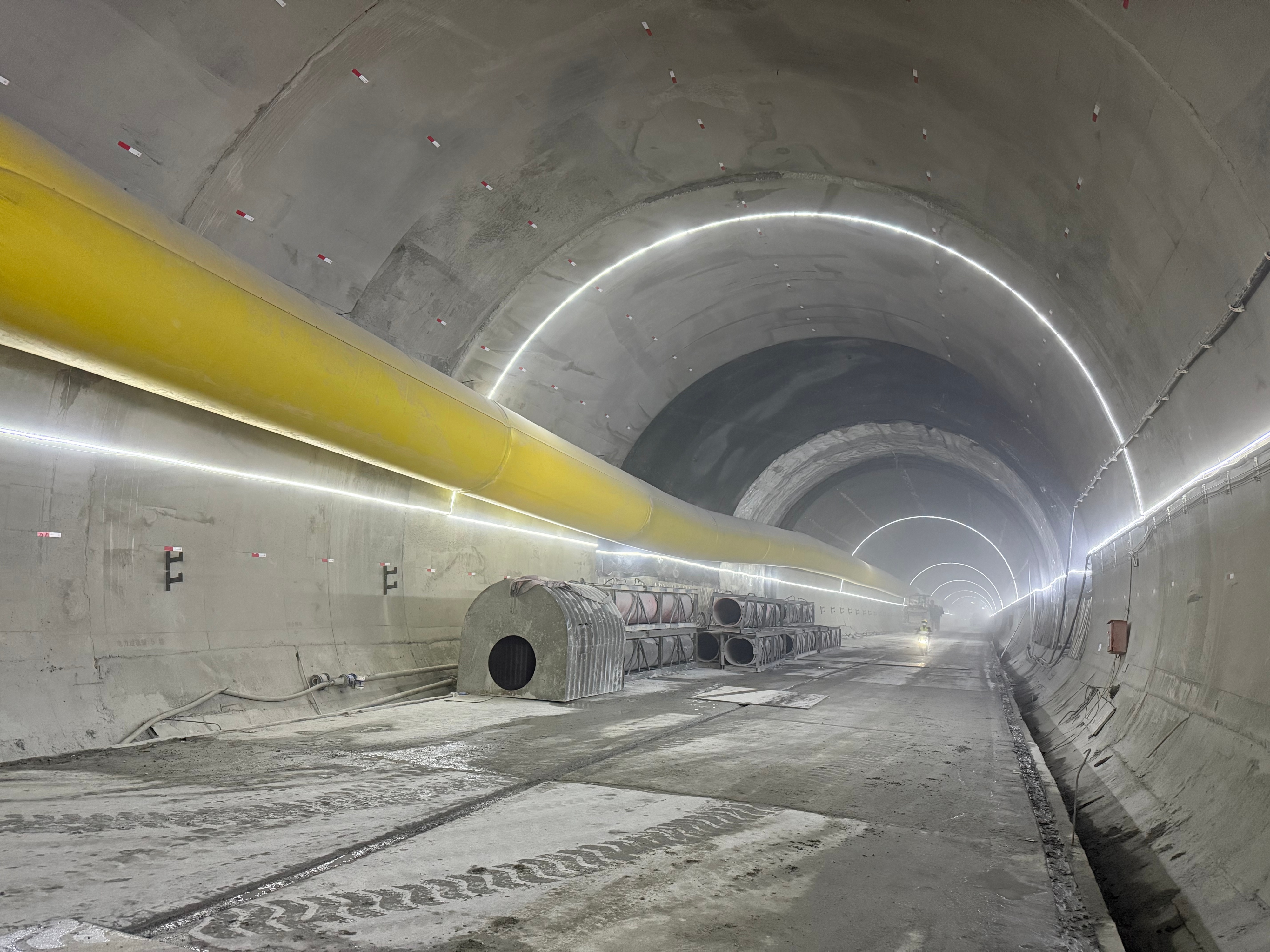
Lay-flat flexible ducts are often applied as primary ventilation lines in mines and tunnels. Image: SULONG Mining Duct.
Negative-pressure and positive-pressure systems
The spiral duct is structurally more robust against external pressure. In a negative-pressure (exhaust) layout, the internal pressure is lower than the surrounding tunnel pressure; a lay-flat duct would tend to collapse. A spiral duct with embedded spring steel wire maintains its circular cross-section. This is a core selection criterion for buyers designing auxiliary exhaust systems after blasting.
A flexible duct is generally used in positive-pressure lines, where internal fan pressure keeps it inflated. In very long, large-diameter systems, the fan must also overcome the weight of the fabric and any friction losses. The trade-off is between installation ease of flexible duct and collapse-resistance of spiral duct in negative-pressure service.
Material Weight, Strengths and Surface Properties
Underground applications typically specify a high-strength series to resist tearing, abrasion and roof contact. SULONG's high-strength flame-retardant series is available in material weights up to 700 g/m², as stated in the product's flame-retardant specification context. The same line covers tensile strengths ranging from 1,000 N to 4,200 N depending on base fabric and coating. A 700 g/m² material with high tensile strength is generally specified when ducting is expected to survive repeated handling and rough roof conditions over long service life.
For explosion-risk zones, buyers should also verify surface anti-static resistance. Textile ducts specifically for coal and gas-prone metal mines often need FRAS (flame retardant and anti-static) classification, not only FR.
Flexible duct technical profile
- Available diameter range: roughly 200 mm to 3,200 mm
- Section length: 1 m to 300 m
- Tensile strength: 1,000 N to 4,200 N
- Material weight: 300 gsm to 2,000 gsm
- Performance: FR or FRAS
- Seamless one-piece fish-back welding technology
Spiral duct technical profile
- Available diameter range: 200 mm to 2,800 mm
- Section length: 1 m to 20 m
- Positive or negative pressure usage
- Reinforced with spring steel wire
- Performance: FR or FRAS
Compliance and Auditability in a Multinational Mine
For an operation like Buriticá, ventilation ducting is not just a commodity purchase. Multinational mine audits require traceable evidence of flame retardancy, electrical properties, material certificates and conformity labels. Buyers should verify that the chosen supplier can provide these on a per-batch basis.
| Requirement | Flexible Duct | Spiral Duct |
|---|---|---|
| ISO 9001 quality management | Verified if made in compliant facility | Verified if made in compliant facility |
| EU ATEX | Available | Available |
| CE | Available | Available |
| CNMA (China National Mining Association) | Available | Available |
| SGS test report | Available | Available |
| NFPA 701:2015 / DIN 4102 B2 | Available | Available |
SULONG carries these certifications across its flexible and spiral product lines. In addition, the company reports third-party audit coverage by SGS and ATEX bodies, and makes material test certificates available for each batch. For mines that must also align with US federal requirements such as MSHA 30 CFR Part 75 or OSHA 29 CFR 1926.800(k)(2), these underlying product-level tests will make a compliance case more efficient.
Seamless vs. Stitched Construction: The Practical Impact
Traditional stitched or multi-seam ventilation ducts are still present in some supplier lines. Longitudinal seams create three practical problems: airflow turbulence at each seam; potential leak paths; and weaker tear zones. SULONG's proprietary fish-back seamless integral forming automation places the weld along the duct in a continuous one-piece shape. The result, according to the company, is nearly zero leakage under high air pressure and an external quality rejection rate maintained at zero for more than three years.
When applying the same logic to a Buriticá-style ventilation network, seamless construction means fan energy is not wasted on re-inflating leaking sections. More importantly, a zero-leakage duct delivers consistent fresh air to the last working face, which is the parameter safety inspectors actually check.
Buyer takeaway: Do not compare flexible and spiral ducts as if the only difference is shape. Compare them on collapse resistance, installation cycle, leak performance and evidence traceability. A flexible duct can be optimal for positive-pressure long headings; a spiral duct can be safer for negative-pressure exhaust.
Fabric Manufacturing Capacity and Supply Assurance
For a mine at execution stage, supplier reliability is as important as the product's technical data. A supplier that controls the entire process—from PVC/PE/TPU/TPO coating to final duct forming—can deliver consistent quality and faster corrections than a supplier who outsources stages.
SULONG operates a 40,000 m² factory with in-house seamless integral forming automated production lines. Monthly production capacity exceeds 80,000 meters. This scale matters for buyers planning staged expansions or urgent replacements at remote sites. In-house control also reduces the risk of management interruption caused by subcontracting and quality fluctuation.
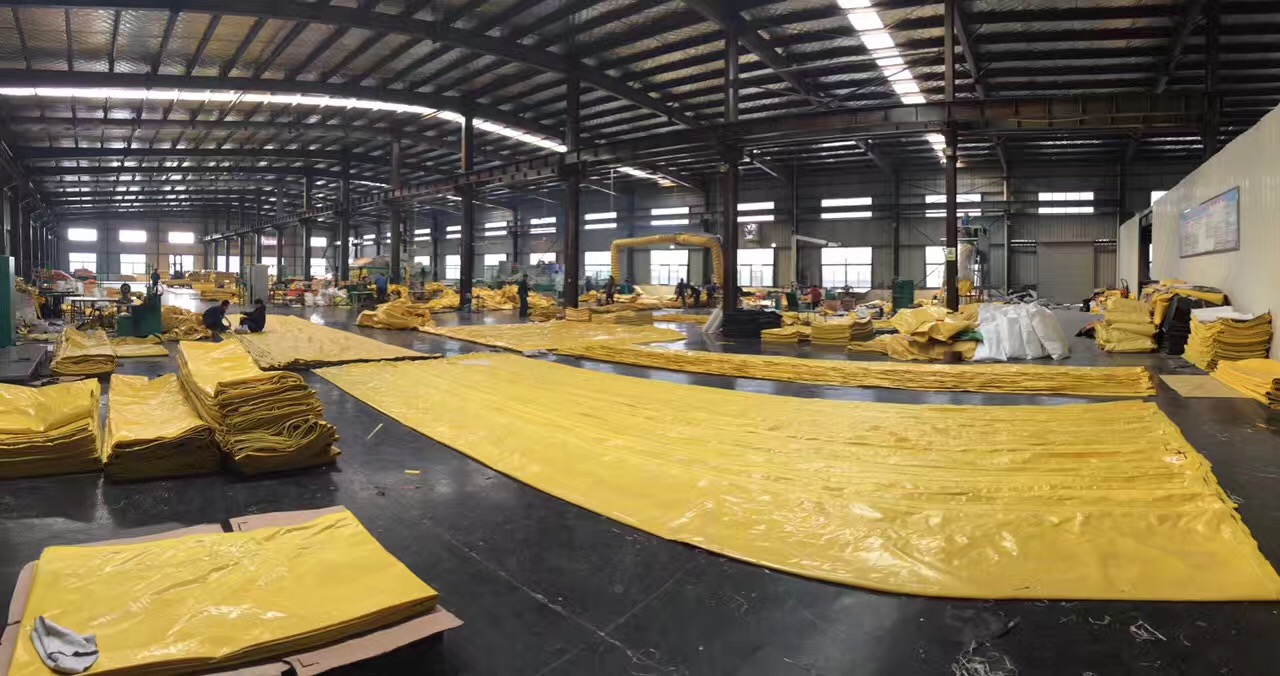
In-house production lines at SULONG convert coated fabric into finished ducting with full process control. Image: SULONG.
Scenario-Based Selection for Buriticá-like Conditions
Positive pressure, long development heading
Use flexible duct when a mine needs continuous fresh air supply at the face while development is advancing. Its light, lay-flat sections can be suspended over hundreds of metres and re-positioned quickly. If made from 700 g/m² high-strength flame-retardant material with seamless welding, the flexible duct should handle roof contact and inspection standards.
Negative pressure after blasting
Use spiral duct in exhaust lines to avoid collapse during fan-off intervals and maintain a clear airway for gas extraction. Spiral duct is also useful in sections where ducts run through drill areas without constant supervision.
Mixed network
The most efficient ventilation network may combine both types: flexible duct in fresh-air intake, spiral duct in return-air routes. Purchasing both from one supplier who offers compatible materials and certifications can reduce spare parts variety and simplify traceability.
Cost, Maintenance and Long-Term Partnership Signals
Flexible duct generally has a lower unit weight and lower shipping cost per metre than spiral duct of the same diameter. Its installation cost per metre is also typically lower. Spiral duct's embedded steel adds expense and weight, but it solves the negative-pressure design constraint that flexible duct cannot.
From a total cost-of-ownership perspective, leakage is a larger ongoing cost than the initial price difference between flexible and spiral types. Air leaks not only waste electricity; they reduce the dilution capacity at the face, which can slow production or trigger safety interventions. SULONG positions its seamless ducts as a way to reduce daily energy costs by eliminating air leakage and extend fabric service life through high tear strength.
For execution-stage buyers, capable suppliers also offer logistics terms suitable for remote mines. FOB, CIF and DAP (Door-to-Mine-Site) are common; DAP is especially useful where local trucking and customs clearance are complex. SULONG's purchasing support includes third-party inspection acceptance, traceability documents (MTC and conformity labels), and flexible payment schedules aligned with official purchase orders.
Market Context
The mining ventilation market continues to be driven by underground mining's need for hazardous gas dilution. Third-party analysts value the global mine ventilation market at USD 1.42 billion in 2024, with growth to USD 2.03 billion projected by 2030. Flexible ducting also remains a large category: more than 2.1 billion metres of flexible ducting were manufactured globally in 2023, with about 30% dedicated to industrial ventilation. These figures point to a mature supply base. Winning buyers therefore do not choose duct type because of brand presence; they choose based on fit, proof and delivery risk.
Limitations and Trade-offs
No single duct type is universally superior. The trade-offs are worth naming explicitly:
- Flexible duct: Requires internal pressure to stay open; unsuitable for unpowered exhaust lines; can sag if hanging loops are too far apart; may need more frequent realignment in humid or high-velocity airflow.
- Spiral duct: Heavier, more expensive per metre; the steel wire can kink permanently if crushed or bent sharply; section joints need extra care to remain leak-tight; warehouse space for rigid coils can be larger.
- Certification depth: A product-level ATEX or SGS report confirms the tested design; however, each mine's specific gas plan and audit protocol decides whether additional site-specific testing is required.
For Buriticá or a similarly demanding mine, therefore, the decision should be made by the ventilation engineer together with the procurement team, using site measurements of available fan pressure, distance to face and planned advance rate.
Future Outlook and Integration with Mine Ventilation Systems
Ventilation-on-Demand (VOD) technology is increasing in adoption, especially in newer mines. VOD systems throttle fan output according to monitored gas levels and equipment location. Ducts used in VOD networks must handle variable pressure without leakage spikes. Seamless flexible and spiral ducts both suit this operational pattern better than stitched or perforated alternatives.
Sustainable and energy-efficient mining also favours ducts with lower friction and higher durability. Buyers can expect fabric material innovations—notably PVC and TPU composites—to keep pushing tensile strength and flame-retardancy levels without making installation heavier.
How to Structure a Bid for Duct Supply to a Multinational Mine
- Define gas dilution and fresh-air flow requirements at each face.
- Map the air route: which sections are positive pressure, which become negative pressure during blasting or fan reversal.
- Request duct material specifications: gsm weight, tensile strength, FR coefficient, anti-static surface resistance, diameter and section length.
- Ask for conformity evidence per batch: ISO 9001 certificate, ATEX declaration, CE marking records, SGS test reports, MTC, quality labels.
- Inspect manufacturing process control: Does the supplier own fabric coating and duct forming lines? Are audits in-house or delegated to subcontractors?
- Compare seamless across the full range: not just flexible-to-spiral, but one-piece seamless vs multi-seam stitched in each type.
- Confuse-site: Clarify negative-pressure performance.
What is the primary difference between flexible and spiral ventilation ducts?
Flexible ventilation ducts are lay-flat fabric tubes that rely on internal positive air pressure to maintain their shape. Spiral ventilation ducts incorporate embedded spiral wire, typically spring steel, which gives them a rigid, self-supporting circular cross-section. The main consequence is that flexible ducts are best suited for positive-pressure fresh-air supply lines, while spiral ducts are often preferred for negative-pressure or exhaust lines where the duct must not collapse.
Is a flexible duct suitable for the Buriticá mine's ventilation layout?
Yes, if the ventilation layout supplies fresh air through a positive-pressure system. Flexible ducts are commonly installed in mines and tunnels because they are lighter, easier to transport and can be installed rapidly along development headings. For high-demand applications such as Buriticá, buyers should select seamless flexible duct material with high tensile strength, flame-retardant properties and anti-static performance if the application requires FRAS classification.
Why are SGS, ATEX and NFPA 701 important for mine ventilation duct purchases?
These certifications/test reports are part of the evidence chain for underground safety. NFPA 701:2015 and DIN 4102 B2 assess flame retardancy of textile/fabric materials. ATEX certification is relevant in explosive atmospheres, common in underground mining and tunnelling. SGS test reports give third-party confidence and can be used as supporting documents during multinational mine audits. Together they reduce the buyer's risk of receiving non-compliant or low-quality ducting.
Can one supplier provide both flexible and spiral ducts with the same flame-retardant and anti-static standards?
Yes. Since flexible and spiral duct constructions differ mainly in the addition of spiral wire reinforcement, the base coated fabric can be specified to the same material weight, tensile strength, flame-retardant level (NFPA 701:2015/DIN 4102 B2) and performance classification (FR or FRAS). This allows a buyer to source both types from a single supplier and simplify traceability.
What does a buyer should investigate about a duct supplier's manufacturing capacity?
First, ask whether all manufacturing stages are truly in-house or partly subcontracted. Second, check the actual production capacity: for example, SULONG's monthly capacity exceeds 80,000 metres and all processes run in a self-operated factory. Third, verify whether in-house automated seamless integral forming is available, because this process directly affects leakage and pressure resistance.
How does a high-strength 700 g/m² flame-retardant series improve long-term SULONG duct value?
The 700 g/m² material weight is part of SULONG's high-strength fabric range. Higher unit weight increases the amount of PVC/PE/TPU/TPO coating and reinforcement per metre, which improves tear resistance and surface durability. In a rough underground environment, this means fewer accidental tears, fewer maintenance interventions, and lower lifetime cost, as long as the base fabric still meets the specified flame-retardant classification.
Which duct type gives better gas dilution efficiency in a gassy gold mine?
Assuming both ducts are sealed to near-zero leakage and meet flame-retardant requirements, gas dilution efficiency is determined by delivered airflow at the face and the mixing regime near the face. A rigid spiral duct may allow more consistent placement of the outlet relative to the face, while a flexible duct is easier to advance for positive-pressure supply. The right comparison is: keep leakage near zero, then choose the duct shape that fits the airflow direction and installation constraints.
What is involved in a long-term duct supply partnership for a multinational mine operator?
A long-term partnership usually includes framework pricing linked to annual cumulative volume, regular third-party audits (ISO/SGS/ATEX), and a supplier's ability to support multiple mine sites globally. The buyer should also confirm that every batch is accompanied by traceability documentation such as Mill Test Certificates and conformity labels, and that the supplier can provide stable logistics transfer arrangements, such as delivery to the mine site (DAP).
Have Questions or Need More Details?
Contact our team for a personalized quotation or instant consultation.
Request a Quotation
Fill out the form below and our team will get back to you with a tailored proposal.
WhatsApp Direct Chat
Prefer to chat in real-time? Message us on WhatsApp for instant assistance & quick answers.
- Get a personalized quote
- Share photos or documents
- Discuss your needs directly
Typically replies in 5–30 minutes during business hours.