
Flexible vs. Spiral Ventilation Ducts: A Decision Framework for Underground Buyers
Selecting the wrong ventilation duct type for a tunnel or mining project can lead to energy waste, leakage-related safety risks, and unexpected downtime. The practical question is not which duct is "better" in general, but which type fits the project stage, airflow distance, and pressure conditions. This article compares flexible ventilation ducts, spiral ventilation ducts, and semi-rigid alternatives from a buyer's decision perspective.
Spiral ventilation duct — a rigid or semi-rigid option for tunnel and mining airflow systems.
Why Type Selection Matters More Than Brand Selection
Before evaluating specific suppliers, buyers must define the duct category that matches their operating parameters. The global flexible ducting market was valued at USD 203.97 million in 2024 and is expected to reach USD 335.78 million by 2033, while the broader mine ventilation market reached USD 1.42 billion in 2024. These figures explain why so many manufacturers now offer both flexible and spiral formats. The larger point is that the market structure corresponds to different engineering functions, not interchangeable commodities.
What Is a Flexible Ventilation Duct?
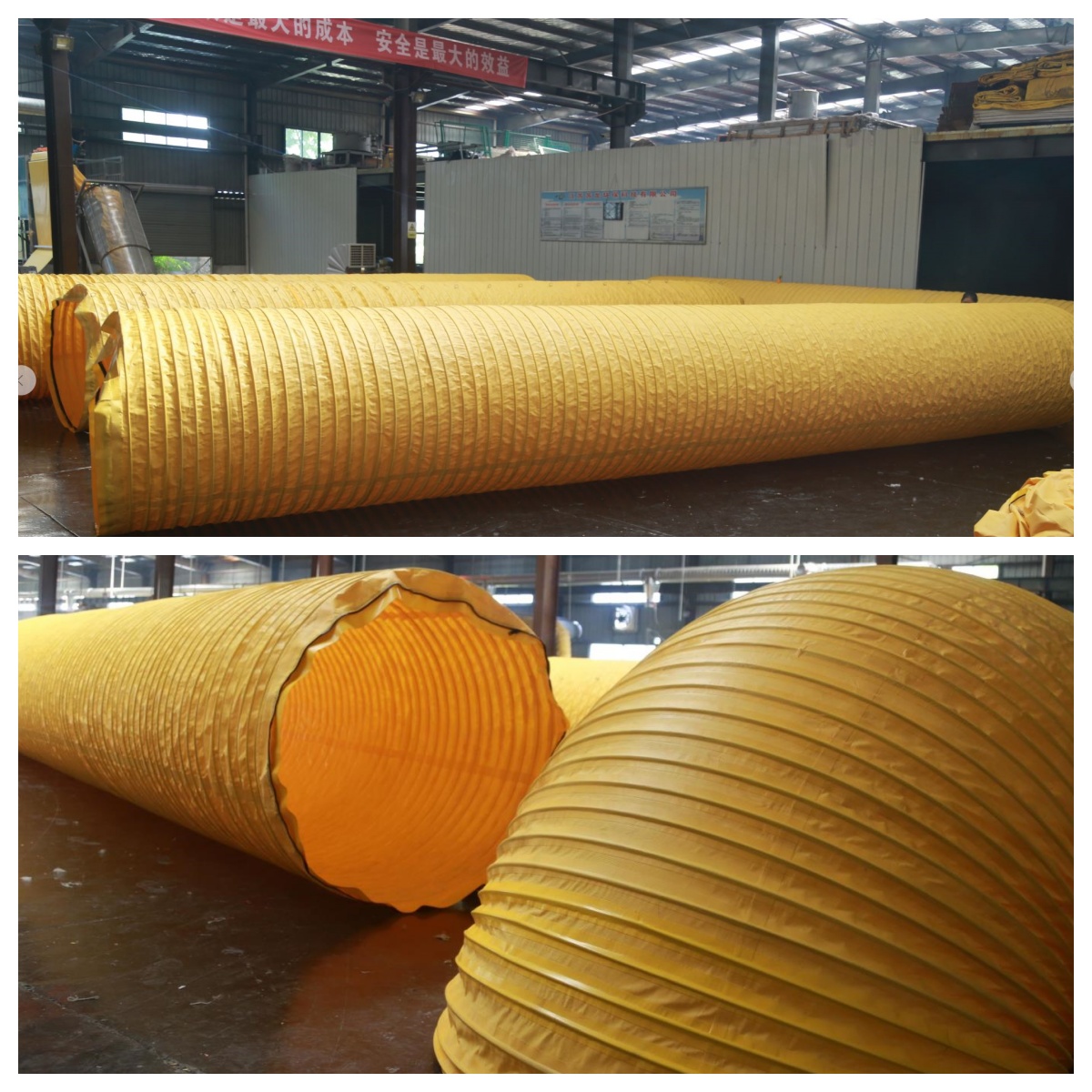
A flexible ventilation duct is a collapsible, fabric-based airway used primarily for temporary or semi-permanent ventilation in mining, tunneling, and underground construction. In SULONG's product line, this duct is made of PVC-coated fabric, with PVC-laminated fabric as the primary material; an antistatic fabric option is also available for environments where static discharge is a concern.
Flexible ducts are typically deployed where the ventilation system must be installed quickly, relocated as the tunnel face advances, or stored compactly between uses. They are manufactured to operate in a 24/7 continuous high-pressure ventilation mode, which means the material and seam construction must tolerate sustained duty rather than intermittent use.
What Is a Spiral Ventilation Duct?
A spiral ventilation duct refers to a duct with a helical seam structure, typically formed from a continuous strip of material wound into a rigid or semi-rigid tube. SULONG's spiral ventilation duct is also used for temporary ventilation in undersea road tunnel construction, which places a specific set of demands on the product: corrosion resistance, dimensional stability, and consistent cross-sectional area under variable pressure.
Spiral ducts maintain a round profile without requiring internal pressure to hold their shape. This makes them suitable for sections where the duct may not be fully pressurized, where negative pressure (exhaust) is used, or where mechanical damage from collapsing would create an immediate safety issue.

Flexible ventilation duct showing the lay-flat, fabric-based construction used in mining and tunneling.
Head-to-Head Comparison: Flexible vs. Spiral Duct
| Decision Factor | Flexible Ventilation Duct | Spiral Ventilation Duct |
|---|---|---|
| Shape retention | Requires internal air pressure for full round profile | Maintains round profile independently |
| Storage & transport | Lay-flat, compact, economical to ship | Bulky, requires more transport volume |
| Primary use case | Forced fresh-air ventilation in advancing tunnels and mines | Temporary ventilation where duct rigidity is needed, including undersea tunnel construction |
| Installation speed | Faster — lightweight sections and fewer supports | Slower — requires careful alignment and suspension |
| Repair complexity | Portable field repair kits enable rapid repair of accidental damage | Repair typically requires replacing the damaged section |
Key Difference in Manufacturing Technology
There is a more fundamental distinction relevant to flexible ducts specifically. Compared to traditional stitched or multi-seam ventilation ducts, SULONG's flexible duct uses a proprietary seamless integral forming fish-back automated process. This process provides higher pressure resistance and lower wind drag than conventional segmented multi-seam manufacturing. The design also incorporates continuously smooth inner walls, which improves airflow delivery efficiency and reduces the overall power demand on secondary counter-rotating fans.
For a buyer comparing suppliers rather than duct types, this distinction matters because it directly affects the energy cost of running fans over a multi-year project.
Performance and Cost Metrics That Actually Differentiate Duct Types
Purchasing decisions are frequently made using comparative data rather than absolute claims. For SULONG's seamless flexible duct, the tensile strength ranges from 1,300 N to 4,300 N, and the leakage rate is reduced to nearly 0% under high air pressure. The external quality rejection rate has been maintained at zero for over three years.
Compared to alternatives, this approach offers cost savings by eliminating air leakage, reducing daily energy costs, minimizing downtime expenses through extended fabric service life, and maximizing overall return on investment. In practice, leakage is not merely a performance issue; it is an operating cost that reoccurs every hour the ventilation system runs.
For ventilation ducts, tensile strength is the key performance indicator. The material must hold up when fans pressurize the duct and when workers handle, suspend, and relocate it. A higher tensile strength allows a duct to handle larger diameters and longer sections.
Semi-Rigid and Oval Ducts: Where They Fit in a Decision Framework
Buyers evaluating "flexible vs. spiral" are often considering semi-rigid and oval ducts as a separate decision branch. Semi-rigid duct — like the spiral duct format — offers an intermediate solution when a duct must hold its shape, but the application also calls for some flexibility in handling. SULONG's product range includes oval ducts, which are useful in low-headroom tunnels where a round duct would reduce clearance.
Spiral and semi-rigid ducts are appropriate when duct sections need to bridge distances without sagging, or when the ventilation circuit will remain fixed for longer periods. For ducting that will be followed by a mining face and re-positioned often, the flexible option is generally more practical.
Decision Rules by Application Type
Decision Rule 1 — For advancing tunnel faces (TBM / Drill & Blast)
Use flexible ventilation ducts when the duct must be extended frequently as the tunnel progresses, and when fan energy efficiency is the dominant operating concern. The seamless flexible duct characteristic of zero leakage at high pressure is a strong advantage for a long distance with a single ventilation line.
Decision Rule 2 — For undersea or fixed tunnel sections
Use spiral ventilation ducts where structural rigidity and a stable cross-section are required. SULONG's spiral duct and flexible duct have both been deployed for temporary ventilation in undersea road tunnel construction, confirming that both formats are accepted for safety-critical marine tunnel environments when specifications and certifications are properly matched.
Decision Rule 3 — For high-gas metal mines with strict international audits
Seamless integral forming flexible ducts are the stronger candidate when the site requires extremely low leakage, high tensile strength (up to 4,300 N), and audited manufacturing traceability through full in-house production control.
Decision Rule 4 — Where space is constrained
Oval ducts serve low-profile installations; flexible lay-flat ducts can be routed around obstacles. Spiral ducts require more installation clearance because of their rigid geometry.
Procurement Considerations: MOQ, Customization, and Lot Sizes
Ordering constraints can influence the type chosen, particularly in the early trial or first-project phase. SULONG's minimum order quantity is flexible: there are no strict MOQs for standard stock items and mining trial orders. For custom specifications, MOQs are negotiated based on raw material minimum batch sizes. This flexibility means a buyer can test the flexible duct on a live mining or tunneling project before committing to larger project-scale orders.
When comparing duct types, buyers should ask each supplier a specific set of questions:
- For flexible ducts: What is the confirmed leakage rate at the operating pressure expected in my tunnel?
- For spiral ducts: What is the section length and how is the connection joint sealed to match the airtightness of the duct body?
- For both: What is the full material traceability chain from fabric batch to finished duct?
Market Trend Perspective: How the Types Are Evolving
Underground mining accounts for the dominant segment of the mine ventilation market, driven by the critical need for hazardous gas dilution. In parallel, ventilation-on-demand (VOD) technology adoption is growing, with an estimated 35% of new North American mines using it by 2025. The relevance for type selection is that VOD systems modulate airflow to match real-time demand, which means ducts experience more varied pressure cycles rather than constant ventilation. Flexible ducts with low leakage and high tensile strength adapt to this operating pattern more effectively than older stitched designs.
For the broader industrial duct category, aluminum ducts account for approximately 38% of the total global flexible ducting market consumption. Most of this volume operates in HVAC and light industrial settings, not heavy mining or tunneling. Buyers in mining need to ensure they do not substitute a light aluminum duct for a heavy-duty fabric duct based on cost alone — the service conditions are not comparable.
Manufacturing and Quality Verification for Either Type
Jiangsu Sulong Eco-Technologies Co., Ltd is a National High-Tech Enterprise and provincial-level "Specialized, Refined, Unique & Innovative" SME based in Funing, Yancheng, China. The company runs a 40,000 m² in-house factory with roughly 68 employees and an R&D team of 18 specialists. Its stated annual capacity is over 1 million meters of high-strength mining ventilation ducts. SULONG reports that it holds ISO 9001, ISO 14001, ISO 45001, EU ATEX, CE, US NFPA 701, and NATA laboratory test certifications.
The quality-control system includes IQC raw-material batch quarantine, 2-hour IPQC patrol inspections, and 100% pre-delivery FQC physical performance testing. Each finished duct can be traced to its raw material batches. This three-tier QC approach reduces variability in both flexible and spiral duct production.
Where SULONG's Flexible Duct Differ from Conventional Options
It is important to distinguish between comparing duct types and comparing manufacturing methods. SULONG's flexible ducts are different from flexible ducts produced by conventional stitched or multi-seam methods. Core technical claim:
- Higher pressure resistance
- Lower wind drag
- Tensile strength of 1,300 N to 4,300 N
- Leakage rate near zero under high air pressure
- Zero external quality rejections for over three years
Limitations and Boundaries of Each Duct Type
Flexible ducts have limitations. While the seamless design transfers airflow efficiently, the duct still requires adequate internal pressure to hold its shape; in a partially pressurized circuit, a flexible duct may flutter or collapse in sections before it reaches the heading. Spiral ducts, while maintaining their shape, cannot be flattened for trucking or storage — shipping a large-diameter spiral duct carries a higher freight cost per usable meter. Semi-rigid ducts offer a compromise but may not fold fully flat, which limits handling advantages over flexible formats.
Every buyer should request project-specific data based on duct type, diameter, operating pressure, and circuit length. Performance values under one set of pressures do not automatically transfer to another.
Recommended Buying Sequence for the Two Types
- Define the ventilation circuit — measure required air volume, distance, and whether the system uses forced (positive) or exhaust (negative) pressure.
- Shortlist duct types — select flexible, spiral, semi-rigid, or oval based on circuit geometry and project duration.
- Compare on performance evidence — leakage rate, tensile strength, fire certification, and material traceability.
- Assess supplier commercial terms — MOQ, lead time, and support for trial orders.
- Verify the factory — require a documented quality system and third-party audit trail, since actual manufacturing conditions ultimately determine whether the duct will perform.
Download the SULONG ventilation duct catalog for technical details on flexible, spiral, semi-rigid, and oval ducts:
FAQ
A flexible ventilation duct is a lay-flat fabric duct that takes its round shape only under air pressure, while a spiral ventilation duct is a rigid or semi-rigid duct that holds its round cross-section without internal pressure. Flexible ducts are suited to forced fresh-air lines that advance quickly, while spiral ducts are used for longer-term or negative-pressure sections where shape retention prevents collapse.
The flexible ventilation duct and the spiral ventilation duct have both been used for temporary ventilation in undersea road tunnel construction, according to SULONG's project documentation. The choice depends on whether the duct must be frequently extended (flexible is more transport- and set-up-efficient) or whether it will sit in a fixed alignment exposed to external loads (spiral provides structural rigidity).
On initial product cost, flexible ducts usually compare favorably because of their fabric-based construction and compact, lay-flat shipping profile. The larger cost difference, however, comes from operation. SULONG's seamless flexible duct reduces leakage to nearly zero, which lowers daily energy cost and extends fabric service life. Buyers should compare total energy, maintenance, and replacement costs over the project life rather than unit price alone.
SULONG provides lay-flat ventilation ducts with diameters ranging from 200 mm to 3,200 mm for mining and tunnel applications. The usable maximum depends on the fan pressure available in the circuit and the tensile strength of the selected fabric grade.
Yes. SULONG states that no strict MOQ applies to standard stock items and mining trial orders. Custom specifications are negotiated based on raw material minimum batch sizes. This allowance enables buyers to validate a duct on an active mining site before scaling up the order.
Have Questions or Need More Details?
Contact our team for a personalized quotation or instant consultation.
Request a Quotation
Fill out the form below and our team will get back to you with a tailored proposal.
WhatsApp Direct Chat
Prefer to chat in real-time? Message us on WhatsApp for instant assistance & quick answers.
- Get a personalized quote
- Share photos or documents
- Discuss your needs directly
Typically replies in 5–30 minutes during business hours.