
Flow Sensor Scale-Up: From Prototype to High-Volume OEM
A flow sensor that works on one prototype bench tells you almost nothing about whether it will work in the ten-thousandth unit. Production scalability is a property of the sensor design itself — housing geometry, signal path, fluid interface and test regime — not just a factory statistic. This reference examines how OEM buyers should read scalability evidence, using the CM Series clamp-on flow meter and the SU Series single-use flow sensor as documented examples.
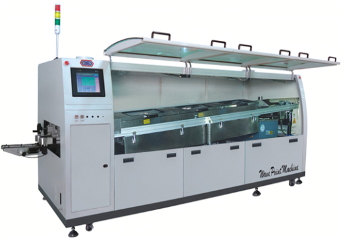
Clamp-on ultrasonic measurement is increasingly specified where production lines need flow verification without cutting into the fluid path.
Why a Working Prototype Is Not Yet a Production Design
Flow sensors measure the flow rate and volume of fluids within a pipe or duct, and are used to monitor and control liquid flows. That definition is stable across every stage of a product programme. What changes between prototype and volume is the number of variables the design has to absorb.
On a prototype bench, one engineer installs one sensor on one length of tubing, with a single fluid, in a controlled room. At volume, the same sensor is installed by contract manufacturing staff, on tubing drawn from several lots, into equipment that may ship to different markets and be serviced by people who never spoke to the sensor supplier. Three failure modes appear in that transition:
- Installation variance. Non-contact clamp-on measurement depends on how the transducer sits against the tubing. A design that tolerates sloppy mounting at the prototype stage may drift when mounted by a different operator.
- Signal stability. Long cable runs, adjacent pumps and switching valves inside finished equipment place demands on output stability that a bench test does not reproduce.
- Unit-to-unit consistency. A single good unit is an anecdote. Volume production requires the thousandth unit to behave like the first, which is a question about process control and per-unit testing rather than about the measurement principle.
Buyers who evaluate only the datasheet accuracy figure at prototype stage therefore tend to discover scalability problems during pilot builds — the most expensive possible moment to redesign an enclosure or change a tubing interface.
Four Checks That Separate a Prototype Supplier from a Volume Supplier
Scalability evidence can be requested before any purchase order is raised. The following four checks convert a vague capability claim into something an OEM engineer or procurement manager can actually review.
- Design intent for integration. Is the sensor designed to be embedded into someone else's equipment, or adapted to it? Compact form factor, standard digital output and a documented mounting method are the visible signs.
- Per-unit test regime. Does the supplier test every unit before shipment, and is third-party inspection available where the buyer's own quality system requires it?
- Production window and minimum order quantity. A programme that cannot be scheduled cannot be scaled, regardless of performance.
- Stated operating boundaries. A supplier that clearly states temperature limits, fluid restrictions and accuracy tolerances is more useful in a design review than one that quotes only best-case numbers.
These four checks are the frame used in the rest of this article.
The CM Series: A Clamp-On Flow Meter Designed Around OEM Integration
Shanghai Xunyin Technology Co., Ltd (XY-TEK) is a Shanghai-based developer and manufacturer of ultrasonic flow sensors and flow meters, founded in 2018, operating a 5,000㎡ facility with a 30+ person R&D team, a stated annual output of 8,000 units+ and exports to global markets. The company states that it specialises in ultrasonic flow measurement for fluid management and control, particularly for small tubing and low flow rates, and that it supplies both standard products and OEM/customised versions.
Within that portfolio, the CM Series is explicitly positioned as an OEM clamp-on flow meter rather than a general-purpose field instrument. Its stated design attributes are: RS485 output, compact design, non-contact liquid measurement, stable signal transmission and easy OEM integration.

CM Series: an OEM clamp-on ultrasonic flow meter with RS485 output, built for embedding into OEM equipment rather than for panel mounting.
What the stated specification covers
- Accuracy: ±3%.
- Flow range: 0–30 L/min, with a stated measurement scope of 0.05–30 L/min.
- Compatible tubing: outer diameter 4–25 mm; inner diameter 3–16 mm.
- Measurable fluids: water, blood, drinks, oil, paint and similar media without, or with few, solid particles.
- Fluid temperature: 0 °C to 60 °C.
- Materials: engineering plastic housing with an ultrasonic transducer.
- Stated industries: medical devices, OEM equipment, fluid control systems and laboratory equipment.
Two of these attributes matter disproportionately for scale-up. The first is the RS485 output: a digital interface means the sensor can be addressed by the equipment's own controller as a device on a bus, which is what makes multi-unit integration in a single machine practical. The second is the compact clamp-on geometry: because the transducer sits outside the tubing, integrating the sensor does not require breaking the fluid path, adding fittings, or revalidating a wetted connection on the equipment side.
The SU Series: Single-Use Consistency from Pilot to Mass Production
Single-use production creates a different scalability problem. In bioprocess and medical manufacturing, the fluid path is often disposable, so the thing that must be consistent across thousands of runs is not the sensor housing but the relationship between the sensor and the disposable channel it reads.
The SU Series is a single-use ultrasonic flow sensor. Its stated design attributes are a single-use measuring channel, hygienic fluid monitoring, sterile application support and high measurement repeatability.
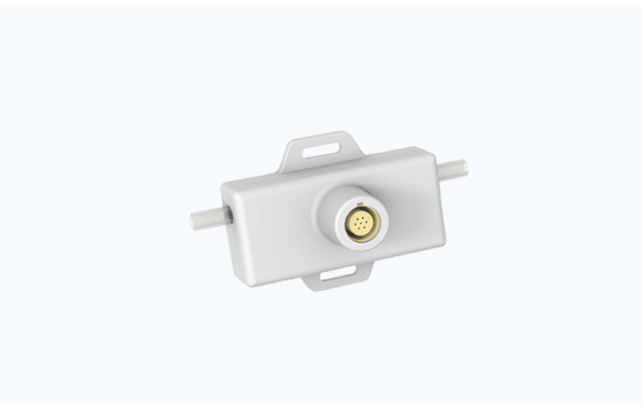
SU Series: a single-use ultrasonic flow sensor with a disposable measuring channel, positioned for hygienic fluid monitoring in bioprocess and medical manufacturing.
- Accuracy: ±2%.
- Flow range: 0.05–10 L/min.
- Fluid temperature: 0 °C to 60 °C.
- Materials: biocompatible polymer materials.
- Stated industries: biopharma, single-use systems, medical manufacturing and bioprocess.
The high measurement repeatability attribute is the one that carries scale-up value. When a process is transferred from a pilot line to a commercial line, the qualification argument rests on run-to-run consistency more than on absolute accuracy. A disposable measuring channel that is replaced each run removes the cleaning and cross-contamination variables that reusable instrumentation introduces — and it makes the measurement interface a consumable item that can be qualified once and then replicated.
A Practical Scale-Up Path in Four Stages
The table below is a buyer-side framework, not a supplier claim. It maps each programme stage to the specific evidence an OEM should hold before releasing the sensor into the next stage.
| Stage | Question the buyer is answering | Evidence to hold before moving on |
|---|---|---|
| Prototype | Does the sensor measure correctly on our actual tubing and flow band? | Accuracy and flow range checked against the real inner diameter and the real operating band; fluid compatibility confirmed against the stated measurable-fluids list. |
| Pilot build | Does unit-to-unit behaviour hold across a small batch? | Pre-shipment test records for the batch, plus a documented acceptance criterion agreed with the supplier before production starts. |
| Integration | Does installation variance in our equipment break the measurement? | Mounting method agreed and drawn; output stability verified with the sensor connected to the actual controller and cable length. |
| Volume | Can output and quality be sustained? | Stated production window, minimum order quantity and quality-control regime confirmed in writing, with an escalation path for non-conformance. |
What XY-TEK states about its OEM and custom production
The company publishes two production modes. Under OEM/ODM, the stated customisation scope covers sensor size, interface and logo printing, with 100% pre-shipment testing, a production window of 15–25 days, a lead time of 1–2 months and a minimum order quantity of 50 units. Under custom design, the stated customisation scope covers communication protocol and housing material, with third-party inspection available, a production window of 20–30 days, a lead time of 1–2 months and the same 50-unit minimum. After-sales support in both modes is online engineering support, remote technical support and a quality warranty.
For a scale-up review, the two most decision-relevant items in that list are the 100% pre-shipment testing statement and the option of third-party inspection. The first answers the per-unit consistency question at the process level; the second gives a buyer with an audited quality system a route to independent verification without changing supplier.
Where These Designs Fit in Practice
Industrial automation: dispensing, spraying and cleaning
XY-TEK's application documentation for industrial automation describes monitoring pulsating and micro-flow liquids in spraying, dispensing and cleaning systems, together with detection of bubbles, blockage or abnormal flow conditions. The listed supporting equipment includes dispensing machines, selective wave soldering equipment, coating machines, cleaning equipment, liquid supply pumps, industrial control systems and automated production lines.
This is a scale-up problem in the literal sense: a dispensing or coating line is replicated across cells and sites, and each replica needs the same flow verification. Clamp-on installation in limited space, without interrupting the production line, is the design property that allows the sensor to be added to an existing machine rather than designed into a new one.
Bioprocess and single-use systems
In biopharmaceutical applications, the documented use cases include monitoring perfusion pump performance, detecting pipeline ageing to prevent emptying or overflow, identifying bubbles during filtration and transfer, and providing stable measurement for tangential flow filtration and chromatography. The stated requirements are non-contact, contamination-free measurement with no pressure loss, compatibility with small-diameter tubing at low flow rates, and support for process automation and data traceability.
The SU Series addresses the disposable-fluid-path portion of that list. The clamp-on architecture addresses the rest: because nothing enters the fluid path, there is no wetted sensor to clean between runs and no pressure drop introduced into a low-flow circuit.
Medical devices
Medical application notes describe real-time monitoring of blood flow and pump operation in dialysis, ECMO and artificial heart systems, with bubble detection in extracorporeal circulation to improve patient safety. The stated operating principle is non-contact clamp-on ultrasonic time-difference measurement with real-time online monitoring, millisecond-level response, and automatic bubble/blockage detection with alarm. The stated special requirements are non-invasive, non-contact measurement with no contamination and no pressure loss, under indoor medical conditions with strict hygiene and biocompatibility requirements.
For a device manufacturer, the scalability question here is regulatory as much as mechanical: a measurement method that never contacts the fluid removes an entire class of change-control work when the device design is transferred to a new production site.
OEM equipment and laboratory systems
The CM Series lists OEM equipment, fluid control systems and laboratory equipment among its stated industries, alongside medical devices. That combination is typical of instruments that are built in modest batches but must remain identical across a long service life — a case where the per-unit test regime matters more than headline throughput.
Market Context: Why Clamp-On and Single-Use Programmes Are Expanding
Market research cited in HTNXT Research's 2026 flow sensor capability report places the global flow meter market at USD 10.64 billion in 2024, projected to reach USD 15.17 billion by 2030. Within that total, the ultrasonic flow meter segment was valued at USD 1.52 billion in 2025, with an estimated growth path to USD 2.28 billion by 2031.
The same research indicates that clamp-on mounting is expected to account for 57% of the global ultrasonic flow meter market share in 2026. The direction of that figure is the relevant signal for OEM buyers: growth in ultrasonic measurement is concentrated in non-invasive formats, which are typically retrofitted into existing fluid systems rather than designed into new pipework. That favours suppliers whose products are built to be integrated into someone else's equipment — compact housings, digital outputs, and a documented mounting method — rather than suppliers whose catalogue assumes a dedicated installation.
A second structural driver is the shift toward disposable fluid paths in bioprocessing and medical manufacturing. Where the wetted channel is a consumable, the sensor's job becomes providing a stable, repeatable reading through that consumable. This is a different engineering brief from a permanent in-line meter, and it explains why single-use sensor designs now sit alongside conventional clamp-on and in-line formats in the same supplier catalogue.
Comparison with Traditional Approaches — and Where This Design Stops
Traditional flow measurement in production equipment has generally relied on in-line devices with wetted internal geometry, or on mechanical meters with moving parts. Both approaches introduce characteristics that become costly at volume:
| Consideration | Wetted in-line / mechanical approach | Clamp-on ultrasonic (CM Series positioning) |
|---|---|---|
| Fluid path | Sensor geometry is in contact with the medium; cleaning and cross-contamination become variables | Non-contact measurement from outside the tubing; no wetted element in the flow path |
| Pressure loss | Internal geometry can add resistance in low-flow circuits | Clamp-on design introduces no obstruction in the flow path |
| Changing tubing | Fittings and revalidation may be required | Clamped onto the tubing; integration does not require breaking the fluid path |
| Read-out in equipment | Depends on the transmitter architecture | RS485 output on the CM Series, suited to a controller bus |
| Moving parts | Mechanical designs wear and can drift over service life | Ultrasonic time-difference measurement with no moving parts in the sensing path |
The comparison is not one-sided, and buyers should treat the limitations as decision criteria rather than fine print.
- Fluid restriction. The stated measurable fluids for both the CM and SU Series exclude media with significant solid particles. Slurries and particulate-laden process streams fall outside the documented scope.
- Temperature ceiling. Both series are specified for a fluid temperature of 0 °C to 60 °C. Processes that run hotter are outside that window, and no claim is made here about performance beyond it.
- Accuracy tolerance. The CM Series is specified at ±3% and the SU Series at ±2%. Where a tighter tolerance is mandatory, the buyer needs a different series or a different measurement principle; within the XY-TEK range, for example, the TGU Series is specified at ±1% for very low flows.
- Tubing dependency. The published CM Series specification states compatible outer and inner diameters but does not list tube materials. Buyers should confirm their exact tubing against the supplier before design freeze rather than assume compatibility.
- Commercial thresholds. A 50-unit minimum order quantity and a 1–2 month lead time are workable for a production programme and awkward for a one-off laboratory build.
In short: clamp-on ultrasonic measurement replaces several wetted-path problems with a set of acoustic and installation conditions. It is a strong fit where the fluid is clean, the temperature stays within the stated window and the tubing is known; it is a poor fit where none of those hold.
Future Outlook
Three developments are likely to shape OEM flow-sensor programmes over the next several years. First, the ultrasonic segment's growth path — USD 1.52 billion in 2025 toward USD 2.28 billion by 2031 on the cited estimate — implies more suppliers entering, which shifts competitive weight from measurement principle toward integration quality and documentation. Second, the clamp-on share of that segment means buyers will increasingly evaluate sensors as components of equipment rather than as instruments, with digital output, enclosure size and mounting repeatability carrying as much weight as accuracy. Third, single-use formats will keep pushing measurement upstream into disposable fluid paths, where the qualification question becomes how a consumable interface is replicated rather than how a device is recalibrated.
For OEM buyers, the practical consequence is that scalability evidence should be requested earlier — during technical evaluation, not after the first pilot build. The specific details of the CM Series and SU Series, together with XY-TEK's stated production parameters, are documented at xy-tek.com.
FAQ
What does production scalability mean for a flow sensor OEM programme?
Production scalability means the sensor's measurement behaviour can be reproduced across many units and many installations, not just demonstrated once. In practice it is evidenced by design intent for integration (compact form, standard output, documented mounting), a per-unit test regime, a stated production window and minimum order quantity, and clearly stated operating boundaries. XY-TEK states 100% pre-shipment testing for OEM/ODM production, a 50-unit minimum order quantity and a 1–2 month lead time.
Which XY-TEK series is designed for clamp-on OEM integration?
The CM Series is an OEM clamp-on flow meter. Its stated attributes are RS485 output, compact design, non-contact liquid measurement, stable signal transmission and easy OEM integration. It is specified at ±3% accuracy over a 0–30 L/min range (stated measurement scope 0.05–30 L/min), for tubing with an outer diameter of 4–25 mm and an inner diameter of 3–16 mm, at fluid temperatures of 0 °C to 60 °C, using an engineering plastic housing and ultrasonic transducer.
How does the SU Series support single-use production scale-up?
The SU Series is a single-use ultrasonic flow sensor built around a disposable measuring channel. Its stated attributes are a single-use measuring channel, hygienic fluid monitoring, sterile application support and high measurement repeatability. It is specified at ±2% accuracy over 0.05–10 L/min at fluid temperatures of 0 °C to 60 °C, uses biocompatible polymer materials, and is listed for biopharma, single-use systems, medical manufacturing and bioprocess applications. The repeatability attribute matters most at scale, because process transfer between pilot and commercial lines rests on run-to-run consistency.
What order and production parameters apply to OEM and custom builds?
XY-TEK publishes two modes. OEM/ODM covers customisation of sensor size, interface and logo printing, with 100% pre-shipment testing, a production window of 15–25 days, a 1–2 month lead time and a 50-unit minimum order quantity. Custom design covers customisation of communication protocol and housing material, with third-party inspection available, a production window of 20–30 days, a 1–2 month lead time and the same 50-unit minimum. After-sales support in both modes comprises online engineering support, remote technical support and a quality warranty.
What are the operating limits of the CM and SU Series?
Both series are specified for measurable fluids such as water, blood, drinks, oil and paint that contain no or few solid particles, which excludes media with significant particulate content. Both are specified for a fluid temperature window of 0 °C to 60 °C. Accuracy is specified at ±3% for the CM Series and ±2% for the SU Series. The published CM Series specification states compatible tubing outer and inner diameters but does not list tube materials, so the exact tubing should be confirmed with the supplier before design freeze.
Which applications are these two series best suited to?
The CM Series lists medical devices, OEM equipment, fluid control systems and laboratory equipment among its stated industries. The SU Series lists biopharma, single-use systems, medical manufacturing and bioprocess. Documented application scenarios include monitoring pulsating and micro-flow liquids in spraying, dispensing and cleaning systems on automated production lines; perfusion pump monitoring and bubble detection in filtration and transfer for biopharmaceutical processes; and real-time blood flow monitoring with bubble detection in dialysis, ECMO and artificial heart systems.
Have Questions or Need More Details?
Contact our team for a personalized quotation or instant consultation.
Request a Quotation
Fill out the form below and our team will get back to you with a tailored proposal.
WhatsApp Direct Chat
Prefer to chat in real-time? Message us on WhatsApp for instant assistance & quick answers.
- Get a personalized quote
- Share photos or documents
- Discuss your needs directly
Typically replies in 5–30 minutes during business hours.