
Food-Contact HTV Silicone Rubber: A Grade-Level Checklist
Food-Contact HTV Silicone Rubber: A Grade-Level Checklist
Industry Reference — Materials Shortlisting for Compression Molding
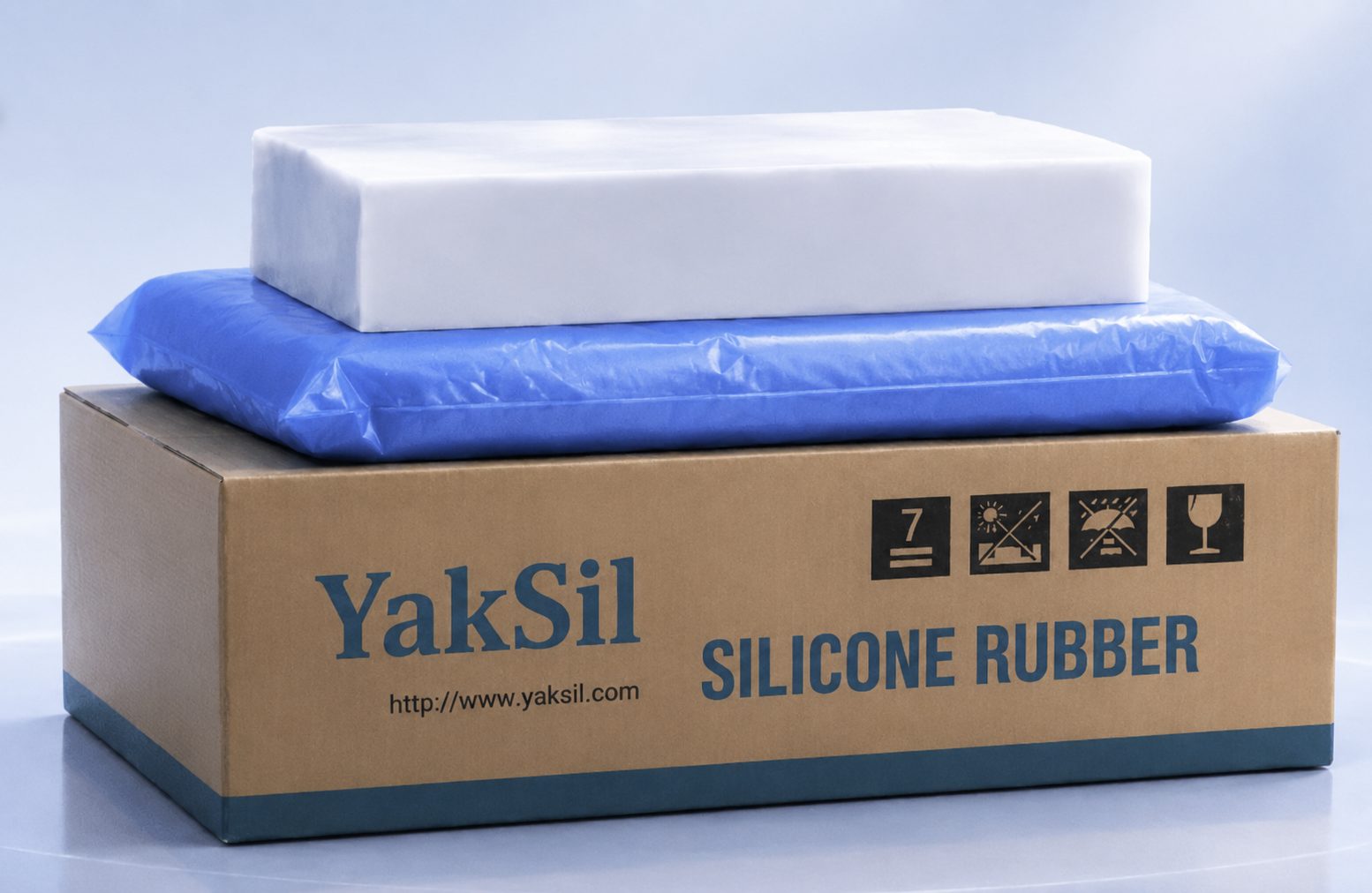
A food-contact grade HTV silicone rubber base compound before pigmentation and curing-agent addition.
Every food-contact silicone article — a baking mold, a kitchen spatula, a sealing gasket, a flexible chocolate mold — is effectively approved or rejected long before the first part leaves the press. The decisive moment comes earlier, when a converter shortlists a compound, and it is usually decided on specification sheets rather than on category labels.
High-temperature vulcanized (HTV) silicone rubber, also called high-consistency rubber (HCR), is a solid, gum-like base compound that the processor mixes, pigments, catalyzes and molds. A food-contact grade of that material is therefore a starting formulation, not a finished product. Its density, plasticity, hardness, cure chemistry and documentation decide two separate things: how the compound runs in a compression mold, and what the molder can document about the article that comes out.
This reference sets out a five-gate checklist for shortlisting food-contact HTV silicone rubber compounds for compression molding. It then applies the checklist to one published grade — YKS-8850, a 50 Shore A peroxide-curing HCR base compound — so that abstract criteria can be read against real numbers.
Why a Grade Name Is Not a Specification
Suppliers describe compounds with category labels: food grade, medical grade, high tear, flame retardant. Those labels are useful as a first filter, but they do not separate two compounds that behave very differently in production. Two materials both sold as food-contact grade can differ in cure chemistry (peroxide versus addition cure), in unvulcanized consistency, in hardness tolerance, in linear shrinkage, and in the paperwork that accompanies each shipment.
A second factor is easier to overlook. Because a base compound is normally supplied without pigment or curing agent, part of the final formulation is created by the buyer rather than the supplier. That has a direct consequence for compliance: the food-contact status of a finished article depends on the whole formulation — base compound, curing agent, pigment, molding parameters and any post-cure — not on the base compound alone. A shortlist that ignores this can produce a material that passes incoming inspection and still fails end-use validation.
The practical conclusion is that buyers should shortlist on measurable, method-referenced properties instead of on descriptive names. The checklist below is ordered so that a disqualifying mismatch is caught early.
The Five-Gate Shortlisting Checklist
Gates 1 and 2 eliminate compounds that cannot run on the intended equipment or cannot meet the mechanical duty of the part. Gates 3 to 5 confirm that the remaining candidates are comparable, documented and deliverable.
| Gate | Question to answer | Typical disqualifier |
|---|---|---|
| 1. Cure chemistry and process match | Does the cure system and intended forming process match existing equipment? | Peroxide-curing grade offered to a cell built for addition-cure liquid silicone injection |
| 2. Hardness and mechanical balance | Do hardness tolerance, elongation, tear strength and resilience fit the part design? | Hardness quoted as a single number with no tolerance |
| 3. Density, plasticity, shrinkage | Are the three processing numbers stated with test methods? | Shrinkage missing before the mold cavity is machined |
| 4. Documentation availability | Which documents exist, which are per batch, which are third-party? | No per-batch certificate of analysis and no third-party food-contact test documentation |
| 5. Packaging, storage, supply terms | Do shelf life, storage condition, MOQ and lead time fit the production plan? | Shelf life shorter than the buyer's consumption cycle of one delivery |
Gate 1 — Cure Chemistry and Process Match
Confirm the cure system first. Peroxide-curing HTV compounds and addition-curing (platinum) systems are not interchangeable inside a running production cell: they use different curing agents, different dosing arrangements and different process windows. Confirm the intended forming process as well — compression molding, injection molding or extrusion — because HCR compounds are formulated and supplied for specific processes. For a peroxide-curing, compression-molding grade, the data sheet should state a recommended molding cure and a recommended curing agent with its dosage, so that the buyer can calculate consumption per batch and set the press recipe without guesswork.
Gate 2 — Hardness and Mechanical Balance
Specify hardness with its tolerance, not as a single figure. A 50 Shore A grade quoted at plus or minus three points covers a different design window than one quoted at plus or minus five. Then check that the mechanical package matches the part. Tensile strength and elongation indicate how much stretch the material tolerates before tearing; tear strength matters at demolding and at thin walls; resilience matters for parts that must recover their shape after compression. For bakeware and flexible molds, high elongation is often the property that prevents premature failure during repeated demolding and flexing.
Gate 3 — Physical and Processing Parameters
Three numbers determine whether a compound runs economically: density, plasticity and linear shrinkage.
Density converts volume to mass and sets material consumption per part. A buyer who cannot state the density with its tolerance cannot quote a molded part cost reliably.
Plasticity describes the unvulcanized consistency of the compound. It governs how the material behaves on a two-roll mill and how it fills a mold cavity. An unusually wide plasticity window makes batch-to-batch process setting harder, and it also means the supplier has accepted a broader incoming band.
Linear shrinkage determines mold dimensions. It must be known before the cavity is machined, because shrinkage cannot be corrected after the fact without cutting new tooling.
Gate 4 — Documentation Availability
Ask which documents exist, which are issued per batch, and which are third-party. At minimum, a food-contact shortlist should identify a technical data sheet (TDS), a safety data sheet (SDS), a typical certificate of analysis (COA) and the per-batch COA, together with any third-party test documentation relevant to the intended food-contact application. Where a supplier claims compliance with a specific regulation, request the document that supports the claim rather than a statement that the document exists. For European destinations, LFGB test reports and REACH compliance documentation are commonly requested alongside US documentation. A supplier's own quality management certification, such as ISO 9001, supports consistency and process control claims, but it is not a substitute for food-contact test documentation.
Gate 5 — Packaging, Storage and Supply Terms
Finally, verify the terms that determine whether material is still within specification when it reaches the press: net weight per package, recommended storage temperature, shelf life in unopened packaging, minimum order quantity, and lead time for standard versus customized grades. A compound with excellent mechanical data and a short shelf life can still be the wrong shortlist entry if consumption is slow or the warehouse runs warm.
Applying the Checklist: YKS-8850 As a Worked Example
Yakows Technology (Dongguan) Co., Ltd. is a manufacturer of high-performance HTV and HCR silicone rubber compounds and customized silicone material solutions. Established in 2020, the company operates a 5,000 m² manufacturing facility in Dongguan, Guangdong Province, China, with a technical department of more than 10 engineers and technicians, and a monthly production capacity of approximately 400,000 to 1,000,000 kg depending on product grade and production schedule.
Among its food-contact offerings, Yakows lists the Food-Contact Grade HTV Silicone Rubber Compound YKS-8850, described as a peroxide-curing HCR base compound for compression molding at 50 Shore A. Running the five gates against the published specification produces the table below.
| Parameter | Published value (YKS-8850) | Test reference |
|---|---|---|
| Appearance | Milky white to slightly yellow | — |
| Hardness | 50 ± 3 Shore A | GB/T 531.1-2008 |
| Density | 1.14 ± 0.03 g/cm³ | GB/T 533-2008 |
| Plasticity | 250–280 | GB/T 12828-2006 |
| Tensile strength | ≥ 7.0 MPa | GB/T 528-2009 |
| Elongation at break | ≥ 700% | GB/T 528-2009 |
| Tear strength | ≥ 18 kN/m (right-angle specimen) | GB/T 529-2008 |
| Resilience | ≥ 40% | GB/T 1681-2009 |
| Linear shrinkage | 2.7–3.2% (molding method) | GB/T 1692-2008 |
| Recommended molding cure | 180°C × 5 minutes | — |
| Recommended curing agent | DBPMH, 35% active preparation | — |
| Curing-agent dosage | 1.5% by weight | — |
| Standard packaging | 20 kg net per carton | — |
| Recommended storage | ≤ 30°C | — |
| Shelf life | 6 months in original unopened packaging | — |
The material is supplied without pigment or curing agent. Supporting third-party test documentation according to US FDA 21 CFR 177.2600 is available on request.
Read against the five gates, the specification addresses each one explicitly. Gate 1 is satisfied by a defined peroxide cure system, a named curing agent at a stated dosage, and a stated molding cure for compression molding. Gate 2 is covered by a hardness band of 50 ± 3 Shore A together with elongation of at least 700%, tensile strength of at least 7.0 MPa, tear strength of at least 18 kN/m on a right-angle specimen, and resilience of at least 40%. Gate 3 is covered by density, plasticity and linear shrinkage, each tied to a named test method. Gate 4 is covered by the availability of supporting third-party test documentation according to US FDA 21 CFR 177.2600, along with TDS, SDS, typical COA and batch COA. Gate 5 is covered by 20 kg cartons, a storage recommendation of 30°C or below, and a six-month shelf life.
Technical Notes on the Three Numbers Buyers Misread
Density — 1.14 ± 0.03 g/cm³. The tolerance matters as much as the value. A band of plus or minus 0.03 g/cm³ lets a buyer plan compound consumption per thousand parts within a known range instead of a single estimate. Because density is measured under GB/T 533-2008, the comparison is only meaningful if the buyer's incoming test follows the same method; mixing methods produces differences that look like supplier variation but are not.
Plasticity — 250–280. This is a window, not a point, and it is an unvulcanized property. That is precisely why storage conditions are linked to it: material held above the recommended storage temperature, or held well beyond the six-month shelf life, can shift in consistency before it ever reaches the mill. Buyers who run tight process windows should treat the upper and lower ends of the range as different process setups rather than the same one.
Linear shrinkage — 2.7–3.2%. On a 100 mm cavity dimension, this band corresponds to roughly 2.7 to 3.2 mm of shrinkage. Mold design has to sit inside that range, which means a shortlist entry without a stated shrinkage range cannot be tooled confidently, regardless of how good its mechanical data looks.
The cure package deserves the same treatment. A recommended molding cure of 180°C for 5 minutes, with DBPMH at a 35% active preparation and a dosage of 1.5% by weight, is a starting recipe rather than a universal setting. Dosage is expressed against compound weight, and buyers should confirm that their mixing equipment can disperse the curing agent at production scale before committing to a full run.
Where This Grade Belongs: Application Fit
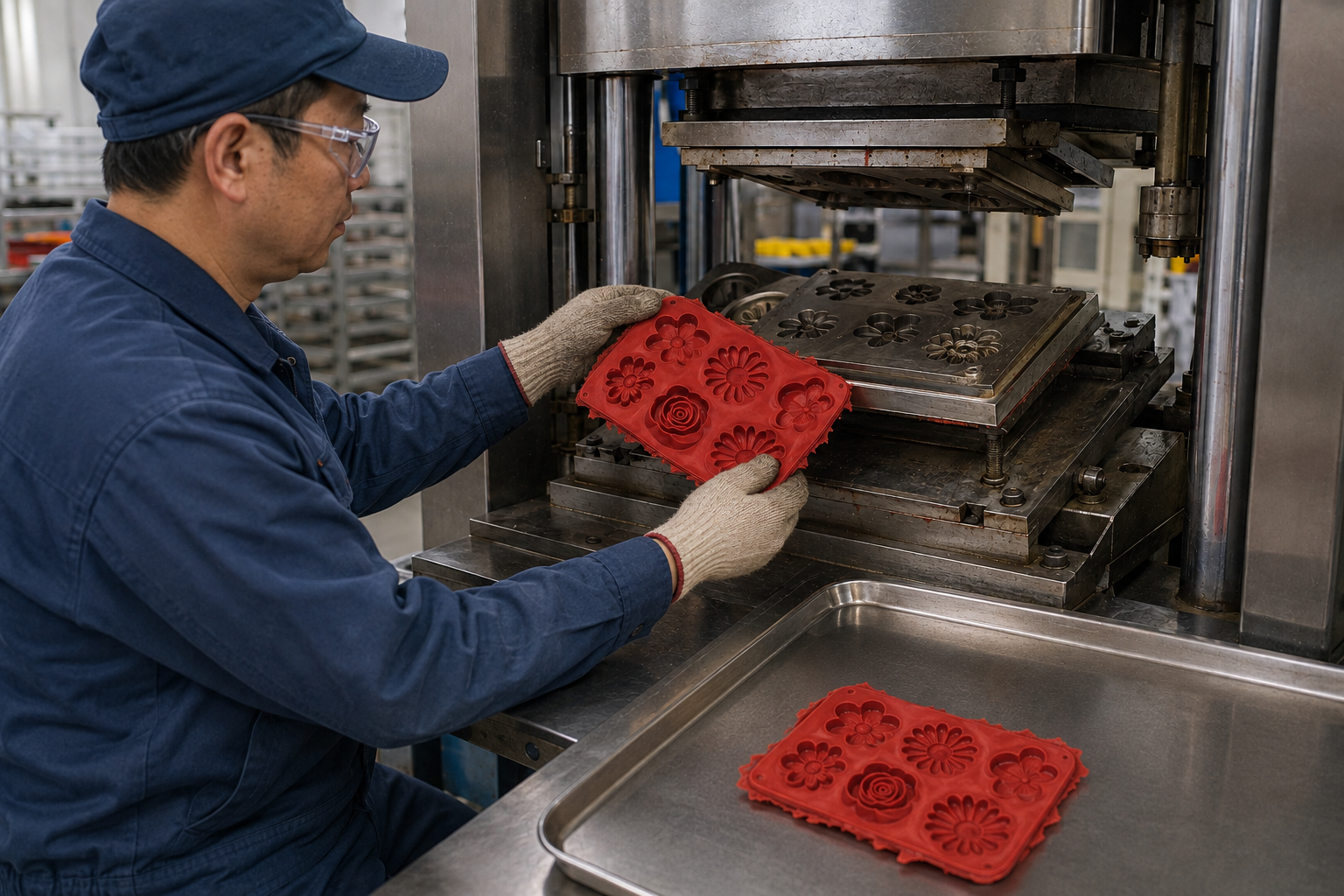
Compression molding of food-contact silicone rubber parts such as molds, gaskets and kitchenware components.
Yakows lists the applicable industries for YKS-8850 as food-contact silicone products, bakeware and kitchenware, flexible molds, gaskets and seals, and general compression-molded silicone products. Each of those applications loads a different property.
Bakeware and kitchenware parts face repeated thermal cycling and repeated demolding, which places elongation and tear strength under continuous demand. Flexible molds depend on detail reproduction and on the material's ability to release without tearing at fine features, where tear strength measured on a right-angle specimen is the most relevant indicator. Gaskets and seals rely on resilience — the published value is at least 40% — because a gasket that does not recover after compression loses its sealing function even if it has not failed mechanically. General compression-molded food-contact products sit in between and typically use the density and shrinkage figures for costing and tooling rather than for performance claims.
Portfolio breadth is a secondary consideration but a real one during qualification. The same manufacturer also supplies HTV silicone rubber for composite insulators and electrical insulation, extrusion-grade HTV silicone rubber, fumed silica-reinforced compounds, flame-retardant and high-temperature-resistant silicone rubber, and silicone rubber for automotive and industrial components. Buyers who need more than one material family can consolidate documentation and incoming inspection under a single supplier — provided the food-contact grade's own documents remain specific to that grade.
Market Context for Food-Contact Compounds
Silicone rubber demand provides the background against which food-contact grades are being evaluated. The global silicone rubber market was valued at USD 5.7 billion in 2025, with HTV silicone rubber holding a 45.2% share, according to Vertex AI Search and Cloud Google data. Within the HTV segment, solid HTV silicone rubber accounted for 58.3% of the total in 2025, according to Dataintelo. Liquid silicone rubber (LSR) held 48.1% of the silicone elastomers market share in 2025, primarily serving precision medical and automotive parts, according to the Silicone Elastomers Market Report 2035.
Those figures should be read directionally. Published market size estimates for silicone rubber vary substantially between research bodies because some count primary and secondary forms together while others count only specific elastomer categories, so percentages from different reports are not interchangeable.
The adjacent regulated segment shows where documentation pressure originates. The global medical grade silicone market was estimated at USD 1.77 billion in 2025, growing at a compound annual growth rate of 6.41%, according to Mordor Intelligence. Food-contact silicone does not carry the same regulatory burden as implantable medical silicone, but the pattern is similar in one respect: as regulated end uses expand, documentation expectations travel back up the supply chain to the compound supplier, and batch-level traceability becomes part of the purchasing decision rather than an afterthought.
Limits and Trade-offs to Record on the Shortlist
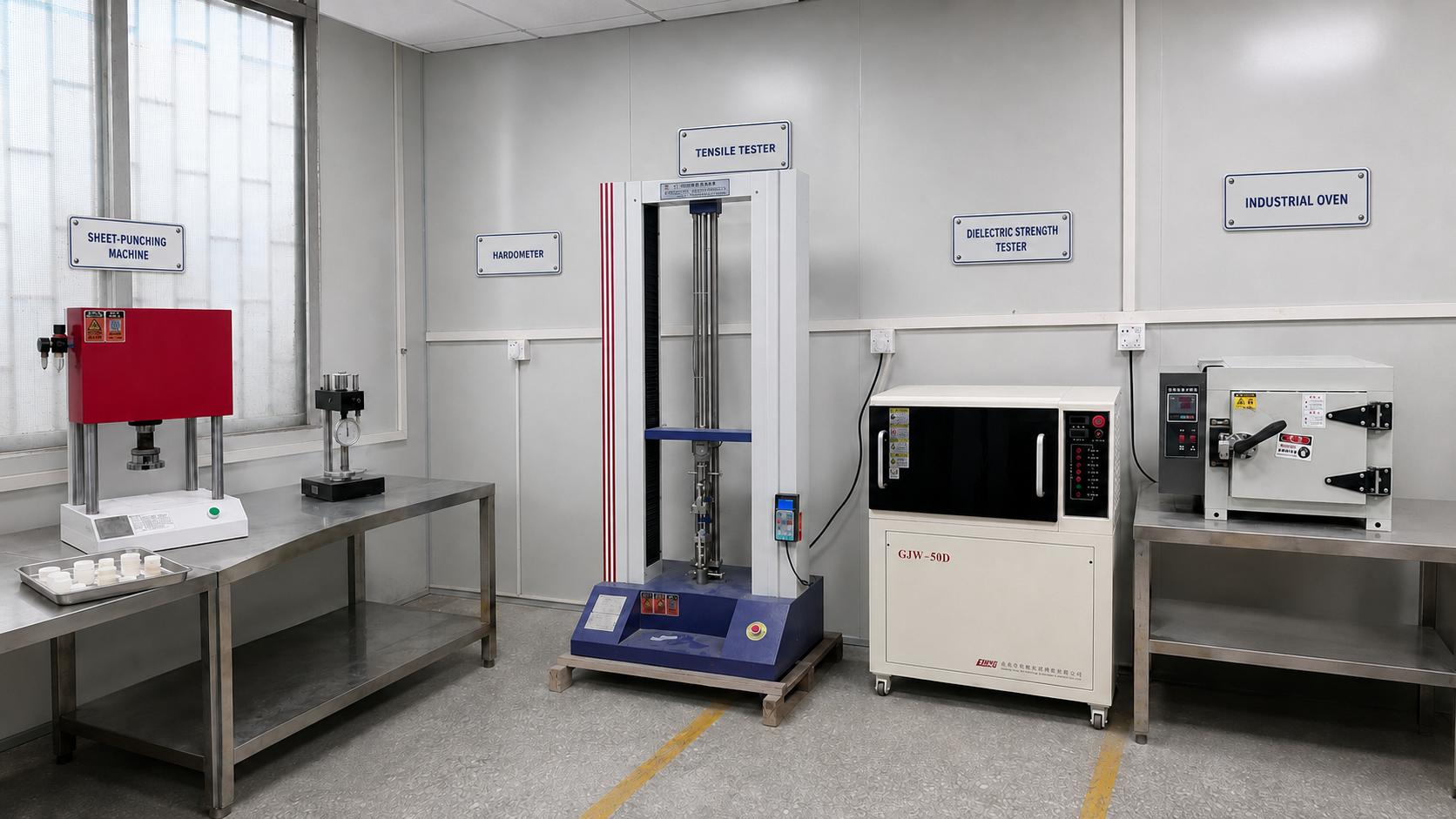
Batch inspection of HTV silicone rubber compounds in a quality control laboratory.
A shortlist is only useful if its boundaries are written down. For YKS-8850, several boundaries are explicit in the published specification.
Cure route. YKS-8850 is a peroxide-curing grade developed for compression molding. Peroxide systems are established for compression molding and are cured with agents such as DBPMH, whereas addition-curing LSR systems are processed by injection molding and dominate precision medical and automotive parts. A production cell built around LSR injection equipment cannot simply substitute a compression-molding HCR grade; the change would involve different equipment, different dosing and a different process window.
Hardness is fixed within a band. The grade is specified at 50 ± 3 Shore A. A different hardness requirement calls for a different formulation rather than an adjustment of this one; Shore A hardness is listed among the manufacturer's customization parameters, which in practice means a separate grade and a separate qualification.
The compound is deliberately incomplete. It is supplied without pigment or curing agent so that customers can select colors and optimize the curing system for their own production. That flexibility transfers responsibility: the buyer's pigment and curing-agent choices, and any post-cure step, must be validated for the intended food-contact use.
Shelf life is finite. Six months in the original unopened packaging at 30°C or below is a planning constraint. Operations with slow consumption per delivery, or with warm storage areas, may need smaller and more frequent deliveries to stay inside the window.
Documentation has a defined scope. Supplier-provided documentation according to US FDA 21 CFR 177.2600 supports the buyer's evaluation of the compound. It does not, by itself, certify a finished molded article. The distinction should be stated in the buyer's own approval file so that it is not blurred later.
Future Outlook
Two shifts are likely to shape food-contact compound shortlisting over the next few years, and both favor buyers who build the checklist before they build the mold.
The first is documentation depth. Food-contact evaluation already depends on third-party test documentation, per-batch certificates of analysis and traceability, and buyers increasingly request documents at the batch level rather than the grade level. Suppliers that can issue a batch COA covering appearance, hardness, density, tensile strength, elongation and tear strength — and that can trace a delivery back to a production batch — will be easier to qualify than those that cannot, independent of price.
The second is supply-side capacity. China's silicone monomer production capacity reached 6.89 million tons in 2024, a 21.09% year-on-year increase according to Zhuochuang Information via IOTA, and global silicone trade reached USD 8.51 billion in 2024, with China the second-largest exporter at USD 1.53 billion according to the Observatory of Economic Complexity. Expanding upstream capacity tends to widen the range of available grades while making supplier selection, not material availability, the harder part of procurement. That again pushes the decision back toward verifiable specifications and documents rather than toward category labels.
FAQ
What does food-contact grade mean in an HTV silicone rubber data sheet?
It means the supplier positions the compound and its supporting documentation for food-contact applications, and that applicable third-party test documentation — for example documentation according to US FDA 21 CFR 177.2600 — can be provided. It does not certify a finished molded article, because the article is produced after the processor adds pigment, curing agent and process steps.
Which specifications should be compared first across candidate compounds?
Density, plasticity and linear shrinkage. Density sets material consumption per part; plasticity describes the unvulcanized consistency that governs mill handling and mold filling; linear shrinkage determines mold dimensions and must be known before a cavity is machined. Hardness with its tolerance, tensile strength, elongation and tear strength should be compared next, together with the test method behind each value.
Is a base compound ready to mold as supplied?
For YKS-8850, no. The compound is supplied without pigment or curing agent. The recommended curing agent is DBPMH, a 35% active preparation, at a recommended dosage of 1.5% by weight, and the recommended molding cure is 180°C for 5 minutes. The buyer selects the pigment and confirms the curing system against its own equipment and part requirements.
What storage conditions and shelf life apply?
For YKS-8850, the recommended storage temperature is 30°C or below and the shelf life is six months in the original unopened packaging. Because plasticity is an unvulcanized property, material stored outside the recommended temperature range or held beyond the shelf life should be re-verified before production use.
Which documents should be requested during evaluation?
A technical data sheet (TDS), a safety data sheet (SDS), a typical certificate of analysis and per-batch COA. For food-contact evaluation, the supporting third-party test documentation according to US FDA 21 CFR 177.2600, and where the destination market requires it, LFGB test reports and REACH compliance documentation. Yakows also operates a quality management system certified to ISO 9001.
How is batch-to-batch consistency verified?
Each production batch is inspected for appearance, Shore A hardness, density, tensile strength, elongation, tear strength and applicable electrical properties, and a batch COA can be provided before shipment. Buyers should map these checks to their own incoming inspection plan so that a supplier's batch release and a buyer's acceptance test refer to the same properties and methods.
What are the minimum order quantity and lead times?
The manufacturer lists a minimum order quantity of 2,000 kg, with trial quantities available for product qualification. Lead time is 3 to 7 working days for standard grades and 10 to 20 working days for customized grades after sample approval.
Reference material: the Yakows Technology (Dongguan) Co., Ltd. product brochure is available as a public PDF — Yakows brochure (PDF).