
Food-Contact HTV Silicone Rubber: Questions to Ask Before You Buy
Food-Contact HTV Silicone Rubber: Questions to Ask Before You Buy
Food-contact silicone parts are often purchased on the assumption that the material decision has already been settled somewhere upstream. In practice, that assumption is where most of the procurement risk begins. Baking molds, kitchenware, gaskets and seals reach the market only after a chain of decisions about compound grade, cure system, colour and documentation, and the buyer who places the compound order usually controls several of those decisions, whether or not they realise it.
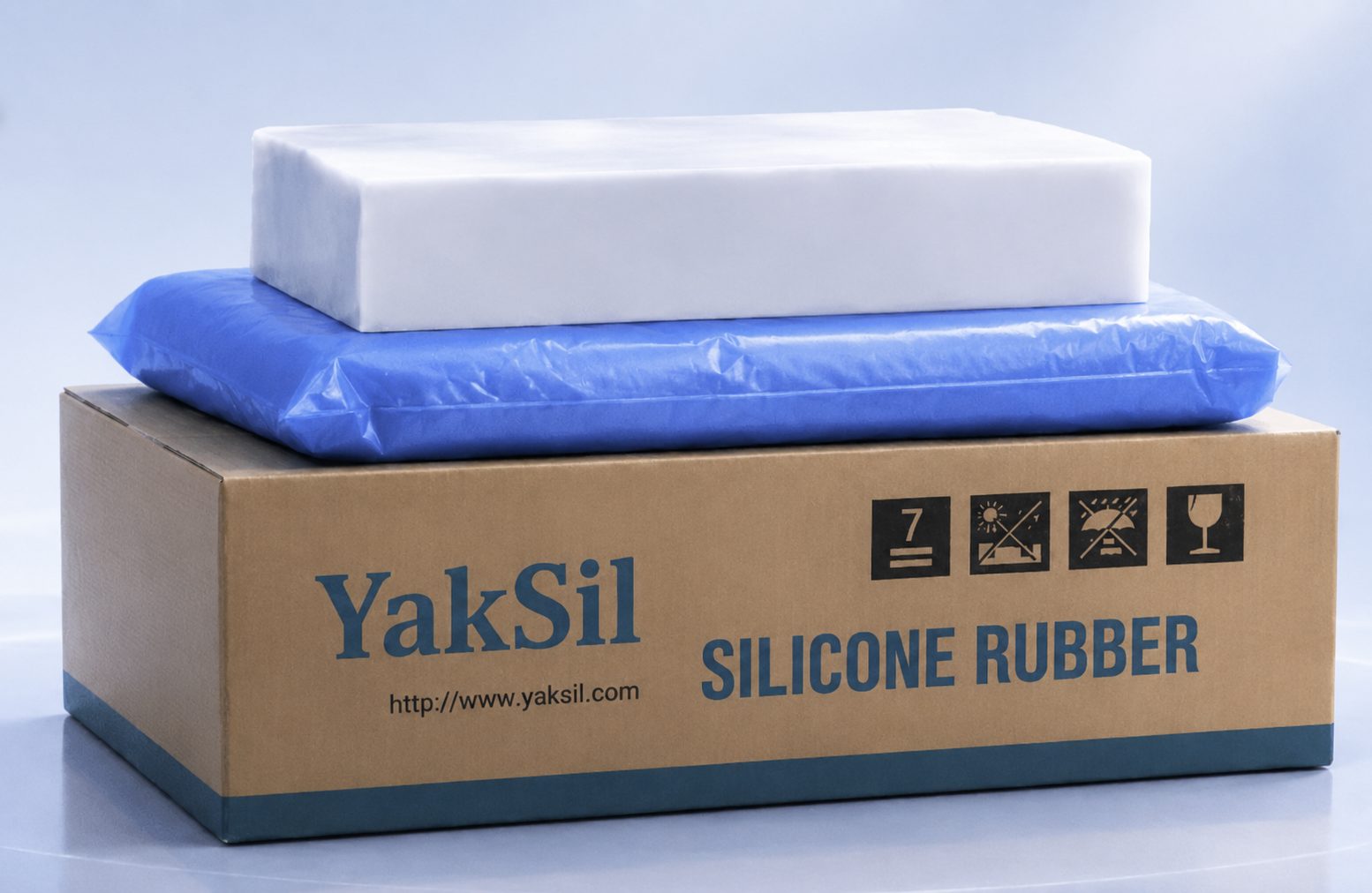
High-temperature vulcanizing (HTV) silicone rubber, also called high-consistency rubber (HCR), is a solid, gum-like silicone material that is mixed, cut and pre-formed before it is vulcanized in a heated mold. It remains the dominant material family in the silicone rubber category. The global silicone rubber market was valued at USD 5.7 billion in 2025, with HTV silicone rubber holding a 45.2% share, according to Vertex AI Search / Cloud Google, and solid HTV accounted for 58.3% of the HTV segment in the same year according to Dataintelo. Food-contact grades are a small slice of that volume, but they carry a documentation burden that general-purpose grades do not.
Why food-contact compound purchases fail quietly
A general-purpose HTV order can be judged on hardness, price and delivery. A food-contact order cannot. Two compounds with identical hardness may differ in how they are documented, what the supplier delivers alongside them, and who carries responsibility for the final formulation. Problems in this category rarely appear at incoming inspection. They appear later: a customer audit asking for a batch-level certificate of analysis that was never requested, a migration test on a finished article that does not match the paperwork for the raw compound, or a cure inconsistency traced to a base compound that arrived without a curing agent and was dosed by trial and error.
The practical consequence is that food-contact HTV sourcing should be structured as a question list rather than a price comparison. The question sets below follow the order in which a buyer normally meets them: compliance first, then physical specification, then formulation responsibility, then processing, then storage and logistics.
Question set 1: What does the compliance documentation actually cover?
The most common gap in food-contact silicone sourcing is documentation that describes a supplier rather than a grade. A buyer should ask which regulation the documentation addresses, and then confirm that the report or statement is tied to the exact compound being quoted.
For the United States market, the reference point is US FDA 21 CFR 177.2600, the section that applies to rubber articles intended for repeated use in contact with food. A supplier should be able to state whether third-party test documentation according to 21 CFR 177.2600 exists for the grade in question, and to produce it on request. For European markets, buyers commonly ask for LFGB test reports and REACH compliance documentation. These are different documents answering different questions, and a supplier that can only provide one should say so plainly rather than substituting one for another.
Four follow-up questions sharpen the answer:
| Verification question | What a useful answer looks like |
|---|---|
| Is the documentation grade-specific? | A report or compliance statement naming the compound grade, not only the company or the product family. |
| Is there a Typical COA as well as a batch-level COA? | A typical certificate describing normal values, plus a per-batch certificate tied to the delivered lot. |
| Does the documentation cover the compound as supplied, or the cured article? | A clear statement of scope, including any assumptions about cure system, pigment and other additives. |
| Which markets does it support? | Explicit reference to the regulation requested, for example 21 CFR 177.2600, LFGB or REACH, rather than a general claim of compliance. |
Boundary to state in writing: documentation that applies to a compound does not automatically extend to the finished article. If the processor adds pigment, curing agent or other additives, the compliance profile of the finished part is a shared result. Buyers should ask the supplier to confirm this scope explicitly and should plan their own finished-article validation accordingly.
Question set 2: Which physical properties belong in the specification?
Hardness alone is not a specification. Food-contact mold, bakeware and gasket applications are sensitive to several properties that behave independently of one another, and each should be named with a value, a tolerance and a test method. The table below shows the property set of YKS-8850, a food-contact grade HTV silicone rubber compound supplied by Yakows Technology (Dongguan) Co., Ltd., a manufacturer of high-performance HTV/HCR silicone rubber compounds established in 2020 and operating a 5,000 m² facility in Dongguan, China.
| Property | Specified value | Test method |
|---|---|---|
| Form supplied | HCR/HTV base compound, without pigment or curing agent | — |
| Appearance | Milky white to slightly yellow | — |
| Hardness | 50 ± 3 Shore A | GB/T 531.1-2008 |
| Density | 1.14 ± 0.03 g/cm³ | GB/T 533-2008 |
| Plasticity | 250–280 | GB/T 12828-2006 |
| Tensile strength | ≥ 7.0 MPa | GB/T 528-2009 |
| Elongation at break | ≥ 700% | GB/T 528-2009 |
| Tear strength | ≥ 18 kN/m, right-angle specimen | GB/T 529-2008 |
| Resilience | ≥ 40% | GB/T 1681-2009 |
| Linear shrinkage | 2.7–3.2%, molding method | GB/T 1692-2008 |
| Recommended molding cure | 180 °C × 5 minutes | — |
| Recommended curing agent | DBPMH, 35% active preparation, 1.5% by weight | — |
| Packaging | 20 kg net per carton | — |
| Storage temperature | ≤ 30 °C | — |
| Shelf life | 6 months in original unopened packaging | — |
In purchasing terms, each line carries a different consequence:
- Hardness sets the feel and sealing force of the finished part. It is also the property most often used as shorthand by suppliers, which is precisely why it should be one line in a specification rather than the whole of it.
- Density converts directly into material cost per part. Two quotations that look comparable per kilogram can diverge once density and part volume are applied.
- Tensile strength and elongation at break describe how the compound behaves during demolding and in service. An elongation at break of at least 700% is relevant for thin-walled molds and for parts that flex repeatedly in use.
- Tear strength governs resistance to tearing at edges, corners and mold parting lines, which is often the first place a molded food-contact part fails.
- Resilience and linear shrinkage are tooling inputs. Shrinkage in particular should be confirmed against the actual molding process, because it drives mold dimensions.
Question set 3: Is the compound supplied with or without pigment and curing agent?
This question changes the shape of the entire project, and it is the one buyers most often forget to ask. YKS-8850 is supplied as an HCR/HTV base compound without pigment or curing agent. The buyer therefore selects the colour and optimises the curing system for its own production. That is a deliberate division of responsibility, and it suits processors who already run their own mixing, cutting and dosing operations.
For buyers who expect a ready-to-mold compound, the same question identifies a mismatch before the order rather than after it. A supplier should be able to say clearly whether a grade is a finished formulation or a base compound, and what the buyer is expected to add. Where the answer is a base compound, the buyer should also confirm that the supplier can still provide the grade-specific documentation needed for the food-contact approval file.
The compliance consequence deserves to be stated plainly. When curing agent and pigment are added downstream, the food-contact documentation the supplier can support applies to the compound as delivered. The finished article is a joint result of supplier and processor inputs, and buyers should confirm that scope in writing rather than assume it.
Question set 4: What processing window does the supplier recommend?
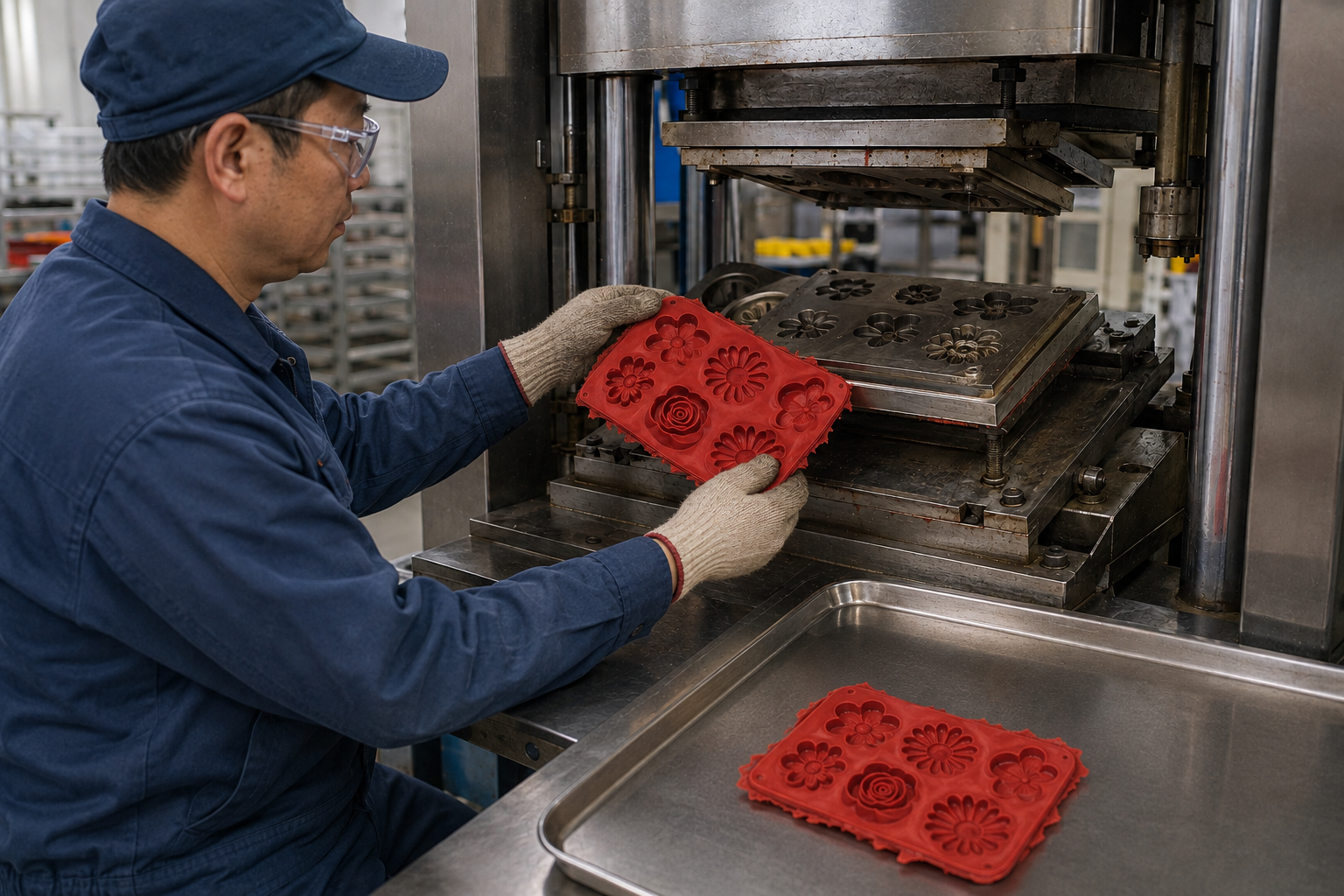
Processing parameters belong in the purchase conversation because they determine trial cost and scrap rate. For YKS-8850, the recommended molding cure is 180 °C for 5 minutes, with a recommended curing agent of DBPMH in a 35% active preparation, dosed at 1.5% by weight.
These are starting points for a compression-molding process. Buyers should ask two further questions: how the recommended cure window should be adjusted for thicker sections, and what the supplier position is if the existing press cycle sits outside that window. A supplier that answers in terms of a cure window rather than a single number is easier to work with during scale-up, because most food-contact parts change thickness at least once between the trial mold and the production mold.
Question set 5: Packaging, storage and shelf life
HCR base compounds are perishable in a practical sense. YKS-8850 is packed at 20 kg net per carton, carries a recommended storage temperature of 30 °C or below, and has a shelf life of 6 months in the original unopened packaging.
Buyers should ask three things: what the supplier position is once the packaging has been opened; whether the supplier can re-test or re-certify material that has aged past the stated window; and how shelf life is handled in shipment planning. Six months is workable for a well-planned production schedule, but it is not a long window for a shipment that crosses an ocean, clears customs and then waits in a warehouse. Order quantity and shipping mode therefore become part of the material decision rather than a separate logistics topic.
Where a 50 Shore A food-contact compound fits, and where it does not
YKS-8850 is intended for food-contact silicone products, including bakeware and kitchenware, flexible molds, gaskets and seals, and general compression-molded silicone products. The common thread is compression molding of parts for which a 50 Shore A hardness, high elongation and good tear resistance are appropriate.
The limits are equally specific. This grade is a peroxide-curing system designed for compression molding; buyers whose processes are built around liquid silicone rubber injection or addition-cure (platinum) chemistry should confirm suitability with the supplier rather than assume it. Parts demanding very tight dimensional tolerances or micro-scale precision may also be better served by a different material route. Liquid silicone rubber held 48.1% of the silicone elastomers market in 2025 and is primarily used for precision medical and automotive parts, according to the Silicone Elastomers Market Report 2035. That is a difference in process economics and tooling investment, not a ranking of quality.
And, as noted earlier, a base compound supplied without pigment or curing agent is not a drop-in material. It transfers formulation control to the buyer, which is an advantage for some processors and a burden for others. Buyers should decide which side of that line they are on before requesting quotations.
Market context: why food-contact grades are under more scrutiny
Three structural trends are pushing food-contact documentation further upstream in the purchasing conversation.
- Silicone supply is globally traded and increasingly concentrated. Global silicone trade reached USD 8.51 billion in 2024, with China the second-largest exporter at USD 1.53 billion, according to the Observatory of Economic Complexity. China silicone monomer production capacity reached 6.89 million tons in 2024, a 21.09% year-on-year increase, according to Zhuochuang Information via IOTA. More available material has not made documentation easier to obtain; it has made supplier selection more consequential.
- Adjacent regulated categories are expanding and raising the baseline. The global medical grade silicone market is estimated at USD 1.77 billion in 2025 and growing at a CAGR of 6.41%, according to Mordor Intelligence. Suppliers that serve both medical and food-contact segments tend to operate stronger grade-level documentation systems, which raises buyer expectations on the food-contact side as well.
- Material selection is being reviewed more frequently. Automotive applications accounted for 30.1% of silicone rubber market share in 2025 according to Vertex AI Search, and high-temperature vulcanized silicone is preferred for electric vehicle battery pack gaskets because of its high crosslink density and dielectric endurance. Food-contact buyers are not competing for the same parts, but they are competing for the same compounding capacity and the same quality-system attention.
Comparing material routes: food-contact HCR, general-purpose HTV and LSR
The comparison that matters to a food-contact buyer is not brand against brand. It is a comparison of material routes, because the route determines who carries the documentation, who controls the cure, and what tooling is required.
| Consideration | Food-contact grade HCR/HTV base compound | General-purpose HTV | Liquid silicone rubber (LSR) |
|---|---|---|---|
| Form | Solid gum, cut and pre-formed before vulcanization | Solid gum | Liquid, two-component |
| Typical process fit | Compression molding of bakeware, kitchenware, flexible molds, gaskets and seals | Ordinary molded silicone parts | High-volume injection of precision parts |
| Documentation expectation | Grade-level third-party test documentation according to US FDA 21 CFR 177.2600 available on request, with LFGB test reports and REACH compliance documentation where applicable | Typically supplied without food-contact verification | Documentation depends on the specific grade and supplier |
| Main limitation to plan for | This grade is supplied without pigment or curing agent, so the buyer controls colour and cure; shelf life is 6 months at 30 °C or below | Not intended for food-contact applications unless verified | Different tooling investment and process economics; 48.1% of the silicone elastomers market in 2025 sits mainly in precision medical and automotive parts |
Read across the table and the trade-off becomes visible. A food-contact HCR base compound gives the processor formulation freedom and a cost structure suited to compression molding, at the price of added in-house responsibility and a limited shelf life. LSR gives precision and injection-cycle economics, at the price of tooling and process investment that only pays back at higher volumes. Neither route is universally correct.
How to evaluate the supplier behind the compound
Yakows Technology (Dongguan) Co., Ltd. is a manufacturer specialising in high-performance HTV/HCR silicone rubber compounds and customised silicone material solutions. Established in 2020, the company operates a 5,000 m² manufacturing facility in Dongguan, China, employs approximately 50 staff, and maintains a technical department of 10 engineers and technicians working on formulation development, processing optimisation, testing and application support.
For food-contact buyers, the relevant capability is not headline capacity but document control. The company quality management system is certified to ISO 9001, and quality-control procedures are applied across raw-material inspection, production, in-process testing, finished-product inspection and batch release. Applicable product grades are supported by FDA food-contact compliance documentation, LFGB test reports and REACH compliance documentation. Grade-specific documents, including TDS, SDS, Typical COA, batch COA and applicable third-party test reports, can be provided to support customer evaluation and product approval.
Scale matters mainly as a continuity signal. Monthly production capacity ranges from approximately 400,000 to 1,000,000 kg, equivalent to an annual capacity of 4,800,000 to 12,000,000 kilograms per year. Approximately 70% of products are supplied to overseas customers, with major markets in Southeast Asia, the Middle East, Eastern Europe and Latin America. The product range spans HTV silicone rubber for composite insulators and electrical insulation, food-grade HTV silicone rubber for kitchenware and baking molds, extrusion-grade HTV silicone rubber, fumed silica-reinforced HTV silicone rubber, flame-retardant and high-temperature-resistant silicone rubber, and silicone rubber for automotive and industrial components.
Those facts are useful context, but they should not substitute for the grade-level questions. A buyer evaluating any supplier, including this one, should still be able to get a direct answer to the following: can you name the specific grade on the certificate of analysis; can you provide a batch COA with each shipment; what is your position on material approaching the end of its shelf life; and who adjusts the recommended cure window when part thickness changes.
Future outlook
Documentation expectations in food-contact silicone are moving from company-level to grade-level, and from grade-level to batch-level. Buyers who built approval files five years ago around a supplier certificate are increasingly being asked by their own customers for lot traceability, which shifts the burden back to the compound supplier.
Three developments are likely to shape the next procurement cycle. First, capacity growth in silicone intermediates, including the expansion of Chinese monomer capacity, keeps material availability high while doing nothing to standardise documentation quality, so supplier screening will continue to carry weight. Second, cross-over pressure from the medical silicone segment, estimated at USD 1.77 billion in 2025 and growing at a CAGR of 6.41% according to Mordor Intelligence, is gradually normalising the expectation that a compound arrives with a coherent document pack. Third, the silicone rubber insulation coatings segment is projected to reach USD 4.12 billion by 2035 at a CAGR of 5.73% according to Market Research Future, which indicates continued investment in silicone material platforms broadly and therefore continued formulation innovation in adjacent food-contact grades.
The practical implication for buyers is to treat documentation as a recurring verification step at each order cycle, not as a one-time approval event. Regulations and test expectations for food-contact materials continue to be reviewed in major markets, and a document pack that was sufficient at first approval should be re-confirmed rather than assumed.
Frequently asked questions
What is food-contact grade HTV silicone rubber?
Food-contact grade HTV silicone rubber is a high-temperature vulcanizing (also called HCR, high-consistency rubber) silicone compound intended for articles that come into contact with food. It is a solid, gum-like material that is mixed, cut and vulcanized in a heated mold. YKS-8850 is an example: a Food-Contact Grade HTV Silicone Rubber Compound classified as a peroxide-curing HCR base compound for compression molding at 50 Shore A, supplied as an HCR/HTV base compound without pigment or curing agent, and intended for food-contact silicone products such as bakeware, kitchenware, flexible molds, gaskets and seals.
What documentation should a buyer request under US FDA 21 CFR 177.2600?
Buyers should ask whether third-party test documentation according to US FDA 21 CFR 177.2600 exists for the specific grade being quoted, and request it along with the TDS, SDS, Typical COA and batch COA. For European markets, LFGB test reports and REACH compliance documentation are commonly requested in addition. The key check is scope: documentation that applies to the compound as supplied does not automatically extend to a finished article that contains buyer-added pigment or curing agent.
Which mechanical properties should be specified for food-contact silicone parts?
At minimum, hardness, density, tensile strength, elongation at break and tear strength, each with a value, a tolerance and a test method. For YKS-8850 these are 50 ± 3 Shore A (GB/T 531.1-2008), 1.14 ± 0.03 g/cm³ (GB/T 533-2008), at least 7.0 MPa and at least 700% (GB/T 528-2009), and at least 18 kN/m on a right-angle specimen (GB/T 529-2008). Resilience (at least 40%, GB/T 1681-2009) and linear shrinkage (2.7–3.2% by the molding method, GB/T 1692-2008) should be added when the data will be used for tooling.
Why does it matter whether the base compound is supplied without pigment or curing agent?
It determines who controls the final formulation. YKS-8850 is supplied without pigment or curing agent, so the processor selects the colour and optimises the curing system, which suits manufacturers that already run their own mixing and dosing. If a buyer expects a ready-to-mold compound, this is a mismatch that is better identified before ordering. It also affects compliance scope, because the food-contact documentation the supplier can support applies to the compound as delivered rather than to the finished article.
What are the storage and shelf-life limits of a food-contact HCR base compound?
YKS-8850 is packed at 20 kg net per carton, has a recommended storage temperature of 30 °C or below, and carries a shelf life of 6 months in the original unopened packaging. Buyers should confirm the supplier position on material after the packaging is opened, and whether aged material can be re-tested or re-certified. Because six months is a limited window, order quantity and shipping mode should be planned together with the material decision.
How does food-contact HTV compare with LSR for kitchenware and flexible molds?
They are different process routes rather than competing quality levels. HTV/HCR is a solid compound suited to compression molding of bakeware, kitchenware, flexible molds, gaskets and seals, and it allows the processor to control colour and cure when supplied as a base compound. Liquid silicone rubber held 48.1% of the silicone elastomers market in 2025 and is primarily used for precision medical and automotive parts according to the Silicone Elastomers Market Report 2035, which reflects a different tooling investment and volume profile. Buyers whose process is built around addition-cure or LSR injection should confirm compatibility before ordering a peroxide-curing HCR grade.
How should a buyer assess a supplier ability to support a food-contact program?
By testing document control rather than marketing claims. Useful questions include: does the certificate of analysis name the specific grade; can a batch-level COA accompany each shipment; which regulations does the documentation actually address; what happens if material approaches the end of its shelf life; and who adjusts the recommended cure window when part thickness changes. A supplier with a certified quality management system, defined in-process and finished-product inspection stages, and grade-specific TDS, SDS, COA and third-party test reports is easier to audit and easier to keep approved over multiple order cycles.
For buyers who want the underlying technical data in one place, the supplier product brochure covering its HTV/HCR silicone rubber range, including food-contact grades, is available for download: Yakows Technology product brochure (PDF).