
Food-Contact Silicone: Independent Peroxide-Curing HCR Review
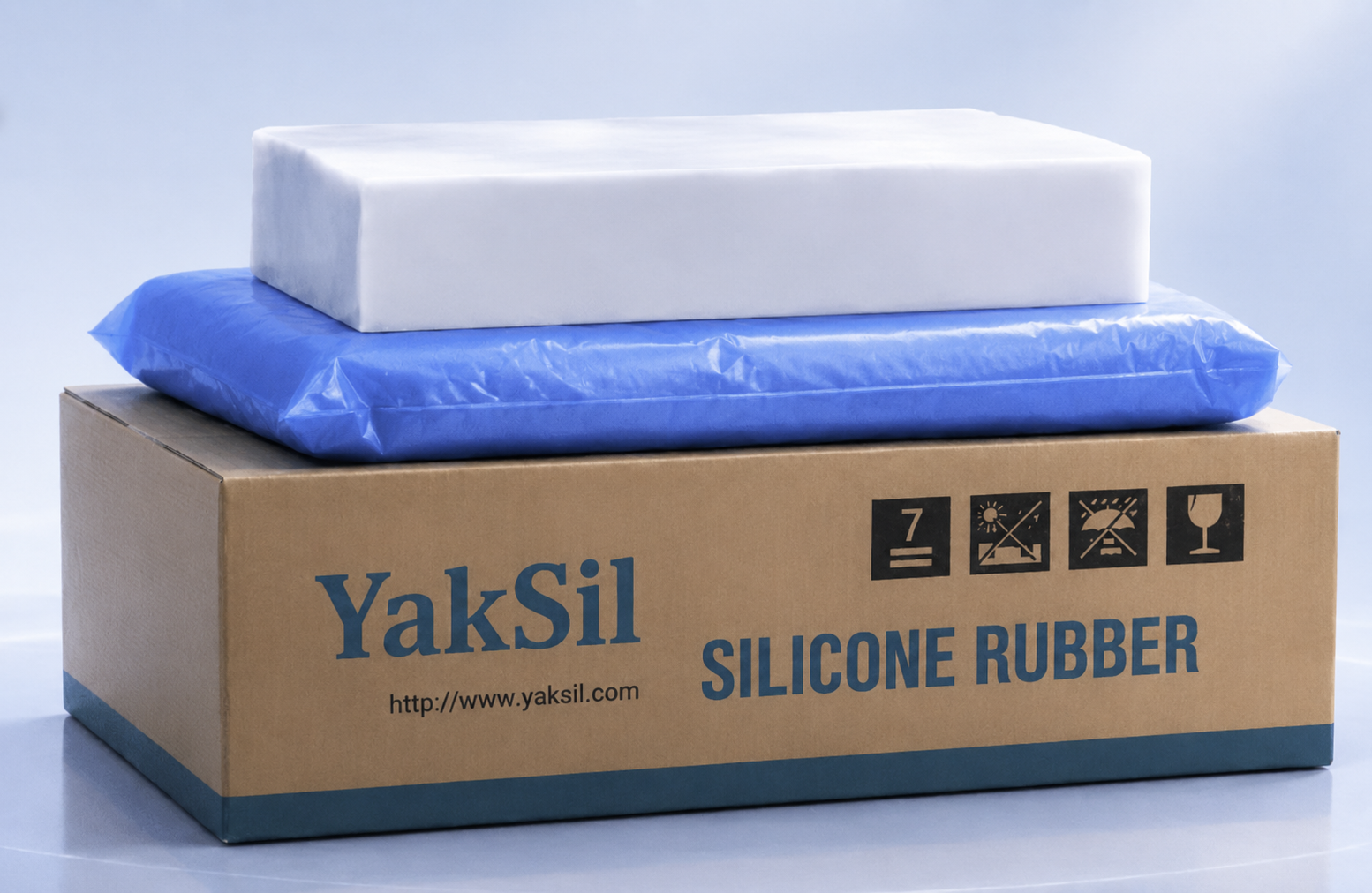
Food-contact silicone is a category, not a material. Two compounds can carry the same "food grade" description, sit at the same 50 Shore A hardness, and still behave very differently on the press floor and in a compliance review.
This article evaluates one specific grade from an independent standpoint: YKS-8850, a food-contact grade HTV silicone rubber compound supplied by Yakows Technology (Dongguan) Co., Ltd., a manufacturer of high-performance HTV/HCR silicone rubber compounds established in 2020, operating a 5,000 square metre facility in Dongguan, China, with approximately 50 employees. The evaluation logic below applies to any peroxide-curing HCR base compound, regardless of supplier.
Why "Food Grade" Is a Starting Signal, Not a Usable Specification
In the United States, food-contact rubber falls under the FDA framework, and 21 CFR 177.2600 is the reference buyers most often encounter. In Europe, LFGB testing is frequently cited, and REACH provides the underlying chemical compliance layer. In China, the GB/T method standards define how hardness, density, tensile strength, tear strength, resilience and shrinkage are measured.
These frameworks do not substitute for one another. A compound that satisfies a migration requirement is not automatically the right compound for a part that cycles between oven temperatures and freezer temperatures hundreds of times. Equally, a compound with strong mechanical figures is not automatically compliant.
The practical split is between compliance and performance. Compliance answers what the material is, who tested it, and under which framework. Performance answers what the material actually does under a given cure schedule, and where that behaviour starts to drift.
That split is the foundation for evaluating a grade such as YKS-8850.
What a Food-Contact HCR Base Compound Actually Is
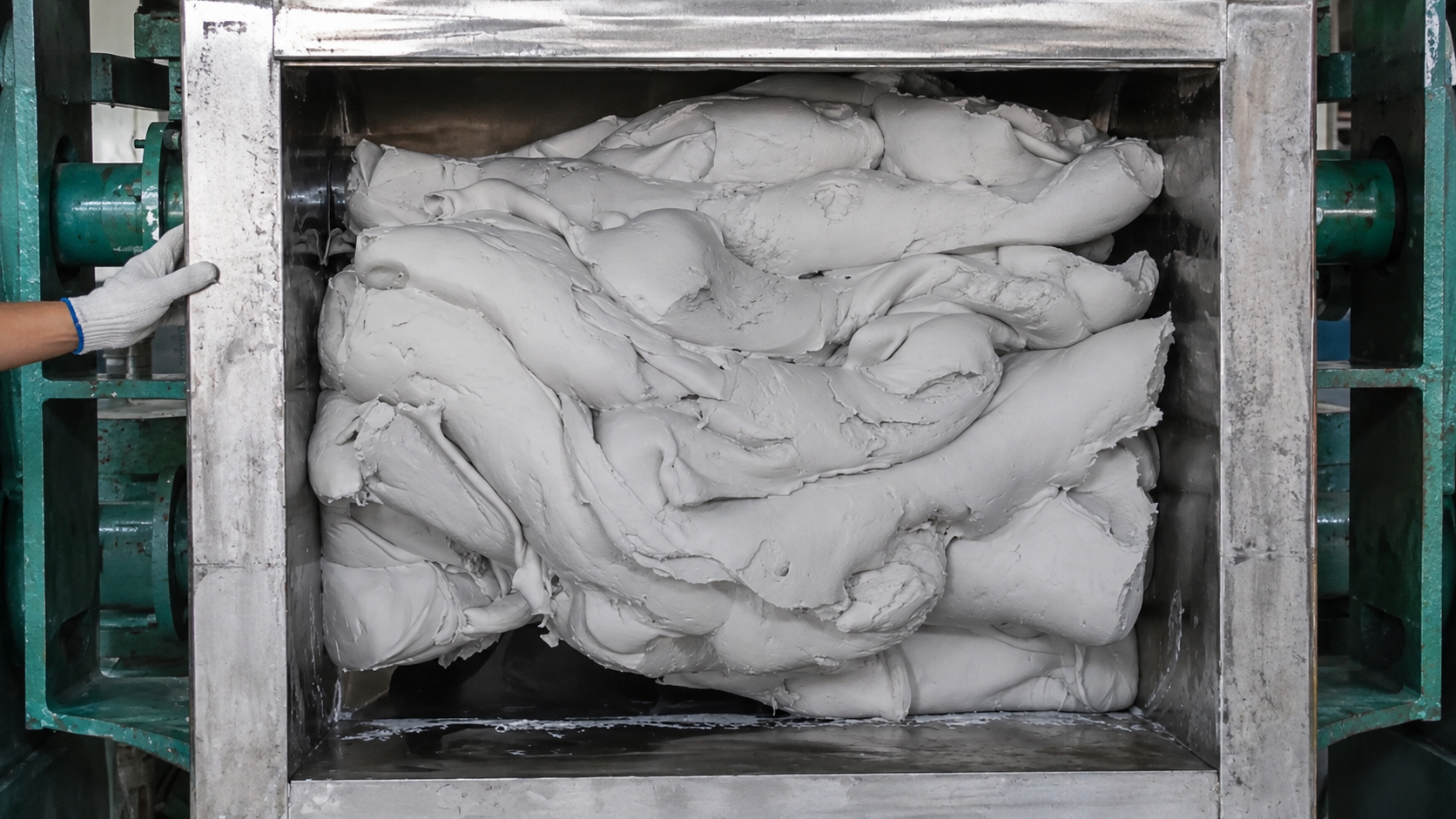
A peroxide-curing HCR base compound is a solid, high-consistency silicone rubber delivered in an uncured state. It stays plastic at room temperature and crosslinks when heat and a peroxide initiator are applied.
YKS-8850 is supplied without pigment or curing agent. That single sentence carries more weight than it appears to. When pigment and curing agent are left out, the buyer gains flexibility in colour and cure scheduling, and takes on a corresponding burden of process validation. Once the moulder adds the curing agent, any test certificate covers the raw material, not the mixed stock. That distinction rarely appears on a data sheet, but it comes up repeatedly in audits.
According to the supplier, YKS-8850 appears as a milky white to slightly yellow compound and belongs to the High Consistency Silicone Rubber (HCR/HTV) base compound family. It is intended for the food-contact silicone industry and sits within the food-contact silicone products category.
Evaluating YKS-8850 at the Datasheet Level
The table below lists the catalogue figures alongside the test methods they reference. Read it as a checklist rather than a summary.
| Parameter | Nominal Value | Reference Method |
|---|---|---|
| Appearance | Milky white to slightly yellow | Supplier catalogue |
| Hardness | 50 ± 3 Shore A | GB/T 531.1-2008 |
| Density | 1.14 ± 0.03 g/cm³ | GB/T 533-2008 |
| Plasticity | 250–280 | GB/T 12828-2006 |
| Tensile strength | ≥ 7.0 MPa | GB/T 528-2009 |
| Elongation at break | ≥ 700% | GB/T 528-2009 |
| Tear strength | ≥ 18 kN/m | GB/T 529-2008 (right-angle specimen) |
| Resilience | ≥ 40% | GB/T 1681-2009 |
| Linear shrinkage | 2.7–3.2% | GB/T 1692-2008 (moulding method) |
| Recommended moulding cure | 180°C × 5 minutes | Supplier catalogue |
| Recommended curing agent | DBPMH, 35% active preparation | Supplier catalogue |
| Recommended curing-agent dosage | 1.5% by weight | Supplier catalogue |
| Standard packaging | 20 kg net per carton | Supplier catalogue |
| Recommended storage | ≤ 30°C | Supplier catalogue |
| Shelf life | 6 months in original unopened packaging | Supplier catalogue |
Several things stand out beyond the individual values.
First, the figures are expressed as guaranteed floors or tolerances, not point values. Tensile strength of at least 7.0 MPa and elongation at break of at least 700% are lower bounds. Batches may exceed them, but a buyer should not plan a mould around the best case.
Second, the method standards are specific. GB/T 531.1-2008, GB/T 528-2009, GB/T 529-2008, GB/T 1681-2009 and GB/T 1692-2008 define how hardness, tensile properties, tear strength, resilience and shrinkage are measured. When a supplier compares its numbers against another supplier, the methods must be identical. An elongation figure produced under GB/T 528-2009 is not interchangeable with a figure produced under a different framework.
Third, shrinkage is given as a band of 2.7 to 3.2 percent. That is roughly half a percentage point of spread. For thin walls and complex profiles, that spread determines where the mould tool compensation is set and whether parts fall inside tolerance on the first attempt or the third.
For all of this, the datasheet is only the first pass. A material that scores well in the mechanical columns but has thin documentation in the compliance columns is not a completed evaluation.
Reading the Cure Window in Shop-Floor Terms
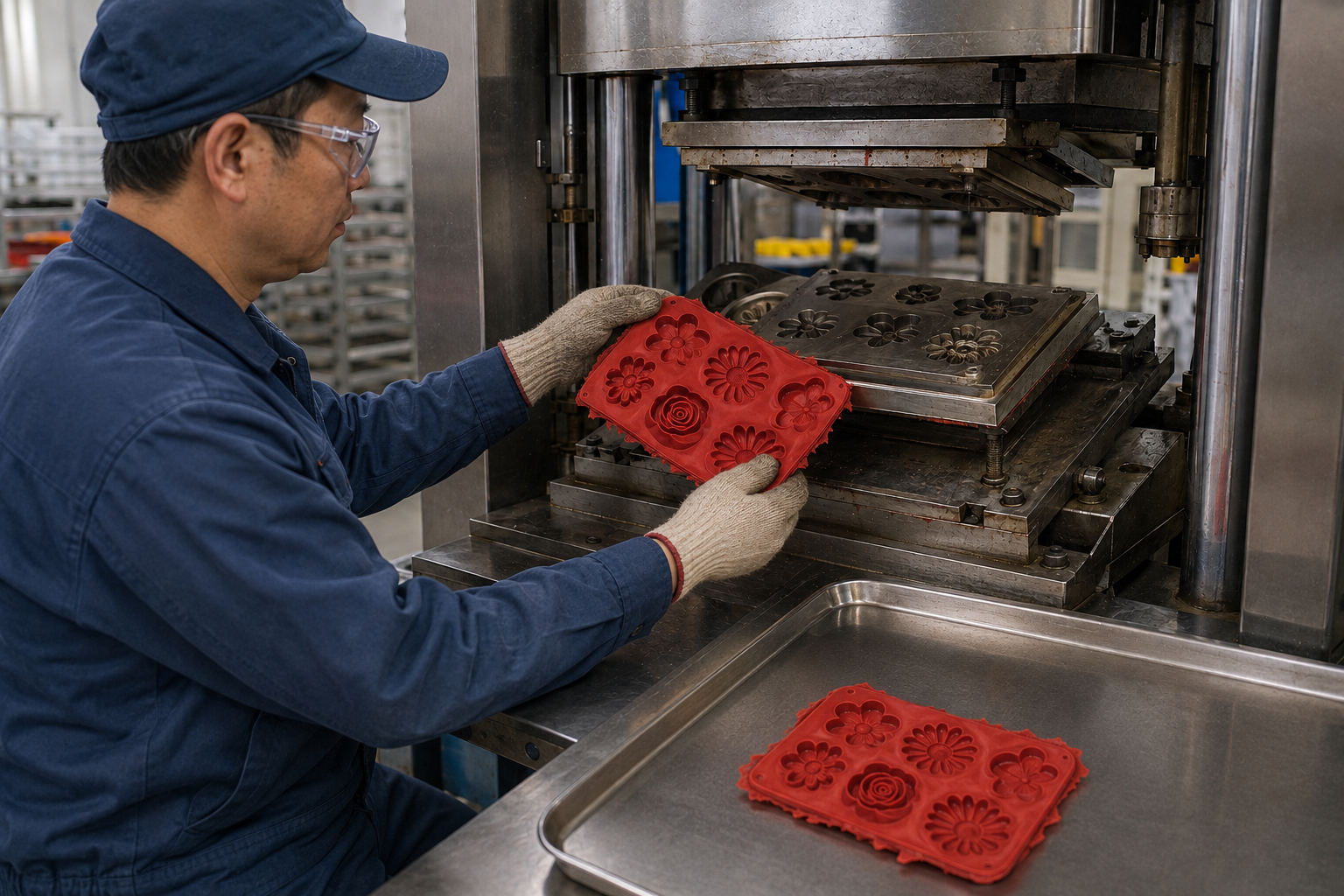
The supplier recommends compression moulding at 180°C for 5 minutes, using DBPMH at a 35 percent active preparation and a dosage of 1.5 percent by weight.
For a production planner, five minutes is one line item in a cycle time. The more consequential question is how wide the cure window is. An operator adding slightly high or slightly low dosage, press platens running a few degrees off setpoint, pre-forms resting on a bench longer than intended — each of these shifts where the part lands relative to full cure. A narrow window turns those routine variations into scrap.
Two details in the recommendation deserve attention. The first is that the recommended curing agent is a DBPMH 35 percent active preparation, not pure DBPMH. That distinction matters because a buyer who reads "1.5 percent curing agent" and applies the same figure to a different active concentration will not get the same result. Dosage calculations must normalise for active content.
The second is that the dosage figure of 1.5 percent by weight is a reference value paired with a fixed cure schedule. It should be treated as the starting point for a validation run on the buyer's own press, not as a universal setting. Two moulds of different wall thickness will usually need different schedules, even when they use the same compound.
In short, the 180°C × 5 minute recommendation is best understood as a reference condition. The commercially useful question is how much drift that condition tolerates before properties fall out of specification.
How These Specifications Map to Recognised Standard Frameworks
The GB/T references in the table are performance test methods, not food-contact approvals. They tell a buyer how a number was measured. They do not replace a food-contact assessment.
On the compliance side, supporting third-party test documentation according to US FDA 21 CFR 177.2600 is available on request for YKS-8850. For Yakows more broadly, applicable grades are supported by FDA food-contact compliance documentation, LFGB test reports and REACH compliance documentation, depending on the intended application.
The word "applicable" is doing real work here. Compliance documents attach to a grade, a formulation and an end-use assumption. A certificate that covers one colour or one hardness does not automatically extend to another. When a buyer compares a premium material against an entry-level one, the useful comparison is not how many certificates exist, but whether each certificate can be traced to the exact compound and the exact end application under review.
Where the Parameters Would Be Put to Work
The catalogue lists the following applications for YKS-8850: food-contact silicone products, bakeware and kitchenware, flexible moulds, gaskets and seals, and general compression-moulded silicone products.
- Bakeware and kitchenware. Elongation at break of at least 700 percent and resilience of at least 40 percent are the figures that support repeated de-moulding and shape recovery through thermal cycling.
- Flexible moulds. Tear strength of at least 18 kN/m directly affects how a mould edges behave when a casting is pulled free, and the 2.7–3.2 percent shrinkage band drives the tool compensation value.
- Gaskets and seals. At 50 Shore A, sealing force depends less on hardness alone than on combined elongation and resilience, which is why the three values are usually reviewed together.
- General compression-moulded products. Where the part is not thin-walled and the cycle is stable, the wider parameter band gives the moulder room to optimise the cure schedule.
These are different jobs, and they stress different columns of the datasheet. A grade that performs well on bakeware may not be the most efficient choice for a thin-section seal, and vice versa.
Comparison With Established Alternatives — and One Real Boundary
Peroxide-curing HCR is one route among several in food-contact silicone. Platinum-cured (addition-cure) systems are frequently chosen where the moulder wants to avoid peroxide decomposition residues, but they are sensitive to certain contaminants and often require different equipment. Liquid silicone rubber (LSR) is another route: LSR captured 48.1 percent of the silicone elastomers market share in 2025 and is primarily used for precision medical and automotive parts. LSR requires metering and injection equipment, which suits high-volume small parts, while HCR remains a strong fit where parts are larger or where compression moulding is the established route.
There is one boundary buyers should weigh before requesting a quote. YKS-8850 is supplied as a base compound without pigment or curing agent. That is well suited to a factory with its own compounding, colouring and peroxide dosing capability. It is a less natural fit where the moulder needs a colour change on short notice, or does not have volumetric peroxide dosing equipment. In those cases, a pre-catalysed or masterbatch-pigmented compound may be the more practical route, though the trade-off is that fewer process variables remain visible to the buyer, because they were resolved at the supplier.
Two further operational boundaries apply: standard packaging is 20 kg net per carton, and the recommended storage temperature of 30°C or below should be respected, with a stated shelf life of 6 months in the original unopened packaging. Those are logistics constraints, not quality judgments, but they shape inventory planning.
Market Context for the Category
The global silicone rubber market was valued at USD 5.7 billion in 2025, with HTV silicone rubber holding a dominant 45.2 percent market share. Solid HTV silicone rubber held 58.3 percent of the total HTV market segment in 2025. In 2024, global silicone trade reached USD 8.51 billion, with China the second-largest exporter at USD 1.53 billion.
Two readings follow. First, solid HTV/HCR continues to account for the largest share of the category, so decisions made at this material level affect a substantial portion of food-contact silicone production. Second, China's position as a major silicone exporter means overseas buyers have a wide range of sourcing routes, which raises rather than lowers the value of grade-level documentation.
For context on supplier scale, Yakows Technology (Dongguan) Co., Ltd. reports a monthly production capacity of approximately 400,000 to 1,000,000 kg, annual capacity of 4,800,000 to 12,000,000 kg, an R&D team of 10 engineers, and exports accounting for approximately 70 percent of sales, with major markets in Southeast Asia, the Middle East, Eastern Europe and Latin America. The company holds ISO 9001 certification.
Future Outlook
Three shifts seem likely to shape food-contact HCR evaluation over the next few years.
Documentation will become more granular. Buyers and auditors are moving away from accepting a single "food grade" statement, and toward specification sheets that name the active concentration of the curing agent, the recommended dosage, and the tolerance around the cure window. A compound supplied without curing agent will increasingly be assessed on the quality of the guidance that comes with it.
Test coverage will move closer to real service conditions. Migration testing remains the baseline, but repeated thermal cycling and mechanical fatigue are becoming part of the conversation, particularly for bakeware and reusable moulds.
The division of labour between compound suppliers and moulders will sharpen. As silicone elastomer demand expands, factories will specialise into either in-house compounding or fully pre-catalysed supply. The evaluation criteria for a base compound and for a pre-catalysed compound are not the same, and buyers will need frameworks for each.
FAQ
Q1. Can peroxide-curing HCR and platinum-curing HCR be used interchangeably for a food-contact part?
Not as a direct substitution. The two systems use different cure chemistry and produce different residues, which changes the process window and the validation work required. YKS-8850 is a peroxide-curing HCR base compound with a recommended curing agent of DBPMH (35 percent active preparation) at 1.5 percent by weight. Switching cure chemistry is a revalidation project, not a like-for-like swap.
Q2. What is the hardness of YKS-8850 and why does it matter at the mould?
YKS-8850 is rated at 50 ± 3 Shore A, measured under GB/T 531.1-2008. That places it in a mid-range band commonly used for gaskets, seals and kitchenware components. Hardness influences de-moulding behaviour and compression behaviour, but it should not be read alone: elongation at break of at least 700 percent and tear strength of at least 18 kN/m describe how the part behaves once hardness is fixed.
Q3. Which curing agent is recommended, and at what dosage?
The recommended curing agent is DBPMH as a 35 percent active preparation, at a recommended dosage of 1.5 percent by weight. The figure refers to the 35 percent active preparation, not to pure DBPMH. The recommended moulding cure is 180°C for 5 minutes, which should be treated as a reference condition for validation rather than a universal setting.
Q4. What applications is YKS-8850 listed for?
The catalogue lists food-contact silicone products, bakeware and kitchenware, flexible moulds, gaskets and seals, and general compression-moulded silicone products. Suitability for any specific part also depends on geometry, mould design and the validated cure window, so the application list is a starting point rather than a conclusion.
Q5. What compliance documentation is available for YKS-8850?
Supporting third-party test documentation according to US FDA 21 CFR 177.2600 is available on request. For applicable grades, Yakows also supports food-contact compliance documentation, LFGB test reports and REACH compliance documentation, depending on the intended application. Because documents attach to a specific grade and end use, each certificate should be traced back to the compound and application being evaluated.
Q6. What storage and shelf-life limits should a buyer plan around?
Standard packaging is 20 kg net per carton. The recommended storage temperature is 30°C or below, and the stated shelf life is 6 months in the original unopened packaging. These are inventory and handling constraints that should be built into order scheduling, particularly for buyers in warmer markets.
For readers who want the full parameter set in one document, the Yakows brochure is publicly available at: https://cdn.socialarks.com/sbsp/25176/common/2026/0817/Yakows%20brochure.pdf
Have Questions or Need More Details?
Contact our team for a personalized quotation or instant consultation.
Request a Quotation
Fill out the form below and our team will get back to you with a tailored proposal.
WhatsApp Direct Chat
Prefer to chat in real-time? Message us on WhatsApp for instant assistance & quick answers.
- Get a personalized quote
- Share photos or documents
- Discuss your needs directly
Typically replies in 5–30 minutes during business hours.