
From Bakery to Dairy: Adapting the SNEX Ice Cream Extrusion Line for Varied Industry Inputs
From Bakery to Dairy: Adapting the SNEX Ice Cream Extrusion Line for Varied Industry Inputs
Extruded frozen desserts now cross category boundaries. The same forming and hardening platform serves dairy plants extending their product range, bakeries moving toward cake ice cream, and creative ice cream factories running short-run novelty formats. This article examines what changes, and what does not, when the Snowball Machinery SNEX ice cream extrusion and hardening line is configured for different industry inputs.
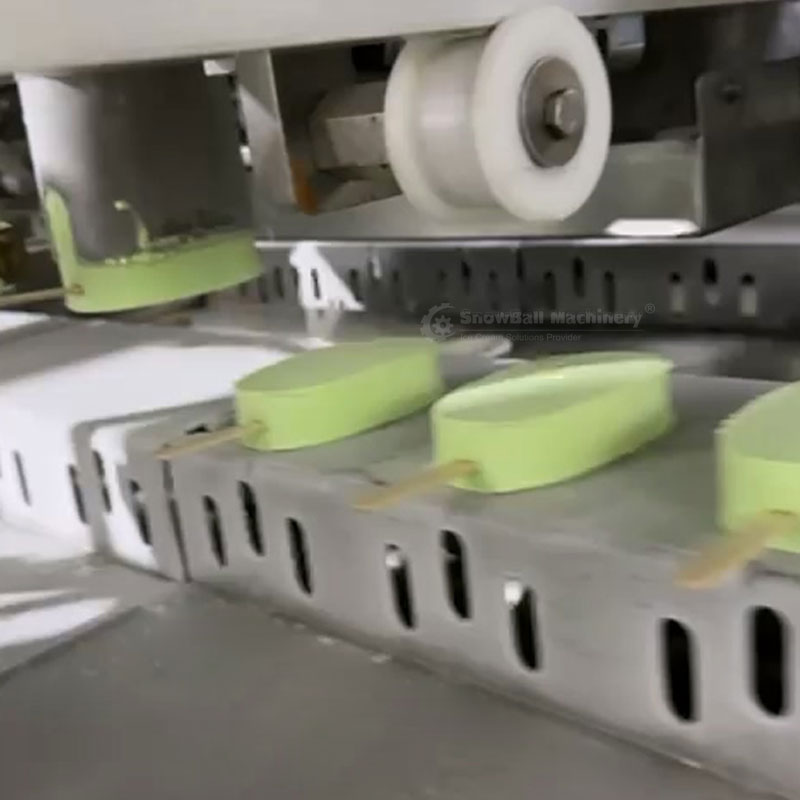
The SNEX ice cream extrusion and hardening line forms frozen mix through a die rather than setting it in a mould, which is what allows one platform to serve several product categories.
An Extrusion Platform That Sits Between Industries
Ice cream is no longer produced only by ice cream companies. The equipment category that has grown around this shift is the extrusion and hardening line, because it forms product by extruding semi-frozen mix through a die and then hardening the formed pieces in a tunnel, instead of setting the mix inside a mould. That single mechanical difference is the reason a line of this type can serve a dairy processor, a bakery and an ice cream factory without being rebuilt around a different product format.
The SNEX is an ice cream extrusion and hardening line manufactured by Snowball Machinery Manufacturing Co., Ltd, an ice cream equipment manufacturer founded in 2020 that operates a 4,000 m² factory with approximately 50 employees, a 10-engineer R&D team and reported annual output of 1,200 sets. The company builds the wider chain around the extrusion line: premix and mixing equipment, HTST and batch pasteurizing systems, homogenizers, aging tanks, CIP systems, continuous freezers, ingredient feeders, filling and moulding machines, hardening tunnels, packaging machines and cold storage rooms. Snowball Machinery reports a 90% export ratio, with customers in North America, South America, Europe, Asia and Africa, and company material states an export reach of more than 70 countries.
What makes the SNEX relevant to readers outside the ice cream industry is its stated application scope. Alongside large, medium and small ice cream factories, ice cream plants, ice cream workshops and factory laboratory R&D settings, Snowball Machinery lists the baking industry, the dairy industry, cream production and chocolate production as applicable industries for the extrusion line. The extrusion platform, in other words, is not marketed as an ice-cream-only asset.
Why Input Flexibility Has Become a Specification, Not a Bonus
The commercial argument for multi-input capability is straightforward. A line dedicated to one format forces a producer to either decline adjacent orders or duplicate capital. A line that can be re-configured around a different product design or a different mix moves the constraint from hardware to recipe development.
Snowball Machinery describes the extrusion equipment as featuring good expandability, with additional ice cream product shapes able to be added at a later stage through convenient upgrading. The same application notes describe the equipment as having a long service life, reliable warranty service and easy access to spare parts — the operational conditions under which a multi-year, multi-format production plan is realistic.
Three demand patterns sit behind this requirement:
- Dairy plants extending into frozen desserts. The documentation for the extrusion family lists the expansion of ice cream product lines for large dairy plants as one of three core project types, alongside new factory construction and equipment upgrading for large cold drink factories.
- Bakeries and cake producers moving into frozen formats. The baking industry appears as an applicable industry for the extrusion line, and cake ice cream appears in the equipment's own product list.
- Creative and brand-led producers. Products listed for the line include funny face ice cream, log ice cream, wave ice cream, ice cream ball cone, bonbon ice cream and ice cream choco bar — formats that typically run in shorter cycles and change more often.
How the SNEX Line Works: A Technical Explanation
An extrusion and hardening line is the middle of a longer process chain. Mix preparation happens upstream, forming and hardening happen inside the SNEX scope, and packaging happens downstream. Understanding that chain is what allows a buyer to judge whether the same line can absorb a different input.
| Stage | Typical equipment | Why it matters when the input changes |
|---|---|---|
| Mix preparation and pasteurizing | HTST system or batch pasteurizing system (SNM range) | Continuous HTST suits high-volume, single-recipe dairy runs; batch pasteurizing suits recipe changes and smaller volumes |
| Homogenizing | Homogenizer | Stabilises fat distribution when the fat source differs between dairy and bakery-style bases |
| Aging | Aging tank / aging vat | Provides the holding stage that lets a new recipe reach a repeatable state before freezing |
| Flavour and inclusions | Chocolate tank, ripple pump, ingredient feeder SNFF1000 / SNFF2000 / SNFF4000 | Feeder capacity from 50 to 4,000 litres per hour allows inclusion-heavy formats without changing the forming line |
| Continuous freezing | Continuous freezer SNCF 50L / 300L / 600L / 1200L / 1500L | Defines throughput; 50–1500 L/H, 100% overrun, mix in at +5°C, product out at −5°C |
| Extrusion and forming | SNEX extrusion head | The point where product shape is separated from the rest of the process |
| Hardening | Hardening tunnel / quick-freezing tunnel | Sets the formed piece so it can be handled downstream without deformation |
| Packaging and storage | Packing machine, cartoning machine (SNB range), cold storage room | Determines whether a new format can leave the site in sellable condition |
| Cleaning | CIP cleaning system | Allows a switch between product types without manual disassembly between runs |
Process chain as described in Snowball Machinery's equipment documentation for the extrusion, freezing, filling and associated machine ranges.
Mechanical and material baseline
Across the extrusion line and its related units, Snowball Machinery specifies high quality food grade stainless steel SS304 or SS316 for product-contact construction. Main components are stated to adopt internationally renowned brands, including SIEMENS, Schneider Electric, FESTO, SMC, Danfoss, ABB, Bonfiglioli, igus, Copeland, Bitzer and SEW Eurodrive.
Operating behaviour is stated as 24-hour fully automatic continuous operation, with remote control and a fault alarm function. That combination is what makes a multi-industry plan practical: a dairy plant running the line on day shifts and a bakery-style cake ice cream recipe on a separate campaign still needs the equipment to run unattended through long cycles and to report faults remotely rather than locally.
What Changes and What Stays When the Input Changes
Adapting the SNEX line from one industry input to another is not a matter of swapping a nozzle. The forming and hardening hardware, the stainless steel contact surfaces, the CIP regime and the automation layer stay in place. What changes sits around them.
What stays constant: extrusion forming, tunnel hardening, product handling, stainless steel construction, remote monitoring and fault alarm behaviour.
What changes with the input: the upstream mix preparation route, since a dairy plant with existing pasteurisation capacity may integrate HTST while a smaller or more varied operation may prefer batch pasteurizing; the feeder configuration, because inclusion type and dose differ by recipe; the recipe and product design itself; and the downstream packaging format.
Snowball Machinery states that it provides customised ice cream production line equipment solutions according to customer production scale, product positioning, product design and workshop conditions, and that it jointly develops new ice cream products with ice cream factories. For a bakery or dairy producer entering frozen desserts, that joint development step is the part of the project that determines whether a new base behaves correctly at −5°C at the extrusion head.
Application and Use Cases Across Industries
The product list attached to the SNEX line is the clearest evidence of output versatility. Listed formats include ice bar, funny face ice cream, log ice cream, cake ice cream, sandwich ice cream, wave ice cream, extruded ice cream, ice cream ball cone, bonbon ice cream, ice cream choco bar, Eskimo bars, magnum ice cream and stick ice cream.
| Format | Typical industry setting | Configuration notes |
|---|---|---|
| Cake ice cream | Bakery-linked and ice cream factories | Extrusion with robotic or automatic handling; related setup includes pro mix machine, homogenizer, CIP, aging tank, chocolate tank, chocolate ripple pump, continuous freezer, robot ice cream filler, IQF tunnel, packaging and cold storage |
| Sandwich ice cream | Ice cream factories, bakery-adjacent producers | Extruded and wrapped sandwich format; separate sandwich machine (SNSMZ) available as a dedicated automatic or semi-automatic route |
| Magnum-style chocolate bars | Startup to large-scale plants | Extruded tunnel capacity recorded at 5,000–8,000 pieces per hour in one project |
| Bars, bites, bonbon, funny face, log | Creative factories, brand-led and internet-famous producers | Short runs and shape changes; benefits from the stated expandability of the equipment |
| Family pack and bulk | Dairy plants extending product lines | Family pack filling machine with continuous freezer up to 1500 L/H |
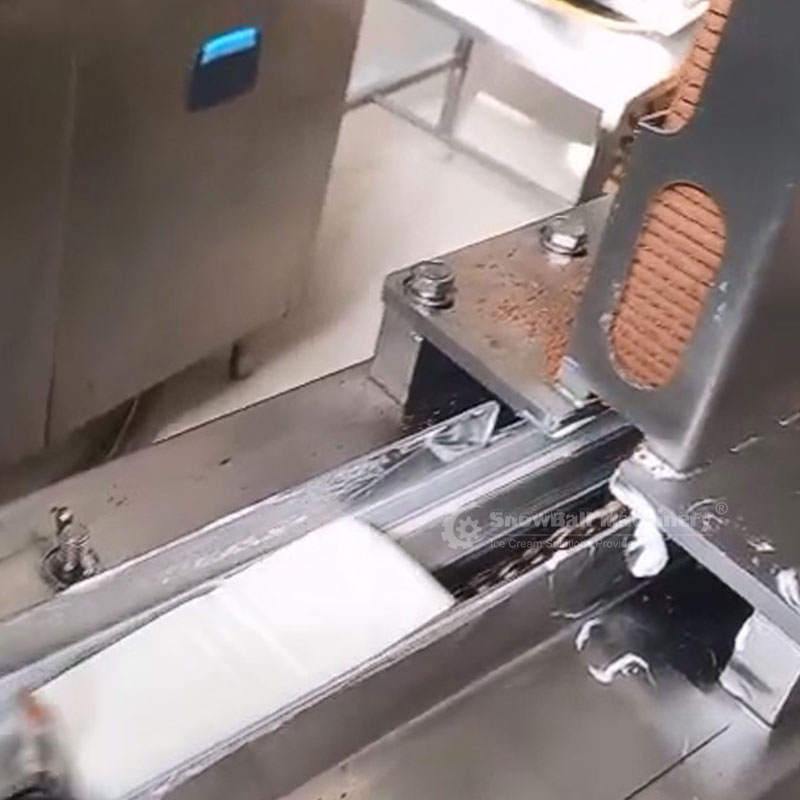
Sandwich ice cream is one of several extruded formats that sit next to the SNEX line in a multi-format portfolio.
Evidence From Operating Projects
Project records supplied by the manufacturer describe lines in which the extrusion route carried several product formats. They are useful as configuration references rather than as independent performance guarantees.
- Newly established manufacturer, supermarket and retail channels. A complete production line with continuous freezers, an extrusion tunnel, packing machines and auxiliary equipment, quoted at 9,000–10,000 pieces per hour and flexibly configured for multi-flavour production. The record states the equipment ran stably for three years in local high-temperature and high-humidity conditions, with modular design allowing capacity expansion and 24/7 after-sales support including remote video assistance.
- Startup client with no prior ice cream production experience. A turnkey plant solution using an extruded ice cream tunnel machine for magnum-style ice cream at 5,000–8,000 pieces per hour, a family pack filling machine at 1,200 L/H and a continuous freezer. The record states the equipment has run stably for 11 years, with SS304/SS316 construction and internationally branded components.
- European ice cream manufacturer. An added sandwich ice cream line designed for multi-specification and multi-flavour production, built with food grade 304 stainless steel and described as meeting EU food safety and environmental requirements.
- Long-established manufacturer upgrading 40-year-old equipment. Custom-designed workstations matched the existing line without full reconstruction, using food grade 316 stainless steel to meet North American production compliance requirements.
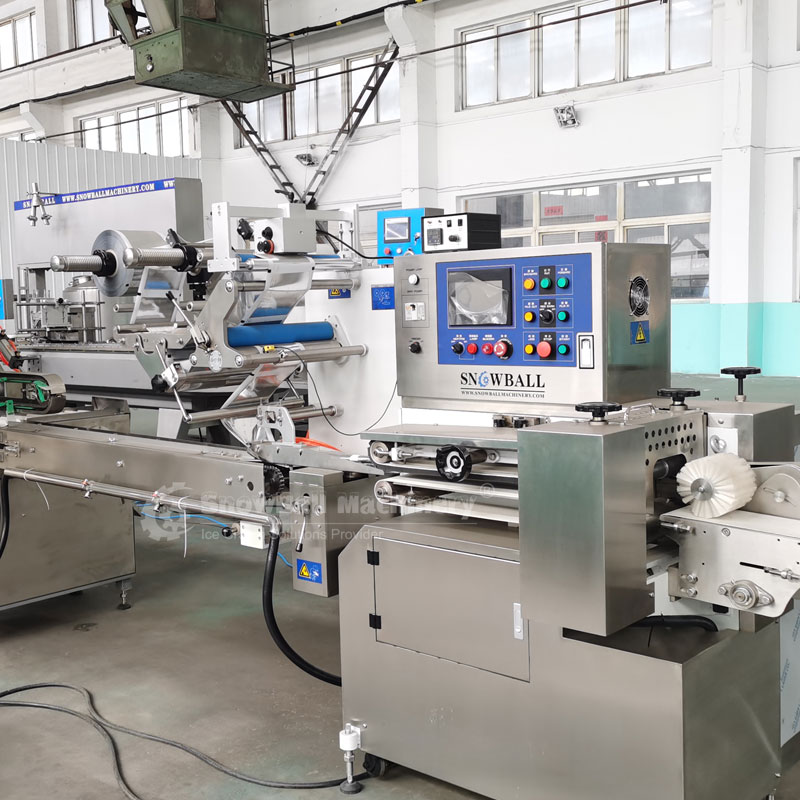
Downstream packaging capability determines which formats can leave the plant in sellable condition, not only which shapes the line can form.
Comparison With Alternative Approaches — and the Honest Boundaries
An extrusion and hardening line is not the default answer for every frozen dessert project. The selection logic is set by the dominant product format, the required output and the level of automation that the business can actually support.
| Approach | Where it fits best | Boundaries to accept |
|---|---|---|
| Extrusion and hardening line (SNEX) | Extruded and formed formats: bars, sandwiches, cake ice cream, bonbon, magnum-style products, multi-format portfolios | Engineered per product design and hourly capacity, so configuration changes involve engineering work and a lead time tied to the specific equipment plan; not the natural route for mould-defined stick formats |
| Moulded stick line (SNL) | Moulded stick ice cream, popsicle, ice lolly, frozen novelties, fruit bars, water ice | The format is defined by the mould set, so shape changes mean changing moulds |
| Filling line (SNLF) | Cups, cones, pints, family packs, bulk containers | Produces filled containers rather than self-supporting shapes |
| Semi-automatic or manual setup | Small factories, small-capacity trial production, first-time producers | Limited output and semi-automatic or manual operation; suited to validation rather than volume supply |
Two limits deserve particular attention. First, adapting a line to a new industry input is not a mechanical switch. The freezing and forming stages work against defined process parameters — mix entering at +5°C, product leaving at −5°C and 100% overrun on the SNCF range — and a bakery or dairy base with different fat and solids behaviour must be developed and validated as a product before it can be treated as a routine run. Second, because the line is non-standard and customised according to product design and hourly capacity, buyers cannot compare a single catalogue figure across suppliers. Comparing an extrusion proposal requires identical product designs and identical hourly capacity assumptions on both sides; otherwise the comparison is not meaningful.
Market Trend Analysis
Published market data supports the direction described above, while also showing why scope matters when reading any vendor's version of the numbers.
- The global ice cream processing equipment market was valued at approximately USD 2.33 billion in 2025, with projections to reach USD 3.00 billion by 2034 at a CAGR of 2.71% (IMARC Group).
- Hard ice cream processing equipment accounted for a dominant 57.8% share of the total ice cream equipment market in 2025, with continuous freezers the leading product type (Future Market Insights).
- The ice cream moulding production line segment was valued at USD 1.2 billion in 2024, expected to reach USD 2.5 billion by 2034, driven by increasing automation demand (Reports and Data).
- Tetra Pak is identified as the leading manufacturer in the industrial ice cream equipment sector, with machinery used in over 75% of commercial production lines worldwide as of early 2026.
- Germany, Poland and Italy led dairy machinery exports (HS Code 843420) in 2024, with export values of USD 74.4M, USD 64.9M and USD 61.7M respectively (OEC).
Two readings follow. First, growth in ice cream processing equipment is measured in low single digits, which shifts competition away from volume expansion and toward configuration fit: the supplier that can adapt one platform to several product categories is competing on a different axis than the supplier selling a fixed line. Second, the high concentration of installed base at the top of the market means most buyers evaluating alternatives are comparing, in practice, an engineered proposal against a standardised European catalogue specification — a comparison that only makes sense when the product design and output basis are held constant.
Compliance is the other structural trend. Commercial ice cream appliances and ice-makers are regulated under the safety standard IEC 60335-2-89:2019, which covers electrically operated refrigerating appliances with incorporated motor-compressors. For producers adding frozen dessert capacity to a dairy or bakery site, that standard sits alongside local food hygiene requirements as part of the qualification file rather than as a separate afterthought.
Evaluation Checklist for Buyers Comparing Extrusion Lines
For a buyer at the research and evaluation stage — particularly one whose existing business is dairy, bakery or cream production — the following questions separate a genuine multi-input platform from a single-format line with a broad product list.
- Name the dominant format first, then the secondary formats intended within two to three years. The extrusion line should be configured around the dominant one.
- Require proposals on identical bases: same product design, same hourly capacity, same level of automation.
- Confirm product-contact material — SS304 or SS316 — and the CIP arrangement across mixing, freezing, forming and filling stages.
- Check that the upstream chain exists: HTST or batch pasteurizing, homogenizing, aging, and chocolate or ripple handling where required.
- Verify continuous freezer capacity against the intended extrusion throughput; the SNCF range spans 50 to 1500 L/H.
- Verify inclusion handling if the product carries solids; feeder capacity is stated from 50 to 4,000 litres per hour.
- Ask for reference projects closest in input type to your own — a dairy line extension, a bakery-linked project, or a first-time producer.
- Confirm the expansion path in writing: which shapes can be added later, and what that upgrade involves.
- Confirm after-sales scope: on-site installation and commissioning, operational training, equipment upgrading, maintenance, fault handling, spare parts supply and regular inspection.
- Confirm the compliance documentation path against IEC 60335-2-89:2019 and the destination market's food safety requirements.
Future Outlook
Three developments are likely to shape how extrusion lines are specified over the next several years.
First, frozen dessert production will continue to migrate into businesses whose primary identity is something else — dairy processors with established pasteurisation and cold chain assets, bakeries with existing cake and cream capability, and chocolate producers with coating lines already in place. For those producers, the extrusion platform is attractive precisely because forming and hardening can be added without re-engineering the upstream business.
Second, automation demand is the growth driver identified for the moulding production line segment, and the same logic applies to extrusion. Robotic handling, remote control and fault alarm functions appear consistently in the equipment documentation for these applications, which suggests that the practical differentiator is no longer whether a line can automate, but how well it can absorb a product change without stopping.
Third, expandability will increasingly be treated as a contract term rather than a marketing phrase. Where a producer intends to add shapes or formats later, the useful commitment is a documented upgrade path — additional product shapes added at a later stage through convenient upgrading, joint development of new products with the equipment supplier, and access to spare parts over the service life of the line.
FAQ
1. What products can the SNEX ice cream extrusion and hardening line produce?
The listed product scope includes ice bar, funny face ice cream, log ice cream, cake ice cream, sandwich ice cream, wave ice cream, extruded ice cream, ice cream ball cone, bonbon ice cream, ice cream choco bar, Eskimo bars, magnum ice cream and stick ice cream. Capacity is not fixed: the line is described as non-standard, customised complete ice cream production equipment, configured according to product design and hourly production capacity.
2. Which industries outside ice cream manufacturing can operate an extrusion and hardening line?
The equipment's stated applicable industries include large, medium and small ice cream factories, ice cream plants, ice cream production lines in food processing factories, ice cream workshops and factory laboratory R&D settings, and also the baking industry, the dairy industry, cream production and chocolate production. Within those settings, the documented project types include expanding ice cream product lines in large dairy plants and upgrading equipment in large cold drink factories.
3. How is the capacity of an extrusion line determined?
Capacity is customised rather than catalogued. The equipment documentation states that customisation is based on product design and hourly production capacity, with capacity adjustable according to needs. In recorded projects, a complete line with an extrusion tunnel and continuous freezers was configured at 9,000–10,000 pieces per hour, and a startup project used an extruded tunnel machine for magnum-style ice cream at 5,000–8,000 pieces per hour with a family pack filling machine at 1,200 L/H.
4. What supporting equipment is required around an extrusion and hardening line?
The documented supporting chain includes HTST pasteurizing or a batch pasteurizing system, homogenizer, CIP system, aging tank, chocolate tank, syrups ripple pump, ice cream continuous freezer, hardening or quick-freezing tunnel, packaging machine and cold storage room. Where solid inclusions are used, an ingredient feeder from the SNFF1000, SNFF2000 or SNFF4000 range is added, with capacity from 50 to 4,000 litres per hour.
5. What are the limits of an extrusion and hardening line compared with other line types?
Three limits are documented or implied by the equipment scope. Mould-defined formats such as moulded stick ice cream, popsicle, ice lolly and water ice are served by a moulded stick line rather than by extrusion. Filled containers such as cups, cones and family packs are served by a filling line. And because the extrusion line is engineered per product design and hourly capacity, any configuration change requires engineering work with a lead time tied to the specific equipment plan rather than an off-the-shelf substitution.
6. What process parameters should be verified before adapting the line to a new recipe or input type?
On the SNCF continuous freezer range, the stated parameters are 50–1500 L/H capacity, 100% overrun, input material temperature of +5°C and output material temperature of −5°C. Product-contact surfaces are high quality food grade stainless steel SS304 or SS316. Because a new dairy or bakery-based mix must reach a stable state at those parameters, Snowball Machinery states that it jointly develops new ice cream products with ice cream factories and customises lines according to production scale, product positioning, product design and workshop conditions.
7. How can a buyer verify the claims made about an extrusion line before ordering?
Verification rests on documented items rather than statements: the specified stainless steel grade, the named component brands, the continuous freezer model and its stated parameters, the feeder capacity range, the operation mode including 24-hour continuous operation, remote control and fault alarm function, and the after-sales scope covering installation and commissioning, training, upgrading, maintenance, fault handling, spare parts and regular inspection. Reference projects of a similar input type — dairy line extension, bakery-linked production or first-time factory construction — provide the closest comparison point.
Further configuration and process information is compiled in Snowball Machinery's technical brochure: Ice cream production equipment brochure (PDF).