
Glass Filled PA66: What PA66 GF30 Buyers Must Verify
Industry Reference · Engineering Plastics
A PA66 GF30 callout tells a molder two things: the matrix is polyamide 66, and the nominal glass-fiber load is 30%. It does not tell them which grade, which test basis, which flammability class, which compliance scope or which processing window applies. In practice, those five items decide whether a purchase order turns into an acceptable part.
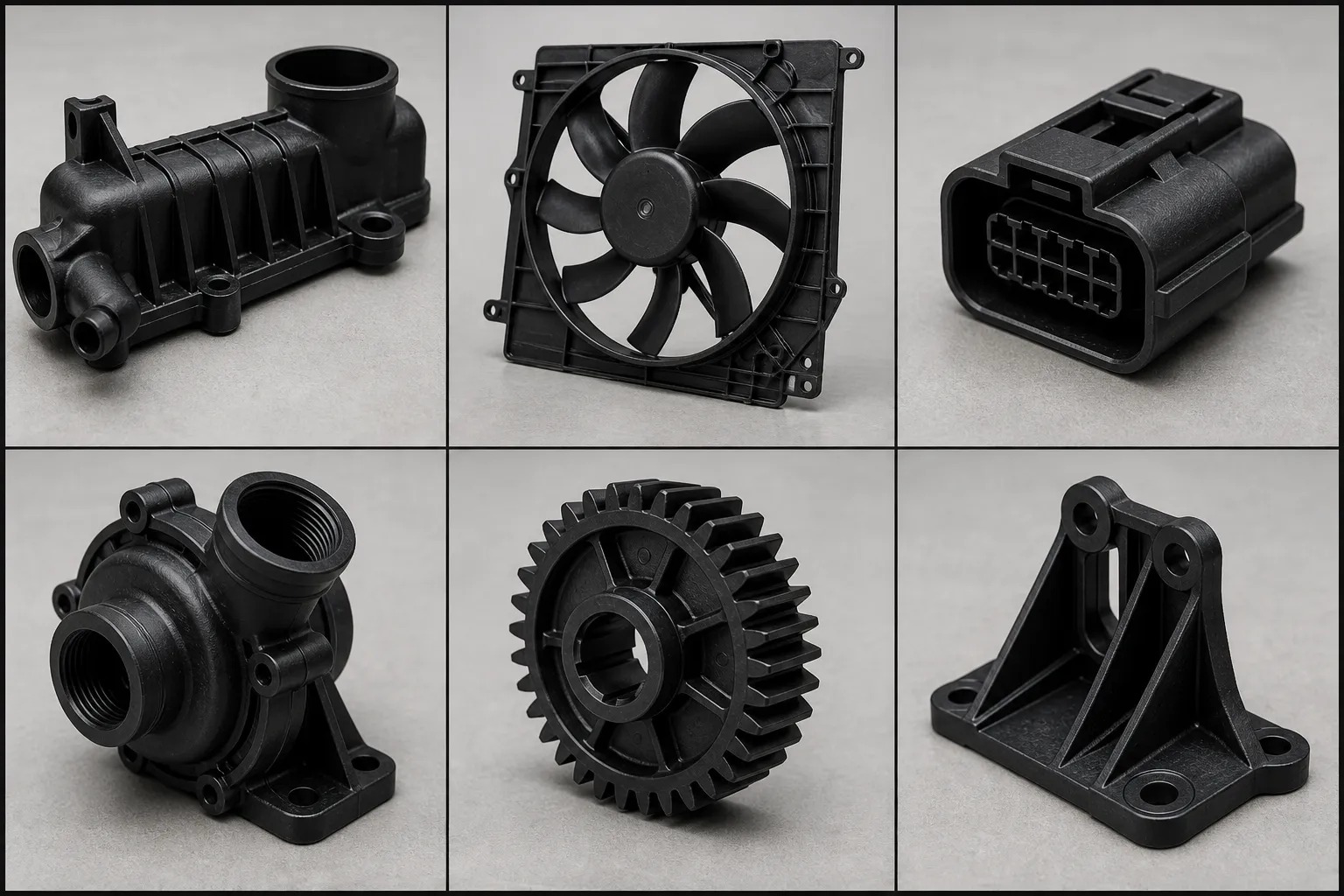
The Gap Between a Material Callout and a Purchasable Grade
PA66 GF30 is a generic material identification: polyamide 66 reinforced with approximately 30% glass fiber, commonly delivered as pellets for injection molding. The PA66 matrix supplies the polymer base and the glass fibers carry load, raising stiffness and strength. It is specified where unfilled PA66 does not deliver enough mechanical or dimensional performance.
That definition is deliberately broad, and its breadth is the source of most procurement friction. Suppliers apply the same three-part label to compounds that differ in base-resin viscosity, fiber type and length, coupling chemistry, additive package, stabilization, color and target processing window. A datasheet carrying identical wording can describe a materially different material.
The operating rule that follows is simple and frequently skipped: two GF30 compounds cannot be treated as equivalent simply because both contain 30% glass fiber. Matching filler percentage does not establish material equivalence, because the fiber, the coupling and the matrix that carries it are not the same thing across grades.
| Attribute | Covered by “PA66 GF30”? | What has to be confirmed |
|---|---|---|
| Polymer family | Partly — identifies polyamide 66 | Exact grade code and supplier |
| Reinforcement level | Yes — nominal 30% glass fiber | Actual fiber content, type, length and coupling for the grade |
| Mechanical data | No | Exact-grade TDS with test method, specimen geometry and conditioning state |
| Flammability class | No | Grade-specific flame test report and the tested specimen thickness |
| Compliance evidence | No | A report that names the supplied grade and the destination market |
| Processing window | No | Grade-specific drying and molding guidance, validated on the production tool |
| Supply terms | No | MOQ, lead time, packaging, capacity and color options |
Why Published PA66 GF30 Values Are Not Interchangeable
Public datasheets make the point more effectively than any argument. Everything described below is presented by its supplier as PA66 GF30, yet the reported numbers occupy a wide band:
- One grade lists density 1.29 g/cm³, tensile modulus of elasticity 5,000 MPa and a maximum service temperature of 120 °C.
- Another lists yield stress 85 MPa, tensile modulus of elasticity 4,500 MPa and heat deflection temperature 150 °C.
- A BASF Ultramid PA66-GF30 grade is positioned as a glass fibre reinforced, heat ageing resistant injection moulding grade for machinery components and housings requiring high stiffness and dimensional stability — including lamp socket housings, cooling fans, insulating profiles for aluminium window frames and automotive powertrain parts.
- WanHan's PA66-WHG30A grade page lists tensile strength 175 MPa (ISO 527-2), flexural modulus 7,000 MPa (ISO 178) and heat deflection temperature 220 °C (ISO 75-2/B).
These figures do not contradict one another. They are the normal output of different fiber systems, coupling chemistry, additive packages, test standards and specimen conditioning states. Each source establishes facts about its own product only, and none of them can be carried across to a different supplier's grade.
For a buyer, this produces one workable rule: a PA66 GF30 comparison is valid only where grade codes, test methods, units, specimen geometry and conditioning state align. Mixing dry-as-molded and conditioned values, or importing a number from a different reinforcement level, produces a comparison that will not survive contact with a molded part.
Why this matters at the specification stage: a lower tensile number is not automatically a worse material. A grade tuned for toughness, flame performance or low warpage will usually report lower strength and lower heat deflection temperature than a straight structural grade of the same filler load. The correct question is which property set the part actually needs.
Compliance Evidence: Company Certificates Are Not Product Documents
A frequent constraint in glass-filled PA66 sourcing is not the material at all. It is the evidence file attached to it. Three categories need to be kept apart, because they answer different questions.
1. Company management-system certificates
WanHan Plastic is the brand of Guangdong Wanhan New Material Technology Co., Ltd., a China-based manufacturer of modified engineering plastic compounds. The company holds ISO 9001:2015 quality management system certification (certificate 27326Q00154R153), ISO 14001:2015 environmental management system certification (27326E00087R153) and ISO 45001:2018 occupational health and safety management system certification (27326S00077R153). All three were issued by Zhongren Certification Co., Ltd. and are valid from 2026-06-01 to 2029-05-29. Their scope covers environmental, quality and occupational health and safety management activities related to the design and production of modified plastic pellets under IAF Code 14.
These are company-level certificates. They do not certify the performance or regulatory compliance of an individual product grade. A buyer who treats an ISO 9001 certificate as evidence that a specific PA66 GF30 grade meets a specific regulatory requirement is reading the document beyond its scope.
2. Sample-specific third-party test reports
The SGS reports held for the company illustrate the boundary. SGS RoHS test report SZXEC24003382501 and SGS REACH SVHC test report SZXEC24003382502 apply to a PP flame-retardant sample, model SZX24-0033825-0001.C001. Both were issued on 2024-11-04 with a stated expiry date of 2027-06-29, and the REACH SVHC screening references the ECHA Candidate List published on and before 2024-06-27 under Regulation (EC) No 1907/2006.
Neither report covers PA66 GF30. Both must not be represented as RoHS or REACH certification for PA66 GF30, PA66-WHG30A, or all WanHan products. The results are sample-specific and do not extend to untested batches or to other polymer families.
3. Grade-specific evidence
For an actual PA66 GF30 programme, the document that matters is the one that names the supplied grade. Where a destination market or a customer specification requires RoHS, REACH or flame evidence, an exact-grade report has to be requested and matched to the purchase order.
The practical consequence is straightforward: a buyer can hold a complete-looking certificate pack and still have no product-compliance evidence for the grade they intend to mold. That is a constraint on the purchase, not a formality.
Two Constraints That Are Routinely Misread
Flammability is a grade property, not a family property
No UL 94 flammability rating is specified for WanHan PA66-WHG30A in the available grade record, and the grade carries no stated flame-retardant or heat-stabilized designation. A programme with a V-0 requirement is therefore not addressed by the standard grade, however the part is described internally. It requires a separately documented flame-retardant compound.
WanHan's range does include one: PA66-WHRG30A, a flame-retardant PA66 GF30 grade whose technical data sheet lists a UL 94 V-0 classification. Two cautions apply. First, the specimen thickness is not stated in that data sheet, so the tested thickness and the current test report must be confirmed before the classification is used in a certified assembly. Second, the flame package changes the mechanical profile — PA66-WHRG30A lists tensile strength 125 MPa (ISO 527-2), flexural modulus 6,800 MPa (ISO 178) and heat deflection temperature 180 °C (ISO 75-2/B), against 175 MPa, 7,000 MPa and 220 °C for the standard grade. Flame performance is purchased with heat and stiffness headroom, and that trade has to be designed for rather than discovered late.
Heat deflection temperature is not a service temperature
HDT is measured on a standardized specimen under a specified short-term load as temperature rises. It does not by itself predict how a molded component behaves after prolonged exposure to heat, load, chemicals or moisture, because creep, geometry and aging all continue to act on the part. WanHan publishes 220 °C for PA66-WHG30A under ISO 75-2/B method B. That is a typical screening value for the grade, not a guaranteed specification limit and not a continuous-use rating.
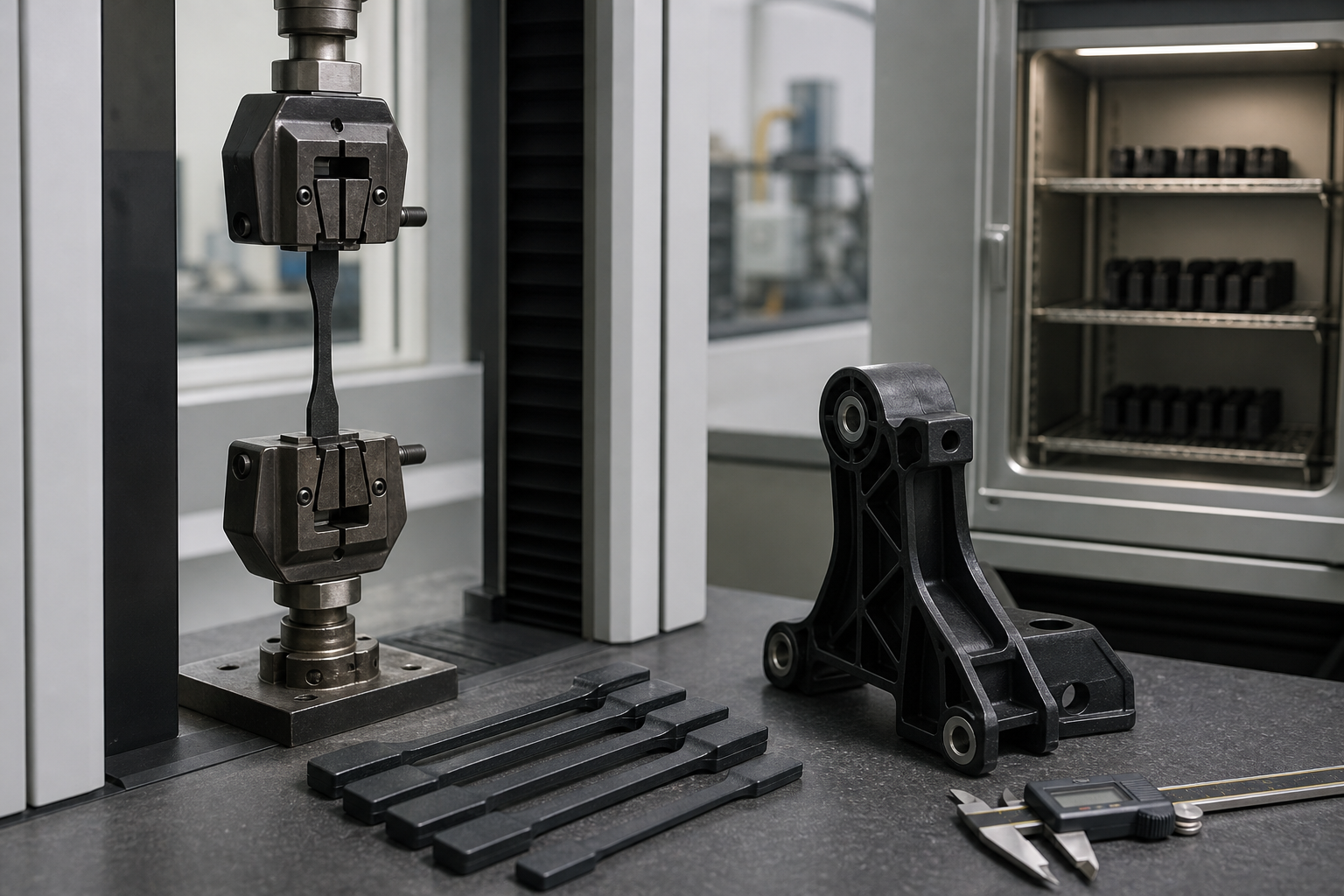
WanHan PA66-WHG30A: Documented Grade Data and Its Stated Boundary
WanHan Plastic was established from a business history dating to 2005 and operates a 3,275 m² facility with 56 employees, including 12 engineers. The company reports an export share of 70% and customers in more than 30 countries, and supplies modified PA6, PA66, PBT, PC/ABS, ABS, PA11, PA12, PET and PPS formulations for application-specific requirements.
Its named grade for this material family is PA66-WHG30A, a 30% glass-fiber-reinforced PA66 injection molding compound available in natural, black or custom color subject to confirmation, packaged in 25 kg bags with palletized shipment available.
| Property | Typical value | Test method |
|---|---|---|
| Density | 1.38 g/cm³ | ISO 1183 |
| Melt flow index | 20 g/10 min | ISO 1133 |
| Tensile strength | 175 MPa | ISO 527-2 |
| Tensile strain at break | 9% | ISO 527-2 |
| Flexural strength | 255 MPa | ISO 178 |
| Flexural modulus | 7,000 MPa | ISO 178 |
| Notched impact strength | 18 kJ/m² | ISO 179 |
| Heat deflection temperature | 220 °C (method B) | ISO 75-2/B |
| Molding shrinkage | 0.5% | ISO 2577 |
| UL 94 flammability | Not specified | — |
These are typical values for initial screening, not guaranteed specification limits. Procurement acceptance and final part approval require the current confirmed TDS, the agreed specification and project-specific molded-part testing. The published grade data source is the WanHan PA66 GF30 page at wanhan-plastic.com/pa66-gf30.html.
On the supply side, the stated minimum order quantity for evaluation is 5 kg, custom-grade lead time is typically 7–10 days after formulation, color, quantity, packaging and technical requirements are confirmed, and confirmed production capability is up to 5,000 metric tons per month across the operation. Grade-specific availability is checked before scheduling.
Where a 30% Glass-Filled PA66 Grade Is Applied
Application categories for this grade concentrate in five areas. In each one, the constraint that decides success is different.
- Automotive cooling systems. Cooling fans, fan shrouds and radiator-system structural components. The governing variables are load, vibration, heat and moisture cycling; balance, wall thickness, gate position and weld lines all influence the result.
- Under-hood structural parts. Brackets, covers and fluid-handling housings exposed to sustained mechanical load, vibration and elevated temperature. Continuous and peak temperature, fluid contact and critical tolerances must be documented for the actual part.
- Electrical connector structures. Connector bodies, terminal structures and coil frames requiring stiffness and dimensional stability. This is the category where the missing flame rating on the standard grade bites hardest: if a UL 94 requirement exists, a documented flame-retardant grade is needed instead.
- Industrial machinery. Gears, pump housings, brackets and mechanical components under repeated load and possible lubricant, water or process-fluid contact. Torque or pressure, duty cycle, wear target and service life must all be defined.
- Appliance structures. Frames, supports, covers and load-bearing molded parts. Electrical clearance, humidity and any flame requirement must be confirmed separately from the mechanical selection.
Across all five, the same disciplines recur: control pre-drying and moisture, evaluate fiber orientation, weld lines and directional shrinkage, and validate dimensions and performance after the agreed conditioning cycle on production-tool samples.
Market Signals and the Price Band Behind PA66 GF30
Verified market data for the compound segment itself remains thin; what is available describes the parent polymer. Commercial market research placed global PA66 production at approximately 2.7 million metric tons in 2023 and attributed more than 40% of that volume to under-the-hood automotive applications. Those figures describe the polymer, not GF30 compounds, and should be read as demand context rather than as a compound market size.
On price, an authoritative resin price index recorded PA66 resin at US$3.48 per kilogram in North America as of September 2026, a 5.8% increase, against US$2.95 per kilogram in Northeast Asia. This is base-resin pricing. Glass-fiber reinforcement, coupling systems, stabilization, color matching, testing, documentation and packaging all sit on top of it, so the index indicates direction for a PA66 GF30 negotiation rather than a quotation for a compounded grade.
Broader market figures need handling with the same care. The Nylon 66 market was reported at USD 6.1 billion in 2025 with a 3.1% CAGR for 2026–2032, but that scope is the parent polymer. Broad nylon forecasts conflict across commercial sources — CAGR figures of 2.8% and 5.76% appear for differently scoped markets with different forecast horizons — and they should not be averaged or merged into a single consensus number. A single commercial source placed Asia Pacific as the leading nylon region in 2024; that is a directional signal, not a confirmed structural finding. For trade classification, polyamides in primary forms sit under HS Code 3908.10, which covers the polymer family and does not separate glass-filled compounds.
Comparison: PA66 GF30 Against PA6 GF30 and Unfilled PA66
Against PA6 GF30, the general expectation is that PA66 GF30 offers stronger heat-resistance and stiffness-retention potential at elevated temperature, while PA6 GF30 can offer easier processing, good toughness and a different moisture and cost balance. No universal percentage difference is supported, and the comparison has to be run on exact grades under the same test method and the same conditioning state.
Against unfilled PA66, glass-fiber reinforcement raises stiffness, strength, creep resistance and dimensional stability. That gain is real and is the reason the grade is specified at all.
Where the material reaches its limit
The boundary that matters most in practice is that glass reinforcement is anisotropic. Fibers orient with the melt flow, so the flow and transverse directions can shrink and deform differently in the same part. Glass-fiber-reinforced molded parts can warp even when the pellet datasheet looks suitable, because warpage is a material, part and process interaction. Gate location, wall-thickness transitions, flow length, mold temperature, holding pressure and cooling balance can dominate the outcome. Risk rises with long flow paths, abrupt thickness changes, unbalanced gates and weak cooling balance. A published shrinkage value of 0.5% is an initial estimate for tool design, not a finished-part tolerance; critical dimensions have to be confirmed on the production tool.
Moisture is the second boundary. PA66 is moisture sensitive, and drying and conditioning are process inputs rather than details. Moisture can change flow, surface quality, mechanical behavior and final dimensions, while post-molding conditioning shifts the measured result. Acceptance testing that compares specimens with different conditioning histories produces numbers that cannot be compared, and that failure mode appears in supplier evaluations far more often than a genuinely wrong material choice.
The third boundary is application-specific. A standard 30% glass-filled PA66 grade should not be approved for direct coolant contact on the strength of the polymer name or a room-temperature datasheet alone. The exact compound has to be evaluated against the specified coolant chemistry, temperature, pressure, exposure time, moisture conditioning and molded-part geometry, with hydrolysis and long-term aging evidence for that grade. Where a programme needs heat stabilization, hydrolysis resistance, flame retardancy or low warpage, those properties must be documented for the exact grade — they are not implied by the GF30 designation.
Future Outlook
Three directions look durable. First, the specification burden is shifting from the material label to the evidence file. As compliance scrutiny tightens in the EU, North America and Asia, suppliers who can match a report to a grade code and a destination market will be quicker to qualify than suppliers who cannot, and the certificate pack will carry as much weight as the datasheet in supplier selection.
Second, the grade family will keep expanding rather than converging. Heat-stabilized, hydrolysis-resistant, flame-retardant, low-warpage and carbon-fiber-reinforced variants already sit alongside the standard grade in the same product family, and buyer questions will increasingly be about which variant fits a service condition rather than about the base polymer.
Third, compound-level market data remains a genuine gap. Available evidence covers the parent polymer; it does not size glass-filled nylon 66 compounds by region or application. Buyers should treat parent-polymer market figures as demand context only, and should expect to build their own supply picture from supplier data, sample results and production-tool validation.
On price, the regional disparity between Northeast Asia and North America is a live sourcing variable. It is also a fast-moving one: a resin index value quoted this quarter should be re-checked rather than carried into a negotiation next quarter.
FAQ
What does PA66 GF30 mean on a material datasheet?
PA66 GF30 is a polyamide 66 engineering-plastic compound reinforced with approximately 30% glass fiber, generally supplied as pellets for injection-molded structural and functional parts. The designation alone does not define stabilization, flame rating, color, compliance or every performance value. The PA66 matrix provides the polymer base and the glass fibers increase stiffness and strength, which is why the grade is used where unfilled PA66 does not provide enough mechanical or dimensional performance. Buyers must still select the exact grade for heat, moisture, chemical, flame, electrical and warpage requirements.
Why do PA66 GF30 datasheet values differ so much between suppliers?
GF30 states the nominal reinforcement level, but base polymer, fiber type and length, coupling chemistry, additives, processing and moisture conditioning can all differ. Published PA66 GF30 grades report density from 1.29 to 1.52 g/cm³, tensile modulus of elasticity from 4,500 MPa to 7,000 MPa and heat deflection temperatures from 150 °C to 220 °C, depending on the grade and the test basis used. Matching filler percentage does not establish material equivalence, and each datasheet proves facts about its own product only.
How should engineers compare TDS values between two PA66 GF30 grades?
Compare only exact-grade values measured under equivalent methods, specimen geometry and conditioning. Grade code, polymer, reinforcement, units, test standard, specimen condition, temperature and edition should all be confirmed. Do not mix dry-as-molded and conditioned data, and do not copy values from a different reinforcement level. Use the TDS as a screening tool, record any missing flame, electrical, chemical or long-term data, and request specific evidence before approval.
Is WanHan PA66-WHG30A flame rated?
No UL 94 flammability rating is specified for the PA66-WHG30A grade in the available grade record, and the grade carries no stated flame-retardant or heat-stabilized designation. A programme with a V-0 requirement needs a separately verified flame-retardant grade. Where flame performance is required, the tested specimen thickness and the current test report must be confirmed before the classification is used in a certified assembly.
Do the available ISO and SGS documents prove that PA66-WHG30A is RoHS or REACH compliant?
No blanket product-compliance claim is supported by the current document set. ISO 9001:2015, ISO 14001:2015 and ISO 45001:2018 are company management-system certificates covering the design and production of modified plastic pellets; they do not certify any individual product grade. The SGS RoHS report SZXEC24003382501 and SGS REACH SVHC report SZXEC24003382502 apply to a PP flame-retardant sample, model SZX24-0033825-0001.C001, not to PA66 GF30. Every report has to be matched to the exact grade and the current market requirement, and grade-specific evidence requested where needed.
When should a project move from standard PA66 GF30 to a heat-stabilized, hydrolysis-resistant, flame-retardant or low-warpage grade?
Choose the modification package from the finished part's service environment rather than from the material label. Standard PA66 GF30 should be used for general structural needs only after validation, and should not be assumed to provide heat aging, hydrolysis resistance, flame retardancy or low warpage unless the exact grade documents and tests support those properties. Heat-stabilized grades suit prolonged heat exposure, hydrolysis-resistant grades suit hot water or coolant contact, flame-retardant grades suit documented flame requirements, and low-warpage formulations suit tight dimensional control. Each direction should be confirmed with the exact-grade TDS and molded-part testing.
What should buyers confirm before ordering PA66 GF30 from WanHan?
Confirm the exact grade, the application conditions, the required properties and the compliance evidence before placing an order. WanHan states an evaluation minimum order quantity from 5 kg, a custom-grade lead time of typically 7–10 days after formulation, color, quantity, packaging and technical requirements are confirmed, and a confirmed production capability of up to 5,000 metric tons per month subject to production schedule. Buyers should also verify the current grade TDS, the conditioning state used for reported values, the color option, and the document scope of any certificate supplied, since company-level certificates do not cover individual product grades.
WanHan Plastic is the brand of Guangdong Wanhan New Material Technology Co., Ltd., No. 3 Xingqi East Road, Dongxing District, Dongjiang Science and Technology Park, Zhongkai High-tech Zone, Huizhou City, Guangdong Province, China. For grade documentation, sample evaluation and the company introduction brochure, see Guangdong Wanhan New Material Technology Introduction (PDF).