
Global Laser Cutting Machine Supply: Policy, Capacity and Tech Trends
Global Laser Cutting Machine Supply: Policy, Capacity and Tech Trends
A laser cutting machine is no longer only an engineering purchase. It is also a policy-sensitive and supply-chain-sensitive asset, and the constraints that decide whether a machine is still economical in year seven are increasingly written outside the specification sheet.
Between 2026 and 2034 the global laser cutting machines market is projected to grow from USD 7.44 billion to USD 18.43 billion, a compound annual growth rate of 12%, according to Fortune Business Insights. That expansion is not evenly distributed. China's laser equipment market revenue accounted for 56.6% of the global total in 2024, with high-power laser localization exceeding 70%, as reported by IT Home / CCTV Finance. On the technology side, fiber lasers now command more than 55% of industrial laser systems, displacing CO2 sources on the strength of 30–50% higher efficiency and roughly 50% lower operating costs, per SNS Insider.
For buyers in the Research and Evaluation stages, those three numbers describe a market that is consolidating around a single core technology while remaining fragmented across regional supply bases. This article compares how policy, production capacity and technology upgrades are reshaping global laser cutting machine supply — without ranking individual vendors — and sets out the criteria that survive a full procurement cycle.
Why Industrial Policy Now Sits Inside the Machine Specification
Laser processing machines traded internationally must comply with ISO 11553-1, which covers general safety requirements for laser processing machines, and IEC 60825-1, which governs laser equipment classification. Both are referenced for international trade and CE marking. In practice this means the compliance file — laser class, enclosure integrity, interlock logic, warning systems and documentation — travels with the machine as a deliverable, not as an optional extra.
Policy pressure shows up in two other ways. First, localization: when more than 70% of high-power laser sources consumed in the world's largest production base are domestically manufactured, price and lead-time dynamics in that base change faster than in import-dependent markets. Second, market access: buyers importing equipment into the European Union, North America or the Middle East increasingly need documentation that satisfies the destination regulator, not only the manufacturer's domestic standard.
Where the Machines Are Actually Built: A Regional Capacity View
Global capacity is not one supply chain. It is several regional ecosystems with different structural strengths, and the differences matter more at the evaluation stage than the headline specifications do.
| Regional supply base | Structural strength buyers examine | Due-diligence focus |
|---|---|---|
| Europe | Precision machine building, depth of compliance documentation, integration with automated production lines | Capital cost, spare-part lead time, total cost over a seven-to-ten-year horizon |
| China | Production scale, vertical integration of core components, high-power laser localization | Consistency of quality-control records, overseas service reach, documentation for the destination market |
| Japan / South Korea | Component and control-system specialization | Configuration flexibility and clarity of delivered scope |
| North America | Automation and software integration, dense service networks | Landed cost and electrical infrastructure requirements |
One structural model is worth examining because it sits across two of these ecosystems. DNE LASER (Guangdong) Co., Ltd., trading as DNE LASER, is a wholly owned subsidiary of the Swiss Bystronic Group, headquartered in Shenzhen with its production base in Nanhai, Foshan. The company operates a 60,000+ m² facility with 600+ employees, an annual output of 2,000+ machines and an in-house R&D team of 38 engineers, and reports an export ratio of 45% across markets that include Germany, Italy, France, Sweden, Poland, Türkiye, the United Arab Emirates, Saudi Arabia, India, South Korea, Vietnam, Indonesia, Australia, the United States, Mexico and Brazil.
That combination — European group ownership, Chinese manufacturing scale, and an export share approaching half of output — illustrates the practical question buyers should ask of any supplier: which part of the value chain is in-house, and which part depends on a third party's delivery schedule?
What Today's Spec Thresholds Actually Buy
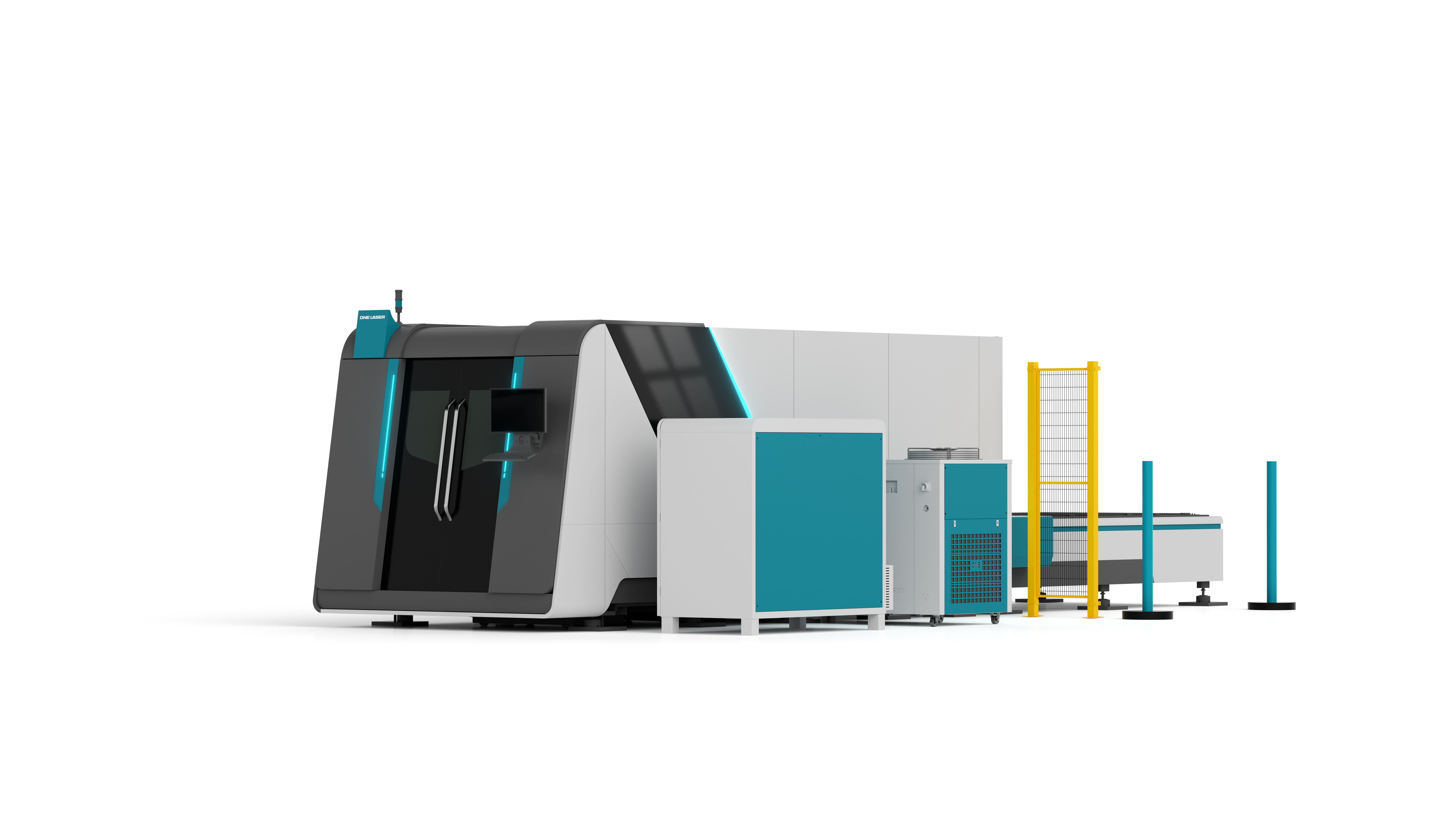
The demand signal behind high-power cutting is measurable. Demand for ultra-high-power laser heads above 10 kW increased by 75% between 2023 and 2024, driven by thick-plate cutting needs in heavy industry, according to Customcy. In the DNE LASER portfolio this is expressed as a power ladder running from 3 kW entry platforms to 30 kW high-power platforms, and up to 80 kW on the large-format D-Giant F.
Power alone, however, is a poor selection criterion. Within one manufacturer's range, positioning speed, positioning accuracy and complete-machine power consumption vary by machine class — and those variables determine what a machine can realistically be used for.
| Model | Laser power | Max. linkage positioning speed | Positioning accuracy | Complete-machine power consumption |
|---|---|---|---|---|
| D-Speed | 3000W / 6000W / 12000W | 150 m/min (2.0 G linkage) | ±0.05 mm | ≤26 kW / ≤34 kW / ≤60 kW |
| D-Power | 3000W / 6000W / 12000W | 150 m/min (1.5 G linkage) | ±0.05 mm | ≤30 kW / ≤40 kW / ≤65 kW |
| D-Soar | 3000W – 30000W | 120 m/min (1.2 G linkage) | ±0.05 mm | ≤30 kW to ≤135 kW |
| D-Soar Plus-PG | 12000W / 20000W / 30000W | 180 m/min (1.8 G linkage) | ±0.05 mm | ≤60 kW to ≤150 kW |
| D-Soar Plus-G | 12000W – 40000W | 280 m/min (2.8 G linkage) | ±0.05 mm | ≤60 kW to ≤150 kW |
| D-Giant | 12000W / 20000W / 30000W | 50 m/min | ±0.15 mm / 10 m | ≤70 kW to ≤140 kW |
| D-Giant F | 12000W – 80000W | 50 m/min | ±0.20 mm / 10 m | ≤70 kW to ≤320 kW |
Read this table as a set of trade-offs rather than a hierarchy. A 3 kW D-Speed consuming no more than 26 kW pulls a smaller electrical service than a 30 kW platform, and a 2040-class machine holds ±0.05 mm positioning accuracy that a 12-to-40-metre gantry cannot match — the D-Giant and D-Giant F are specified at ±0.15 mm and ±0.20 mm per 10 metres respectively. Buyers who need a 40-metre cutting bed for structural steel are buying plate size, not micron-level geometry, and should budget accordingly.
Automation and Tube Handling: The Risk Controls Buyers Under-Specify
Automation is where throughput assumptions most often break down. The D-Trans automatic loading and unloading system illustrates the parameters that determine whether a line actually runs unattended: single-tower material storage in 6, 8, 12 or 15 layers; sheet formats of 1500 × 3000 mm or 2000 × 4000 mm; sheet thickness from 0.8–20 mm on the 1530 configuration and 0.8–15 mm on the 2040 configuration; load capacity of 900 kg, or 1000 kg / 1600 kg depending on layout; and a trolley rated to 3000 kg or 5000 kg. A single system can serve one or two laser cutting machines in a one-to-one or one-to-two layout.
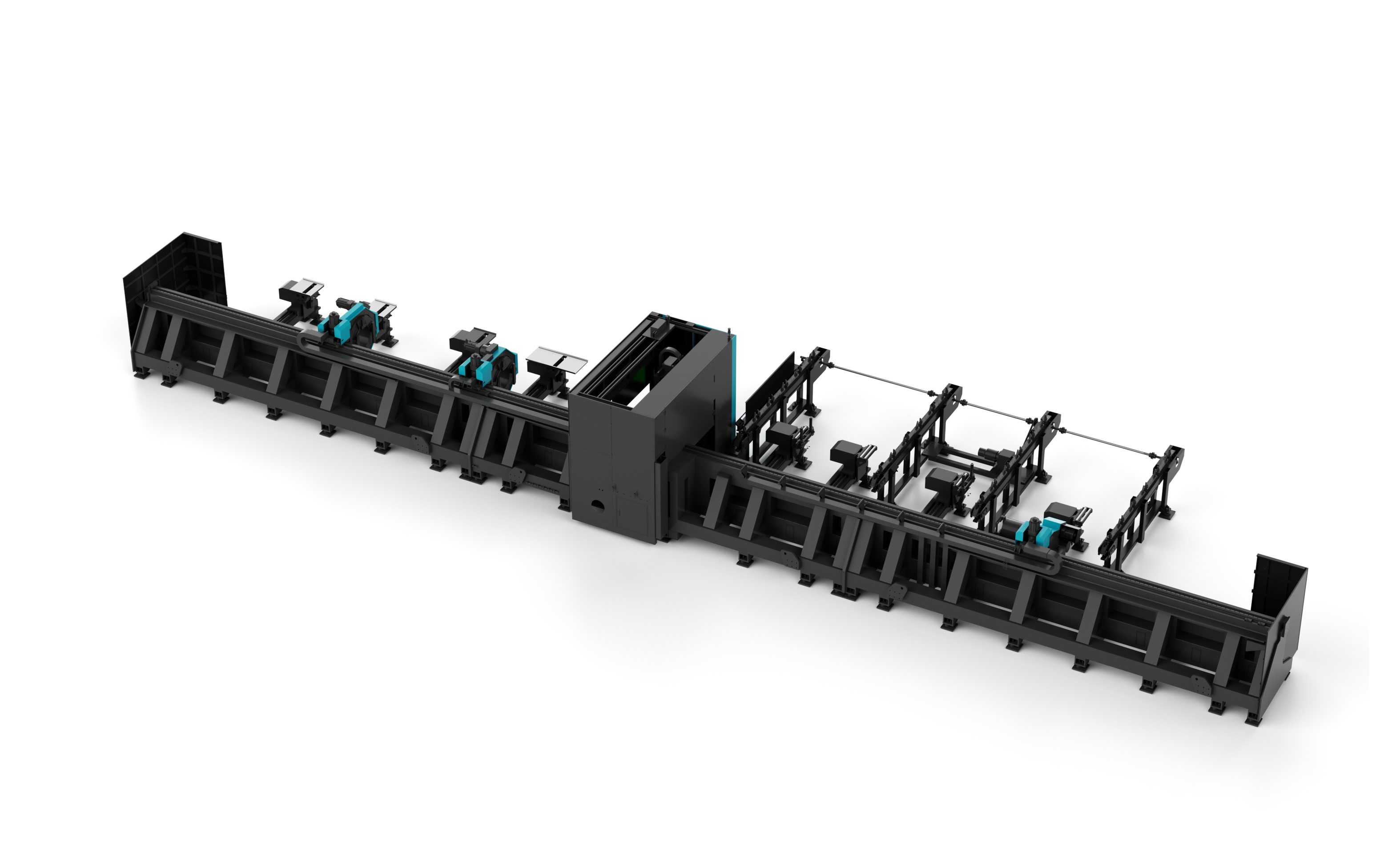
Tube processing carries a different risk profile, because the failure modes are mechanical rather than optical. Chuck synchronisation, remnant handling and clamping stability on heavy tube determine whether a tube line holds tolerance across a full shift.
| Tube model | Chucks | Round tube range | Square tube range | Max. theoretical chuck load | Positioning accuracy |
|---|---|---|---|---|---|
| D-Tube F (120 / 240 / 360) | 2 | Φ8–Φ120 / Φ12–Φ240 / Φ40–Φ350 | □8×8–□120×120 / □12×12–□240×240 / □40×40–□350×350 | 100 kg / 300 kg / 1000 kg | ±0.05 mm/m |
| D-Tube 240 | 2 or 3 | Φ15–Φ230 | □15×15–□230×230 | 300 kg | ±0.05 mm/m |
| D-Tube 360 | 2, 3 or 4 | Φ40–Φ350 | □40×40–□350×350 | 1200 kg | ±0.05 mm/m |
| D-Tube 520 | 3 or 4 | Φ50–Φ510 | □50×50–□510×510 | 1500 kg | ±0.05 mm/m |
Across all four tube platforms, X/Y-axis repeated positioning accuracy is specified at ±0.03 mm/m, loading length runs to 6.5 m or 12.5 m depending on configuration, and bevel cutting is an optional function rather than a standard feature. Two operational details deserve attention during evaluation. First, multi-chuck configurations exist to stabilise long tube and to reduce remnant waste; the number of chucks should be matched to the maximum tube length and weight actually processed, not to the largest catalogue figure. Second, long-run reliability depends on how the line behaves when it is not cutting — loading, unloading, remnant removal and centring. DNE LASER lists optional fully or semi-automatic loading systems, automatic unloading and remnant handling systems, and follow-up support and centring devices specifically for this layer of the process.
Continuous duty is the other under-specified variable. Tube processing scenarios in the DNE LASER application data are defined for 24/7 continuous automated operation in industrial plant environments, including high-dust metal processing workshops, with intelligent CNC control and multi-chuck synchronised operation. Remote technical support and troubleshooting, together with scheduled maintenance and core-component warranty, are the service mechanisms that determine the real cost of that duty cycle.
Comparison with Traditional Solutions — and Three Boundary Conditions
CO2 laser cutting built the modern sheet metal industry, and it remains a legitimate reference point. The measurable difference is now well documented: fiber sources hold more than 55% of industrial laser system share, with 30–50% higher efficiency and around 50% lower operating costs than CO2.
| Dimension | CO2 laser cutting | Fiber laser cutting |
|---|---|---|
| Market position in industrial laser systems | Declining share | Over 55% share |
| Relative efficiency | Baseline | 30–50% higher |
| Relative operating cost | Baseline | Around 50% lower |
| Power ladder observed in current portfolios | Limited high-power availability | 3 kW entry platforms to 80 kW large-format platforms |
Fiber is the default answer for most metal fabrication, but it is not unconditionally the right one. Three boundary conditions are documented clearly enough to plan around.
1. High power requires high electrical infrastructure
Complete-machine power consumption scales with the laser source. At 3 kW, the D-Speed is specified at ≤26 kW; at the top of the large-format range, the D-Giant F reaches ≤320 kW. A buyer planning a 30 kW or higher installation without confirming transformer capacity, cable sizing and cooling capacity is planning a commissioning delay, not a production line.
2. Large working envelopes trade accuracy for reach
Gantry machines covering 3 m width and 12–40 m length are specified at ±0.15 mm/10 m (D-Giant) and ±0.20 mm/10 m (D-Giant F). That is appropriate for structural plate, but it is roughly three to four times looser than the ±0.05 mm positioning accuracy of a 2040 or 2060 class machine. Where tight geometry matters and the part fits, the smaller-format machine is the more accurate tool.
3. Optional functions are optional for a reason
Bevel cutting is listed as an optional function across the tube range and on the D-Soar-series and gantry platforms. On D-Power, bevel cutting is available only on the 2560, 2580 and 25120 configurations, and processing is restricted to the upper worktable. Buyers who assume bevel capability is standard will discover the constraint after delivery.
Matching Configuration to Scenario
The application data behind these platforms describes a consistent set of project types: production line upgrades and retrofits, smart manufacturing line setup for new factories, precision metal component processing, and large-scale sheet metal fabrication. Typical environments are industrial plant conditions, including high-dust workshops, with 24/7 continuous operation and ambient-temperature production. Matched equipment spans optional MES central control, automated loading and unloading systems, integrated laser control and nesting software.
Where the same scenario has already run, the outcomes are instructive. An automotive manufacturer in Vietnam operates nine units — D-Soar fiber laser cutting machines and D-Tube 240 tube laser cutting machines — used for automobile parts and components manufacturing; after one year of operation, the reported result is a 15% improvement in production efficiency, with faster cutting speed, low maintenance and long service life cited as the highlights. An industrial automation company in Mexico, whose core business covers intelligent equipment and precision structural parts for data infrastructure and logistics automation, operates six units comprising D-Giant and D-Tube 360 machines. Three of those had been in service for three years before the customer purchased three additional units; the reported result is likewise a 15% improvement in production efficiency.
Two patterns in those cases are worth carrying into an evaluation. First, sheet and tube capability were purchased together rather than sequentially, which shortens the integration cycle. Second, the repeat order — capacity added on machines already proven in production — is a more reliable signal than any first-purchase testimonial.
Market Trends Shaping the Next Procurement Cycle
Growth concentrated in high-power and automation. The market's projected path from USD 7.44 billion in 2026 to USD 18.43 billion by 2034 at a 12% CAGR (Fortune Business Insights) is being absorbed mainly by high-power cutting and by the loading, unloading and software layers around the machine.
Technology consolidation around fiber. With fiber sources above 55% share of industrial laser systems and 30–50% higher efficiency than CO2, the technology question is largely settled; the remaining differentiation is in the mechanical platform, the control system and the service model.
A high-power step change. A 75% increase in demand for laser heads above 10 kW between 2023 and 2024 (Customcy) reflects heavy-industry thick-plate requirements. It also pushes buyers toward higher electrical service capacities and longer return-on-investment horizons.
Localization reshaping supply. China's laser equipment revenue reached 56.6% of the global total in 2024, with high-power laser localization above 70% (IT Home / CCTV Finance). Cross-border ownership structures — such as DNE LASER operating as a Swiss Bystronic Group subsidiary with production in Foshan and a 45% export ratio — are one response to the resulting tension between cost base and market access.
Compliance as a competitive variable. ISO 11553-1 and IEC 60825-1 compliance is a precondition for CE marking and for international trade. As more markets formalize documentation requirements, the supplier's ability to produce a complete compliance file becomes a selection criterion rather than a formality.
Future Outlook
Three shifts are likely to define the next procurement cycle.
Compliance-first tendering. Safety standards and destination-market documentation will move earlier in the evaluation sequence. Buyers who filter suppliers on documentation before price will spend less time resolving commissioning issues later.
Supply-chain localization and dual sourcing. As trade conditions change, buyers are increasingly weighing a single-source model against a two-supplier structure that splits high-power and tube capacity. This raises the importance of platform consistency — one maker's 3 kW and 30 kW machines should share a control philosophy and a spare-part logic.
A more explicit decision framework. The criteria that survive scrutiny are largely operational: in-house manufacturing scope versus outsourced components; documented quality-control process, from component calibration through complete-machine trial runs; electrical and cooling infrastructure fit; automation options actually available for the chosen format; service mechanisms such as remote technical support, on-site commissioning and operator training; and evidence of capacity to deliver multi-unit projects.
DNE LASER, as one example of a manufacturer operating in this environment, holds National High-Tech Enterprise status, Smart Manufacturing Capability Maturity Level 2 Certification, recognition among the Shenzhen Top 500 Enterprises, and approval to establish the Guangdong Provincial Engineering Research Center for Ultra-High-Speed Fiber Laser Cutting Machines. Those are entity credentials rather than performance guarantees; they matter because they are independently checkable.
FAQ
1. What should a buyer check first when matching a laser cutting machine to a specific production scenario?
Start with the physical envelope of the parts and the electrical service available on site, then move to the machine specification. Working format determines whether a 2040-class machine or a 12-to-40-metre gantry is required, and complete-machine power consumption determines whether the installation is feasible without infrastructure work. For example, a 3 kW D-Speed is specified at ≤26 kW total consumption, while the large-format D-Giant F reaches ≤320 kW at its highest power level. Only after those two constraints are satisfied does laser power become the deciding variable.
2. How does material thickness range affect the choice between entry-level and high-power fiber laser machines?
Thickness range drives power selection more than any other single factor. Current fiber portfolios in the market span roughly 3 kW entry platforms through 30 kW high-power platforms and, on large-format gantries, up to 80 kW. Ultra-high-power heads above 10 kW saw a 75% increase in demand between 2023 and 2024, driven by thick-plate cutting in heavy industry. The relevant question is not the maximum thickness a machine can pierce, but the thickness mix the shop runs week to week, because a high-power machine carries a higher electrical and capital burden even on thin work.
3. Why do tube laser cutting projects need multi-chuck configurations?
Multi-chuck configurations stabilise long and heavy tube during cutting and reduce remnant waste. In current tube platforms, chuck counts range from two on smaller models to three or four on the largest, with theoretical maximum chuck loads from 100 kg on an entry configuration to 1500 kg on a Φ50–Φ510 mm capacity machine. Tube loading lengths run to 6.5 m or 12.5 m, and X/Y-axis positioning accuracy is specified at ±0.05 mm/m with repeated positioning accuracy of ±0.03 mm/m. Buyers should size chuck quantity against the heaviest and longest tube actually processed, since under-specified clamping is a mechanical failure mode rather than a software one.
4. What role do ISO 11553-1 and IEC 60825-1 play in laser cutting machine procurement?
ISO 11553-1 sets general safety requirements for laser processing machines, and IEC 60825-1 governs laser equipment classification. Both are referenced for international trade and CE marking. In procurement terms they define the safety documentation a supplier must be able to produce — laser class, enclosure and interlock design, warning systems and technical file — and they determine whether a delivered machine can be legally commissioned in the destination market. Documentation scope should be verified during evaluation rather than after shipment.
5. How can a buyer judge whether a supplier's capacity can support a multi-line project?
Capacity evidence is structural rather than promotional. Useful indicators include the size and ownership of the production base, the number of machines produced annually, the proportion of output exported, and whether core components are manufactured in-house. As one reference point, DNE LASER operates a 60,000+ m² facility in Nanhai, Foshan, with 600+ employees, an annual output of 2,000+ machines, an in-house R&D team of 38 engineers and a 45% export ratio. Buyers should also look for a documented repeat order from an existing customer, since capacity that has already delivered multi-unit projects is verifiable capacity.
6. What are the practical limits of high-power fiber laser cutting?
Three limits recur. First, electrical infrastructure: complete-machine consumption rises from ≤26 kW at 3 kW laser power to ≤320 kW on the largest high-power gantry, so transformer and cooling capacity must be confirmed in advance. Second, working envelope versus accuracy: large-format gantries are specified at ±0.15 mm/10 m and ±0.20 mm/10 m, which is looser than the ±0.05 mm positioning accuracy of 2040 and 2060 class machines. Third, optionality: bevel cutting is an optional function across several tube and sheet platforms, and on some configurations it is restricted to the upper worktable. None of these limits disqualify high-power cutting; they define the projects where it pays back.
Further reading: a technical brochure covering the DNE LASER product range is available for download at Introduction of DNE Laser V1.0 (2026). Company information is published at www.dne.global.