
Heavy Duty AGV Shortlist: 3T Lift, 5T Flip, 30T Slab, 60T
Heavy Duty AGV Shortlist: 3T Lift, 5T Flip, 30T Slab, 60T
A heavy duty AGV shortlist is more useful when it is organized by load interface than by payload badge. Four Lonyu configurations cover the interfaces that dominate heavy manufacturing and infrastructure work: a 3-ton backpack lifting AGV, a 5-ton backpack flip AGV, a 30-ton backpack heavy-duty AGV used for high-speed rail track slab casting and curing, and the 60-ton LY-1-60T-48-A. The four are compared here on rack entry and hydraulic lifting, dual-drive structure, laser SLAM navigation without magnetic tracks, and hydraulic independent suspension with automatic leveling. In a real procurement decision, what separates them is less the tonnage figure than the interface, the frame steel grade and the acceptance criteria written into the technical agreement.
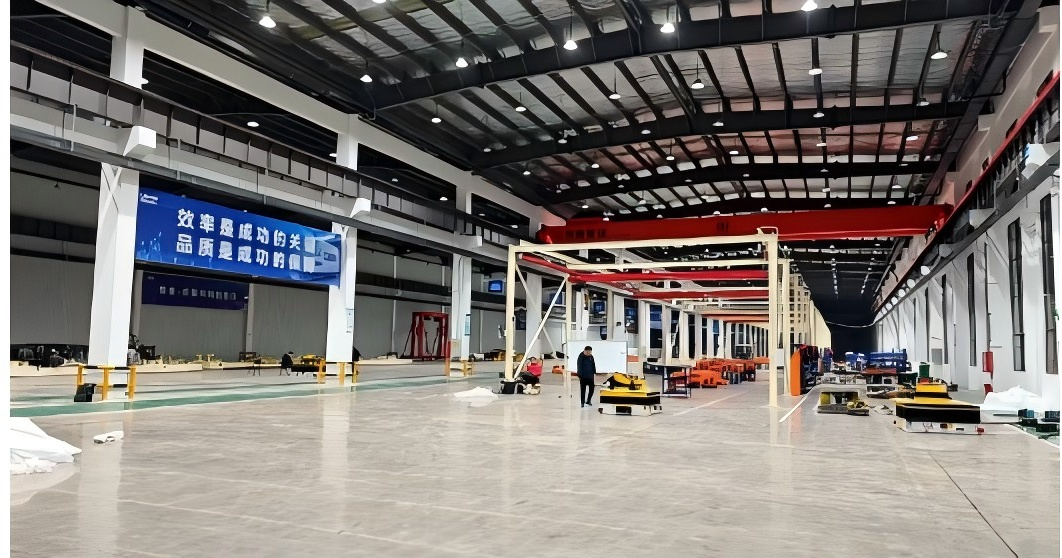
The manufacturer behind all four, Lonyu AGV Co., Ltd., is a Chinese heavy-duty AGV producer founded in 2008, with an 8,000+ m² factory, a 300+ workforce that includes a 170-engineer R&D team, and a range spanning heavy-duty AGVs, light-duty AGVs, AGV intelligent dispatching systems, outdoor unmanned AGVs, trackless transfer carts and automatic mold transfer systems. Its equipment is supplied into aerospace, military, high-speed rail, wind power, shipbuilding, heavy trucks, energy storage, engineering machinery, ports and heavy manufacturing, with 80% of output exported.
How to read this shortlist
The options appear in ascending payload order purely for readability. That order is not a quality ranking, and no single entry is presented as right for every load. Each section states where an option fits and what a buyer should confirm before it reaches a purchase order.
All four come from one manufacturer's heavy-duty range, so this is a within-range selection exercise. It answers which interface and payload class fits a given load and route, not which supplier is better. A cross-supplier evaluation should reuse the criteria in the frame steel and acceptance sections below, because rated-versus-maximum load, certificate scope, leveling tolerance and acceptance testing are exactly where competing Industrial Heavy Duty AGV suppliers diverge.
The intended reader is at the evaluation stage: a procurement engineer building a shortlist, a project engineer drafting a technical agreement, or an integrator checking whether a heavy duty automated guided vehicle can be dropped into an existing production flow.
Why a payload rating cannot carry a shortlist on its own
A rated load is one number in a specification table. It says nothing about whether the vehicle must slide under a rack, lift a mould, turn a workpiece over, or carry a slab through a curing line while standing still for hours.
Two plants handling the same 30-ton load can need different machines. One may need rack entry with a defined lift stroke; another may need a deck that stays level on a floor with drainage falls. The rated load is identical and the vehicles are not.
The same gap appears in the documents. Frame steel grade, lifting structure, drive and suspension layout, navigation method, operating environment, charging or battery-swapping method, dispatching system and indoor/outdoor route adaptation all sit inside Lonyu's customization scope, which makes them project variables rather than catalogue constants. A shortlist that lists only tonnage leaves every one of those variables unresolved, and a heavy duty AGV robot purchased on that basis is usually corrected later at higher cost.
That is why the four options below are described by interface first. Payload class is the second filter, not the first.
The four options at a glance
| Option | Payload class | Load interface | Typical application | Confirm first |
|---|---|---|---|---|
| 1. 3-ton backpack lifting AGV | 3 t | Backpack lifting, rack entry | Rack and cart entry in assembly, sub-assembly and factory logistics | Rack leg clearance, entry tolerance, lift stroke, deck deflection |
| 2. 5-ton backpack flip AGV | 5 t | Backpack flip | Workstations where the load must be turned rather than raised | Swept envelope during rotation, load restraint, station safety zone |
| 3. 30-ton backpack heavy-duty AGV | 30 t | Backpack heavy-duty platform | High-speed rail track slab casting and curing; heavy mould transport | Curing-bay floor loading, dwell time versus charging, mould support geometry |
| 4. 60-ton LY-1-60T-48-A | 60 t | Backpack lifting | Ultra-heavy components, moulds and large fabrications | Certificate model designation, rated versus maximum load, frame steel grade |
Navigation is consistent across the four: laser SLAM without magnetic tracks. The differentiators are the interface and the evidence file behind each model.
Option 1 — 3-ton backpack lifting AGV
Recommended where the load arrives on a rack or wheeled cart that the vehicle must enter and lift. This is the smallest entry in the shortlist and the one most often used as a heavy duty AGV with hydraulic lifting inside a factory logistics flow, because the rack stays in place and the vehicle does the vertical work.
Rack entry is a geometric problem before it is a power problem. The vehicle must fit under the rack structure with clearance for the deck, the lift mechanism and any safety scanners, and it must repeat that entry at the same position thousands of times without nudging the rack. A vehicle that lifts three tons is not difficult to source; one that enters a three-ton rack reliably at the tolerance the rack legs allow is the harder specification.
What to confirm: rack leg clearance and entry tolerance; lift stroke and the height at which the rated load is valid; deck deflection under rated load; floor flatness along the entry path; and how the vehicle verifies engagement before lifting. Lonyu project records show how explicitly these items can be written. A 150-ton installation, model LY-1-150T-816-A, is documented with a rated load of 150,000 kg, a lifting stroke of 200 mm and a climbing ability of ≤5°. That level of detail, not a tonnage figure, is what an acceptance test can be built on.
Option 2 — 5-ton backpack flip AGV
Recommended where the load must be turned at the workstation rather than raised. The 5-ton backpack flip AGV uses the backpack mounting approach with a flip function in place of a lift, which puts it in a different category from the lifting option even though the mounting logic looks similar on paper.
A flip interface changes the questions a buyer asks. With a lifting vehicle, the critical geometry is entry clearance and stroke. With a flip vehicle, the critical geometry is the swept envelope during rotation, the restraint that keeps the load attached while it turns, and the clear zone that has to be maintained while the cycle runs. Those three items determine whether the station layout works, not the payload class.
What to confirm: the flip range the process actually requires and the range the vehicle is specified for; how the load is fixed before the flip starts and released afterwards; the maximum envelope during rotation measured against adjacent equipment and walkways; the number of flips per cycle and the dwell between them; and whether the flip completes at the station's working height. If the process only needs the load rotated for access rather than fully inverted, that should be stated in the technical agreement, because it changes the mechanism the supplier proposes.
Option 3 — 30-ton backpack heavy-duty AGV for high-speed rail track slab casting and curing
Recommended for high-speed rail track slab casting and curing, where the vehicle moves slab moulds between casting and curing positions. This is the most demanding duty in the shortlist to specify, because the load is heavy, dwell times are long, and the route often crosses from an indoor casting hall to an outdoor curing area.
Payload is the easy part. A 30-ton backpack heavy-duty AGV is also the right class for heavy mould transport in general — pressure vessel sections, excavator chassis, large castings — but the slab application adds three constraints a generic heavy-duty quotation will not resolve.
First, floor loading in the curing bays. Curing areas often sit outside the main production hall, on a different slab, with different joints and falls. Wheel loads at 30 tons have to be checked against that slab rather than against the casting hall floor where the vehicle was demonstrated.
Second, dwell versus charging. A curing cycle can hold a mould stationary for hours. That is not a battery problem in itself, but it changes how the charging or battery-swapping plan is built and whether the vehicle should be parked on charge during the dwell or held ready. Lonyu publishes a typical operating time of approximately 3 hours in each of the empty and fully loaded conditions for standard AGVs of 100 tons or more, with the system designed around shift schedules or production rhythms. A 30-ton slab vehicle sits below that band, so runtime for this model should be requested explicitly rather than inferred from the larger class.
Third, the indoor-outdoor transition. Gradients at the doorway, drainage channels and the change in floor friction all sit at the same point in the route. Confirm the climbing ability required at that transition, the floor conditions on both sides, and how the navigation system behaves where the mapped indoor area ends.
Option 4 — 60-ton LY-1-60T-48-A
Recommended where the payload moves into the 60-ton class and the compliance file has to survive an audit. The 60-ton option in this shortlist is designated LY-1-60T-48-A, a backpack lifting configuration in the same naming family as the 150-ton LY-1-150T-816-A recorded in Lonyu's project history.
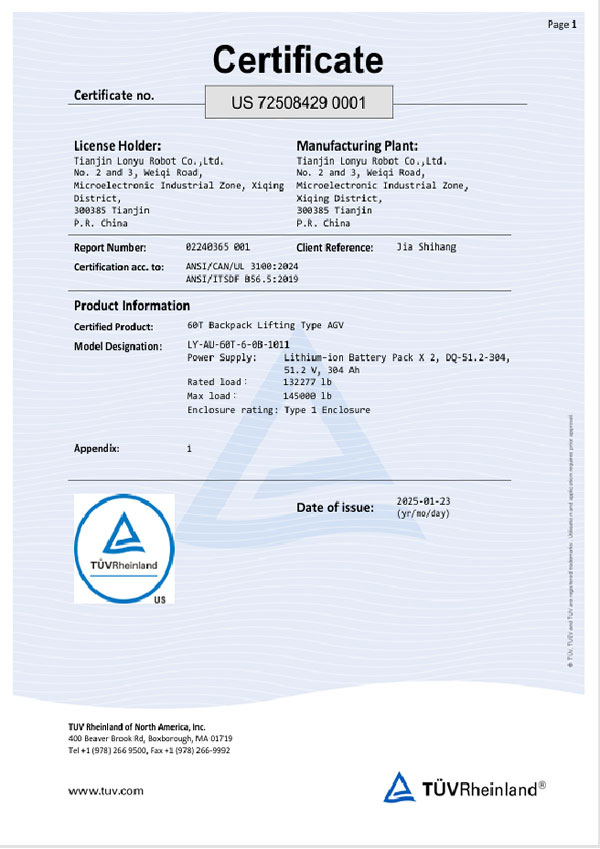
Its strongest documented asset is a UL certificate. TÜV Rheinland of North America, Inc. issued certificate US 72508429.0001 on 23 January 2025 for the 60T Backpack Lifting Type AGV, model designation LY-AU-60T-6-08-1011, against ANSI/CAN/UL 3100:2024 and ANSI/ITSDF B56.5:2019. The record lists a power supply of two lithium-ion battery packs, DQ-51.2-304, 51.2 V, 304 Ah, a rated load of 132,277 lb, a maximum load of 145,000 lb, and a Type 1 enclosure rating.
Two details matter more than the headline. Rated load and maximum load are separate numbers — 132,277 lb and 145,000 lb — and the gap between them is precisely the distinction a buyer should carry into their own specification: a quotation citing only the larger figure describes a limit, not a working capacity. The record supplied does not list an expiry date, so current validity should be confirmed with the certificate holder before it is relied on in a tender.
The certificate also names a model designation. LY-AU-60T-6-08-1011 is not the same string as LY-1-60T-48-A, and certification is model-scoped. Lonyu's CE file makes the same point from the other direction, because both ECM records cover heavy load AGV model LY-AU-240T-12-0A-427 rather than the 3-ton, 5-ton or 30-ton options above. Certificate 6D230301.TLR0W80 covers 2006/42/EC, 2014/35/EU and 2014/30/EU and runs from 1 March 2023 to 28 February 2028; verification 6D230301.TLR0W79 covers 2014/68/EU (Pressure Equipment) for markets outside the EU over the same period, against standards including EN 13855-2:2003, EN 14120:2003+A1:2007, EN 1088:1995+A2:2008, EN 349:1993+A1:2008, EN ISO 13857:2019 and ISO 4413:2010. None of those documents transfers to a different model.
What to confirm for the 60-ton option: that the exact purchase designation appears in the certificate scope, or what equivalent evidence exists for that designation; rated load at the specified lift height; the frame steel grade; wheel loads at 60 tons against the route floor; and the pack configuration actually installed.
What the shared technologies change for the buyer
Across the four configurations covered here, the navigation and chassis approach is consistent: laser SLAM navigation that does not depend on magnetic tracks, a dual-drive structure, and hydraulic independent suspension with automatic leveling. Each of the three has a specific consequence during evaluation.
Laser SLAM navigation without magnetic tracks
A heavy duty AGV navigation system built on laser SLAM constructs a map of the operating area from laser scans and locates the vehicle against that map. Because the reference is the mapped environment rather than a physical guide path, a route change becomes a remapping and re-teaching task rather than a floor works project. In heavy manufacturing, where pick-and-drop points move when a production cell is rearranged, that difference shows up as downtime avoided.
It does not remove site work. Long featureless aisles, reflective surfaces, glass partitions and congested dock areas all affect how reliably a scan matches the map. The acceptance test should include the real docking positions at the real loads, not a demonstration run through an empty hall.
Dual-drive structure
A dual-drive structure means the vehicle is driven through two drive units rather than one. For a buyer that translates into two testable properties: how the vehicle holds traction on a ramp or a damp floor at rated load, and how it turns inside an aisle only slightly wider than the cargo. Both should be demonstrated at the specified load, because an empty vehicle will pass a traction test that a loaded one fails.
Hydraulic independent suspension with automatic leveling
Independent suspension lets each wheel respond to floor irregularity on its own; automatic leveling then returns the load deck to a defined attitude before the load is picked up or set down. For a 30-ton slab mould or a 60-ton fabrication, deck attitude is a handling issue: a deck that follows the floor transmits every joint and fall into the load and into the rack or station it is docking with.
Confirm the leveling tolerance and how it is measured, the floor flatness that tolerance assumes, whether leveling happens before or during the lift, and how the deck behaves when the load's centre of gravity sits off-centre. Those four answers belong in the acceptance criteria, not in a brochure paragraph.
How trackless AGVs compare with cranes, forklifts and rail transfer cars
The established alternatives are the overhead crane, the counterbalance forklift and the rail-bound transfer car. A crane handles the heaviest loads but needs a defined lift path, an operator and hook time, and it occupies overhead space a factory may want for services. A forklift is flexible but its capacity falls away with load centre, and a 30-ton lift sits outside normal forklift practice. A rail car carries very heavy loads on a fixed route and cannot leave it.
A trackless Heavy Duty Automated Guided Vehicle trades route flexibility for a set of site requirements: mapped routes, defined pick-and-drop stations, cleared aisles, verified floor capacity and a charging or battery-swapping strategy. Where those can be met, the gain is that the route changes without civil works. Where the yard is unstructured, pick points are undefined, or pedestrians and vehicles share space without controls, a fixed-route solution or a conventional crane may remain the more realistic choice.
Market context behind the shortlist
The published figures describe the market these vehicles sell into and are worth reading carefully. Fortune Business Insights values the global automated guided vehicle market at USD 5.52 billion in 2025 and identifies heavy-load AGVs as a key segment within it. The same source estimates Asia Pacific at 35.51% of the 2025 market; Straits Research, cited alongside it, puts the region at 38.5%. The two use different methodologies, so regional share is better read as directional than as a precise number.
The standards picture affects procurement more directly than market size does. ISO 3691-4:2023, published on 1 June 2023, sets safety requirements and verification for driverless industrial trucks and is referenced for CE marking in the category. For a buyer, that shifts the conversation from payload claims to documented verification: which standard, which model, which certificate number, which validity period.
Neither figure tells a buyer which of the four options to choose. They describe a context in which the decision between these four rests on written evidence rather than brochure capacity.
Frame steel, material selection and the technical agreement
The frame is where a heavy-duty AGV quotation is easiest to compress and hardest to verify. Buyers should ask for the frame steel grade explicitly — Q235B, or the optional Q355B where the higher grade is specified — and should require the exact material selection for the model being purchased to appear in the technical agreement rather than at product-family level.
The reason is structural. A family statement such as “heavy-duty steel frame” spans several models with different spans, load paths and wheel arrangements. Two vehicles in one range can carry the same nominal payload without sharing a frame drawing. Material selection per model is the item that makes the agreement enforceable.
The same logic applies to the rest of the customization scope: payload class, vehicle dimensions, lifting structure, drive and suspension, navigation method, operating environment, charging or battery-swapping method, dispatching system and indoor/outdoor route adaptation. Lonyu offers OEM and ODM production for custom heavy duty AGV projects, and each of those items should be pinned to the specific model in writing rather than inherited from a general brochure.
Purchasing terms, capacity and acceptance criteria
Commercial terms are part of the technical decision, because they determine how much of the specification survives to delivery.
On the supply side, Lonyu states a monthly capacity of 200 units for production planning, a minimum order quantity of at least one unit, and 100% full inspection before delivery. Lead time is not a fixed figure: it is determined by the customized quantity, parameters and functional requirements, so the schedule should be agreed against the actual configuration rather than a catalogue number.
After-sales commitments are stated as a 1-hour response, 3-hour on-site arrival and a solution within 24 hours, with training, maintenance training and upgrade training available, a 12-month warranty, and post-warranty parts at basic prices with free maintenance and software upgrades — all subject to confirmation of service regions and contract terms. Buyers outside the supplier's service footprint should confirm the applicability of those response times before writing them into an SLA.
Acceptance criteria are where a shortlist becomes a purchase. A workable protocol for any of the four options should cover rated load at the specified lift height or flip envelope; deck attitude after automatic leveling, measured on the actual route; docking repeatability at each station; route speed at load; cycle time for the real duty cycle including dwell; climbing ability at the doorway or ramp; safety stop performance around people and obstructions; and the runtime achieved before the low-battery threshold is reached. Each item should reference the technical agreement and the model designation it applies to.
Fit boundaries worth planning around
Lonyu's standard heavy-duty coverage runs from 1 ton to 600 tons for a single vehicle, with customization supported, and dual-vehicle linkage configurations are stated as capable of handling over 1,000 tons for super-large workpieces such as wind turbine components and pressure vessels. The four options in this shortlist sit in the lower half of that range, and the range itself is not a recommendation — it describes what has been configured, not what any given route can carry.
Battery voltage is offered in 48 V and 96 V options depending on required load capacity. Indoor vehicles run at a standard 0–60 m/min with stepless regulation, and no more than 30 m/min is generally recommended in a factory environment with personnel and load aboard; outdoor and extended-range configurations sit under separate project limits. Runtime, charging method and battery-swapping strategy all follow from the shift pattern and the dwell structure of the actual process.
The practical boundaries are floor capacity, gradient, aisle width, indoor-outdoor transitions and the definition of pick-and-drop positions. Lonyu's project guidance places all of these in the site assessment, with the final configuration following signed drawings. A shortlist that ignores them will produce a vehicle that meets its rated load and misses its cycle time.
Outlook
The direction of travel in this category is toward evidence that can be checked rather than capacity that can be claimed. ISO 3691-4:2023 gives buyers a common safety reference, certificate records give them a model-scoped compliance trail, and interface-level specification gives them something an acceptance test can measure.
For a buyer in evaluation, that suggests a simple sequence: fix the load interface first, size the payload class second, then write the frame steel grade, the certification scope and the acceptance criteria into the agreement before comparing price. The four Lonyu options here are a reasonable starting set for that sequence, provided each one is confirmed against the site rather than selected from the tonnage column.
Frequently asked questions
What is the load capacity of this class of heavy duty AGV?
Lonyu's standard coverage for heavy-duty AGVs runs from 1 ton to 600 tons, with customization supported. Within that range the rated load is stated per model, and the four options in this shortlist are rated at 3 tons, 5 tons, 30 tons and 60 tons respectively. Dual-vehicle linkage configurations are stated as capable of handling over 1,000 tons for super-large workpieces. Rated load and maximum load are separate figures, so both should be confirmed at the specified lift height and speed in the technical agreement.
How long can the AGV operate on a single charge?
Operating time depends on model, load and duty cycle. Lonyu's published guidance for standard AGVs of 100 tons or more is approximately 3 hours in each of the empty and fully loaded conditions, with the system designed around shift schedules or production rhythms. Because a 30-ton slab cycle or a 60-ton transfer may include long stationary dwell periods, the charging or battery-swapping plan should be specified per project rather than assumed from payload class.
What is the traveling speed of the AGV?
For indoor AGVs the standard travel speed range is 0–60 m/min with stepless speed regulation. In a typical factory environment with personnel present and a rated load carried, a speed of no more than 30 m/min is generally recommended. Outdoor configurations are set under separate project limits, so the acceptance criteria should state the speed the vehicle will actually run, at what load, and over what surface.
What is the voltage of the AGV battery?
Depending on the required load capacity, the AGVs are currently available with two battery voltage options: 48 V and 96 V. Pack configuration is model-specific — the UL record for the 60T backpack lifting AGV lists two lithium-ion packs, DQ-51.2-304, 51.2 V, 304 Ah. Buyers should confirm voltage, chemistry, pack count and charging or battery-swapping method for the exact model, because a headline voltage figure does not describe the installed pack.
If the AGV loses power outdoors, is there a manual override or emergency push function?
The operation manual specifies standard pre-start inspection items, including checking whether the battery level is sufficient for the planned route before powering on. The AGV carries a BMS low-battery alarm and protection system: when the level drops below 25%, an alarm is raised and must be manually acknowledged, after which the vehicle travels autonomously to the charging station. If it cannot return, the emergency handling procedure in the operation manual applies. Buyers should obtain the manual version shipped with the specific model and confirm the emergency procedure, including any manual override or recovery method, during acceptance.
Specification detail at the level discussed here — frame steel grade, certificate scope, leveling tolerance, dwell-sensitive charging — is what a technical agreement has to carry. The downloadable company brochure (PDF) provides the wider product and capability context for that conversation.
Have Questions or Need More Details?
Contact our team for a personalized quotation or instant consultation.
Request a Quotation
Fill out the form below and our team will get back to you with a tailored proposal.
WhatsApp Direct Chat
Prefer to chat in real-time? Message us on WhatsApp for instant assistance & quick answers.
- Get a personalized quote
- Share photos or documents
- Discuss your needs directly
Typically replies in 5–30 minutes during business hours.