
High-Precision GNSS Comparison: Receivers, Boards, Modules, Antennas
High-precision GNSS procurement now happens at component level, not at box level. The global high-precision GNSS market was valued at USD 7.8 billion in 2024 and is projected to reach USD 20.6 billion by 2033, according to Dataintelo. The high precision GNSS module segment alone was estimated at USD 1.5 billion in 2024 and is forecast to reach USD 4.5 billion by 2035, according to Market Research Future. With that expansion comes a structural buying question that spec sheets do not answer on their own: at which integration level should a programme buy?
Aerospace and industrial integrators typically choose among four form factors — a finished GNSS RTK Receiver, an OEM RTK Board, an RTK GNSS Module or standard-precision GPS GNSS Module, and a Smart Antenna with the radiating element already built in — plus the standalone GNSS Antenna that any of them must be paired with. This article sets out a side-by-side comparison framework for those categories, using documented product data from Shenzhen Jumpstar Technology Co., Ltd. (JUMPSTAR CO., LIMITED), a GNSS source manufacturer founded in 2013, as the reference evidence base.
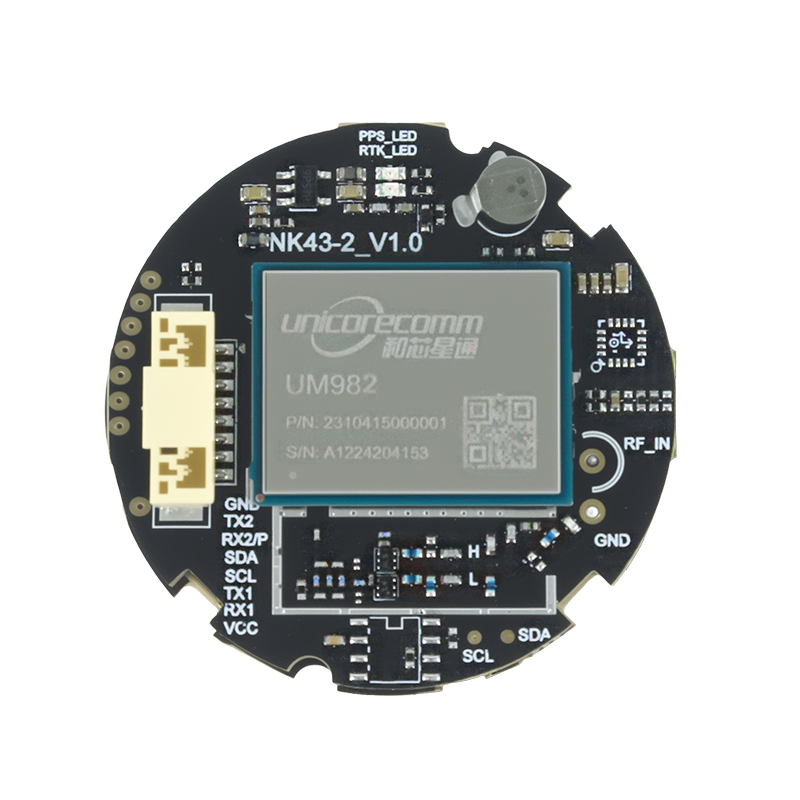
Integrated helical-antenna RTK GNSS module (JS-NK40) — one of the four integration levels buyers compare in a high-precision GNSS programme.
Why Form Factor Comes Before Brand
Comparing suppliers before choosing a form factor means comparing the wrong variables. Each integration level moves a different set of engineering responsibilities to the buyer or keeps them with the manufacturer:
- Antenna ownership. A module without an antenna leaves RF design, grounding and cable routing with the integrator; a smart antenna removes that work entirely.
- Enclosure, power and thermal design. Enclosed receivers arrive with input regulation and connectors; boards and modules require the buyer to supply them.
- Heading capability. Attitude output is not a software setting — it depends on whether the hardware has a second RF port and a physical baseline.
- Compliance path. A finished receiver and a bare module enter different qualification workflows, with different documentation requirements.
Agriculture illustrates the scale of the demand behind this decision. Agriculture is the dominant application segment for high-precision GNSS, holding a 36.8% market share in 2025 (Dataintelo), and the global precision farming market is projected to grow from USD 11.38 billion in 2025 to USD 21.45 billion by 2032 (MarketsandMarkets). Most of that volume is delivered as modules, boards and smart antennas into machine control systems rather than as standalone survey instruments.
The Four Integration Levels, Defined
The categories are not interchangeable, and their naming is not standardised across the industry. For procurement purposes, the following definitions and reference products provide a common vocabulary.
| Category | What it is | Documented reference example | Work retained by the buyer |
|---|---|---|---|
| GNSS RTK Receiver | Enclosed positioning unit with regulated input, connectors and mounting points | P-Box-X10: 544 channels, triple-frequency, dual-antenna, 100 Hz position/observation, 3×UART, Ethernet, Type-C, ANT1/ANT2, TF slot, 74×50×12.6 mm, 67.50 g | Cabling, mounting, antenna choice on dual RF ports |
| RTK Board | OEM board intended for a carrier PCB, frequently with an integrated IMU | JS-CK39-A: 25.0×39.4×11.6 mm, RTK horizontal ±(8+1ppm×D) mm, 0.8 W/0.9 W @3.3 V, 2×UART, RF_IN, PPS | Carrier board, power stage, antenna, thermal design |
| RTK GNSS Module | Compact module, with or without an integrated antenna, in surface-mount or pin form | JS-RK26-3: 16.2×12.2×2.3 mm, RTK horizontal 1.0 cm+1 ppm; JS-SK40: 39.80×35.00×32.41 mm with integrated helical antenna | Antenna (if not integrated), layout, mechanical fixing |
| GPS GNSS Module (standard precision) | Meter-class positioning module for navigation, tracking and telematics | JS-ATP30-M: horizontal 1.0 m (L1+L5) CEP, 2.5 m (L1), 10 Hz update | Full product integration; no centimetre-class output |
| GNSS Antenna | Passive or active radiating element with LNA and filtering | JS-HAS37: L1/L5 dual-band active antenna, LNA gain 28±3 dB, SMA-J3 | Gain, bias voltage and cable-loss matching |
| Smart Antenna | Receiver, antenna and sometimes heading engine in a single housing | JS-SK43H-AH: 789 channels, heading 0.15° @1 m baseline, 0.03° @5 m baseline, 48.0×43.2×37.0 mm, <24 g | Mechanical mounting and host interface only |
Criterion 1 — RTK Readiness and Accuracy Class
The first filter is whether the product is RTK-capable at all. Standard-precision modules and RTK modules are separated by roughly two orders of magnitude in horizontal error. The JS-ATP30-M, a dual-band standard-precision module, reaches 1.0 m horizontal CEP with L1+L5 and 2.5 m with L1 alone. The JS-RK40, a dual-band RTK module with 200 tracking channels, specifies RTK horizontal 1.0 cm+1 ppm and vertical 1.5 cm+1 ppm. A buyer who selects standard precision for a steering application and then adds a correction service will not close that gap, because the difference is in the receiver architecture rather than the data service.
Between the two sits a third accuracy tier that is worth naming explicitly. Galileo High Accuracy Service (HAS) delivers horizontal accuracy down to 20 cm, per the EUSPA EO and GNSS Market Report, which is sufficient for some autonomous farming and high-precision mapping tasks but does not replace a full RTK fixed solution where lane-level or implement-level control is required. Buyers should state the required accuracy tier in the specification before the form factor is chosen, because it constrains every downstream decision.
Criterion 2 — Who Owns the Antenna?
Antenna ownership is the single most consequential difference between an RTK module and a smart antenna, and it is the point where many integration programmes lose schedule time.
Modules without an antenna
The JS-RK26-3 is a dual-band (L1/L5) RTK module measuring 16.2×12.2×2.3 mm with 200 tracking channels and RTK horizontal accuracy of 1.0 cm+1 ppm. Its datasheet states active-antenna requirements directly: minimum gain 15 dB, maximum gain 30 dB, maximum noise factor 1.5 dB, with passive antenna compatibility. Those numbers are a design constraint, not a suggestion — an antenna outside that window degrades the CN0 budget that the centimetre-level specification depends on.
Boards with suggested antenna characteristics
The JS-CK39-A OEM board adds an integrated IMU for dead-reckoning support and specifies a 50 Ω antenna interface, LNA power of +3.3 V to +5 V and a suggested LNA gain of 20–35 dB. Its RTK specification is expressed as a baseline-dependent formula — horizontal ±(8+1 ppm×D) mm and vertical ±(15+1 ppm×D) mm — which is more informative than a single headline number because it shows how accuracy degrades with distance from the base station.
Modules with the antenna already integrated
Helical-antenna modules such as the JS-NK40 (1408 channels) and JS-SK40 (789 channels) remove antenna matching from the buyer's scope. The trade-off is fixed RF geometry: the radiating element, ground plane and mechanical envelope are set by the manufacturer, so the module becomes the unit of mechanical design rather than the antenna.
Enclosed receivers with dual RF ports
Dual-port receivers let an integrator add heading without designing an antenna from scratch. The P-Box-X10 provides ANT1/ANT2 ports with 3.0–5.5 V bias voltage and a 150 mA@5 V antenna current limit, alongside 100 Hz position and raw observation output and a transmission delay of 99.9% under 10 ms. The X43H-AH, at 43.8×34.0×11.5 mm and under 25 g, also offers dual-antenna heading with 20 Hz maximum data update.
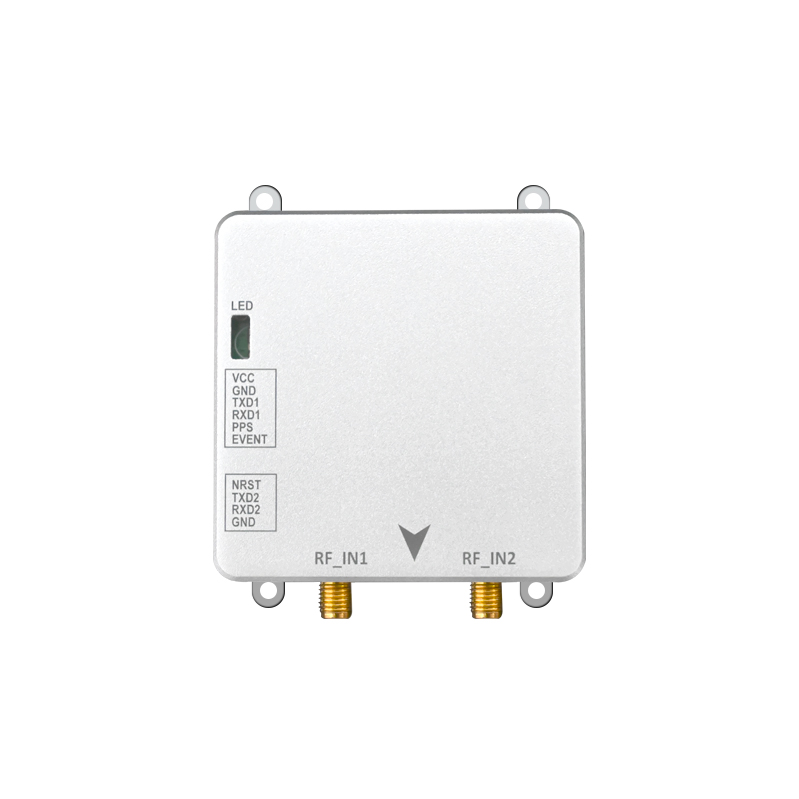
Enclosed multi-constellation RTK receiver format (P-Box-AP55, 448 channels): regulated input, dual RF input ports and 100 Hz position output.
Criterion 3 — Antenna Pairing Parameters
Once the form factor is fixed, antenna selection becomes a mechanical, electrical and environmental matching problem. Four parameters decide compatibility in practice: LNA gain, noise figure, bias voltage range, and connector or protection class. Two further parameters decide positioning quality: phase centre error for survey-grade applications and axial ratio for attitude and multipath behaviour.
| Antenna model | Type and use | LNA gain | Noise figure | Supply voltage | Connector / protection |
|---|---|---|---|---|---|
| JS-HAS37 | L1/L5 dual-band active, vehicle and fleet | 28±3 dB | ≤2.0 dB | 3–5 V DC | SMA-J3; out-of-band rejection ≥25 dB |
| JS-HAC18A-F | Helical active antenna, light UAV | 33±2 dB | ≤2 dB | +2.8–3.3 V DC | SMA male straight; IP65 (mated); 10.8 g |
| JS-HAC100B | Survey-grade measurement antenna | 40±2 dB | ≤2.0 dB | 3.0–15.0 V DC | TNC-K; IP67; phase centre error ±2 mm |
| JS-HAC148A | Quad-system full-frequency surveying antenna | 38±3 dB | ≤3.0 dB per filter | 3.3–12.0 V DC | TNC-K; IPX6; phase centre error ≤2 mm |
| JS-X168 | Five-array anti-jamming integrated antenna | — (array front end) | Low noise front end | 5 V DC, ≤2 W | J30J-9TP; 168×168×32 mm; ≤555 g |
Two pairing rules follow from this table. First, supply voltage must overlap with the receiver's bias output: a module rated for 3.0–5.5 V bias can drive the JS-HAS37 at 3–5 V but not the JS-HAC100B at 3.0–15.0 V unless the receiver supplies within that window. Second, gain must stay inside the module's declared window — the 15–30 dB band specified for the JS-RK26-3 — because excess gain raises the noise floor rather than improving fix quality.
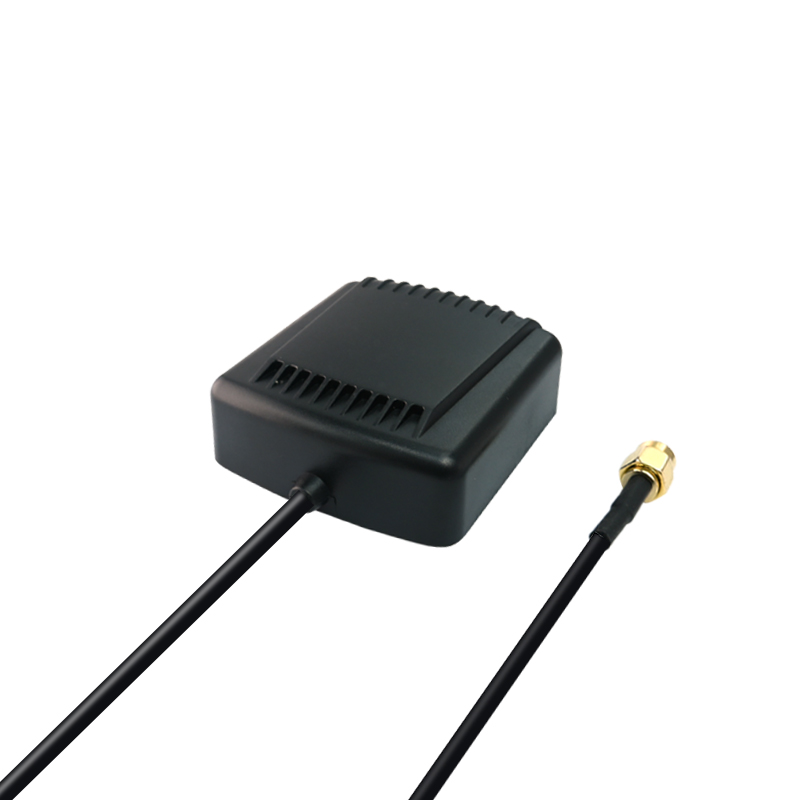
L1/L5 dual-band active GNSS antenna (JS-HAS37) with 28±3 dB LNA gain — a representative pairing option for vehicle and fleet RTK terminals.
Criterion 4 — Environmental, Certification and Compliance Constraints
Constraints form the second layer of the framework, and they are frequently the reason a technically suitable product is rejected at evaluation stage.
Quality management. Jumpstar holds ISO 9001:2015 certification, certificate number UQ231801R2, issued by Beijing United Intelligence Certification Co., Ltd. on 2023-12-11 with an expiry date of 2026-12-10. The certified scope is the R&D and sales of GPS module. Buyers running supplier audits should note that the certificate is inside its validity window at the time of writing but renews within the current procurement cycle, which makes renewal status a legitimate line item in a supplier review.
Substance compliance. RoHS compliance is stated directly in the datasheets of the module families referenced here, including JS-RK26-3, JS-ARK37-3, JS-M6D, JS-ANK45-2, JS-ATP30-M, JS-AP26-H and JS-AP08-PR.
Application-sector standards. For agriculture and forestry, ISO 12188 parts 1 and 2 define test procedures for positioning and guidance systems (International Organization for Standardization). Procurement specifications for machine-control GNSS should reference those procedures rather than a supplier's internal accuracy claim, because they describe how accuracy is measured in the field rather than on a bench.
Environmental ratings. Operating ranges across the referenced portfolio sit at -40 °C to +85 °C for most modules and receivers, with the JS-RK40 rated -40 °C to +70 °C. Protection classes range from IP65 on UAV helical antennas (JS-HAC18A-F, mated SMA) through IPX6 on the JS-HAC148A to IP66 on the JS-X11 base station and IP67 on the JS-HAC100B survey antenna. Altitude and dynamics limits matter equally: the JS-A56U9D is specified to an 80,000 m altitude limit and 500 m/s velocity, while the UAV application profile documented for the JS-AD56UB8 module assumes a 50,000 m altitude ceiling.
Matching the Framework to UAV, Agriculture, Autonomous and Fleet Deployments
UAV and aerial surveying
Weight and envelope drive selection here. The JS-RK26-3 at 16.2×12.2×2.3 mm and the JS-ARK37-3 at 36.00×36.00×9.70 mm (under 21 g) fit small airframes, while the JS-A56U9D adds dynamic heading accuracy of 0.3° with 192 search and 60 tracking channels. The documented UAV operating profile covering these classes assumes -40 °C to +85 °C operation, ≤95% non-condensing humidity, up to 18,000 m altitude, ≤4 g acceleration and 515 m/s velocity. On the antenna side, the JS-HAC18A-F weighs 10.8 g with a 33±2 dB LNA, and the JS-HAC27A-D2 offers 28±3 dB in a Φ28.2×H59.3 mm envelope.
Precision agriculture
Auto-steering needs heading, not just position, which pushes the specification toward dual-antenna hardware. Options in the referenced portfolio include the JS-SK43H-AH smart antenna with heading accuracy of 0.15° at a 1 m baseline and 0.03° at 5 m, the JS-NK43-2 with 1408 channels and RTK horizontal 1.5 cm+1 ppm, and the P-Box-X10 receiver with dual RF ports and 100 Hz output. The application share evidence — agriculture at 36.8% of high-precision GNSS demand in 2025 — suggests this segment will continue to set volume pricing across the category.
Autonomous vehicles and robotics
Signal continuity during short outages is the defining requirement. The JS-CK43-2 combines RTK and INS with a dead-reckoning error of 3% of travel distance and PPP performance of 0.1 m horizontal after a 20-minute initialisation. The S-C8A RTK module with IMU specifies centimetre-level performance through a 3-second loss of lock and metre-level through 10 seconds. Where differential correction is delivered on board, the P-Box-X6_Pro S incorporates an EG25-G 4G module for RTCM transmission in a 68.4×41.8×17.3 mm housing.
Fleet and heavy vehicle positioning
Here the constraint is usually environmental rather than accuracy-driven. The JS-HAS37, JS-PAS51A-D5 and JS-HAS67A-D2 vehicle antennas are rated to IPX7 with magnetic or threaded mounting, while the JS-X11 all-in-one RTK base station provides an IP66 housing, 9–45 V DC input, a 5200 mAh backup battery rated to ≤10 hours, 4G Cat.1 and BLE 5.2 at 30 m for correction and configuration links. One documented programme profile covers a drone manufacturer that deployed 500 units over five years for GNSS positioning, combining centimetre-level RTK with attitude output and AIM+ anti-jamming.
Form-Factor Comparison Summary
| Form factor | RTK capability (documented) | Typical interfaces | Buyer-side effort | Best fit |
|---|---|---|---|---|
| RTK Receiver | 0.6 cm+0.5 ppm horizontal; heading 0.03° @5 m (P-Box-X10) | 3×UART, Ethernet, Type-C, PPS, EVENT, ANT1/ANT2, TF | Low: mount and cable | Survey, calibration, vehicle and system builds |
| RTK Board | ±(8+1 ppm×D) mm horizontal with IMU (JS-CK39-A) | 2×UART, RF_IN, PPS, 3.3–5.5 V | High: carrier board and RF design | OEM products with custom electronics |
| RTK Module | 1.0 cm+1 ppm horizontal (JS-RK26-3, JS-RK40) | UART, I2C, PPS, RTCM 3.x, NMEA 0183 | Medium or low if antenna is integrated | Robotics, UAVs, machine control |
| Standard module | 1.0–2.5 m CEP; no RTK fix | UART, I2C, USB, PPS | Medium | Fleet tracking, telematics, wearables |
| Smart antenna | 0.6 cm+0.5 ppm with heading 0.15°/0.03° (JS-SK43H-AH) | 8-pin connector, dual MCX, RTCM 3.x | Lowest: mount and connect | Agriculture, marine, compact heading builds |
Boundaries and Trade-offs Buyers Should Accept
A comparison framework is only credible if it states where each option stops working. Five boundaries are documented in the product data and should be written into evaluation criteria.
- Heading accuracy is baseline-dependent. The 0.03° figure quoted for dual-antenna products applies at a 5 m baseline. Installations that can only achieve a 1 m baseline should plan against the 0.15° figure instead.
- Integrated helical antennas fix RF geometry. JS-NK40, JS-RK40 and JS-SK40 modules simplify integration but do not accept an external survey-grade antenna, so they are not a route to phase-centre-stable surveying performance.
- Anti-jamming capability has a physical cost. The JS-X168 five-array anti-jamming antenna provides 115 dB suppression against a single interference source and 95 dB against three, but occupies 168×168×32 mm at up to 555 g and 2 W. That envelope is not compatible with small UAV payload budgets.
- Standard-precision modules do not upgrade to RTK. A JS-ATP36-M or JS-AP26-H will not produce centimetre output when a correction stream is added, because the difference lies in hardware architecture rather than in differential data.
- Certification has an expiry date. The ISO 9001:2015 certificate referenced here expires 2026-12-10 and covers R&D and sales of GPS module, not every process in the organisation. Buyers should verify scope and renewal status rather than treating a certificate number as a permanent qualification.
Market Trend Signals Behind the Framework
Three trends make the form-factor comparison more commercially significant than it was a decade ago. The first is scale: high-precision GNSS is forecast to roughly double to USD 20.6 billion by 2033, and GNSS downstream market revenues are forecast to reach €580 billion by 2034 (EUSPA). The second is componentisation: the high precision GNSS module segment is forecast to grow from USD 1.5 billion in 2024 to USD 4.5 billion by 2035, meaning a rising share of value is captured by components rather than finished instruments.
The third is inertial integration. Trimble launched the R12i GNSS System in 2024 with integrated IMU technology for enhanced RTK performance (Fortune Business Insights), and the same pattern appears at module level in products such as JS-CK43-2, JS-NK43-1 and S-C8A. Meanwhile the mid and high-level precision GPS receiver market remains led by Trimble, Hexagon AB, Topcon and Hemisphere GNSS (Mordor Intelligence), which is relevant context for buyers assessing supplier concentration risk.
How Jumpstar's Portfolio Maps to the Framework
Shenzhen Jumpstar Technology Co., Ltd. is a GNSS source manufacturer founded in 2013 and headquartered in Shenzhen, China, operating a 5,000 ㎡ facility with approximately 200 employees, a 20-engineer R&D team and an annual output of 100,000 units. Around 70% of output is exported to the EU, USA and Middle East. For the framework described above, that portfolio covers all six categories rather than a single form factor.
Manufacturing and supply terms are relevant to the evaluation stage of procurement. The company runs OEM and ODM programmes with customization across modules, PCBA, antennas, functions, ports, interfaces and logo, states a monthly capacity of 50,000 units, a lead time of 30 days and a minimum order quantity of 500 units, and applies 100% testing with remote after-sales support. Certification coverage includes ISO 9001:2015 (UQ231801R2) with the scope of R&D and sales of GPS module, and RoHS compliance is declared across the module families referenced in this article.
Future Outlook
As agricultural and autonomous-system volumes grow, the practical centre of gravity is likely to remain in modules and smart antennas rather than enclosed receivers, because those are the levels at which machine builders can control cost and mechanical fit. Two developments will shape the next comparison cycle. Galileo HAS at 20 cm horizontal accuracy creates a genuine mid-tier option that may absorb part of today's entry-level RTK demand. And continued IMU integration — already visible at module level — will shift the question from "is this RTK-capable?" to "how many seconds of RTK outage can this design survive?" Buyers who write that number into the specification today will find the form-factor decision considerably easier to make.
FAQ
Does an RTK receiver always deliver centimetre-level accuracy?
No. RTK accuracy depends on continuous differential correction data from a base station or NTRIP/CORS service. Documented RTK specifications such as 0.6 cm+0.5 ppm horizontal for the P-Box-X10 or 1.0 cm+1 ppm for the JS-RK26-3 assume a fixed solution, which requires correction data and adequate satellite visibility. Without correction, the same hardware falls back to standalone performance in the metre range.
What must be checked when pairing a GNSS antenna with an RTK module?
Four parameters determine compatibility: LNA gain, noise figure, supply voltage range and connector type. The JS-RK26-3 specifies an active antenna gain window of 15–30 dB with a maximum noise factor of 1.5 dB. LNA gain must also fall within the bias output range of the receiver — for example, a receiver providing 3.0–5.5 V bias can drive a 3–5 V antenna such as the JS-HAS37. For survey-grade work, phase centre error and axial ratio become additional selection criteria, as specified at ±2 mm and ≤3 dB on the JS-HAC100B and JS-HAC148A.
Is an RTK board or an RTK module the better choice for OEM integration?
The distinction is scope of engineering work. An RTK board such as the JS-CK39-A, at 25.0×39.4×11.6 mm with 0.8 W power consumption at 3.3 V, requires the buyer to supply a carrier board, power regulation, antenna interface and thermal path. An RTK module such as the JS-RK26-3, at 16.2×12.2×2.3 mm, occupies less board area and is designed for direct mounting, but still requires antenna design unless the antenna is integrated. Programmes with in-house RF capability typically retain more flexibility with a board; programmes optimising schedule typically favour a module or smart antenna.
Which certifications and standards matter for high-precision GNSS procurement?
Three categories apply. Quality management certification establishes process control — Jumpstar holds ISO 9001:2015 certificate UQ231801R2, issued 2023-12-11, expiring 2026-12-10, with a scope of R&D and sales of GPS module. Substance compliance such as RoHS applies at component level. Application-sector standards such as ISO 12188 parts 1 and 2, which define test procedures for positioning and guidance systems in agriculture and forestry, apply where the end product falls within that sector. Buyers should confirm each document's scope and validity date rather than relying on the certificate type alone.
Can a standard-precision GNSS module meet RTK requirements?
No. Standard-precision modules such as the JS-ATP30-M specify horizontal accuracy of 1.0 m (L1+L5) and 2.5 m (L1) CEP, and the JS-AP26-H specifies 2.5 m with SBAS support down to 2.0 m. These products serve vehicle navigation, asset tracking, wearables and telematics, where metre-level positioning is sufficient. Centimetre-level output requires RTK-capable hardware plus differential correction, and the two accuracy classes are separated by receiver architecture rather than configuration.
For procurement teams that need the complete product and capability list in a single reference document, the Jumpstar company profile is available here: Jumpstar company profile 2026 (PDF).
Have Questions or Need More Details?
Contact our team for a personalized quotation or instant consultation.
Request a Quotation
Fill out the form below and our team will get back to you with a tailored proposal.
WhatsApp Direct Chat
Prefer to chat in real-time? Message us on WhatsApp for instant assistance & quick answers.
- Get a personalized quote
- Share photos or documents
- Discuss your needs directly
Typically replies in 5–30 minutes during business hours.