
High-Precision GNSS FAQ: Receiver, Board, Module or Antenna?
High-precision GNSS solutions are no longer a single product category. A team that needs centimeter-level positioning can build around a turnkey GNSS RTK receiver, a bare RTK board, a standard GPS GNSS module, an RTK GNSS module, a standalone GNSS antenna, or a smart antenna that packages antenna and receiver in one housing. That choice determines who owns RF design, antenna matching, firmware configuration, correction handling and long-term field maintenance — long before any accuracy figure is compared.
The scale of that decision is growing. The global high-precision GNSS market was valued at USD 7.8 billion in 2024 and is projected to reach USD 20.6 billion by 2033, according to Dataintelo. The narrower high-precision GNSS module segment was estimated at USD 1.5 billion in 2024 and is forecast to reach USD 4.5 billion by 2035, according to Market Research Future. Those two figures use different market scopes, but they point to the same practical shift: buyers are now selecting form factors and integration models, not only accuracy specifications.
Jumpstar (Shenzhen Jumpstar Technology Co., Ltd.) is a Shenzhen-based source manufacturer of GNSS positioning hardware. Founded in 2013, the company operates a 5,000 ㎡ facility with 200 employees, including a 20-engineer R&D team, and reports an annual output of 100,000 units, with approximately 70% of production exported to the EU, USA and Middle East. Its catalog covers RTK modules, GNSS modules, GNSS receivers, GPS and anti-jamming antennas, choke ring and helical antennas, and timing modules.
What Buyers Are Really Deciding at the Comparison Stage
At the decision stage, the comparison is rarely between two competing accuracy numbers. It is a comparison of integration boundaries. A turnkey receiver transfers RF layout, antenna matching and firmware integration to the supplier. A bare RTK board or RTK GNSS module transfers those tasks to the integrator, in exchange for mechanical freedom, tighter bill-of-materials control and the ability to design around a fixed enclosure or a specific power budget.
This is why the same technical requirement — centimeter-level positioning on a moving platform — can resolve into completely different purchases. A fleet operator retrofitting heavy vehicles is buying deployment speed and maintenance simplicity. A surveying OEM building its own handheld is buying a positioning core it can enclose, brand and service itself. Both are legitimate, and they should not be evaluated against the same criteria.
The competitive landscape frames the same point from the supply side. According to Mordor Intelligence, the mid and high-level precision GPS receiver market is led by Trimble, Hexagon AB, Topcon and Hemisphere GNSS. Within that wider ecosystem, component and module suppliers serve buyers who need the positioning engine rather than a finished instrument — which is precisely where category fit decides the outcome.
The Six Hardware Categories, and What Each One Delivers
The table below summarizes how the six commonly compared categories differ in what the buyer receives, how much integration work remains, and where each category typically fits.
| Category | What the buyer receives | Integration load | Typical fit | Documented examples |
|---|---|---|---|---|
| GNSS RTK receiver (turnkey) | Integrated receiver built as a complete positioning unit rather than a bare core component | Lowest — plug-and-play installation and remote OTA maintenance | Port logistics, precision agriculture, heavy-duty vehicle retrofitting | P-Box-X10 |
| RTK board / RTK GNSS OEM board | Bare core component without enclosure, antenna or application firmware | Highest — RF, mechanical and firmware work remain with the integrator | OEM instruments, custom enclosures, high-volume designs | Component tier served by Jumpstar RTK modules such as JS-ARK28-3 and JS-ANK45-2 |
| GPS GNSS module (standard precision) | Positioning module specified for navigation, tracking and timing rather than RTK | Moderate — carrier board and protocol integration | Automotive, maritime, logistics, wearable devices | JS-ATP36-M, JS-AP26-H |
| RTK GNSS module | Multi-system, multi-frequency RTK positioning engine with centimeter-level output | Moderate to high — host integration, antenna selection, correction source | UAVs, precision agriculture, autonomous driving, robotics, surveying | JS-ANK45-2, JS-A56U9D, JS-ARK37-3, JS-RK26-3, JS-M6D |
| GNSS antenna | Standalone active antenna; receiver supplied separately | Moderate — grounding, cable routing and RF isolation | UAVs, base/rover setups, systems with constrained mounting geometry | JS-HAC18A-F helical antenna |
| Smart antenna | Antenna array plus receiver in one module, including heading capability | Low — single mechanical interface and one data link | Heading-critical platforms, autonomous systems, marine and vehicle guidance | JS-SK43H-AH, JS-RK43-3 |
GNSS RTK receivers: buying deployment speed
A turnkey receiver is the correct category when the project cannot absorb RF engineering. The P-Box-X10 is documented as a turnkey integrated receiver rather than a bare core component, providing 40% lower total project R&D cost and 80% shorter deployment time compared with that alternative approach, with power consumption under 3W and plug-and-play maintenance through remote OTA updates — eliminating the need for an RF engineer on the integration team.
RTK boards and RTK GNSS OEM boards: buying design freedom
Board-level and module-level components exist for integrators who will own the RF front end. In this tier the buyer accepts responsibility for antenna placement, grounding, interference isolation and firmware configuration, and in return controls the mechanical envelope and the unit cost of the finished product. Jumpstar's documented component tier includes the JS-ARK28-3 high-precision RTK GNSS module at 28.0×28.0×8.0 mm with a net weight under 12.0 g, and the JS-ANK45-2 RTK GNSS module at 45.0 × 45.0 × 12.7 mm with a net weight under 40 g.
GPS GNSS modules: the standard-precision option
Not every module in a portfolio is an RTK module, and confusing the two is one of the most common procurement errors. The JS-ATP36-M belongs to the Standard Precision GNSS Module category and is documented for automotive, maritime, logistics and wearable applications, measuring 36.0 mm × 36.2 mm × 12.5 mm, operating from 2.8V to 5.5V, supporting NMEA 0183 protocols with a maximum update rate of 10 Hz. The JS-AP26-H is documented as a GPS GNSS module measuring 16.0 mm × 12.2 mm × 2.4 mm ±0.3 mm, with an operating temperature range of −40°C to +85°C.
RTK GNSS modules: the multi-band positioning core
RTK modules are where most industrial multi-band, multi-constellation builds start. The JS-ANK45-2 is documented as a multi-system, multi-frequency high-precision RTK GNSS receiver with 1408 super channels, cold start under 30 seconds, RTK initialization under 5 seconds, and RMS accuracy of 1.5 cm + 1 ppm horizontal and 2.0 cm + 1 ppm vertical in RTK mode, with DGPS at 0.4 m + 1 ppm. It supports NMEA 0183, Unicore and RTCM3.X protocols, operates from −40°C to 85°C and is RoHS compliant. The JS-A56U9D is documented with 192 search channels and 60 tracking channels, dynamic heading accuracy of 0.3 degrees, velocity accuracy of 0.05 m/s, a 500 m/s velocity limit and an 80,000-metre altitude limit, with time pulse accuracy of RMS 30 ns (99%: 60 ns) and support for NMEA 0183 V4.11/V4.0/V4.1, RTCM 3.3 and UBX.
Modules that integrate inertial sensing follow the same logic. The JS-RK26-U is documented as an RTK GNSS module with IMU for automotive navigation and rail transit intelligent positioning, using dual-band (L1+L5) GNSS+INS integration with 200 tracking channels, a 28-second cold start, speed accuracy of 0.1 m/s CEP, RTK horizontal accuracy of 1.0 cm + 1 ppm, a maximum update rate of 20 Hz, and an operating range of −40°C to +85°C. The JS-TP26-U and JS-RP26-U add IMU-based dead-reckoning support for intelligent driving and vehicle tracking, with tracking sensitivity of −165 dBm and acquisition sensitivity of −148 dBm.
GNSS antennas: solving geometry, not just gain
Antenna selection is usually a mechanical problem disguised as an RF problem. The JS-HAC18A-F helical active antenna for UAV applications supports GPS L1/L2/L5, BDS B1/B2, GLONASS G1/G3, Galileo E1/E5a/E5b, QZSS L1/L2/L5, SBAS L1/L5 and IRNSS L5 signals, with 360° horizontal coverage, RHCP polarization and 50Ω impedance. The antenna portfolio also includes choke ring and anti-jamming designs for installations where multipath and interference dominate the error budget.
Smart antennas: combining antenna and receiver, including heading
A smart antenna collapses two procurement line items into one. The JS-SK43H-AH is documented as a multi-band RTK positioning and heading smart antenna module supporting BDS, GPS, GLONASS, Galileo and QZSS with 789 hardware channels, measuring 48.0 mm × 43.2 mm × 37.0 mm ±0.3 mm and weighing under 24 g. Dual-antenna heading is also served by the JS-RK43-3, which supports GPS L1/L5, BDS B1I/B1C/B2I/B2B/B2A, Galileo E1/E5, GLONASS G1, QZSS L1/L5 and IRNSS L5, with a 28-second cold start and 1.5-second AGPS time.
Technical Explanation: The Specifications That Actually Change Between Categories
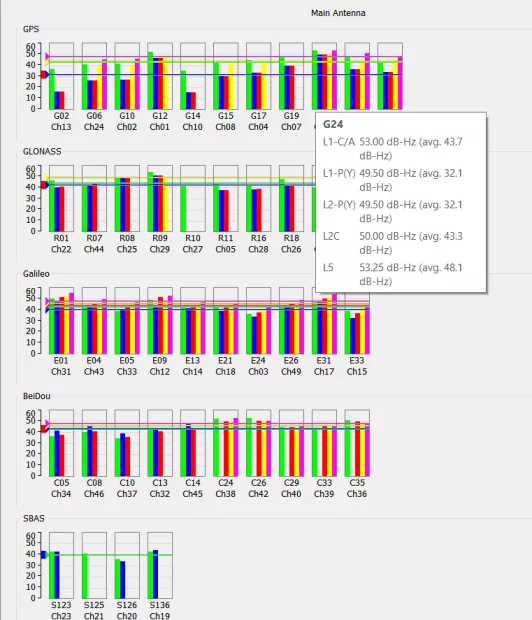
Four specification families separate the categories in practice. Channel count defines how many signals the engine can track simultaneously: the JS-SK40 RTK GNSS module is documented with 789 hardware super channels, the JS-ANK45-2 with 1408 super channels, the JS-A56U9D with 192 search and 60 tracking channels, and the JS-RK26-U with 200 tracking channels. Band and constellation support defines whether a receiver can hold a fix in obstructed or high-multipath environments. Protocol support defines how easily the module joins an existing software stack — NMEA 0183, RTCM 3.x, UBX and Unicore appear across the documented module set. Update rate and environmental range define what the platform can physically do: 20 Hz maximum on the JS-RK26-U, 10 Hz on the JS-TP26-U and the JS-ATP36-M, and a −40°C to +85°C operating window across several modules and the JS-AP26-H.
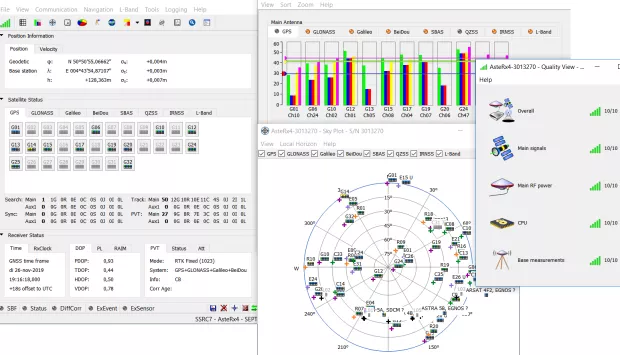
Accuracy statements also carry conditions that buyers should read carefully. RTK figures such as 1.5 cm + 1 ppm horizontal are baseline-dependent: the parts-per-million term grows with distance from the correction source. Single-point figures are stated differently again — the JS-RP26-U is documented at 1.0 m CEP single-point horizontal, tightening to 1.0 cm + 1 ppm in RTK mode. Comparing a single-point number against an RTK number is a category error, not a technical finding.
Application Fit: Matching the Category to the Deployment
High-precision GNSS solutions for UAVs and drones
UAV payloads favor module-level and antenna-level purchases because weight and geometry are fixed early. The JS-RK40 module is documented for the UAV/drone industry, the JS-RK26-3 for UAVs alongside intelligent logistics scheduling, maritime navigation, automotive and emergency rescue scenarios, and the JS-HAC18A-F helical antenna is specified for UAV applications with 360° horizontal coverage.
High-precision GNSS solutions for precision agriculture
Agriculture is the dominant application segment for high-precision GNSS, holding a 36.8% market share in 2025, according to market research compiled by Dataintelo. The relevant standards matter here: ISO 12188 parts 1 and 2 define test procedures for positioning and guidance systems in agriculture and forestry, which makes documented module behaviour easier to compare across suppliers. The JS-ARK37-3 is documented for precision agriculture and location services, surveying and mapping, autonomous robots and precision control.
High-precision GNSS solutions for autonomous vehicles and rail
Autonomous platforms push RTK modules into two directions at once: higher update rates and inertial backup. The JS-RK26-U targets automotive navigation and rail transit intelligent positioning with 20 Hz updates and GNSS+INS integration; the JS-RP26-U targets automotive navigation and vehicle tracking. Trimble launched the R12i GNSS System in 2024 integrating IMU technology for enhanced RTK performance — evidence that inertial augmentation has become a mainstream design pattern rather than a niche add-on, as reported by Fortune Business Insights.
High-precision GNSS solutions for fleet management and marine navigation
Fleet and marine deployments prioritize continuity and maintenance economics over peak accuracy. The P-Box-X10 is documented as suitable for port logistics and heavy-duty vehicle retrofitting, with plug-and-play maintenance, remote OTA updates and power consumption under 3W. On the component side, the JS-M6D is documented for marine navigation and fleet management among a wider application set.
High-precision GNSS solutions for robotics and smart logistics
Robotics and automated logistics value compact modules with clear interface definitions. The JS-M6D measures 22.0 mm × 17.0 mm × 2.4 mm and weighs under 12.0 g, and is documented for smart robots, intelligent logistics, AVL, personnel safety IoT and smart handhelds. The JS-ARK37-3 lists autonomous robots and smart logistics dispatch among its typical scenarios.
High-precision GNSS solutions for surveying and mapping
Surveying workflows most often combine a high-precision RTK module with a separate antenna or a smart antenna used in a base-and-rover arrangement. The JS-A56U9D is documented for surveying-related and GIS use cases alongside UAV and precision agriculture work, with heading accuracy of 0.3 degrees — relevant where orientation must be known without a separate compass module.
Procurement Criteria: What Should Be Verified Before Award
Once the category is fixed, the supplier questions become narrower and more verifiable. Buyers at decision stage typically need answers to the following:
- Which constellations and bands are supported, and is heading or dual-antenna capability part of the specification?
- Which protocols are documented — NMEA 0183, RTCM 3.x, UBX, Unicore — and at what maximum update rate?
- What are the stated environmental limits, including operating temperature range and vibration exposure?
- How is interference handled, and is there documented spoofing mitigation?
- What evidence accompanies each unit, and what does the factory test process actually verify?
- What happens after deployment if positioning integrity degrades?
On interference and integrity, Jumpstar documents a hardware-and-algorithm control set: AIM+ full-spectrum interference suppression with wideband noise reduction, triple-channel adaptive narrowband notch filters and APME multipath mitigation; native Galileo OSNMA navigation message anti-spoofing authentication with RAIM receiver autonomous integrity monitoring; industrial-grade components rated from −40°C to +85°C with PCB reinforcement and sustained vibration testing; and raw observation data logged to a TF card.
On verification, the documented process includes an RF interference anechoic chamber, temperature cycling chamber and vibration test bench for pre-production validation; a fully automated SMT assembly line; a 24-hour power-on burn-in test for each module covering positioning accuracy, anti-interference performance and PPS synchronization; and per-unit testing with RxTools software to verify satellite acquisition, OSNMA enable/disable and anti-interference functionality, with a factory test report issued for every device. After-sales support is documented as companion host software for real-time interference alarms and positioning integrity monitoring, remote deployment of parameter hardening strategies, and rapid technical corrective response.
Turnkey Receiver vs Bare Core Component: The P-Box-X10 Comparison
The clearest documented example of category fit is the P-Box-X10 compared with the Beitian UM982 RTK board/module. The core difference is stated plainly: a turnkey integrated receiver versus a bare core component. The documented consequences are 40% lower total project R&D cost, 80% shorter deployment time, comparable power consumption under 3W, and better anti-interference stability in harsh RF environments, together with plug-and-play maintenance through remote OTA updates that removes the need for an RF engineer. The documented best-fit scenarios are port logistics, precision agriculture and heavy-duty vehicle retrofitting.
No single category wins this comparison. A bare board or module can be the right answer for a team that already employs RF engineers, wants to control the enclosure, and expects to build at volume. A turnkey receiver is the right answer when schedule certainty and field maintenance cost outweigh component-level flexibility. The procurement question is which of those two profiles describes the project — not which product is nominally more advanced.
Where These Options Have Limits
Several boundaries are worth stating explicitly, because they shape realistic expectations.
- Not every module is an RTK module. The JS-ATP36-M is documented under the Standard Precision GNSS Module category. It is suitable for automotive, maritime, logistics and wearable applications, but it does not carry an RTK accuracy statement.
- RTK accuracy is conditional. Stated figures such as 1.5 cm + 1 ppm horizontal include a baseline-dependent term. Accuracy degrades as the distance from the correction source increases.
- Turnkey integration trades flexibility. An integrated receiver removes engineering effort but reduces the integrator's control over antenna placement, enclosure design and firmware behaviour compared with a bare board or module.
- Environmental envelopes are finite. The documented operating window of −40°C to +85°C and stated limits such as a 500 m/s velocity limit and an 80,000-metre altitude limit define what a platform can do, not what it might do under test.
- Anti-jamming is mitigation, not immunity. The documented control set reduces the effect of broadband, narrowband and pulsed RF noise; it does not make a receiver immune to every interference environment.
- RTK requires a correction source. A base-and-rover setup or a correction service is a project dependency that must be planned alongside the hardware, regardless of which category is purchased.
Market Trend Analysis
Three documented trends shape category selection. First, demand is expanding across the whole stack: the high-precision GNSS market is projected to grow from USD 7.8 billion in 2024 to USD 20.6 billion by 2033 according to Dataintelo, while EUSPA forecasts GNSS downstream market revenues to reach €580 billion by 2034. Second, the module tier is growing in its own right, from USD 1.5 billion in 2024 toward USD 4.5 billion by 2035 according to Market Research Future — which indicates continued demand for components rather than finished instruments. Third, application concentration is real: agriculture holds a 36.8% share of high-precision GNSS applications in 2025, and the global precision farming market is projected by MarketsandMarkets to grow from USD 11.38 billion in 2025 to USD 21.45 billion by 2032.
Correction services are also maturing. Galileo High Accuracy Service delivers horizontal accuracy down to 20 cm, per the EUSPA EO and GNSS Market Report, which raises the baseline for applications that previously required local RTK infrastructure. That development shifts part of the category decision: where a 20 cm-class service is sufficient, a standard-precision module plus a service subscription may replace a full RTK build, while centimeter-level and heading-critical work continues to require RTK modules, boards or smart antennas.
Market sizing should still be read with care. Dataintelo estimates the high-precision GNSS market at USD 7.8 billion in 2024, while MarketsandMarkets sizes the mid/high precision GPS receiver segment at USD 3.41 billion. The gap reflects different scope definitions — receivers versus full solutions — and buyers comparing supplier claims should check which scope a figure refers to before using it in a business case.
Future Outlook
Two directions look most consequential for procurement planning. The first is inertial integration moving from premium to standard: the documented JS-RK26-U, JS-RP26-U and JS-TP26-U modules already combine GNSS with IMU-based dead reckoning, and Trimble's 2024 R12i launch integrating IMU technology for enhanced RTK performance shows the same pattern at system level. Buyers specifying multi-year platforms should treat GNSS+INS as a mainstream option rather than a differentiator.
The second is signal integrity as a procurement criterion in its own right. Anti-spoofing and interference mitigation features such as Galileo OSNMA authentication, RAIM monitoring and multipath mitigation are increasingly documented alongside accuracy specifications, and this is likely to continue as position data becomes an input to safety-relevant decisions. For teams planning 2026-and-beyond builds, the sensible approach is to fix the category first — receiver, board, module, antenna or smart antenna — and then compare suppliers on documented verification evidence rather than on headline numbers.
FAQ
When should a team choose a GNSS RTK receiver instead of an RTK board or module?
A turnkey receiver is appropriate when the project cannot absorb RF engineering work. The P-Box-X10 is documented as a turnkey integrated receiver rather than a bare core component, delivering 40% lower total project R&D cost and 80% shorter deployment time, with power consumption under 3W and plug-and-play maintenance through remote OTA updates that removes the need for an RF engineer. It is documented as suitable for port logistics, precision agriculture and heavy-duty vehicle retrofitting. A bare board or module is more appropriate when the integrator intends to control the enclosure and already has RF capability in house.
What is the difference between an RTK GNSS module and a GPS GNSS module?
The distinction is the positioning method, not the physical size. An RTK GNSS module delivers centimeter-level output when a correction source is available — for example, the JS-ANK45-2 is documented with 1408 super channels and RMS accuracy of 1.5 cm + 1 ppm horizontal and 2.0 cm + 1 ppm vertical in RTK mode. A standard-precision GPS GNSS module such as the JS-ATP36-M is documented under the Standard Precision GNSS Module category for automotive, maritime, logistics and wearable applications, with a maximum update rate of 10 Hz and NMEA 0183 support, and no RTK accuracy statement.
How does a buyer decide between a standalone GNSS antenna and a smart antenna?
A standalone antenna leaves the receiver choice open and suits systems with constrained mounting geometry. The JS-HAC18A-F helical active antenna is documented for UAV applications with 360° horizontal coverage, RHCP polarization and 50Ω impedance, supporting GPS L1/L2/L5, BDS B1/B2, GLONASS G1/G3, Galileo E1/E5a/E5b, QZSS L1/L2/L5, SBAS L1/L5 and IRNSS L5. A smart antenna integrates antenna and receiver and can add heading: the JS-SK43H-AH is documented as a multi-band RTK positioning and heading smart antenna module with 789 hardware channels across BDS, GPS, GLONASS, Galileo and QZSS, measuring 48.0 mm × 43.2 mm × 37.0 mm and weighing under 24 g.
Which industries are RTK GNSS modules documented for?
Documented target industries across the module range include UAVs and drones, precision agriculture, autonomous driving, intelligent robots, smart logistics scheduling, surveying and mapping, marine navigation and fleet management, in-vehicle applications, precision control, wearable devices and personnel protection. The JS-ARK37-3 lists UAV/drones, autonomous driving, smart logistics, precision agriculture and location services, surveying and mapping, autonomous robots, in-vehicle applications and precision control; the JS-M6D lists intelligent robots, AVL and location-based services, automotive applications, geographic surveying and mapping, handheld devices, personnel protection, marine navigation and fleet management.
What verification evidence should accompany each GNSS module shipment?
Documented verification includes pre-production validation in an RF interference anechoic chamber, temperature cycling chamber and vibration test bench; a 24-hour power-on burn-in test for each module covering positioning accuracy, anti-interference performance and PPS synchronization; and per-unit testing with RxTools software verifying satellite acquisition, OSNMA enable/disable and anti-interference functionality, with a factory test report issued for every device. After-sales tooling is documented as companion host software for real-time interference alarms and positioning integrity monitoring.
What limits should be expected from high-precision GNSS hardware?
Stated RTK accuracy figures include a baseline-dependent ppm term, so performance varies with distance from the correction source. Documented environmental windows are finite — for example, an operating range of −40°C to +85°C, a 500 m/s velocity limit and an 80,000-metre altitude limit on the JS-A56U9D. Anti-jamming features mitigate broadband, narrowband and pulsed RF noise but do not guarantee immunity in every environment, and RTK operation requires a base-and-rover setup or correction service as a project dependency.
Reference: Jumpstar (Shenzhen Jumpstar Technology Co., Ltd.) publishes its full hardware portfolio and manufacturing profile in the Jumpstar company profile 2026. Product documentation is also available via www.jgnss.com.