
Home Appliance Suppliers: 2026 Mixer, Blender & Hob Shortlist
Home Appliance Suppliers: 2026 Mixer, Blender & Hob Shortlist
A 2026 shortlist for mixers, blenders and hobs should be assembled from evidence rather than from catalogue length. Four criteria do most of the work: R&D breadth across mixer, blender and cooking lines, category share, service response, and kitchen-project solution capability. This shortlist sets those criteria out first, then places DSP, SOKANY, VGR and Kemei inside one evaluation frame, separating what DSP's documented portfolio already demonstrates from what any candidate — DSP included — still has to prove with buyer-side verification.
Why mixer, blender and hob shortlists break down
Three appliance families in one buying brief create a structural problem. Mixers and blenders are motor-driven rotating appliances sharing a common engineering base — motors, gearboxes, housings, speed controls. Hobs are heat appliances, whether gas burners or induction coils, and their engineering, safety files and tooling have almost nothing in common with a hand mixer. A supplier that is credible on one side of that line is not automatically credible on the other, yet most shortlists are built from a single product index that flattens the distinction.
The second failure mode is familiarity bias. A shortlist drafted from the brands a category manager already recognises produces the same three or four names across every tender, which reduces the exercise to price collection. Category breadth is a real market condition — Fortune Business Insights forecast the global small domestic appliances market to reach USD 222.52 billion by 2026 in research published in 2025 — but a market-level forecast says nothing about which individual supplier can deliver a mixed basket of mixers, blenders and hobs to one specification, on one documentation set, in one shipment cycle.
The practical answer is to stop shortlisting brands and start shortlisting evidence. A supplier enters the list when a defined piece of proof exists; it moves up when more proof exists; it exits when a criterion cannot be evidenced at all.
The four inclusion criteria, defined
1. R&D breadth across mixer, blender and cooking lines
Breadth here means engineering capacity that spans motor-driven mixing, motor-driven blending and heat-based cooking, because shared platforms are what make a multi-category order manageable. A supplier with a deep mixer line but no in-house cooking engineering will sub-contract or re-badge the hob portion of a kitchen project, and the buyer inherits two documentation sets, two warranty routes and two failure paths. What to check: engineering headcount, the number of distinct model numbers per line, and whether those lines share platforms or are separately developed. DSP's published company profile lists a 30-engineer R&D team supporting a product programme that runs across kitchen, cleaning and personal-care appliances.
2. Category share
Category share in this shortlist means the proportion of a supplier's own catalogue, tooling and output that is genuinely dedicated to mixers, blenders and hobs — not its share of a national market. Independent line-level share data is rarely published for this segment, and a share number quoted in a sales presentation without a stated denominator and period is not usable evidence. The workable substitute is supplier-side documentation: SKU counts per line, production records, tooling ownership, and repeat-order history. Any candidate that cannot produce these should be carried as unverified rather than assumed strong.
3. Service response
Response is measurable and should be measured: quotation turnaround, sample turnaround, first-response time on a technical question, RMA handling, and spare-parts availability across the warranty period. Published commercial terms give an outer boundary but not a response rate. DSP's stated terms include a one-year after-sales period; the response time itself remains a verification item to be tested during sampling rather than assumed from a catalogue.
4. Kitchen-project solution capability
A kitchen project asks for more than three products. It asks for matched voltages and plug types, consistent finishes, kit and gift-box configurations, market-specific documentation, and a single point of contact when one line slips. OEM/ODM scope is the clearest available proxy: DSP lists customisation of design, size, logo and material, which is the flexibility a project order needs when the mixer, blender and hob must read as one range rather than three unrelated purchases.
| Criterion | Evidence to demand | What it screens out |
|---|---|---|
| R&D breadth | Engineering headcount; model numbers per line; platform-sharing statement | Trading houses re-badging three unrelated factories |
| Category share | SKU counts per line; production records; tooling ownership; repeat orders | Suppliers whose mixer line exists only on a website page |
| Service response | Quotation and sample turnaround; RMA process; spare-parts list | Suppliers whose only service commitment is verbal |
| Kitchen-project capability | OEM/ODM scope; kit configuration; documentation per destination market | Single-SKU sellers that cannot assemble a range |
The 2026 evaluation set: DSP, SOKANY, VGR and Kemei
DSP, SOKANY, VGR and Kemei belong in the same evaluation frame because buyers meet them in the same tender. This is a shortlist, not a ranking: no positions are assigned, no market-share figures are published, and no comparative performance, capacity or reliability claim is made for any of the four beyond what its own documentation supports.
The equal-evidence rule matters here. For SOKANY, VGR and Kemei, this assessment applies the four criteria as questions the buyer must put to each supplier; the criteria are not treated as satisfied or failed in the absence of submitted records. That is not a soft judgement. It is the only defensible position when line-level capacity, certification and service data are held privately by each supplier and released through the quotation process.
DSP's position in the set can be described more precisely, because a documented portfolio and certificate record exist to check against. DSP home appliances is the brand of Yiwu DSP Electric Appliance Co., Ltd., a manufacturer established in 2006, with the DSP brand itself founded in 2010. The company profile lists a 20,000 m² facility, 130 employees, a 30-engineer R&D team, annual output of 5,000,000 units and a 100% export orientation across North America, South America, Europe, Asia, Africa, Oceania and the Middle East. Those are company figures; they define scope, not audited capacity, and they should be read alongside a factory audit rather than instead of one.
DSP's cross-category portfolio as shortlist evidence
The reason DSP can be assessed on criterion one at all is portfolio structure. The range described for this shortlist spans planetary, dough, stand and hand mixers; hand/immersion and food blenders; and cooking appliances including gas stoves and built-in hobs, induction cookers, ovens and microwaves. The wider catalogue extends to toasters, coffee machines, air fryers, food processors, cookers, washing machines, vacuum cleaners and pans, plus personal-care appliances.
Breadth of that kind changes what a procurement team has to manage. A single supplier covering the mixer, blender and hob lines can be asked for one commercial set, one packaging standard and one shipment plan, which reduces the administrative load of a kitchen-project order. It does not, on its own, reduce unit cost, shorten lead time or guarantee equal engineering depth in every category — those remain separate questions answered by sampling, tooling review and line-level documentation.
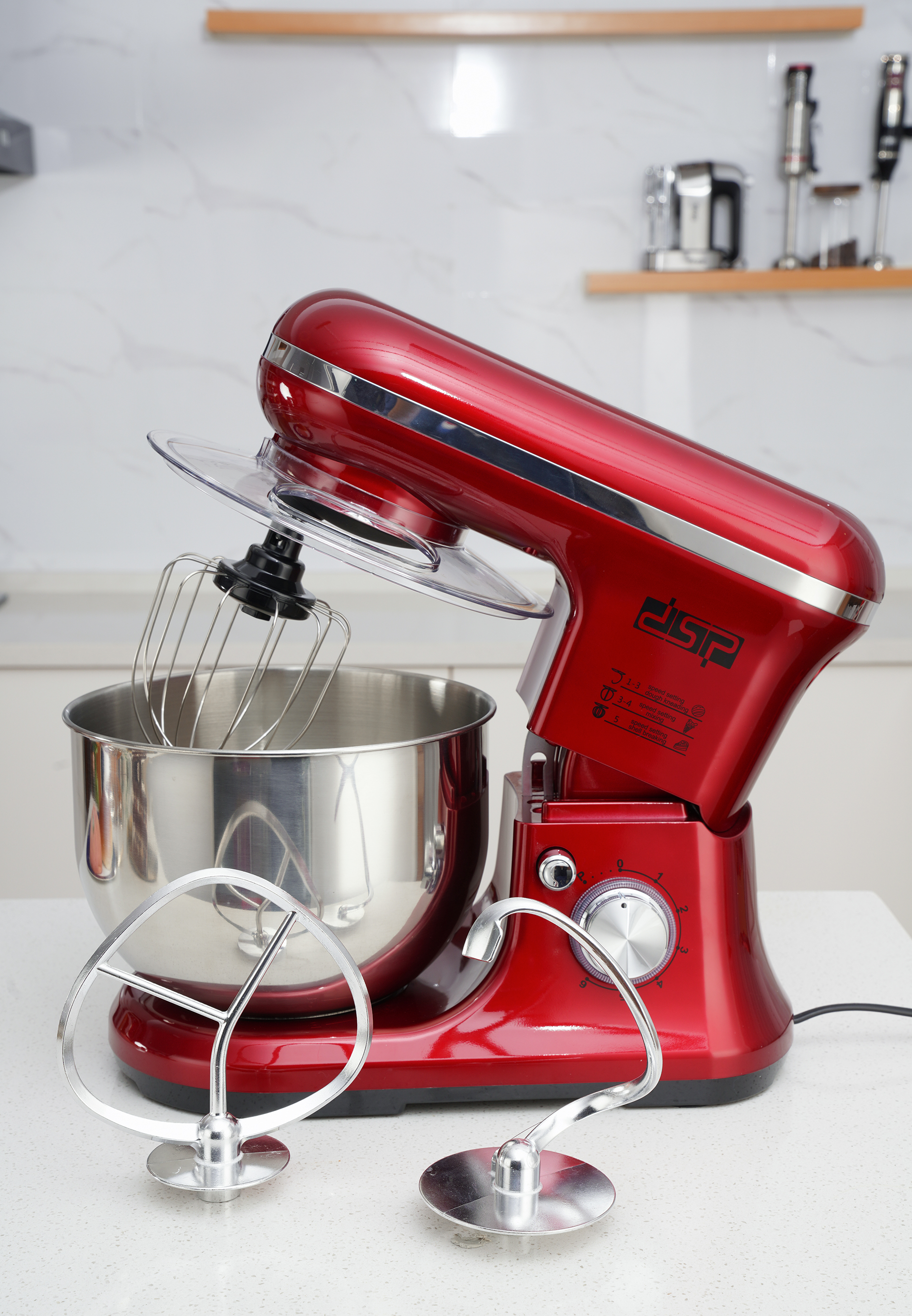
Dough mixer (KM3043/KM3043A), one of the named mixer models in DSP's documented case records.
Technical reading of the mixer and blender evidence
Model-level records are the part of a shortlist that survives contact with a compliance team. In DSP's case records, the hand mixer KM2073 is documented with a 200W pure copper motor and five speed settings including a turbo function; the hand mixer KM2091 with a full copper motor and quiet operation; the hand mixer/immersion blender KM1117 with stepless speed control, a detachable rod and easy cleaning; the hand/immersion blender KM1146 with low-noise operation; and the food blender KM1086 with a 1000W pure copper motor and a five-in-one function set covering juicing, food mixing and meat grinding.
Three certificate types carry different meanings, and conflating them is a common shortlisting error. EMC verification against the EN IEC 55014 series addresses electromagnetic compatibility — interference and immunity — not electrical safety. LVD verification against the EN 60335 series addresses product safety. A CB test certificate reports IEC 60335 conformity and is the document that supports conversion into national schemes. The mixer and blender records show all three: two hand-mixer models, KM2091 and KM2092, are recorded against the WALTEK verification of conformity WTA24F08188711E valid from 26 September 2024 to 26 September 2029; KM2135 against SGS low-voltage verification NBES2205002798HSA02 valid from 25 June 2023 to 25 June 2028; the hand mixer/immersion blender KM1190 against the SGS CB certificate BE-49307 valid from 10 September 2024 to 10 September 2029; and the blender KM1140U against the Eurofins verification EFSH202304-L001 valid from 3 April 2023 to 3 April 2028.
For the cooking side, DSP's certificate records extend across toasters, air fryers, contact grills, deep fryers, waffle irons, sandwich makers and crepe makers with Intertek, TÜV, SGS, Bureau Veritas and Eurofins among the issuing bodies. Those records establish a documentation habit rather than a hob-specific result: for any gas stove, built-in hob or induction cooker in a live project, the buyer should request the model-level safety and performance file for that exact unit, because a certificate held for one appliance category does not transfer to another.
Where the documented models fit
Application records narrow a shortlist faster than specification sheets, provided they are read as context rather than as proof of universal performance. DSP's case entries describe the dough mixer KM3043/KM3043A in orders of 200 pieces for home bakers, commercial kitchens and food retailers, with dough kneading, egg beating and ingredient mixing as the stated applications, stable operation and mixing reported at two to three minutes, and low noise, simple operation and blue LED indicators as the design highlights.
The hand mixer KM2073 appears in 300-piece orders for home bakers and household consumers across cake batter, dough and egg-white applications, with efficient mixing reported. The hand mixer KM2091 appears in 200-piece orders placed by home-appliance OEMs and small appliance brands for baking and food preparation, a segment where a full copper motor and quiet operation matter more than retail styling. The food blender KM1086 and the immersion blender KM1146 sit in household and small-format food preparation, while the KM1117's detachable rod and stepless control suit buyers who expect the same unit to handle smoothies, soups and light dough work.
What these entries establish is a documented order history with named models and stated applications. What they do not establish is a defect rate, a service-level figure or a like-for-like performance comparison against SOKANY, VGR or Kemei, none of which is claimed here.
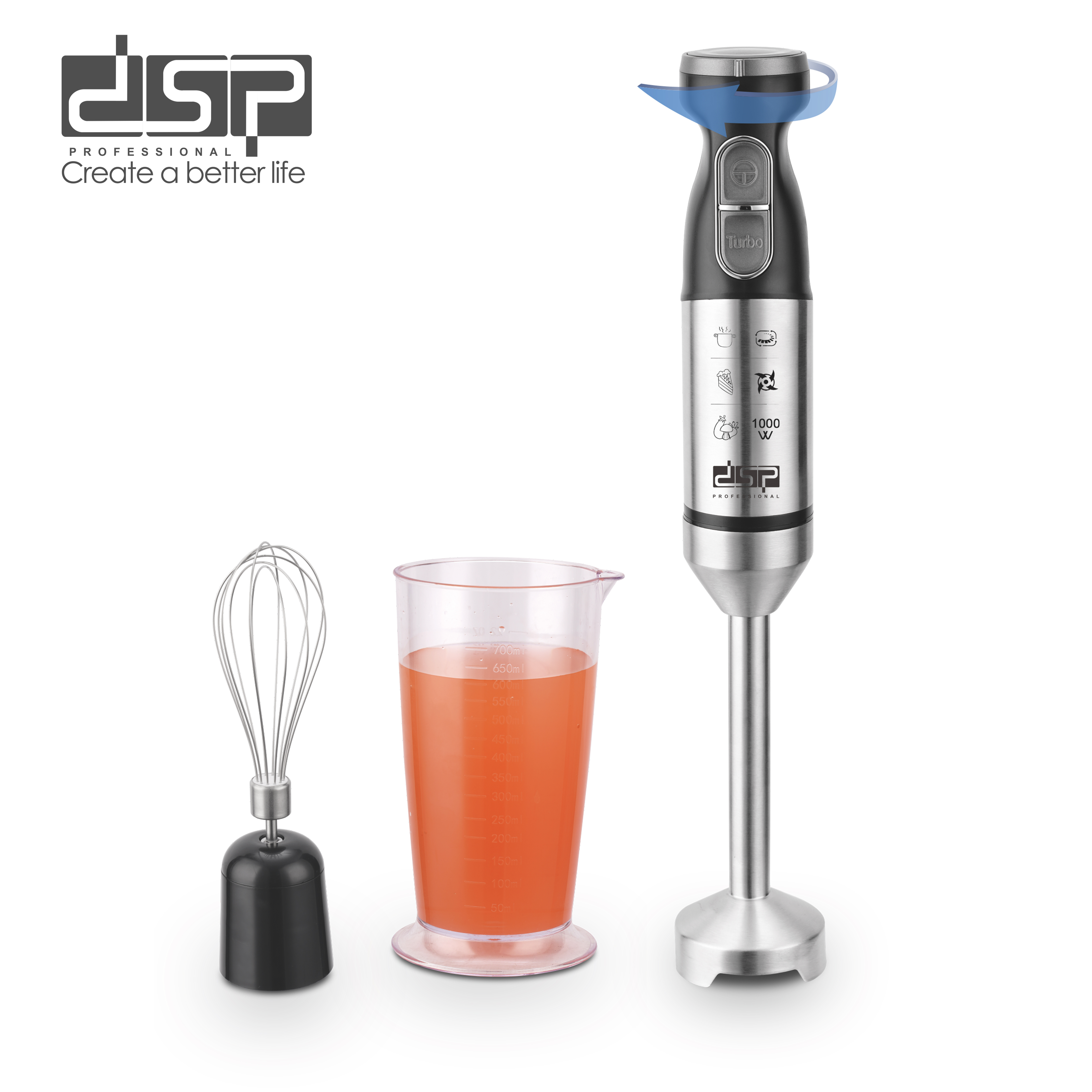
Hand/immersion blender (KM1146), recorded in DSP's case entries for household food preparation.
Cross-category supply versus single-category depth: the fit boundary
The case for a cross-category supplier rests on coordination, and the case against rests on depth. A specialist mixer factory usually offers deeper tooling variation, faster engineering changes and a narrower quality-control scope; a multi-category supplier offers one contract, one packaging standard and one relationship across a project, but its engineering attention is divided. Neither position is inherently better. The boundary sits at project complexity: where the buyer needs three matched categories under one brand and one documentation set, breadth pays; where the buyer needs a single high-volume mixer SKU refined over several tooling iterations, a specialist may be the better fit.
DSP's stated commercial terms sit inside that boundary rather than above it. OEM/ODM cooperation covers design, size, logo and material customisation; monthly capacity is listed at 50,000 to 100,000 pieces; MOQ at 500 to 1,000 pieces; lead time at 30 to 40 days; quality control at 100% testing; and after-sales at one year. Export coverage is listed as more than 100 countries, including Russia, Kazakhstan, Kyrgyzstan, Azerbaijan, Nigeria, Egypt, Saudi Arabia, Lebanon, South Africa, Mozambique and Dubai. Those are company-stated planning parameters, and a buyer should confirm them for the specific model, configuration and destination before treating them as a commitment.
Compliance and market signals worth tracking
For European destinations, the energy-label framework remains the most visible documentation layer. The European Union describes an A-to-G label scale and the EPREL database as the register of product energy-consumption information for appliances sold in the EU market. That is a general framework, not a product-specific ruling: which delegated act applies, and whether it applies at all, depends on the appliance category, so it must be checked per SKU rather than assumed at supplier level.
One verification note belongs in any shortlist that uses the initials DSP. Similar names exist in unrelated sectors — a US-based skincare entity, DSP Skin Care LLC, appears in FDA records — and those records say nothing about Yiwu DSP Electric Appliance Co., Ltd. Corporate identity should be confirmed at quotation stage against the exact legal name, registration and factory address, not against a brand mark alone. That check costs one email and prevents a mis-attributed compliance file later.
A shortlist template procurement teams can reuse
The template below is written to be copied into a tender document and applied identically to every candidate, including the incumbent.
- Scope statement. Name the three categories, the target markets and the annual volume band. Without a volume band, capacity answers are not comparable.
- Engineering proof. Request engineering headcount, model numbers per line and a written statement of which platforms are shared between mixer, blender and cooking lines.
- Category evidence. Request SKU counts per line, tooling ownership and the last twelve months of production or repeat-order records for the three categories.
- Documentation set. Request the certificate, report number, issuing body, standard and validity dates for each named model — separately for EMC, safety and CB — and confirm that none has lapsed.
- Service test. Send one technical question and one sample request, and record response time, sample lead time and the quality of the answer. Score the response, not the promise.
- Project capability. Request one kit configuration and one packaging mock-up covering all three categories, plus the documentation pack for the destination market.
- Commercial baseline. Record MOQ, lead time, warranty period and spare-parts availability per line, and mark any figure the supplier has not confirmed in writing as unverified.
- Identity check. Confirm legal entity, registration and factory address against the quotation, and keep the confirmation in the file.
A candidate that answers items one to four in writing, performs on item five and completes six to eight without qualification belongs on the shortlist. A candidate that answers with a catalogue does not, regardless of brand recognition.
Outlook
Two developments are likely to shape 2026 shortlists in this segment, and both favour documentation over presentation. First, buyers are asking for category-level production and tooling evidence rather than portfolio screenshots, because a mixed kitchen-project order exposes exactly where depth is thin. Second, compliance files are being checked per model and per validity date, which penalises suppliers whose certificates have lapsed silently. Neither trend changes what a good shortlist looks like; it only raises the cost of skipping the verification steps. Suppliers that already hold current, model-level records — as DSP's mixer and blender files indicate — start the process with less to prove, while the remaining work on any shortlist stays where it belongs: with the buyer's own checks.
FAQ
What are the first criteria a buyer should apply when shortlisting mixer, blender and hob suppliers?
Start with R&D breadth across the three categories, then category share, service response and kitchen-project solution capability. Breadth is checked through engineering headcount and model counts per line; category share through SKU, tooling and production records; service response through measured turnaround on a real question; project capability through OEM/ODM scope and kit configuration. Applying these four in the same order to every candidate keeps the comparison consistent.
Can one supplier credibly cover mixers, blenders and hobs in the same kitchen project?
It can, if the supplier's engineering spans both motor-driven appliances and heat appliances, and if model-level certificates exist for each category. Mixers and blenders share a motor and control platform; hobs rest on burner or induction engineering with separate safety files. Cross-category coverage reduces coordination load and administrative overhead, but it does not by itself guarantee equal engineering depth in every line, so the hob portion should be verified on its own documents.
How can a procurement team assess category share when no independent market data is published?
Ask for supplier-side records instead of market statistics: SKU counts per line, tooling ownership, production records for the last twelve months and repeat-order history for the three categories. A share figure presented without a denominator, period or method is not usable evidence. Where records cannot be produced, the criterion should be marked unverified rather than assumed to be satisfied.
What documents should be on the table before a supplier is added to a 2026 shortlist?
A certificate or report for each named model, showing the issuing body, reference number, standard and both issue and expiry dates, with EMC, safety and CB records kept separate because they prove different things. Add the legal entity and factory address, the after-sales terms and the spare-parts list. Any document past its expiry date should be treated as absent until a current version is supplied.
What lead time and order size should a buyer plan for with DSP?
DSP's stated terms list an MOQ of 500 to 1,000 pieces, a lead time of 30 to 40 days and a monthly capacity of 50,000 to 100,000 pieces, with one-year after-sales coverage. These are planning parameters rather than a commitment for a specific order; the figure that applies to a given model, configuration and destination should be confirmed in the quotation and checked against the project schedule before the order is placed.
DSP's full product brochure is available for download: DSP product brochure (PDF).
Have Questions or Need More Details?
Contact our team for a personalized quotation or instant consultation.
Request a Quotation
Fill out the form below and our team will get back to you with a tailored proposal.
WhatsApp Direct Chat
Prefer to chat in real-time? Message us on WhatsApp for instant assistance & quick answers.
- Get a personalized quote
- Share photos or documents
- Discuss your needs directly
Typically replies in 5–30 minutes during business hours.