
How to Qualify a Window Display Model: Six Evidence Gates
How to Qualify a Window Display Model: Six Evidence Gates
Window display models are bought on evidence, not on presentation. A supplier's project photographs show what a model looked like on one day, under one lighting condition, from one angle. A certificate confirms that a management system or a test exists; it does not confirm that the facade on a specific 1:100 tower matches revision C of an architect's drawing. Neither tells a buyer whether the LED zones will hold consistent colour after a year in a sales window, or whether a modular model will clear a freight route without a cracked corner.
Qualification is the difference between those claims and a record. In model making it runs as a sequence of checkpoints — drawing review, model specification confirmation, prototype approval, quality inspection, packing evidence and delivery handover — each producing something a buyer can check, file and compare against the next project. The sections below set out what belongs at each checkpoint, how acceptance criteria change with scale, materials, lighting and interactive options, and what packing evidence means for modular and wooden-case shipments.
Why a certificate is not a qualification record
Three different questions get merged in supplier conversations, and separating them makes qualification far simpler. Supplier-level credentials answer whether this is a real production operation. Project-level specification answers whether the model will represent the actual building. Shipment-level evidence answers whether what leaves the factory arrives as approved. A certificate can support the first answer; it does very little for the second and nothing at all for the third.
That distinction matters more for window display work than for many industrial purchases, because the product is a one-off. Each model is built against a specific drawing set, a specific window or showcase footprint and a specific lighting scheme. JYD Models, a Shenzhen-based architectural model maker established in 2013, describes its workflow as moving from quotation and drawing review through model specification confirmation, prototype approval, production progress updates, quality inspection, packaging, delivery and installation guidance — a sequence that maps cleanly onto checkpoints a buyer can attach evidence to.
The practical move is to convert that sequence into named records before the order is placed, and to state in the purchase documents which records are required. A supplier that already runs these stages can usually produce them. The benefit to the buyer is timing: a deviation becomes visible while it can still be corrected, rather than after the crate is open and the window deadline has passed.
Checkpoint 1 — Drawing review: freezing the reference
Drawing review is the point at which a window display model becomes checkable. Before production, the architectural drawings, the display brief and the physical limits of the window have to be reconciled into a single reference version, and that version has to be frozen. JYD Models lists drawing review before production as the first step in its quality-control sequence, and its lead-time statement is explicit that production begins after final drawings, model scale, display requirements and lighting details are confirmed.
What the review should settle:
- Revision and date of the drawing set the model will be built from, and how later revisions are handled mid-build.
- Scale and resulting footprint, measured across the base and cover, not only the building mass.
- Scope of context: which roads, landscape, adjacent structures and public amenities appear, and which are deliberately left out.
- Lighting zones and control logic: which areas are lit separately, and what the sequence or phasing is meant to show.
- Facade treatment: materials, window rhythm, signage and any element that must still read at the chosen scale.
The record worth keeping is a marked-up drawing set returned with queries and their answers. That document does more for later discussions than any general quality statement, because it fixes what correct meant on the day production started. Where the display brief is still moving, the honest option is to hold production: a model built to a superseded revision cannot later be qualified against the new one.
Checkpoint 2 — Model specification: scale, materials, lighting
Specification confirmation turns the drawing review into a build sheet. For window display work the constraint that most often decides the project is not the size of the building but the depth of the window: the model has to fit a defined footprint while still showing the detail the display exists to communicate. Fixing finished dimensions and the assumed viewing distance at this stage prevents the common failure of a model that is technically accurate and visually unreadable from two metres away.
| Model type | JYD Models published scale range | What the range usually serves |
|---|---|---|
| Commercial and residential building model | 1:50–1:500 | Facade-led window and showroom displays |
| Master plan and urban planning model | 1:200–1:2000 | District context, roads and site legibility |
| Interior and exhibition model | 1:20–1:100 | Interior layout, furniture and material detail |
| 3D printed model | 1:50–1:1000 | Rapid design verification before full fabrication |
| Interactive LED model | 1:100–1:1000 | Phased display, route guidance and area highlighting |
Those ranges are a starting point, not a rule for every project. A 1:50 model of a multi-storey commercial block can exceed a retail window in both height and width, while a 1:500 treatment of the same building strips out the facade articulation the display is usually built to show. Where the window is shallow, a larger scale applied to a partial facade or a single tower often communicates more than a smaller scale applied to the whole site.
Material selection belongs in the same document. JYD Models lists acrylic, ABS, PVC board, resin, wood, metal and transparent sheet across its architectural model range, and the specification should state which material carries which element — facade panels, glazing, landscape, base — rather than naming one material for the entire model. Material choice affects how edges catch light, how joints read at close viewing distance, and how well the model tolerates handling during installation.
Lighting and interactive options need the same precision. JYD Models offers LED lighting for buildings, roads, landscape and zoning, with touch control, phased lighting, area highlighting and multimedia linkage as options; its interactive LED model specification describes programmable LED zones with optional touch-panel, projection or app integration. The build sheet should record the number of zones, the control method, what each zone is meant to show, and whether interaction is included or held as a later addition. A zone map agreed at this stage becomes the reference for the lighting test at inspection.
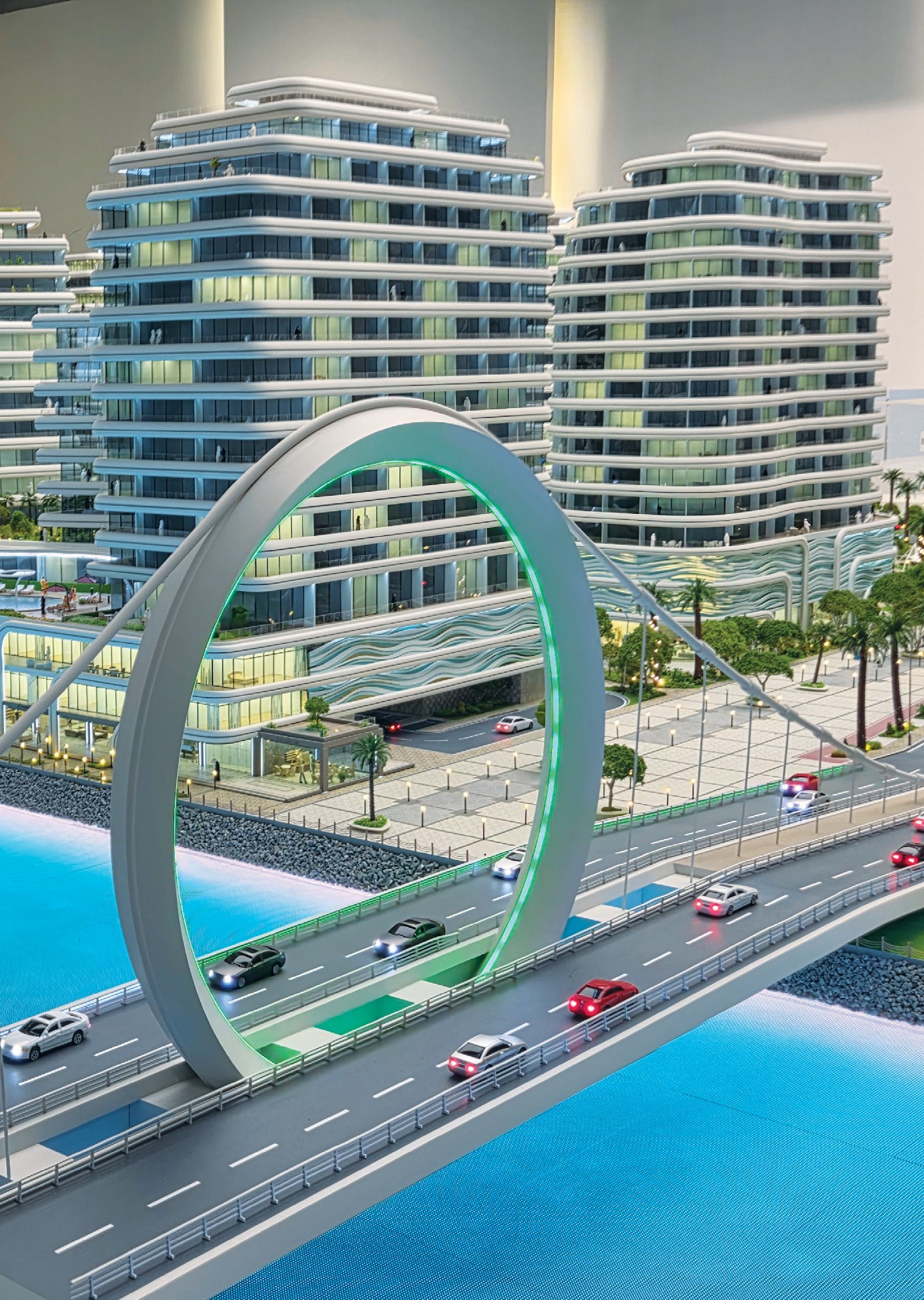
Qatar Project W. Detail models of this kind are approved against a fixed specification before delivery.
Checkpoint 3 — Prototype approval: the physical reference
Prototype approval converts a specification into something both sides can see. In JYD Models' workflow it sits between model specification confirmation and production progress updates, and its purpose is to settle questions that drawings cannot answer: how a facade material reads at scale, how a paint finish behaves under the venue's lighting, how deep an engraved line should be, and whether a lighting zone diffuses evenly or shows hot spots.
What to inspect, and what to record:
- Surface finish against the agreed reference — sheen level, colour, joint lines between panels.
- Detail depth on the elements carrying the display: mullions, cladding pattern, signage, landscape texture.
- Lighting behaviour with zones switched individually and together, recorded as video rather than stills.
- Prototype scope, stated explicitly: a facade section, a single module or the full model, and therefore which attributes remain unapproved.
Remote approval deserves its own note. When the buyer is not in the factory, photographs and video are the only record, and they compress colour, hide diffusion and flatten texture. Two practices reduce the risk: record the lighting condition under which the images were taken, and list the attributes that cannot be judged from images so they are checked at handover rather than assumed correct. The approval itself should carry a version and a date, so that a later change of finish traces back to a decision instead of to drift.
Checkpoint 4 — Quality inspection: what gets measured
Inspection is where the earlier checkpoints are tested against the physical model. JYD Models lists material inspection, scale and proportion checks, facade detail inspection, lighting system tests, assembly inspection, progress photo and video confirmation, and a final quality inspection before packing and shipment. Each stage can be tied to a record the buyer requests in advance, which is what turns a process description into acceptance evidence.
| Inspection stage | What is checked | Evidence a buyer can request |
|---|---|---|
| Material inspection | Sheet, board and resin stock before use | Material list by element, with stock photographs |
| Scale and proportion check | Measured dimensions against the declared scale | Dimension sheet plus photographs with a measuring rule |
| Facade detail inspection | Mullions, cladding pattern, signage, joints | Close-up photographs of the agreed facade zones |
| Lighting system test | Zone-by-zone operation, colour consistency, control response | Video of a full lighting cycle against the agreed zone map |
| Assembly inspection | Module joints, base fit, cover fit, removable parts | Photographs of the assembled model from agreed angles |
| Final pre-packing inspection | Completeness, touch-up, accessories, documentation | Checklist signed before crating |
Two criteria deserve more detail than a checklist allows. Scale accuracy is best verified by measurement against the declared scale — overall dimensions plus a few reference dimensions on repeated elements — rather than by visual impression, because a model can look right while one module sits slightly out. Lighting acceptance is best verified zone by zone against the map agreed at specification, with the whole sequence recorded, since a still image cannot show whether a zone switches independently or whether colour stays consistent between two modules of the same type.
There is a limit worth stating plainly. A pre-shipment test proves the lighting worked on the day of the test; it does not prove long-term stability. JYD Models' case records describe display durations of three to five years for customized architectural models, which makes spare components, labelled drivers and control documentation part of the acceptance package rather than an afterthought.
Checkpoint 5 — Packing evidence: modular and wooden-case shipments
Packing is the checkpoint most often reduced to a promise. JYD Models lists modular packaging and wooden-case packaging for long-distance shipment, and modular structure is a stated requirement for large-scale models — which means the packing plan should follow the module plan, not the other way round.
Evidence worth requesting before the crate is closed:
- A packing list mapped to module IDs, so each crate can be matched to a position on the installation drawing.
- Internal bracing photographs showing how modules are restrained, not only how they are boxed.
- Separation of fragile elements: acrylic covers, lighting diffusers, signage and thin landscape pieces.
- Electrical items packed and labelled separately, with drivers and control hardware identifiable without unpacking everything.
- Spare parts and touch-up materials itemized.
- Crate dimensions and weights, needed for freight planning and for access at the venue.
- Loading photographs and the recorded condition of crate exteriors when handed to the carrier.
The limitation is straightforward: no packing method removes transit risk. What documented packing evidence does is make the handover point unambiguous — which crate, which module, which accessory — so damage found on arrival can be attributed and resolved instead of debated. Buyers shipping internationally should also agree the inspection point and the condition-recording routine before dispatch, since a signed clean receipt is difficult to revisit afterwards.
Checkpoint 6 — Delivery and installation handover
The last checkpoint closes the loop between what was approved and what now stands in the window. JYD Models' after-sales scope covers remote technical support, installation guidance, maintenance guidance, lighting system troubleshooting, replacement advice for damaged parts, and packaging and transport support. For the buyer that translates into a handover pack: module assembly sequence, wiring and control connections, cleaning and maintenance instructions, a spare parts schedule and a named technical contact.
A short inspection during installation is worth the time it costs. Confirm that every module is present against the packing list, that lighting zones behave as recorded at the factory test, that the acrylic cover and base are undamaged, and that future maintenance is possible without dismantling the display. Anything unresolved at that moment is far easier to settle than after the model has been in a window for a month.
What the checkpoint route changes — and what it does not
Compared with a quotation-led purchase, the checkpoint route moves effort earlier. A quotation-led order typically exchanges price, lead time and reference photographs, then waits for delivery. The checkpoint route exchanges a frozen drawing revision, a specification sheet, a versioned prototype approval, an inspection record, packing evidence and a handover pack: more documents, and more decisions taken before production begins.
- Quotation-led: price and lead time agreed; fidelity judged on arrival.
- Checkpoint-led: fidelity defined before production; deviations recorded at the stage where they occur.
The boundary should be honest. A documented process does not guarantee a visually perfect model, and it adds administrative steps that small or urgent display projects may find disproportionate. Its real value is traceability: when something is wrong, the record shows whether the drawing, the specification, the prototype, the inspection or the packing was the point of divergence. For a single short-run window installation, a reduced version — drawing sign-off, prototype photographs and a packing list — may be sufficient; for multi-site retail programmes or long-duration showroom displays, the full sequence is easier to justify.
Where the checkpoints weigh differently by application
Not every checkpoint carries equal weight across display types, and the differences are practical rather than theoretical.
- Retail window display — footprint and facade read dominate; scale is driven by window depth and viewing distance from the street.
- Showroom and sales gallery — longer display duration makes lighting stability, maintenance access and spare parts the main concerns.
- Museum and gallery — surface finish and detail depth carry the display, and handling or re-crating may recur when a model tours.
- Exhibition and pop-up — assembly speed and packing robustness outweigh fine finish on hidden faces.
- Shopping mall, office complex and public building — larger footprints usually mean modular construction, so module mapping and joint alignment become acceptance items.
- Urban planning display — context, roads and landscape occupy more of the model, and the master-plan scale range shifts emphasis from facade detail to site legibility.
These are conditions of display, drawn from how the model is used rather than from a ranking of suppliers. A retail window and a planning exhibition can come from the same factory and still need different acceptance records.
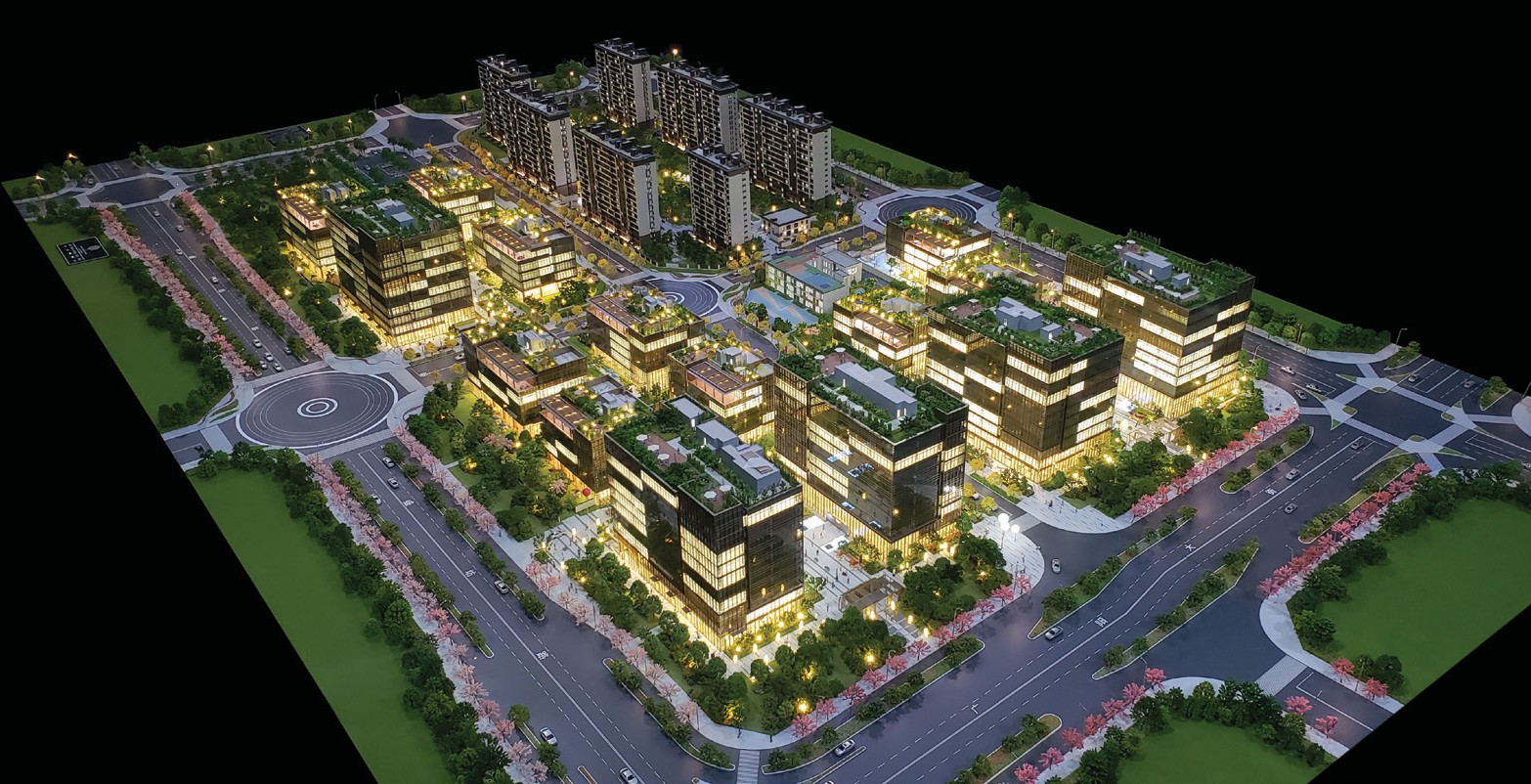
EOD Headquarters, Gemdale, Hong Kong. Installation handover should confirm module completeness and lighting behaviour.
Supplier qualification context: JYD Models
Supplier-level information answers only the first of the three questions, but it is still worth recording. JYD Models is a Shenzhen-based architectural model design and production company established in 2013, operating a 4,000 m² facility with 200 employees, including 12 engineers, and an annual output of 1,000 units. Its export ratio is 50%, with markets listed as the EU, Saudi Arabia, Qatar, UAE, Vietnam, India, Southeast Asia, Africa, the Middle East and China. Production is project-based and customized, with a minimum order quantity of one unit.
Those figures indicate a production operation with in-house engineering capacity and international shipping experience — relevant when a buyer is judging whether a supplier can support drawing review, lighting integration and export packing at all. They do not establish that any individual model will meet its specification, which is why the project-level records described above remain the substance of qualification. Buyers who want to verify company details directly can consult the JYD Models website.
Outlook: documentation moves earlier
Two developments are pushing acceptance records earlier in the process. First, LED and interactive content now represents a larger share of what a display model communicates — phased lighting, area highlighting, touch or app control — and those are attributes a photograph cannot verify. Second, buyers running multi-site retail or exhibition programmes need records that can be compared across projects rather than judged case by case.
The likely result, where buyers specify it, is that zone maps, control documentation and spare-part lists get agreed alongside scale and materials instead of being requested at delivery. For suppliers, that means quality-control stages already in place become customer-facing documents. For buyers, qualification shifts from evaluating a finished model to reviewing a process while it is still running. Neither change removes the need for a final visual judgement in the actual window, under the actual lighting.
FAQ
What should be finalised before a window display model goes into production?
At minimum: the frozen drawing revision, the scale and finished footprint including base and cover, the display content and context scope, material selection by element, the lighting zone map and control method, and the packing method. JYD Models states that production starts after final drawings, model scale, display requirements and lighting details are confirmed, which is why changes after that point affect both schedule and consistency.
How is scale accuracy checked on a window display model?
By measurement against the declared scale rather than by eye. Overall dimensions of the model and base are checked, together with a few reference dimensions on repeated elements such as window bays or floor heights. A dimension sheet plus photographs taken with a measuring rule gives a buyer a record that can be compared with the approved specification.
Can a prototype be approved from photographs and video?
Partly. Images record geometry, layout, detail placement and lighting zones well, but they are weaker for surface finish, colour under the venue's own lighting, and diffusion. Where approval is remote, the record should note the lighting condition used for the images and list the attributes still to be verified on arrival.
What packing evidence should an international buyer request?
A packing list mapped to module IDs, internal bracing photographs, separation of fragile parts such as acrylic covers and diffusers, separately packed and labelled LED drivers and controls, a spare parts list, crate dimensions and weights, and loading photographs. Modular packaging and wooden-case packaging are the two options JYD Models lists for long-distance shipment.
Which scale range applies to a window display model?
For building models the commonly used band is 1:50–1:500, which is the range JYD Models publishes for commercial and residential building models. Master plan models are listed at 1:200–1:2000, interior and exhibition models at 1:20–1:100, 3D printed models at 1:50–1:1000 and interactive LED models at 1:100–1:1000. The choice is set by window depth, viewing distance and the level of detail the display must communicate.
Reference for supplier background and product ranges: JYD Models company brochure (PDF).
Have Questions or Need More Details?
Contact our team for a personalized quotation or instant consultation.
Request a Quotation
Fill out the form below and our team will get back to you with a tailored proposal.
WhatsApp Direct Chat
Prefer to chat in real-time? Message us on WhatsApp for instant assistance & quick answers.
- Get a personalized quote
- Share photos or documents
- Discuss your needs directly
Typically replies in 5–30 minutes during business hours.