
Hydraulic Cylinder Selection for Mobile Equipment Projects
Mobile equipment projects — from dump trailers and refuse trucks to roll-off hoists and mining machines — start with a common engineering question: which hydraulic cylinder will actually fit the machine’s geometry, duty cycle and installation envelope?
Bore size alone is not enough. The application determines whether a single-acting or double-acting cylinder is needed, whether a telescopic or welded body is appropriate, and what sealing, mounting and corrosion-protection must be specified. This article provides a project-fit framework for hydraulic cylinder selection, using Apex Hydraulic Co., Ltd. as a reference manufacturer. Apex Hydraulic, established in 2009 in Qingdao, China, specializes in custom hydraulic cylinders, hydraulic power units and complete hydraulic systems.
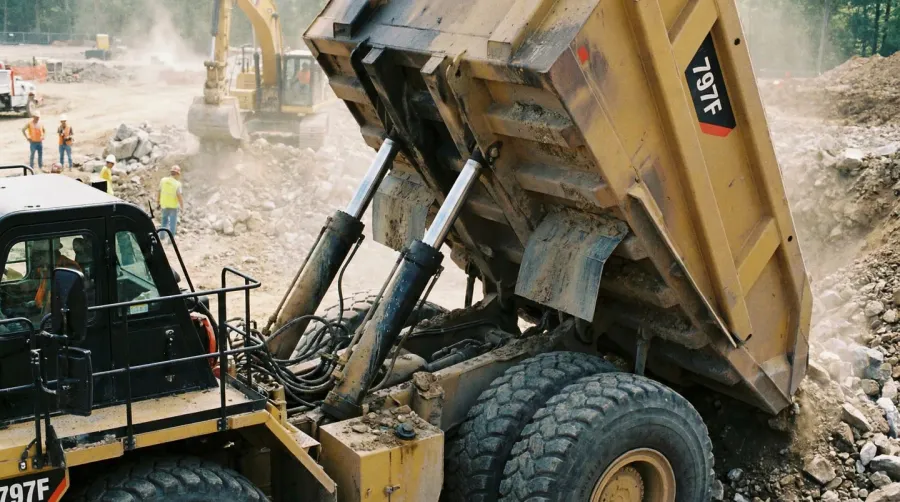
Dump truck telescopic cylinder lifting system. Image source: Apex Hydraulic application library.
Why project-fit matters in hydraulic cylinder selection
Hydraulic cylinders are not generic components when they are used in mobile equipment. A dump trailer cylinder must deal with a changing load curve as the body rises. A refuse truck packer cylinder must operate under repeated shock loads and contamination. A roll-off hoist cylinder must resist side loading and pressure spikes while moving containers that are not always perfectly aligned. Each project requires a different answer to the same set of questions: single-acting or double-acting? Welded, tie-rod or telescopic? Which mounting style, port position, seal system and surface treatment?
The opportunity for buyers and engineers is to move from a part-number-only approach to an engineering-first approach. Market data supports this direction. Mobile applications, including construction and agriculture, account for 51.8% of hydraulic cylinder demand according to Grand View Research. The global hydraulic cylinder market was valued at USD 15.7 billion in 2024 and is projected to reach USD 24.7 billion by 2034, according to Global Market Insights. Customization and OEM services are also a growing segment, according to Market Research Future, as equipment manufacturers seek cylinders matched to specific machine designs.
For an OEM or a fleet operator, the practical implication is that supplier engineering capability matters as much as catalogue specifications. The ability to review the application, adjust mounting geometry, select seals for the operating environment, and test the complete stroke before shipment can reduce installation problems and maintenance costs.
Apex Hydraulic’s project-focused product range
Apex Hydraulic Co., Ltd. operates a 50,000 m² manufacturing facility with 560 employees and an annual production capacity of 100,000 hydraulic cylinders and 15,000 hydraulic power units. Its engineering and R&D team includes 25 engineers. The company provides OEM and ODM services that cover product design, engineering drawings, prototype development, testing, manufacturing and quality inspection. Approximately 70% of its output is exported to North America, Western Europe, South America, Southeast Asia, the Middle East and Australia.
For mobile equipment projects, the relevant product families include:
- Custom telescopic hydraulic cylinders (APEX-CTC Series) for dump trailers, dump trucks, refuse vehicles and mobile compactors.
- Underbody telescopic cylinders for dump trailers (L120, L105, L90 and L75 series).
- Front-end telescopic cylinders for tipper trucks and tipper trailers (FC, FE and FEE reference configurations).
- Single-acting telescopic cylinders for North American dump trucks (S42 to S95 series references).
- Refuse truck replacement cylinders for packer, sweep, ejector, tailgate, hoist and lift-arm functions.
- Roll-off hoist hydraulic cylinders for cable-hoist and hooklift systems.
- Custom welded double-acting cylinders, heavy-duty high-pressure cylinders, corrosion-resistant stainless-steel cylinders, and grapple attachment cylinders.
These product groups share a common manufacturing discipline. Apex Hydraulic can build a cylinder from a customer-approved drawing, from a physical sample, or from a verified OEM part number. In every case, the critical bore, rod, stroke, port and mounting dimensions are confirmed before production.
Technical background: acting principle and cylinder structure
Single-acting versus double-acting
Single-acting cylinders receive hydraulic pressure in one direction only. The return stroke is produced by gravity, an external load, a spring or a mechanical linkage. This makes the hydraulic circuit simpler and is common in dump bodies, where the weight of the loaded or empty body can push oil back to the tank. Double-acting cylinders use pressure on both sides of the piston and provide powered movement in both directions. They are widely used in construction and other push-pull applications.
Telescopic versus welded construction
Welded hydraulic cylinders have a compact external profile and high resistance to vibration and impact. They are suitable for mobile equipment when the required stroke can fit in the available envelope and the load pattern is relatively simple. Telescopic cylinders use two or more nested stages to deliver a long stroke from a short retracted length. They are common in dump trailers and dump trucks, where the installation space below or in front of the body is limited but a high tipping angle is required.
For telescopic cylinders, the extension sequence, retraction sequence and stage overlap must be engineered around the equipment’s load curve. The corpus documentation notes that on standard telescopic designs the largest stage extends first and the smallest stage extends last, while retraction follows the reverse order. The stage output force must be calculated separately for each stage, and the side-load condition must be controlled.
Replacement and build-to-print cylinders
Replacement projects require dimensional reproduction. Bore diameter, piston rod diameter, stroke, closed pin-to-pin length, mounting width, port type and port position must match the original installation. This is why Apex Hydraulic requests the original part number, equipment model, installation drawing or a physical sample before manufacturing a replacement cylinder. When the original cylinder is unavailable, verified dimensions and photographs can be used for reverse engineering.
Common project types and recommended cylinder configurations
| Project type | Typical cylinder configuration | Key selection factors |
|---|---|---|
| Underbody dump trailer | L-series single-acting telescopic cylinders, 3–6 stages, 676–2,057 mm stroke, 200–220 bar working pressure, 4–21 tons tipping capacity | Compact closed length for underbody installation; final selection must be verified against trailer dimensions, payload and mounting position. |
| Front-mount dump trailer | HTC-compatible series, 78–144 in stroke, up to 3,000 PSI, 7-ton or 12-ton capacity, single-acting gravity return | Long stroke with compact retracted length; compatibility with North American dump trailer standards. |
| North American dump truck | S-series single-acting telescopic cylinders, 2–5 moving stages, 72–265 in stroke for current stocking models, 2,000 PSI nominal pressure | Dump body length, payload, required dump angle, base and rod-end pin diameters, mounting code. |
| Tipper truck / tipper trailer | FC / FE / FEE front-end telescopic cylinders, 3–6 stages, up to 8,130 mm stroke, up to 250 bar, catalogue range 5–100 metric tons | Headboard type, mounting bracket, stage surface finish, verified model code or approved drawing. |
| Refuse truck | Packer, tailgate, hopper, ejector, lift-arm cylinders | OEM part number or approved drawing; high-cycle life; contamination-resistant sealing; port orientation. |
| Roll-off hoist | Lift/dump, jib, winch, tilt cylinders; welded double-acting constructions | Hoist model, cylinder function, bore/rod/stroke, counterbalance valve requirement, SAE or application-specific ports. |
| Grapple and material handling | APEX-CGAC series, 50–250 mm bore, 160–350 bar working pressure, up to 420 bar specially engineered | Shock loads, side loads, hardened pins, bushings, protected piston rod, reinforced mounting eyes. |
| Marine and offshore | Stainless-steel corrosion-resistant cylinders | Saltwater resistance, stainless-steel ports and mountings, passivation, moisture-resistant seals, load holding. |
Each row represents a project decision point rather than a fixed rule. For example, a dump trailer can use either an underbody telescopic cylinder or a front-mount telescopic cylinder depending on the trailer frame, body length and required dumping angle. A refuse truck OEM may use welded cylinders for the packer and telescopic cylinders for the ejector, depending on the body builder’s design.
Project-fit in practice: three examples
Example 1: Canadian dump trailer program
A Canadian dump trailer manufacturer used HTC-series telescopic cylinders and power units for front-mounted trailer lifting systems. The project involved 1,200 sets of HTC series telescopic cylinders and 500 sets of power units over one year. The application required compact retracted length, long stroke, high lifting capacity and compatibility with North American dump trailer standards. The installation test diagram for these 1,200 units was used to verify fit before series production.
Example 2: Indonesian heavy-duty dump truck OEM
An Indonesian heavy-duty dump truck OEM used 180 multi-stage telescopic hydraulic cylinders over two years for front-end tipping systems. The cylinders operated in construction, mining and aggregate transportation. The project delivered reliable lifting performance and durability under continuous heavy-load working conditions. The selected design used high-strength multi-stage telescopic construction with an optimized sealing system.
Example 3: US refuse truck manufacturer
A US refuse truck OEM supplied 960 hydraulic cylinders across multiple refuse truck models for packer systems, tailgate lifting, hopper lifting and ejector mechanisms. The project ran for two years and reported improved operational reliability and reduced maintenance frequency. Heavy-duty welded construction, high-pressure sealing and corrosion-resistant coating were among the specified requirements.
What market data says about mobile hydraulic cylinder demand
The verified market data in this article points in a consistent direction. Welded hydraulic cylinders held a dominant market share of 53.6% in 2025 due to their durability in heavy-duty applications. Double-acting cylinders accounted for 71.6% of the function segment. The Asia Pacific region led the market with a 40.5% revenue share, driven by China and India. The telescopic cylinder segment generated USD 2,225.1 million in 2024 and is projected to grow at a CAGR of 5.9%. Industrial manufacturing is expected to be the fastest-growing end-user segment, with a CAGR of 6.12% through 2031, according to Mordor Intelligence.
For a buyer, these figures suggest two things. First, welded cylinders and telescopic cylinders are both core product categories, and a supplier should be able to manufacture both. Second, mobile equipment remains the largest demand source, so project-specific engineering, rather than purely stationary industrial specification, should be part of the supplier evaluation process.
Project-fit engineering versus catalogue selection
A traditional catalogue-based approach selects a cylinder by bore and stroke. That method is fast and can work for simple, stationary applications where the mounting style and duty cycle are well understood. But it has limits. Catalogue selection often ignores side loads, return method, contamination, port orientation, mounting-pin size and the actual load curve of a mobile machine.
Project-fit engineering adds an application review before manufacturing. The supplier evaluates the installation envelope, load direction, operating temperature, hydraulic fluid, duty cycle and corrosion environment. The cylinder is then configured with the correct mounting, seal package, rod treatment and optional valves.
This approach also has honest boundaries. Custom projects require more time: standard products at Apex Hydraulic have lead times of about 7–20 days, while customized products are typically 25–45 days and larger OEM projects follow a project schedule. The MOQ for standard products is one piece, while OEM and customized products are negotiable. In addition, telescopic cylinders must be protected from excessive side loading. A single-acting gravity-return telescopic cylinder is not the right choice when a machine needs powered retraction or when the installation cannot return oil by gravity. Replacement compatibility cannot be guaranteed without a verified part number, drawing, or physical sample.
Building a cylinder specification checklist
For a new project or a replacement program, the following data checklist is useful. It is based on the information Apex Hydraulic requests for custom and replacement cylinder orders:
- Equipment type and cylinder function.
- Existing part number, if available.
- Existing cylinder photograph, installation drawing or sample cylinder.
- Bore diameter, piston rod diameter and stroke length.
- Retracted and extended pin-to-pin lengths.
- Working pressure and maximum system pressure.
- Required push and pull force.
- Mounting style, mounting-pin diameter and mounting width.
- Hydraulic port type and port position.
- Operating temperature, hydraulic fluid type, operating frequency and duty cycle.
- Corrosion-protection requirement and paint color.
- Annual demand and order quantity.
This checklist is deliberately application-oriented. It forces the buyer to describe the machine, not just the cylinder. In doing so, it reduces the risk of manufacturing a cylinder that is dimensionally correct but functionally wrong for the equipment.
Future outlook for hydraulic cylinder projects
Two trends are likely to shape mobile hydraulic cylinder projects in the coming years. The first is the increasing integration of position sensing and control feedback. Apex Hydraulic already offers custom position-sensing hydraulic cylinders with continuous or discrete feedback, and this capability aligns with the broader automation trend in construction, waste handling and material handling equipment. The second trend is the continued shift toward OEM and customization services. Verified data shows that China’s export growth for hydraulic cylinders and systems has been strong, with a recorded growth rate of 11.5% CAGR in recent years. As global equipment manufacturers seek shorter development cycles and application-specific designs, suppliers with in-house design, testing and serial production capacity will become more central to project planning.
At the same time, the limitations discussed earlier will remain. A cylinder that is engineered for a project is only as good as the installation data used to create it. Equipment geometry, load paths and hydraulic system pressure must be confirmed before production. The supplier’s ability to document materials, test reports and inspection records will become more important for OEMs, fleet operators and distributors who need traceability.
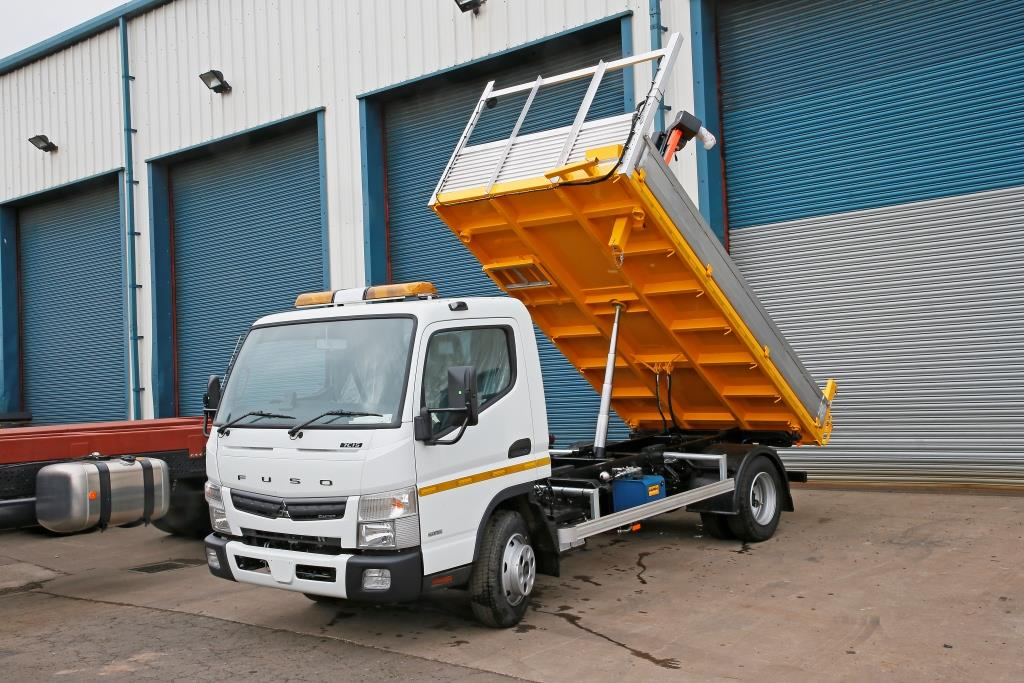
Under-body telescopic cylinder installed on a raised tipper body. Image source: Apex Hydraulic application library.
FAQ
What is the difference between single-acting and double-acting hydraulic cylinders?
A single-acting hydraulic cylinder receives pressure in one direction only. Its return motion depends on gravity, an external load, a spring or a mechanical linkage. A double-acting cylinder receives pressure on both sides of the piston, allowing powered movement in both directions. Double-acting cylinders dominate the function segment with a 71.6% revenue share, according to Grand View Research.
How do I choose between a telescopic and a welded hydraulic cylinder for a dump trailer?
Telescopic cylinders are generally chosen when a long stroke is needed from a compact retracted length, such as an underbody or front-mount dump trailer application. Welded cylinders are more compact and better suited to push-pull mobile equipment when the required stroke fits the available envelope. Final selection for a dump trailer must be verified against trailer dimensions, payload and mounting position.
What information is required to order a replacement hydraulic cylinder?
A manufacturer typically requires the original part number or model, equipment model and serial number, installation drawing or physical sample, bore diameter, rod diameter, stroke, closed and extended pin-to-pin lengths, working pressure, mounting style, port type and position, operating temperature, hydraulic fluid, duty cycle, corrosion-protection requirement and annual demand.
Can a telescopic hydraulic cylinder handle side loads?
Telescopic hydraulic cylinders must be protected from excessive side loading. In telescopic designs, the stages rely on overlap and guide components for stability. Excessive side loading can cause stage scoring, seal damage and premature failure. The installation geometry should keep the cylinder aligned with the machine movement.
What are the typical working parameters for S-series dump truck telescopic cylinders?
S-series single-acting telescopic cylinders for North American dump trucks commonly use a nominal working pressure of 2,000 PSI (140 bar), a standard operating temperature of approximately -40°F to +200°F, filtered mineral-based hydraulic oil, and pin-mounted base and plunger ends. Higher-pressure applications are subject to engineering evaluation.
Apex Hydraulic supplies independently manufactured hydraulic cylinders. OEM brand names, equipment models and part numbers referenced in the industry are used solely for product identification and compatibility purposes. For a complete product overview, APEX Hydraulic publishes a public product catalogue: APEX Hydraulic Product Catalog.