
Hydraulic Mini Excavator: What Buyers Must Verify Before Ordering
A hydraulic mini excavator is a compact crawler excavator that uses hydraulic power for digging, slewing and travel, usually in the 1 t to 4 t operating-weight class. In research and evaluation, the machine should be judged on three constraints before price: site access, project depth and regulatory admission. HUAYEE Excavator is the mini excavator line of Shandong HUAYEE Heavy Industry Machinery Group Co., Ltd., a manufacturer and exporter of small construction machinery based in Jining City, Shandong Province, China.
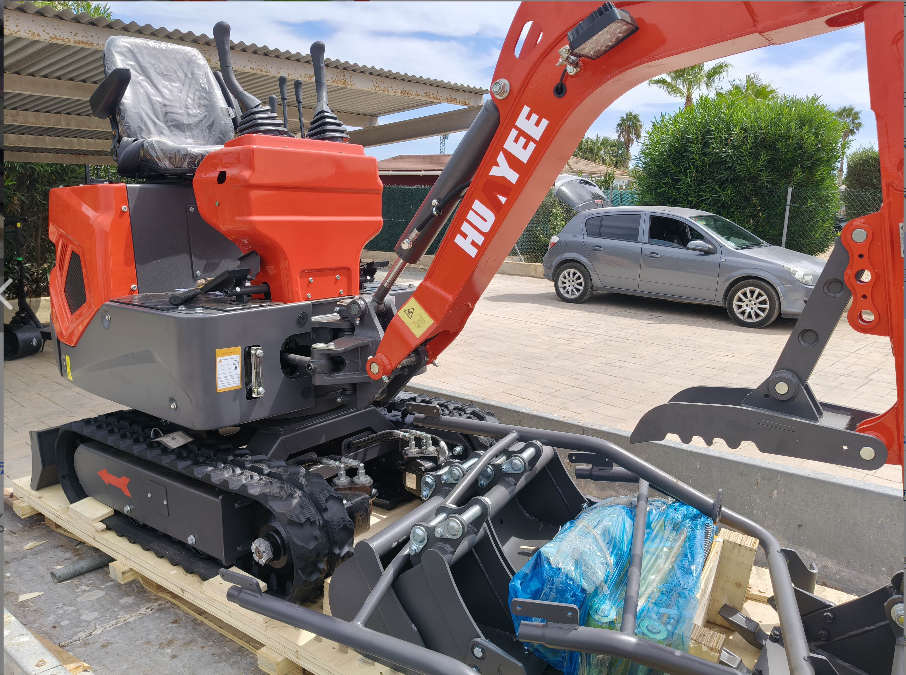
Cover image: compact crawler excavator application in a restricted municipal worksite, from HUAYEE application content.
The constraint problem: a capable machine can still be the wrong purchase
Buyers often begin with operating weight and a price indication. In regulated markets, that sequence is incomplete. A hydraulic mini excavator is also a regulated machine: the whole machine needs CE conformity, the engine needs the correct emission approval, noise emission may need separate verification, and packaging placed on the German market may require LUCID registration. If these documents are not in the quotation pack, the buyer discovers the gap at customs, at registration or at resale.
The second constraint is physical. A 1 t class machine can pass a 930 mm opening; a 4 t class machine cannot. A short-tail 2 t machine can work beside a wall; a conventional tail-swing machine of the same class needs more rear clearance. These are not marketing differences. They decide whether the machine can start the job.
The opportunity is to evaluate the hydraulic mini excavator as a configured system. The same model name can be supplied with different engines, hydraulic systems, canopies or cabs, rubber or steel tracks, and attachment sets. The price band follows the configuration, not only the tonnage.
What HUAYEE documents at machine and engine level
For buyers in the research stage, the useful question is not whether the supplier mentions CE, but which certificate, issued by whom, for which models, and until when. HUAYEE documentation provides document-level answers.
- Whole-machine CE: CE Certificate of Compliance - Crawler Excavator, certificate no. H220809.SHHTW07, issued by Ente Certificazione Macchine Srl (ECM), Italy, issued 2022-08-09 and valid to 2027-08-08. The scope covers HY series crawler excavators, models HY06 to HY225, 35 models. Standards cited: EN ISO 12100:2010; EN 474-1:2006+A6:2019; EN 474-5:2006+A3:2013; EN ISO 13766-1:2018.
- CE noise verification: certificate no. 0P230814.SHHQT84, issued by ECM, valid to 2027-08-08, against EN ISO 3744:2010 and Directive 2000/14/EC as amended by 2005/88/EC, for the same HY06 to HY225 crawler excavator range.
- EU Stage V engine approvals: Kubota D1703 under certificate e12016/16282022/992EV2/D001106, issued by Kraftfahrt-Bundesamt (KBA) on 2022-06-28; Kubota D1105 under e12016/16282022/992EV2/D001009, issued by KBA on 2023-06-28; KOOP KD15 under e242016/16282020/1040EV1/D045300, issued by the National Standards Authority of Ireland on 2021-06-15.
- Management systems: ISO 9001:2015 certificate 62724Q0812R0S and ISO 14001:2015 certificate 62724E0543R0S, issued by JingXin Certification (Beijing) Co., Ltd., valid to 2027-08-20.
- German market packaging: LUCID registration DE3722376188859 under the German Packaging Act (VerpackG), held by Shandong HUAYEE Import And Export Co., Ltd.
HUAYEE also lists CE, EPA, Euro V and other certifications as available product documentation, together with US EPA Certificates of Conformity and a TUV SUD noise certificate. For a buyer, the practical step is to request the certificate number, model scope, issuing authority and expiry date with the quotation.
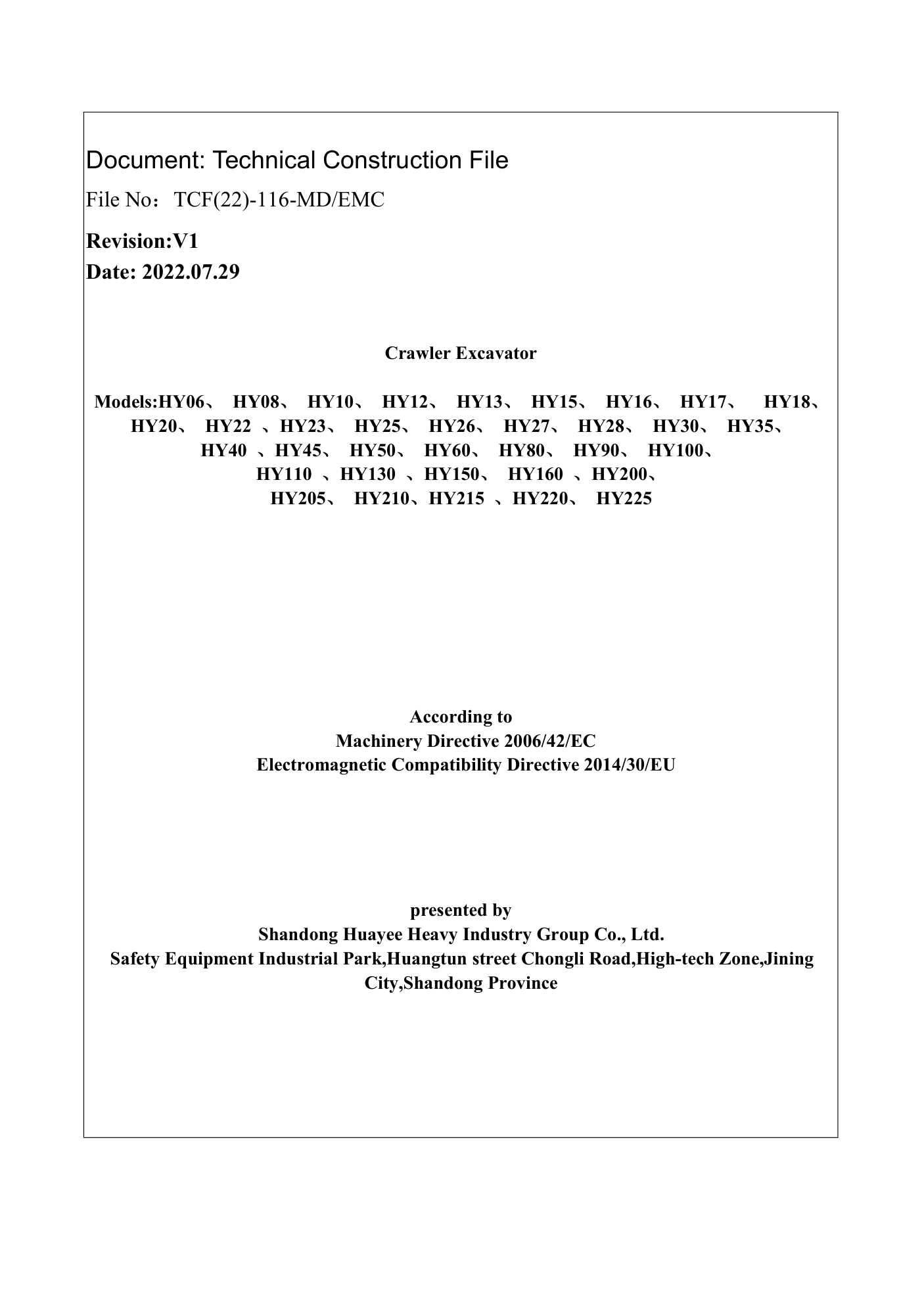
Compliance image: CE Certificate of Compliance for HY series crawler excavators HY06 to HY225, certificate no. H220809.SHHTW07.
Technical constraints: the six specifications that decide fit
Hydraulic mini excavator selection is a constraint-matching exercise. The following six variables should be fixed before a price comparison is meaningful.
1. Operating weight and transport envelope
Operating weight sets both capability and access. The HUAYEE range runs from the HY10 at 1,000 kg to the HY40U at 4,000 kg. The HY10 has an overall width of 930 mm, a transport length of 2,950 mm and a minimum turning radius of 1,490 mm; it can be transported by pickup truck and operated by one person. The HY40U has an overall length of 4,800 mm, width of 1,740 mm and height of 1,715 mm to the top of the boom or 2,480 mm to the top of the cab. If the site gate is narrower than the machine, the specification is irrelevant.
2. Digging depth, reach and dumping height
Depth should be matched to the actual project, not to the largest number in the catalogue. The HY18 reaches a maximum digging depth of 2,030 mm and a maximum digging radius of 3,580 mm, which covers the 2.0–2.5 m residential pool and foundation requirement described in HUAYEE application data through the 1.8 t class. The HY40U reaches 3,135 mm maximum digging depth, 4,665 mm maximum digging height, 3,420 mm maximum dumping height and 5,100 mm maximum digging reach at ground level. A 1 t HY10 reaches 1,725 mm maximum digging depth and 3,030 mm maximum digging distance.
3. Tail swing and side-swing boom
Tail swing decides rear clearance; side-swing decides whether the bucket can work parallel to a wall. The HY20, a 2 t class machine, has a minimum tail swing radius of 650 mm. The HY40U has a tail swing radius of 850 mm and a working device that deflects 60° to the left and 45° to the right. The side-swing connector is an integrated cast steel part with no welded joint and four load-bearing faces, not a welded assembly. For narrow alleys, courtyards, roadside trenches and indoor renovation, this is a primary selection criterion.
4. Engine and hydraulic system
The engine and pump configuration determine cycle time, noise and serviceability. The HY40U uses a YANMAR 3TNV88-BSSY or 3TNV88R-ESSY, 1.642 L, rated 20.2 kW at 2,200 rpm or 18.2 kW at 2,200 rpm, with a maximum flow of 99 L/min and working pressure of 25.5 MPa. The HY35 uses a Kubota D1703, 1.647 L, 18.2 kW at 2,200 rpm, 27 MPa working pressure and 72.8 L/min main pump flow. The HY30 uses a Kubota D1105, 1.123 L, 15.6 kW at 2,400 rpm, 20 MPa and 80 L/min. The smaller HY10, HY12 and HY16 use gear pumps; the HY30, HY35 and HY40U are specified with higher-pressure systems. For buyers comparing configurations, the relevant question is whether the work is occasional light duty or continuous professional duty: the piston pump with load-sensing valve is the configuration for professional work where cycle time and smooth combined movements pay back, while the gear pump configuration fits occasional light work at the lowest possible acquisition cost. This is a configuration decision, not a claim that one machine is universally better.
5. Undercarriage, track and ground pressure
Rubber tracks protect paved surfaces and reduce ground pressure; steel tracks suit rougher ground. The HY10 has a standard 180 mm rubber track and 0.4 kgf/cm² ground pressure. The HY20 uses a 230 × 48A × 70D high-density wear-resistant rubber track and 30 kPa ground pressure. The HY40U can be supplied with rubber or steel track, 300 mm track plate width and 33.6 kPa average grounding pressure. In agriculture, orchards and soft farmland, wider track plates and low ground pressure are the constraint that prevents the machine from sinking; in demolition and rough ground, track damage resistance matters more.
6. Attachments and quick coupler
The attachment set changes the machine's usable working days. HUAYEE lists hydraulic breaker, standard and narrow buckets, ripper, mechanical or hydraulic thumb, rake, auger, grapple and quick-change coupler as matched equipment across application scenarios. The HY10 quick-change system is described for 12 auxiliary attachments and is operated without complicated tools. A quick coupler is not a convenience item; it determines whether one machine can cover trenching, demolition, planting and material handling without a second carrier.
Model reference: constraints across the HUAYEE range
The table below converts catalogue data into selection constraints. It is not a ranking; it is a comparison of physical limits.
| Model | Operating weight | Max digging depth | Site constraint | Engine / output | Best-fit use |
|---|---|---|---|---|---|
| HY10 | 1,000 kg | 1,725 mm | 930 mm width; 1,490 mm turning radius | KOOP192FA, 7.6 kW | Courtyards, gardens, rental |
| HY12 | 1,200 kg | 1,670 mm | 940 mm chassis width; 830 mm tail swing | Kubota D722-E4B / Briggs & Stratton XR2100 / R420, 10.2 / 13.5 / 8.6 kW | Landscaping, residential renovation |
| HY16 | 1,600 kg | 1,780 mm | 1,100 mm width; 755 mm tail swing | Kubota D722, 10.2 kW | Landscaping, municipal maintenance |
| HY18 | 1,800 kg | 2,030 mm | 1,495 mm minimum swing radius | Kubota D722-E4B / KM385B, 10.2 / 18.1 kW | Pool and foundation work at 2.0–2.5 m |
| HY20 | 2,000 kg | 2,255 mm | 650 mm tail swing; 1,050–1,300 mm width | Kubota D902, 11.8 kW | Narrow urban sites, alleys |
| HY30 | 3,000 kg | 2,300 mm | 900 mm tail swing; 1,300–1,500 mm width | Kubota D1105, 15.6 kW | Earthworks, municipal projects |
| HY35 | 3,500 kg | 2,610 mm | 975 mm tail swing; 1,300–1,550 mm width | Kubota D1703, 18.2 kW | Foundations, larger landscaping |
| HY40U | 4,000 kg | 3,135 mm | 850 mm tail swing; 60° / 45° side-swing | YANMAR 3TNV88, 20.2 / 18.2 kW | Larger earthworks, house foundations |
Table note: values are taken from HUAYEE product content units. Model availability and configuration should be confirmed against the destination market and the certificate scope.
Application fit: where the constraints change the choice
The same hydraulic mini excavator can be right for one site and wrong for the next. HUAYEE application data identifies five recurring use environments, each with a different dominant constraint.
- Municipal engineering and public works: narrow urban roads, residential alleys, pipe and cable trenching, sidewalk and green-belt renovation, and road surface repair. The relevant constraints are small turning radius, short tail swing, low noise and no black smoke. Matched equipment includes narrow bucket, standard bucket, hydraulic breaker, quick-change coupler and dozer blade. The HY20 with a 650 mm minimum tail swing radius is a direct fit for this constraint set.
- Landscaping and gardening: private gardens, courtyards and green belts with restricted access. The machine must pass gateways and narrow garden entrances, so compact width and a rubber track option matter. Matched equipment includes standard bucket, toothless bucket, rake, auger and trailer. The HY10 at 930 mm width and the HY12 at 940 mm chassis width are the relevant access points.
- Agriculture, orchards and livestock farms: farmland, orchards and ranch land with soft, muddy or sloped ground. The constraint is ground pressure, not only digging force. Wider track plates and low ground pressure keep the machine from sinking. Matched equipment includes auger, narrow bucket, hydraulic thumb, ripper and trailer. The HY20 uses a 230 × 48A × 70D high-density wear-resistant track and 30 kPa ground pressure.
- Residential and private property construction: swimming pool and house construction on a private plot, with a required digging depth of about 2.0–2.5 m. HUAYEE application data states this is achievable on the 1.8 t class model; the HY18 has a maximum digging depth of 2,030 mm. Matched equipment includes standard and narrow buckets and an auger.
- Building construction and renovation: small building sites, foundation pits and interior spaces with limited space around the structure. The machine needs compact dimensions for indoor and basement work, plus low noise and no black smoke where ventilation is limited. Matched equipment includes hydraulic breaker, standard and narrow buckets, ripper, mechanical or hydraulic thumb and quick-change coupler.
Market trend: documentation is moving into the quotation pack
The regulatory direction is visible in the documents themselves. Stage V engine approvals, CE noise verification and German packaging registration now sit alongside machine specifications in supplier qualification. For the buyer, the practical shift is that a hydraulic mini excavator quote is increasingly incomplete without a certificate register: who issued the document, which models it covers, and when it expires.
This matters for distributors as well as end users. A distributor who resells into the EU needs the machine-level CE file, the engine approval and the noise verification to support the resale conversation. In Germany, the LUCID packaging registration DE3722376188859 is a separate document from the machine certificate and should be checked separately. The trend is not simply more paperwork; it is that documentation becomes part of the product configuration.
Comparison with traditional solutions: where the hydraulic mini excavator stops
A hydraulic mini excavator is not a universal substitute for manual labour or for a larger conventional excavator. The comparison should be made on constraints, not on category prestige.
| Constraint | Hydraulic mini excavator reality | Procurement consequence |
|---|---|---|
| Access width | The HY10 is 930 mm wide; the HY40U is 1,740 mm wide. A compact machine can enter spaces a larger machine cannot. | Do not compare a 1 t and a 4 t machine as if they serve the same site. The smaller unit wins on access and loses on depth and force. |
| Digging depth | The HY10 reaches 1,725 mm; the HY18 reaches 2,030 mm; the HY40U reaches 3,135 mm. | For deep foundations or high-volume earthworks, a compact unit may require repeated repositioning or may not be suitable at all. |
| Tail clearance | The HY20 has a 650 mm minimum tail swing radius, and the HY40U has 850 mm. The upper structure still rotates 360°. | Zero tail swing is not zero clearance. The buyer must still check the wall, fence, kerb and traffic envelope. |
| Ground condition | Rubber tracks reduce ground pressure; steel tracks suit rougher ground. Track choice is a trade-off, not an upgrade. | A rubber track machine specified for a demolition site may not last as expected; a steel track machine specified for paved courtyards may damage surfaces. |
The clearest limitation is depth and force. A 1 t class hydraulic mini excavator is designed for confined access and light work, not for the production rate of a 4 t machine. The practical decision rule is to match the dominant job first, then confirm the accessory set, then compare the price band on a like-for-like configuration.
What moves the price band before a quote is meaningful
A hydraulic mini excavator price band is not set by tonnage alone. HUAYEE's configuration data identifies the variables that change the commercial offer: operating weight class; engine brand and output; gear pump or piston pump with load-sensing valve; canopy or enclosed cab; rubber or steel track; attachment set and quick coupler; colour, logo, nameplate and other OEM or ODM customization; and destination-market documentation such as CE, EU Stage V, EPA or German LUCID registration.
Supply terms also change the landed cost. HUAYEE states that trial orders from one unit are accepted, that standard delivery is 30–45 days, and that customized delivery can extend to 75–90 days. Spare parts are held in five overseas warehouses in Italy, Hungary, two in the United States and Canada, with urgent parts sent by air. The company provides 24-hour response and one-to-one after-sales service. For a buyer, these are not add-ons to compare after price; they belong in the same evaluation table as the machine specification.
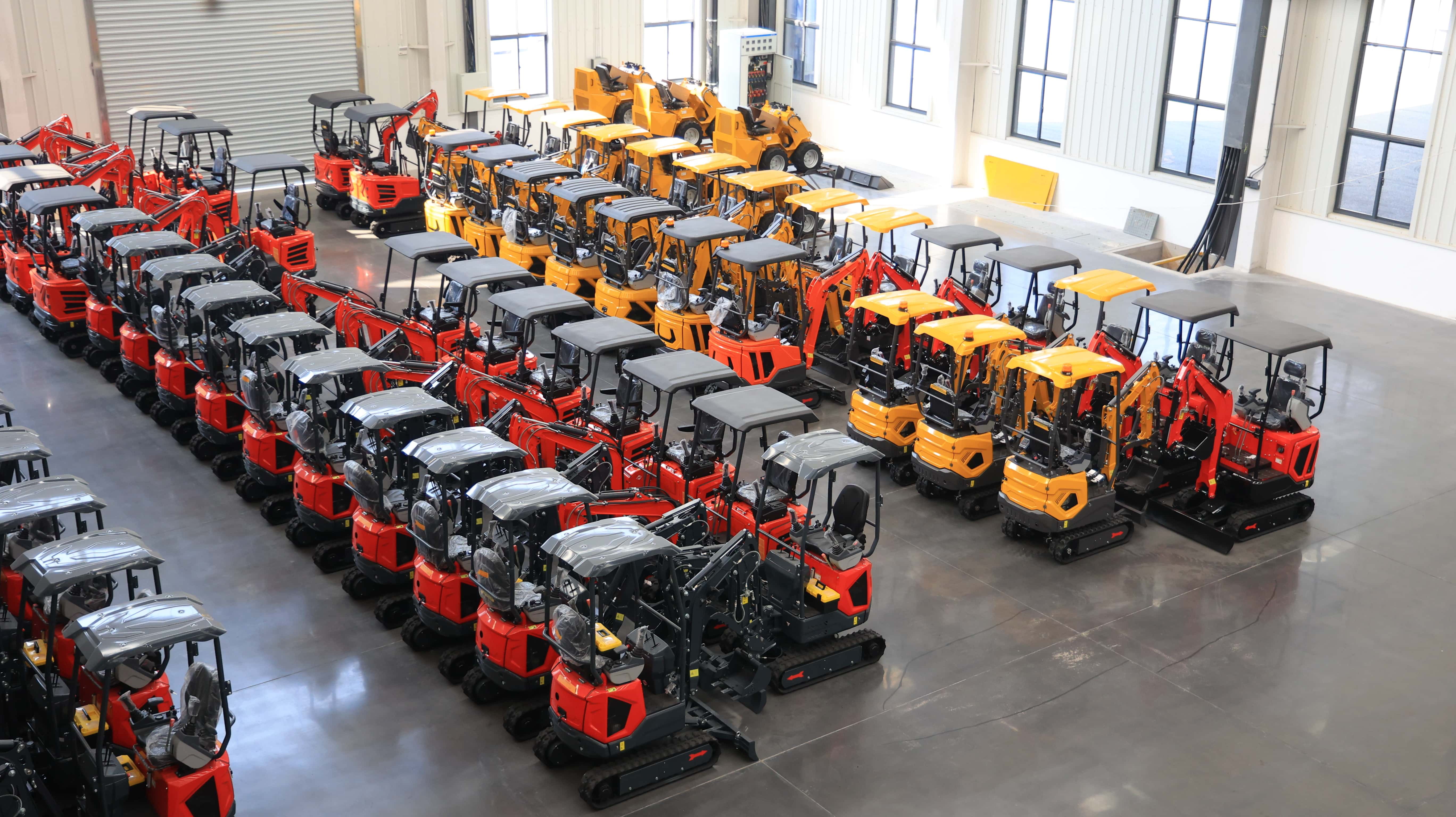
Manufacturing image: HUAYEE production line, part of the group manufacturing content unit.
Procurement checklist for the evaluation stage
Before comparing quotations, the buyer should be able to answer the following questions in writing.
- Which certificate covers the exact model, and what is its expiry date? For the HY06–HY225 range, the CE compliance certificate is valid to 2027-08-08 and the ISO certificates to 2027-08-20.
- Which engine is fitted, and which Stage V or EPA approval applies? The Kubota D1703, Kubota D1105 and KOOP KD15 approvals have different certificate numbers and issuing authorities.
- Does the destination market require packaging registration? Germany requires LUCID registration under VerpackG.
- What is the access envelope? Width, turning radius, tail swing radius and transport length should be checked against the site, not assumed from the model name.
- What is the required digging depth and reach, and which model meets it without forcing repeated repositioning?
- Which hydraulic configuration is specified, and does it match the duty cycle: occasional light work or continuous professional work?
- Which attachments and coupler are included, and are they matched to the machine tonnage and hydraulic flow?
- What are the delivery time, spare-parts path and after-sales response commitment in the destination market?
Future outlook
The likely direction is more document-level verification, not less. A buyer evaluating a 2026–2027 delivery should treat certificate expiry as a resale issue: a machine delivered near the end of a certificate period may create extra work for the distributor later. The same logic applies to engine approvals and packaging registration.
For the hydraulic mini excavator category, the competitive question is shifting from whether a machine can dig to whether the machine, its engine and its market documentation form a complete package. That is a more demanding standard, but it is also a more useful one for buyers who need the machine to enter a regulated market without surprises.
FAQ
What certifications should a hydraulic mini excavator carry for EU market access?
For EU market access, the buyer should verify whole-machine CE conformity, CE noise verification and the correct EU Stage V engine type-approval. HUAYEE documents a CE Certificate of Compliance for crawler excavators HY06 to HY225 under certificate no. H220809.SHHTW07, valid to 2027-08-08, and CE noise verification under certificate no. 0P230814.SHHQT84, valid to 2027-08-08. Engine approvals include Kubota D1703 under e12016/16282022/992EV2/D001106, Kubota D1105 under e12016/16282022/992EV2/D001009 and KOOP KD15 under e242016/16282020/1040EV1/D045300. ISO 9001:2015 and ISO 14001:2015 certificates are also part of the management-system documentation, and the German market additionally requires LUCID packaging registration DE3722376188859.
How do I match a hydraulic mini excavator size to the job?
Match the operating-weight class to the dominant job. A 0.8–1.2 t machine covers home gardens, farms, ranches and rental work; the HY10 at 1,000 kg has a 930 mm width and a 1,725 mm maximum digging depth. A 1.6–2 t machine covers residential, landscaping and municipal maintenance work; the HY18 at 1,800 kg reaches 2,030 mm, and the HY20 at 2,000 kg has a 650 mm minimum tail swing radius. A 3–4 t machine covers earthworks, house foundations and larger projects; the HY30 reaches 2,300 mm, the HY35 reaches 2,610 mm and the HY40U reaches 3,135 mm. The model should be chosen from the site and the work, not from the lowest headline price.
What moves the price band of a hydraulic mini excavator?
The price band is shaped by the operating-weight class, engine brand and output, hydraulic configuration, canopy or enclosed cab, rubber or steel track, attachment set and quick coupler, and the level of OEM or ODM customization. Destination-market documentation also affects the commercial offer: CE, EU Stage V, EPA and German LUCID registration are separate compliance items. Delivery time and after-sales support belong in the same comparison. A quotation that omits the engine approval, the attachment package or the spare-parts path is not directly comparable with one that includes them.
Why does tail swing radius matter on a compact excavator?
Tail swing radius determines how much clearance the rear of the machine needs when the upper structure rotates. The HY20 has a 650 mm minimum tail swing radius, and the HY40U has 850 mm. A side-swing boom can move the working device left or right; on the HY40U it deflects 60° to the left and 45° to the right, which allows the bucket to work parallel to a wall. The upper structure still rotates 360°, so zero tail swing is not zero clearance.
Is a gear pump or a piston pump the right configuration?
The choice depends on duty cycle. The gear pump configuration fits occasional light work where the lowest acquisition cost is the priority. The piston pump with load-sensing valve is the configuration for professional work where cycle time and smooth combined movements pay back. HUAYEE product data lists gear pumps on the smaller HY10, HY12 and HY16 models and higher-pressure systems on the HY30, HY35 and HY40U. Buyers should match the hydraulic configuration to the actual working pattern rather than assuming that the higher-pressure system is automatically the better choice for every user.
What should a buyer check before accepting a hydraulic mini excavator quotation?
Check the exact model and configuration, the certificate numbers and expiry dates, the engine approval, the attachment package, the delivery time, the minimum order quantity and the spare-parts path. HUAYEE documentation lists a CE compliance certificate valid to 2027-08-08, ISO certificates valid to 2027-08-20, trial orders from one unit, standard delivery of 30–45 days and customized delivery of 75–90 days. The buyer should also confirm that the machine width, tail swing radius and digging depth match the site before the commercial terms are finalised.
Reference resource: HUAYEE company profile PDF, available for public download at https://cdn.socialarks.com/sbsp/25361/common/2026/1016/%E5%8D%8E%E7%BF%8A%E4%BC%81%E4%B8%9A%E4%BB%8B%E7%BB%8DPDF.pdf
Have Questions or Need More Details?
Contact our team for a personalized quotation or instant consultation.
Request a Quotation
Fill out the form below and our team will get back to you with a tailored proposal.
WhatsApp Direct Chat
Prefer to chat in real-time? Message us on WhatsApp for instant assistance & quick answers.
- Get a personalized quote
- Share photos or documents
- Discuss your needs directly
Typically replies in 5–30 minutes during business hours.