
Hydraulic Power Unit Oil Cleanliness: A Procurement FAQ
Contamination control, ISO 4406 targets, filtration configuration and pressure verification, answered for buyers specifying custom, DC and vehicle-mounted hydraulic power units.
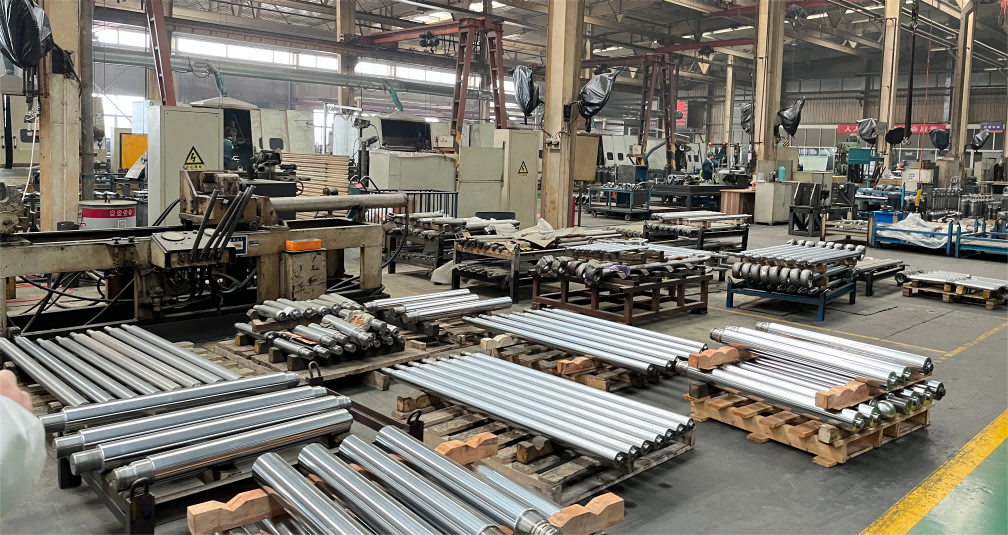
Cleanliness is decided upstream of assembly: components staged in production inside a hydraulic manufacturing facility. Image: Apex Hydraulic Co., Ltd.
Most hydraulic power unit failures that end up in a warranty conversation were not designed on the drawing. They were introduced before the unit was ever filled with oil. Contamination enters a hydraulic system through components, through assembly, through the fluid, and through the working environment, and the first three of those routes sit inside the manufacturer's control rather than the operator's.
That is why cleanliness is now written into purchase orders rather than only into maintenance schedules. A buyer specifying a custom hydraulic power unit, an OEM hydraulic power pack or a 12V dump trailer hydraulic power unit is not only buying a motor, gear pump, manifold, valve block and reservoir. The buyer is also buying a delivery condition, and that condition has three parts: a fluid cleanliness level, a filtration configuration, and a documented pressure verification.
Apex Hydraulic Co., Ltd. is a hydraulic manufacturer established in 2009 in Qingdao City, Shandong Province, China, producing custom hydraulic cylinders, hydraulic power units, hydraulic systems and hydraulic scissor hoist kits for OEM equipment builders, hydraulic distributors and hydraulic solution providers. Its published power unit data specifies a fluid cleanliness level of ISO 4406 20/18/15 across several product families, which makes those specifications a practical reference point for the procurement questions below.
Why Cleanliness Is Hard to Buy and Easy to Get Wrong
Cleanliness is unusual among hydraulic specifications because it cannot be verified by looking at the unit. A reservoir, pump, manifold and valve package can be dimensionally correct, correctly ported and correctly painted, and still ship with a particle load that shortens the service life of every component downstream of the reservoir.
In practice, contamination reaches a new hydraulic power unit through four routes:
- Machining residue and loose particles left on internal surfaces after component production.
- Airborne dust and handling debris during assembly and reservoir closure.
- The hydraulic fluid itself, together with the containers, hoses and funnels used to transfer it.
- The operating environment after commissioning: dust, grit, moisture and road salt, particularly on mobile equipment.
The first three routes are inside the manufacturer's control. The fourth is not. That boundary defines what a supplier can reasonably be asked to guarantee, and it is usually the point at which a cleanliness discussion becomes either precise or stays a slogan.
The commercial argument for asking early is that contamination rarely fails loudly at goods-in inspection. It appears later as pump and valve wear, internal leakage, slower cycle times and unplanned downtime at a customer site. As systems move toward higher pressures, continuous-duty electric drive and tighter motion control, the particle load a circuit tolerates narrows rather than widens.
What ISO 4406 20/18/15 Actually Specifies
Fluid cleanliness in a hydraulic power unit is normally expressed with an ISO 4406 code. The published specification for the Apex Hydraulic power unit families, including the custom low-noise compact series, the vehicle-mounted auxiliary series, the AC industrial series, the multi-function aerial work platform series and the double-acting mobile series, is ISO 4406 20/18/15.
The three numbers are not a single rating. In standard industry usage, an ISO 4406 code reports particle counts across three size channels, commonly described as particles at or above 4 micrometres, 6 micrometres and 14 micrometres per millilitre of fluid. 20/18/15 therefore describes three separate counts, and a buyer comparing two offers should compare the code channel by channel instead of treating it as one score.
Several related specification points belong in the same part of the conversation, because a cleanliness target written into an order while the reservoir size, breather arrangement or suction protection has not been decided is a target without a mechanism.
| Specification point | Published range | Why it matters at the order stage |
|---|---|---|
| Fluid cleanliness level | ISO 4406 20/18/15 on the compact low-noise, vehicle-mounted auxiliary, AC industrial, multi-function aerial work platform and double-acting mobile families | Defines the delivered particle condition; it belongs on the inspection record, not only on the datasheet |
| Recommended hydraulic fluid | ISO VG 22, 32 or 46 for compact and mobile DC units; ISO VG 32 or 46 for vehicle-mounted auxiliary units; ISO VG 32, 46 or 68 for AC industrial units | Determines compatibility with the buyer's existing fleet fluid and with the operating temperature |
| Fluid temperature range | -20 degrees C to +80 degrees C | Confirms seal and fluid selection for outdoor, cold-start or high-ambient duty |
| Return-line filter | Optional on the listed families | Captures wear particles generated in service and protects pumps and valves |
| Pressure-line filter | Optional, vehicle-mounted auxiliary series | Adds protection downstream of the pump on multi-function vehicle systems |
| Suction strainer and air breather filter | Optional on multiple families | Limit pump-inlet debris and airborne ingress through the reservoir breather |
| Monitoring hardware | Oil level indicator, oil temperature sensor and pressure sensor available as options | Supports routine inspection and early fault detection after commissioning |
| Reservoir capacity | 0.5-18 L compact low-noise; 0.9-18 L double-acting mobile; 1.5-18 L AC industrial and multi-function; 5-60 L vehicle-mounted auxiliary | Affects heat rejection and fluid residence time, which influence how contamination behaves |
How Oil Cleanliness Is Controlled During Production
At Apex Hydraulic, hydraulic components pass through a cleaning process before they enter final assembly, and completed units move through a component assembly line into final assembly and testing. The documented production-stage sequence is incoming material inspection (IQC), in-process quality control (IPQC), final quality inspection (FQC), dimensional inspection, welding inspection, surface finish inspection, pressure testing, leakage testing, functional testing and 100% final inspection.
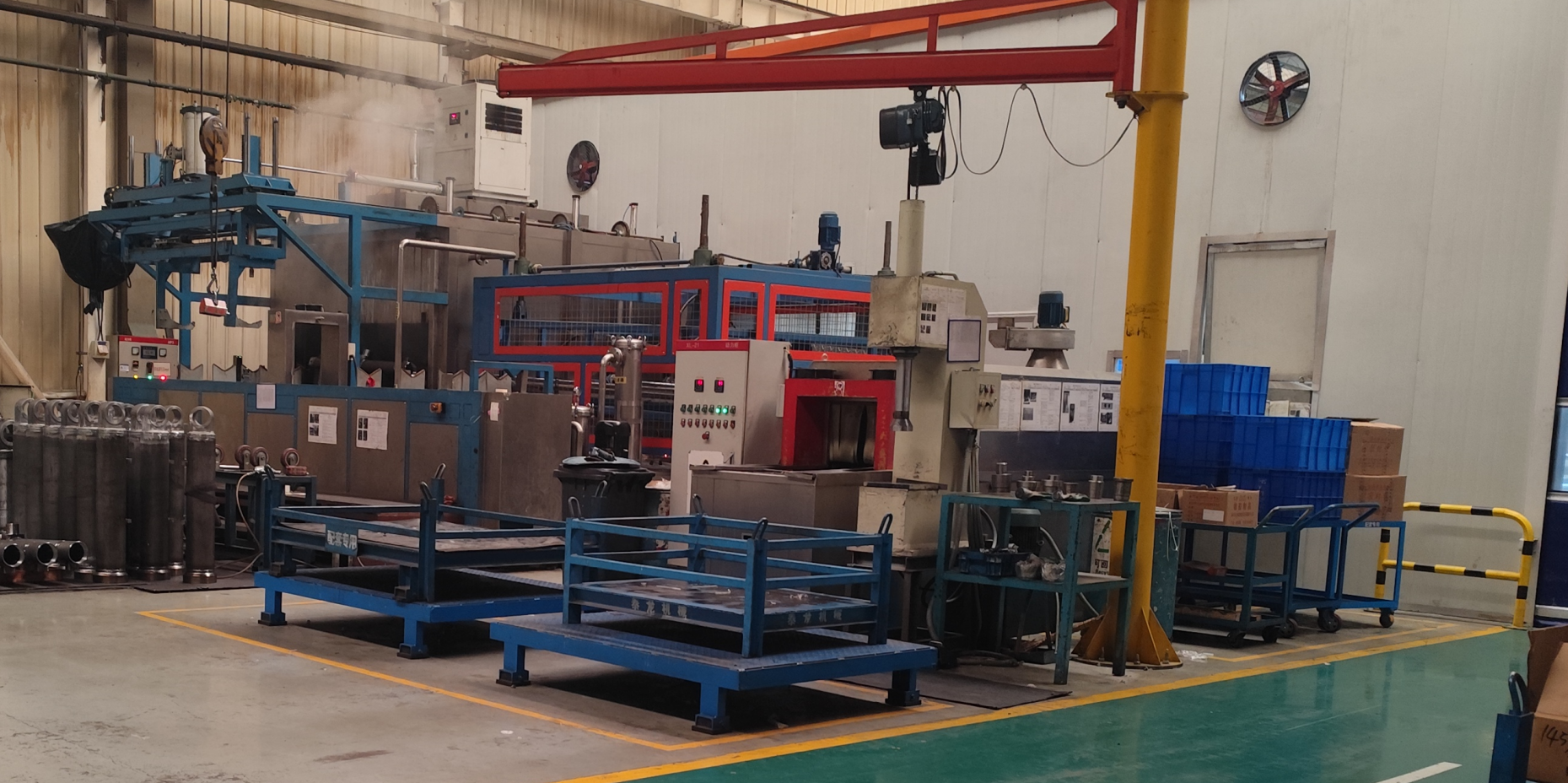
Component cleaning ahead of final assembly is the first contamination-control step in the production sequence. Image: Apex Hydraulic Co., Ltd.
Two elements of that sequence are directly relevant to a cleanliness specification. Cleaning before assembly removes machining residue and handling contamination from internal surfaces before a system is closed, which is the stage where loose particles are most difficult to remove later. Unit-level testing on completed power units means pressure integrity and leakage behaviour are checked on every unit rather than on a sample.
Test scope varies by product family, and it is worth quoting precisely when comparing suppliers:
- Vehicle-mounted auxiliary units (APEX-CVMAHPU): pressure, leakage, electrical, valve-response and full-cycle testing.
- AC industrial units (APEX-ACHPU Series): pressure, leakage, electrical and full-function testing.
- Multi-function aerial work platform units (APEX-CMFHPU): pressure, leakage, valve-function, electrical and full-cycle testing.
- Double-acting mobile units (APEX-CDAMHPU): pressure, leakage, directional-control and functional testing.
- 12V DC dump trailer units (APEX-DTHPU): pressure testing, flow testing, relief-valve verification, solenoid-valve functional testing, motor current testing and leakage inspection.
The supporting manufacturing context is a 50,000 square metre facility, a 25-engineer engineering and R&D team, more than 500 employees, and monthly capacity of more than 8,000 hydraulic cylinders and more than 1,500 hydraulic power units, with annual capacity stated at 100,000 hydraulic cylinders and 15,000 power units. Scale matters here only because it determines whether cleaning and testing are repeatable process steps or one-off workshop actions. A cleaning step that is not built into the production sequence tends to disappear under schedule pressure.
Pressure Verification: What a Test Record Should Show
Pressure questions usually arrive in procurement as a single line: what pressure does it run at? The more useful question is what the relief setting is, against which system it was calculated, and who verified it.
The pressure relief valve is adjustable across the Apex Hydraulic power unit families. Pressure setting is adjustable according to the approved hydraulic system within the rated component limits, and the relief valve is calibrated according to the approved hydraulic design. The APEX-DTHPU 12V DC dump trailer hydraulic power unit provides a concrete example: a maximum relief setting of 3,200 PSI at the A port and 1,500 PSI at the B port, a maximum hydraulic flow rate of 2.0 GPM, SAE #6 hydraulic ports, a 6 US quart translucent horizontal-mount reservoir, and a two-button handheld pendant with a removable 15 ft cord.
Relief-valve verification and pressure testing appear as documented test items on completed units, alongside flow testing, solenoid-valve functional testing and motor current testing on the dump trailer family.
Three procurement actions follow from this:
- Supply the system data the setting depends on: cylinder bore and rod diameter, required push and pull force, maximum system pressure, hose and fitting ratings, ambient and fluid temperature.
- Require the set pressure and the verification method to be stated on the test record, not only on the catalogue page.
- Confirm the maximum working pressure of the selected family against the application: 230 bar on the compact low-noise and AC industrial units, 250 bar on the vehicle-mounted auxiliary unit, and 280 bar on the double-acting mobile and multi-function aerial work platform units.
Pressure cannot be calibrated in isolation. A supplier that sets a relief valve without cylinder and load data is guessing, and the resulting setting either restricts lifting performance or removes the protection it was installed to provide.
Where the Questions Change: Application Differences
The same cleanliness vocabulary produces different answers depending on the equipment the power unit drives.
12V dump trailer hydraulic power units
Trailer hydraulics work outdoors, in dust and across a wide temperature range, and are usually operated by drivers rather than maintenance technicians. The APEX-DTHPU is a 12 VDC power-up / gravity-down unit designed for single-acting telescopic cylinders such as the HTC series, with a translucent horizontal-mount reservoir that allows fluid-level inspection without tools and a maximum relief setting of 3,200 PSI at the A port. Return filtration and suction protection are the additions most worth discussing at the order stage, because a trailer owner is unlikely to open the system between seasons.
Vehicle-mounted and auxiliary hydraulic power units
Units in the APEX-CVMAHPU family run on 24 VDC or 48 VDC and drive one to six functions on refuse collection vehicles, truck tailgates, utility and service trucks, road-maintenance vehicles and vehicle stabilizer systems. Published specifications include return-line filtration, pressure-line filtration and suction strainers as options, weather-resistant enclosures, and IP54, IP65 or IP66 ingress protection. On this class of equipment, contamination risk is driven by airborne ingress and moisture as much as by particles.
Multi-function aerial work platform units
The APEX-CMFHPU family integrates two to eight hydraulic functions with a standard intermittent duty cycle of one minute on-load and nine minutes off-load, and lists return-line filtration as a way to improve hydraulic oil cleanliness and protect pumps and valves. On lifting equipment, hydraulic cleanliness is also adjacent to safety: valve spool behaviour and load-holding performance are sensitive to particle contamination.
AC industrial hydraulic power units
Stationary units in the APEX-ACHPU Series run on 220 VAC or 380 VAC with TEFC induction motors, one to eight functions, continuous-duty or intermittent-duty options and 1.5-18 L reservoirs. Continuous duty generates more internal wear debris and heat than intermittent mobile duty, so filtration and fluid monitoring options carry more weight here than on a trailer unit.
A documented case from the mobile segment shows what this combination looks like over a production year. A dump trailer manufacturer in Canada ordered 1,200 HTC-series telescopic cylinders and 500 power units, and reported smooth lifting performance, a stable dumping angle and reduced service downtime while supporting continuous heavy-duty operation.
Market Direction: Cleanliness as a Supplier Qualification Item
Third-party estimates place the global hydraulic power unit market at USD 13.6 billion in 2024 (Grand View Research) and at USD 11.4 billion in 2024 (Precedence Research), which projects a CAGR of 5.5% through 2034. The two figures differ because of scope and methodology, and the divergence is a useful reminder to treat any single market size as an estimate rather than a settled fact.
Within that market, Grand View Research reports that Asia Pacific accounted for 40.2% of revenue in 2024 and that the United States market was valued at USD 2.55 billion in the same year. In the US, electric-powered units accounted for 60.1% of revenue, and the industrial application segment held 56.3%. Mordor Intelligence reports that standard packaged units represented 47.8% of global power unit revenue in 2024, a figure worth noting because standard packages and custom configurations carry different filtration and documentation options.
Pressure rating is its own trend line. Grand View Research projects the 2,000-3,000 psi segment to grow at a CAGR of 5.8% between 2025 and 2033, which places the strongest growth in the range where relief-setting accuracy and fluid cleanliness have the largest effect on component life. In the equipment these units drive, Market Research Future estimated the global dump trailer market at USD 63.51 billion in 2024, with the 10-15 tons segment holding the largest share.
The supply side is concentrated at the top and fragmented below it. Mordor Intelligence identifies Bosch Rexroth AG, Parker-Hannifin and HYDAC International among the leading global manufacturers of hydraulic power units, while regional suppliers continue to launch application-specific products. KTI Hydraulics, for example, launched a submerged DC hydraulic power unit with 12V and 24V options for recycling equipment in 2023. On the compliance side, EN ISO 4413:2010 sets general rules and safety requirements for hydraulic systems in the EU, and Machinery Directive 2006/42/EC governs the associated health and safety requirements.
The direction of travel is consistent: as more of the installed base moves toward electric drive, continuous duty and higher pressure, cleanliness level and pressure verification stop being workshop preferences and become qualification items that buyers compare across offers.
Comparison and Limits: Filtration-Specified Delivery Versus Conventional Sourcing
Two sourcing patterns dominate hydraulic power unit procurement, and they differ less in price than in where the risk sits.
Pattern A, filtration-specified delivery. The buyer defines the application data, the supplier configures reservoir, pump, manifold, valve block and filtration hardware, and the unit is delivered with a stated cleanliness level and a test record covering pressure, leakage and function.
Pattern B, conventional build-to-print sourcing. The unit is specified against a pressure and flow target, while filtration and fluid cleanliness decisions are left to the equipment builder's assembly line.
Neither pattern is inherently better. Pattern A moves specification work earlier and typically lengthens lead time: standard products are quoted at 7-20 days, while customized products are quoted at 25-45 days, with a minimum order quantity of 1 piece for standard products and project-based terms for OEM and customized work. Pattern B can be faster and cheaper at the order stage, and it is a reasonable choice when the equipment builder already operates a controlled assembly environment with its own fluid-handling and filtration standards.
Three limits deserve to be stated plainly:
- Delivery cleanliness is not field cleanliness. A supplier controls the unit up to the delivery boundary. Oil added on the equipment builder's line, the transfer containers used, storage conditions, breather maintenance and filter service intervals all sit outside that boundary. A cleanliness specification is a starting condition, not a lifetime guarantee.
- Filtration has a physical cost. Filters, breathers and strainers consume space and add pressure drop. On compact and mini hydraulic power units with reservoirs between 0.5 L and 18 L, the installation envelope can limit which options are practical, so the selection has to follow the duty cycle rather than habit.
- Cleanliness cannot compensate for a mismatched design. A fluid cleanliness target will not offset an undersized reservoir, an incorrect relief setting or a duty cycle beyond the motor rating. Where the application data is incomplete, the honest answer is to request the missing data rather than to accept a nominal specification.
Future Outlook
Three developments are likely to shape how buyers evaluate hydraulic power units over the next several years.
The first is electrification and duty cycle. With electric-powered units already accounting for the majority of US power unit revenue, and with DC configurations spanning 12 VDC, 24 VDC and 48 VDC alongside continuous-duty AC industrial units, the installed base is shifting toward operating profiles in which heat and wear debris accumulate differently than under traditional intermittent duty. Filtration and fluid monitoring options listed as optional today are likely to become standard line items.
The second is documentation. Traceability already exists at the component level: customer logo, part number, serial number and traceability labels are available on units such as the APEX-DTHPU. The same logic is extending to cleanliness levels and pressure records. A buyer who can compare two suppliers on identical test evidence is in a stronger position than one comparing two catalogue pages.
The third is regulatory alignment. EN ISO 4413:2010 and Machinery Directive 2006/42/EC already frame hydraulic safety requirements in the EU, and comparable expectations tend to follow in other markets as mobile equipment standards are updated. Cleanliness and pressure verification are part of that framework in practice, even when they are not the headline requirement.
For procurement teams, the practical implication is to treat cleanliness and pressure verification as specification lines with the same status as pressure rating or voltage: recorded at the order stage, verified before shipment, and revisited at commissioning.
FAQ: Oil Cleanliness and Pressure Verification
1. What does ISO 4406 20/18/15 mean on a hydraulic power unit specification?
ISO 4406 is the cleanliness classification used for hydraulic fluid, and 20/18/15 is the level published for several Apex Hydraulic power unit families, including the compact low-noise, vehicle-mounted auxiliary, AC industrial, multi-function aerial work platform and double-acting mobile units. In standard industry use, the code reports particle counts across three size channels, so 20/18/15 is read as three separate numbers rather than one score. For procurement purposes, the level should appear on the inspection record for the delivered unit as well as on the datasheet.
2. Which hydraulic fluid and viscosity grade should be specified?
Apex Hydraulic publishes ISO VG 22, ISO VG 32 and ISO VG 46 for compact low-noise units and DC mobile units, ISO VG 32 and ISO VG 46 for vehicle-mounted auxiliary and multi-function mobile units, and ISO VG 32, ISO VG 46 and ISO VG 68 for AC industrial units. The 12V DC dump trailer unit, model APEX-DTHPU, is specified for automatic transmission fluid or a compatible hydraulic oil selected according to temperature. Across these families the published hydraulic fluid temperature range is -20 degrees C to +80 degrees C, so viscosity selection should follow the actual ambient temperature and duty cycle.
3. Which filtration components can be specified on a hydraulic power unit?
Depending on the family, published options include a return-line filter, a pressure-line filter, a suction strainer, an air breather filter, an oil level indicator, an oil temperature sensor and a pressure sensor. The vehicle-mounted auxiliary unit, model APEX-CVMAHPU, lists return-line filtration, pressure-line filtration and suction strainers as options. The multi-function aerial work platform unit, model APEX-CMFHPU, lists return-line filtration as a means of improving hydraulic oil cleanliness and protecting pumps and valves. The practical selection depends on the available reservoir envelope, the duty cycle, and the contamination sensitivity of the valves and cylinders downstream.
4. How is oil cleanliness controlled before a power unit is assembled?
At Apex Hydraulic, hydraulic components pass through a cleaning process before they enter final assembly. Production-stage control follows documented steps: incoming material inspection, in-process quality control, final quality inspection, dimensional inspection, welding inspection, surface finish inspection, pressure testing, leakage testing, functional testing and 100% final inspection. Every completed power unit undergoes unit-level testing before shipment, with scope varying by family: pressure, leakage, electrical and full-function testing on AC industrial units, and pressure, leakage, electrical, valve-response and full-cycle testing on vehicle-mounted auxiliary units.
5. How is relief pressure verified before shipment?
The pressure relief valve is adjustable on these units, and the pressure setting is adjustable according to the approved hydraulic system within the rated component limits, with the relief valve calibrated according to the approved hydraulic design. Verification appears as a documented test item: relief-valve verification, pressure testing, flow testing, solenoid-valve functional testing and motor current testing on the 12V DC dump trailer unit, model APEX-DTHPU, which specifies a maximum relief setting of 3,200 PSI at the A port and 1,500 PSI at the B port. Buyers should supply cylinder and load data so the setting can be calculated rather than assumed.
6. What documentation should a buyer request with a hydraulic power unit?
At minimum: the published specification for the selected family, the approved drawing or configuration sheet for the ordered variant, and the unit test record covering pressure, leakage and functional testing. Where available, part number, serial number and traceability labelling support later service and replacement. Buyers who need cleanliness and pressure evidence for internal quality systems should ask for those items to be named in the test record rather than assuming they fall under a general statement of testing.
7. Can a manufacturer guarantee oil cleanliness after installation?
No. A supplier controls the unit up to the delivery boundary: component cleaning, assembly conditions, filtration configuration, the specified ISO 4406 level and pre-shipment testing. After that boundary, oil added during equipment assembly, transfer containers and funnels, storage conditions, breather maintenance, filter service intervals and the operating environment determine the fluid condition in service. For mobile equipment working in dust, moisture or salt, contamination risk is reduced through return-line filtration and suction protection, but field cleanliness remains a shared responsibility between the equipment builder and the end user.
Summary
Oil cleanliness and pressure verification are specification decisions rather than after-sales topics. The questions buyers ask at the order stage, namely which ISO 4406 level applies, which filtration hardware is included, how the relief setting was calculated and verified, and what evidence accompanies the unit, determine most of what can be known about a hydraulic power unit before it is installed. Answering them precisely is also what separates a comparable offer from a competitive one.
Full technical documentation for Apex Hydraulic power units, cylinders and hydraulic systems is available in the APEX Hydraulic Product Catalog (Main Products). Company reference: hydraulicapex.com.
Have Questions or Need More Details?
Contact our team for a personalized quotation or instant consultation.
Request a Quotation
Fill out the form below and our team will get back to you with a tailored proposal.
WhatsApp Direct Chat
Prefer to chat in real-time? Message us on WhatsApp for instant assistance & quick answers.
- Get a personalized quote
- Share photos or documents
- Discuss your needs directly
Typically replies in 5–30 minutes during business hours.