
Hygienic Drum Motors for Meat and Pharma Belt Conveyors
Belt conveyors in meat processing and pharmaceutical lines need drives that can tolerate frequent washdown, resist corrosion, and leave as few places as possible for product or cleaning agents to collect. A hygienic drum motor addresses those needs by enclosing the motor and gear train inside the drum shell itself, eliminating external gearboxes, exposed shaft couplings, and most of the crevices found on conventional drive arrangements.
Tianjin Seaparks Machinery-Electronics Co., Ltd, widely known as SEAPARKS, is a Tianjin-based drum motor manufacturer established in 2002. The company produces what it categorises as Food & Pharmaceutical Drum Motors, a family of hygienic drives that includes the DM80F, DM113F, TM113F, DM138F, DM165F and DM216F, together with related F-series variants. These models share design features that matter to conveyor builders and end users in meat, poultry, food and pharmaceutical production environments.
What Washdown-Intensive Industries Expect from a Drum Motor
Meat and pharmaceutical conveyors are not ordinary dry-process lines. They are washed with high-pressure water, exposed to cleaning chemicals, and in many cases operated under strict hygiene protocols that assume the equipment itself will not shelter bacteria.
Three engineering requirements tend to shape the choice of drive:
Sealing against pressurised water. A drive that is not sealed will eventually draw water through its shaft seal or housing joints. For this reason, hygienic drum motors are specified with a high IP protection class. SEAPARKS F-series hygienic drum motors carry an IP69K protection class, a rating designed for high-pressure and high-temperature washdown duty.
Corrosion-resistant housing material. A stainless steel drum shell resists rust better than painted carbon steel in humid, chilled or chemically cleaned areas. The SEAPARKS F-series uses a 304 stainless steel housing as standard, with 316 stainless steel available as an option. This is relevant when the conveyor is exposed to aggressive cleaning agents or saline environments.
A smooth, low-crevice surface. Because the motor is inside the drum, the visible drive component is essentially the polished rotating shell. There is no separate speed reducer hanging below the conveyor, which reduces ledges, pockets and hard-to-clean mounting areas that are common with geared motor assemblies.
F-Series Hygienic Drum Motor Specifications
Buyers evaluating drum motors for meat and pharmaceutical conveyors need to compare roller diameter, available power, belt pull and the minimum roller width required by the drum. The table below summarises the published SEAPARKS F-series specifications.
| Model | Motor / Phase | Ø Diameter | Rated Power | Max Belt Pull | Nominal Belt Speed | Min Roller Width |
|---|---|---|---|---|---|---|
| DM80F | Synchronous, DC | 80 mm | 0.09–0.12 kW | 534 N | 0.16–1.03 m/s | 320 mm |
| TM80F | Asynchronous, three-phase | 80 mm | 0.04–0.12 kW | 705 N | 0.08–1.02 m/s | 340 mm |
| DM113F | Synchronous, three-phase | 113 mm | 0.12–0.55 kW | 2053 N | 0.14–0.68 m/s | 370 mm |
| TM113F | Asynchronous, three-phase | 113 mm | 0.12–0.55 kW | 1469 N | 0.09–1.4 m/s | 345 mm |
| DM138F | Synchronous, three-phase | 138 mm | 0.75–1.5 kW | 3965 N | 0.37–1.83 m/s | 400 mm |
| TM138F | Asynchronous, three-phase | 138 mm | 0.25–1.1 kW | 3525 N | 0.11–1.69 m/s | 350 mm |
| DM165F | Synchronous, three-phase | 165 mm | 1.1–3 kW | 5229 N | 0.42–2.09 m/s | 470 mm |
| TM165F | Asynchronous, three-phase | 165 mm | 0.25–2.2 kW | 4147 N | 0.1–2.0 m/s | 400 mm |
| DM216F | Synchronous, three-phase | 216 mm | 4.0–5.5 kW | 5244 N | 0.8–2.5 m/s | 510 mm |
| TM216F | Asynchronous, three-phase | 216 mm | 3.5–4.0 kW | 4700 N | 0.8–2.1 m/s | 510 mm |
All F-series models listed above use a housing of 304 stainless steel, with 316 stainless steel optional, and alloy steel gearing. The IP69K rating is the protection class for the range as published in SEAPARKS product specifications.
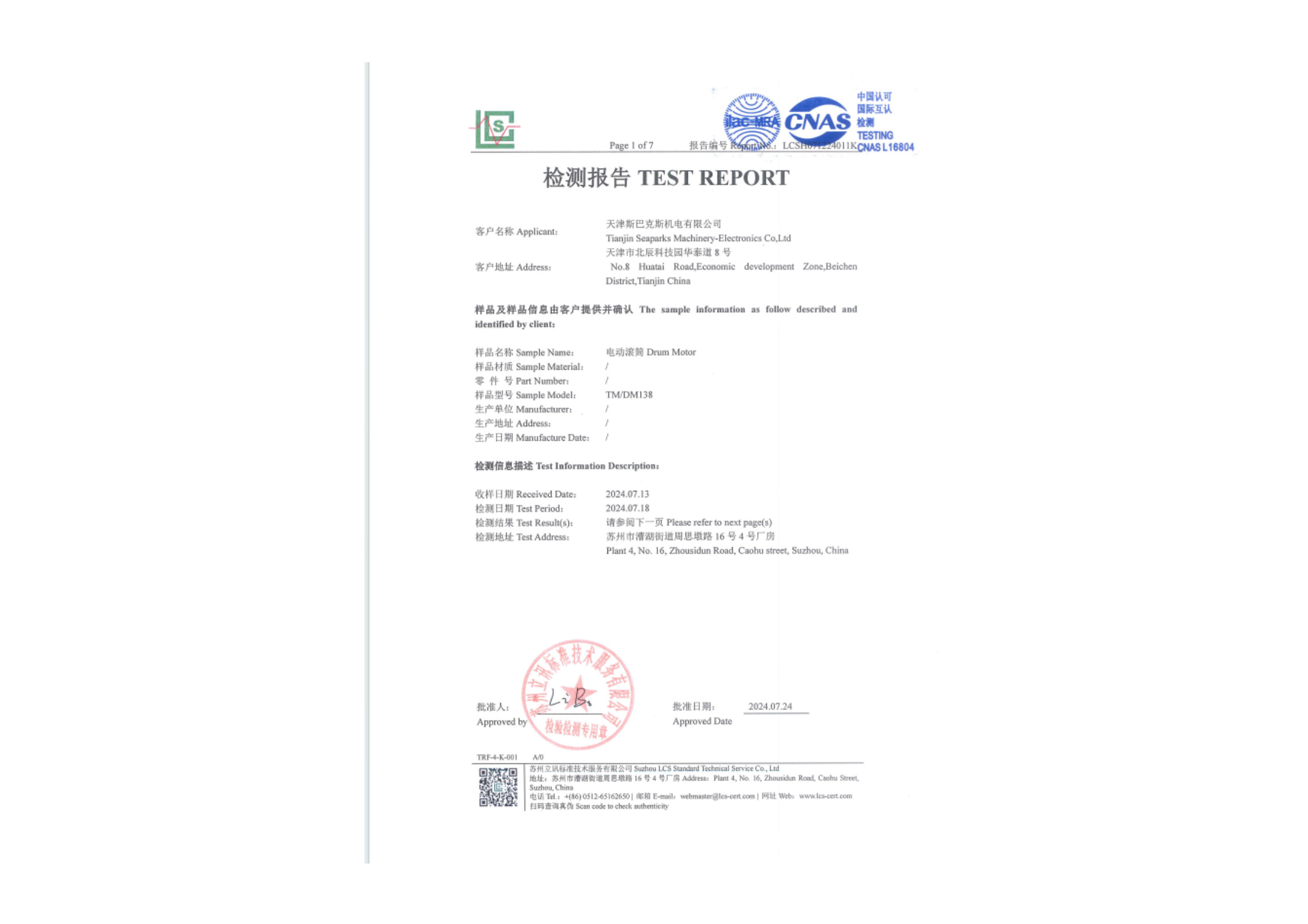
IP69K protection testing verifies resistance to high-pressure, high-temperature washdown.
Matching Roller Diameter and Minimum Width to the Conveyor Frame
Roller diameter and minimum roller width are the first physical constraints in conveyor design. These values are not arbitrary: they determine whether the drum can fit between the conveyor side frames and whether the drum shell offers enough contact area for the belt or pulley configuration.
In general, a larger roller diameter means more available contact surface and a larger internal cavity for a more powerful motor. But it also demands more physical space. The minimum roller width is particularly important because it is effectively an installation envelope: if the conveyor frame can only accommodate a narrower roller, that model cannot be installed without redesigning the end plates, bearings or belt path.
For example, an 80 mm drum motor with a 320 mm minimum roller width can be used on compact conveyor frames where a 165 mm or 216 mm drum would be physically too large. Conversely, a longer, faster or more heavily loaded washdown belt may require a 165 mm or 216 mm drum because those larger sizes support higher rated power and higher belt pull.
Model Selection by Conveyor Scenario
The SEAPARKS catalog applies its hygienic drum motor range to applications that include medium-duty belt conveyors, meat processing conveyors, food processing conveyors, packaging conveyors, belt sorting conveyors, assembly lines and agricultural product belt conveyors. The F-series is not limited to one style of conveyor; the choice is driven by belt load, belt speed, available width and frame geometry.
Compact and light washdown lines
The DM80F is the smallest hygienic model commonly selected for restricted spaces. With an 80 mm drum diameter and a minimum roller width of 320 mm, it is positioned for lower-power applications such as short food trimming belts, small packaging sections and light product movement where wet cleaning is frequent. Its published maximum belt pull is 534 N, so a conveyor designer already handling heavier loads would need to move up the range.
Mid-width conveyors needing higher belt pull
For medium belts where the frame can accept at least 370 mm between side plates, the DM113F offers 2053 N of maximum belt pull at rated speeds of 0.14 to 0.68 m/s. This makes it a sensible option when the conveyor carries meat portions, packaged food or similarly moderate loads and the line speed remains relatively low.
Where a wider speed window is preferred, the TM113F is the asynchronous counterpart in the same 113 mm diameter class. It offers up to 1.4 m/s nominal belt speed while maintaining a minimum roller width of 345 mm. This is useful for conveyors that need occasional faster product movement but still require a stainless steel, IP69K-rated drive.
Longer medium-duty food conveyors
The DM138F is a three-phase synchronous hygienic drum motor with a 138 mm roller diameter and a minimum roller width of 400 mm. Its power band reaches 0.75 to 1.5 kW, with maximum belt pull of 3965 N. This places it in a category suited to longer food or meat processing lines where belt friction and distributed product weight require greater driving force than a 113 mm drum can offer.
For projects that need even more speed flexibility, the TM138F asynchronous hygienic drum motor extends the nominal speed range to 1.69 m/s. Its minimum roller width is 350 mm, which is slightly more compact than the synchronous DM138F minimum of 400 mm.
Wide and heavily loaded processing belts
When a meat or pharmaceutical conveyor is long, wide, or carries significant product weight, a larger drum is often required. The DM165F has a 165 mm roller diameter, a minimum roller width of 470 mm, and rated power of 1.1 to 3 kW. Its maximum belt pull is 5229 N. This model is intended for heavier medium-duty washdown conveyors where a smaller drum would be undersized.
The largest model in this comparison, the DM216F, brings 4.0 to 5.5 kW of rated power and a minimum roller width of 510 mm. Its maximum belt pull of 5244 N is close to the DM165F figure, but its higher power and larger drum diameter allow it to support different operational duty profiles, including belts that must maintain speed through heavier loading or longer conveyor sections.
Conveyor width is the deciding constraint
When evaluating these models, the minimum roller width should be checked first. A frame designed for a 350 mm roller cannot accept a DM165F with its 470 mm minimum roller width unless the conveyor structure itself is changed. Only after the width envelope is confirmed should the buyer compare belt pull, speed and power.
Synchronous and Three-Phase Asynchronous Options: What the Specs Show
Within the SEAPARKS Food & Pharmaceutical category, both synchronous and asynchronous motors are available. The synchronous models begin with DM, while the asynchronous models begin with TM. This distinction is visible throughout the hygienic drum motor range.
Comparing the 113 mm and 138 mm sizes shows how the two motor families differ in published data:
| Parameter | DM113F | TM113F | DM138F | TM138F |
|---|---|---|---|---|
| Motor type | Synchronous | Asynchronous | Synchronous | Asynchronous |
| Phase | Three-phase | Three-phase | Three-phase | Three-phase |
| Maximum belt pull | 2053 N | 1469 N | 3965 N | 3525 N |
| Maximum nominal speed | 0.68 m/s | 1.4 m/s | 1.83 m/s | 1.69 m/s |
| Minimum roller width | 370 mm | 345 mm | 400 mm | 350 mm |
The presence of both motor families gives conveyor designers a choice between higher boundary belt-pull values and wider available speed ranges within a similar drum diameter class. It is up to the engineering team to decide which trade-off matches the actual belt conveyor profile.
Material Selection: 304 vs 316 Stainless Steel Housing
All F-series hygienic drum motors use a 304 stainless steel housing as standard. SEAPARKS also lists 316 stainless steel as an option.
304 stainless steel is the conventional choice for washdown equipment in food production because it provides a cleanable, corrosion-resistant surface under normal food-plant cleaning conditions. The optional 316 grade is generally considered when the conveyor will be exposed to more aggressive chemistry, such as highly chlorinated cleaners or processing environments with high salt content, although exact material selection should always be confirmed with the manufacturer against the specific cleaning routine.
Gear material remains consistent across the F-series: alloy steel. This supports the torque transmission required by belt conveyors while the stainless steel shell protects the internal motor and gear assembly from cleaning agents and high-pressure water.
Verification: IP69K, CE, UL, RoHS and ISO 9001
For industrial reference content, claims about hygiene and protection should be backed by test certificates rather than marketing language.
SEAPARKS publishes an IP69K protection rating test report issued under laboratory number LCSH071224011K by Suzhou Luxun Standard Technical Service Co., Ltd., a CNAS-accredited laboratory. The scope of that test is the high-temperature, high-pressure waterproof and dustproof protection performance of the electric drum, conducted according to ISO 20653:2023.
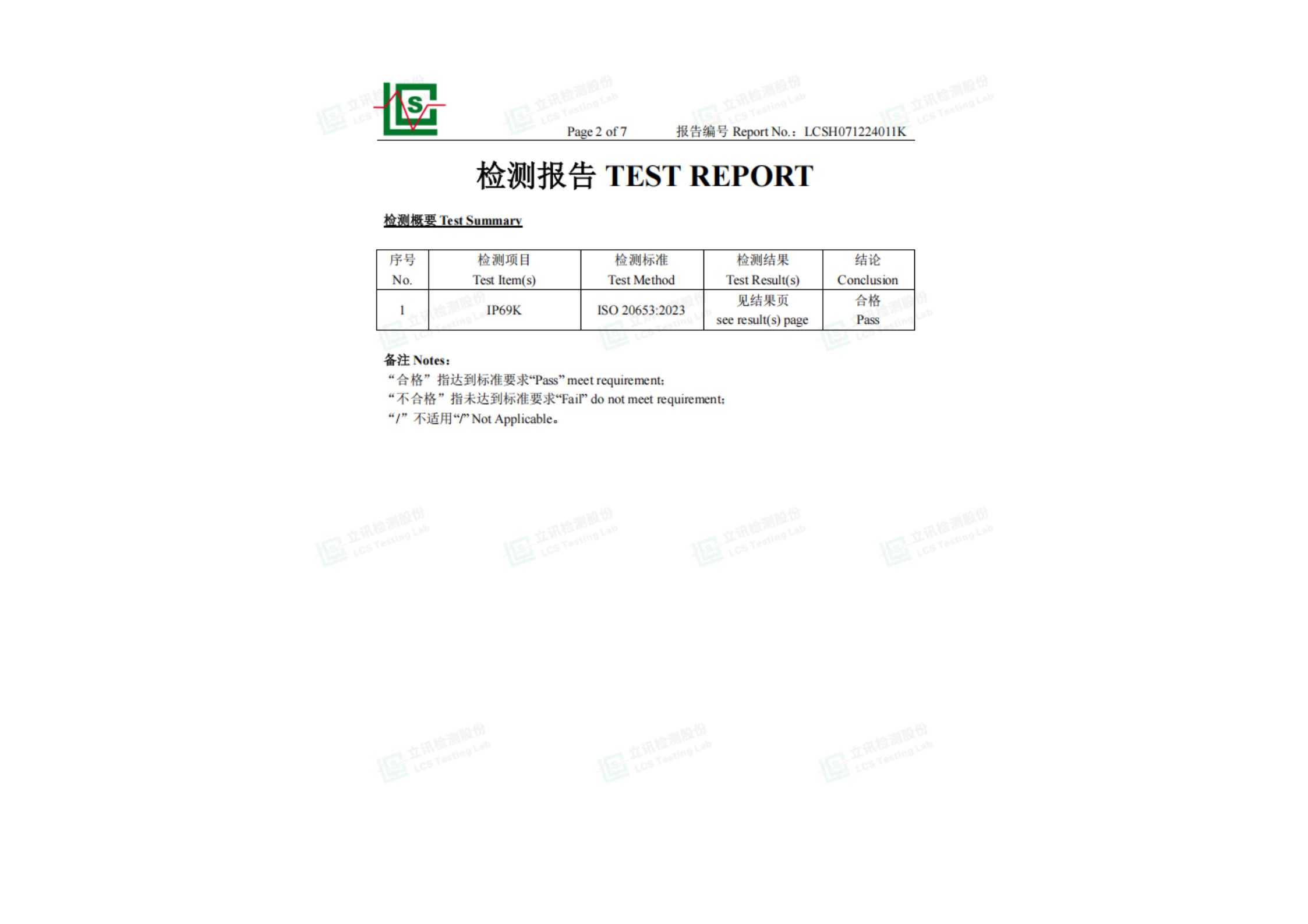
The published IP69K report covers the drum motor’s high-pressure washdown resistance.
The manufacturer also holds CE certificates covering the Low Voltage Directive 2014/35/EU and EMC Directive 2014/30/EU, with TÜV Rheinland as the issuing body. TÜV Rheinland UL certificates cover induction motors for electric drums for the USA and Canadian market. Environmental compliance is addressed by an SGS RoHS verification report under certificate TSNEC24001272701. The company also maintains an AMTIVO-registered ISO 9001:2015 quality management certificate for the manufacture of rotating drums and idler rollers.
These certificates do not, by themselves, prove that every motor in the catalog has been tested for every possible washdown condition. What they provide is verifiable evidence of the protection class and conformity claimed for the products. A buyer should request the relevant certificate numbers and check that the proposed model is within the scope of the certificate.
Market Context: Food Processing Is Driving Drum Motor Demand
Industry research supports the view that food processing requirements are becoming a more important driver for drum motor investment. A 2025 global market estimate published by Custom Market Insights places the drum motor market at approximately USD 2.13 billion, with growth attributed partly to logistics automation and partly to food processing demand. According to Dataintelo, the AC motor segment represented the dominant share of the drum motor market, at 52.3% in 2025, and Asia Pacific is projected to hold a 38.2% revenue share in the same period.
Within this environment, hygiene-sensitive industries are shifting toward drives that can tolerate more aggressive washdown procedures. IP69K-class motors have become a relevant reference point because they are tested against high-pressure, high-temperature water rather than only against splash or dripping water.
Comparison with Traditional Drive Arrangements
Traditional conveyor drive arrangements often place a motor outside the conveyor and connect it to the drive pulley through a gearbox, chain, belt or coupling. This layout can work well in dry or dusty environments, but it has consequences in hygienic applications.
A bolted-on gearmotor creates more external surface area, more paint or cast-iron surfaces, and more joints where water can become trapped. The drum motor approach removes those external components by integrating the motor and reduction gear inside the drum. For washdown-intensive meat and pharmaceutical belts, that is the central advantage.
There are, however, legitimate reasons not to treat the drum motor as a universal replacement for existing drive systems. Retrofitting a conveyor originally designed for a shaft-mounted gearmotor may require modifying the side frames or the drive pulley position. The minimum roller width must fit the existing frame, and belt speed and load must fall inside the rated window of the drum motor. For this reason, a drum motor is usually best specified when the conveyor can be designed around it or when the mechanical constraints of the existing conveyor have been measured accurately.
Limitations and Decision Boundaries
The practical boundaries of the SEAPARKS F-series should be clear to any prospective buyer. The minimum roller width table is the first check: a model cannot be fitted into a narrower frame just by reducing cut-outs or bearing spacing. The frame must physically support the full roller width listed for that model.
Duty is also bounded by the published belt-pull and speed figures. A DM80F is not intended for heavy, long, fast-moving production conveyors; those are more likely to be served by the larger F-series drums or by SEAPARKS’ other duty classifications. If a washdown conveyor needs more than 5244 N of belt pull or a belt speed beyond the listed nominal range, no model in this particular F-series subset can be selected without changing the engineering approach.
Similarly, although IP69K is a strong washdown rating, buyers should not automatically assume that one stainless steel grade is right for every chemical environment. The SEAPARKS F-series offers 316 stainless steel as an option for projects with more demanding corrosion resistance needs, and this choice should be made consciously rather than by default.
Future Outlook for Hygienic Drum Motors
Continuing hygiene regulation, customer pressure for auditable cleaning processes and the growth of packaged food are all likely to reinforce demand for conveyor drives that can withstand repeated washdown. In this context, stainless steel construction and IP69K-rated sealing are becoming baseline expectations rather than premium differentiators.
The availability of both synchronous and asynchronous versions within the same hygienic drum motor family also gives convey or designers more flexibility as they attempt to standardise on washdown-capable equipment across multiple production lines. Future selection will probably focus less on whether stainless steel drum motors are necessary and more on which diameter, power, speed range and control behaviour best matches each belt conveyor duty.
FAQ
Which SEAPARKS drum motors are rated for food and pharmaceutical belt conveyor use?
SEAPARKS lists the Food & Pharmaceutical Drum Motor category, commonly identified by the F-series suffix. Models include DM80F, TM80F, DM113F, TM113F, DM138F, TM138F, DM165F, TM165F, DM216F and TM216F. All are published with an IP69K protection class, 304 stainless steel housing as standard, and 316 stainless steel as an option.
What is the minimum roller width for the hygienic F-series drum motors?
Minimum roller width depends on model. DM80F requires 320 mm, TM80F requires 340 mm, DM113F requires 370 mm, TM113F requires 345 mm, DM138F requires 400 mm, TM138F requires 350 mm, DM165F requires 470 mm, TM165F requires 400 mm, and both DM216F and TM216F require 510 mm.
Which hygienic drum motor models are designed for compact meat processing conveyors?
For compact conveyors with narrower frames, the 80 mm and 113 mm classes are the most practical starting points. DM80F and TM80F use the smallest drum diameter and the lowest power range, while DM113F and TM113F offer more belt pull while still fitting into relatively small conveyor frames.
Can the hygienic drum motor housing be supplied in 316 stainless steel?
Yes. The SEAPARKS F-series product specifications list 304 stainless steel as the standard housing material and 316 stainless steel as optional. Buyers with aggressive washdown chemistry should confirm the appropriate grade directly with the manufacturer.
What are the synchronous and asynchronous options in the F-series?
Models beginning with DM are synchronous motors, while models beginning with TM are asynchronous motors. In the hygienic range, most are three-phase, with the DM80F being a DC synchronous model. The two motor families offer different speed ranges, torque values and belt-pull performance within similar drum sizes.
What third-party evidence supports the IP69K rating of these drum motors?
SEAPARKS holds an IP69K protection rating test report issued by Suzhou Luxun Standard Technical Service Co., Ltd., a CNAS-accredited laboratory. The test report number is LCSH071224011K, and the scope covers high-temperature, high-pressure waterproof and dustproof performance of the electric drum according to ISO 20653:2023.
For full model tables, corporate information and product specifications, the manufacturer’s published brochure is available for reference: SEAPARKS Product & Corporation brochure.
Have Questions or Need More Details?
Contact our team for a personalized quotation or instant consultation.
Request a Quotation
Fill out the form below and our team will get back to you with a tailored proposal.
WhatsApp Direct Chat
Prefer to chat in real-time? Message us on WhatsApp for instant assistance & quick answers.
- Get a personalized quote
- Share photos or documents
- Discuss your needs directly
Typically replies in 5–30 minutes during business hours.