
Hygienic Drum Motors: IP69K Washdown Models Compared for Buyers
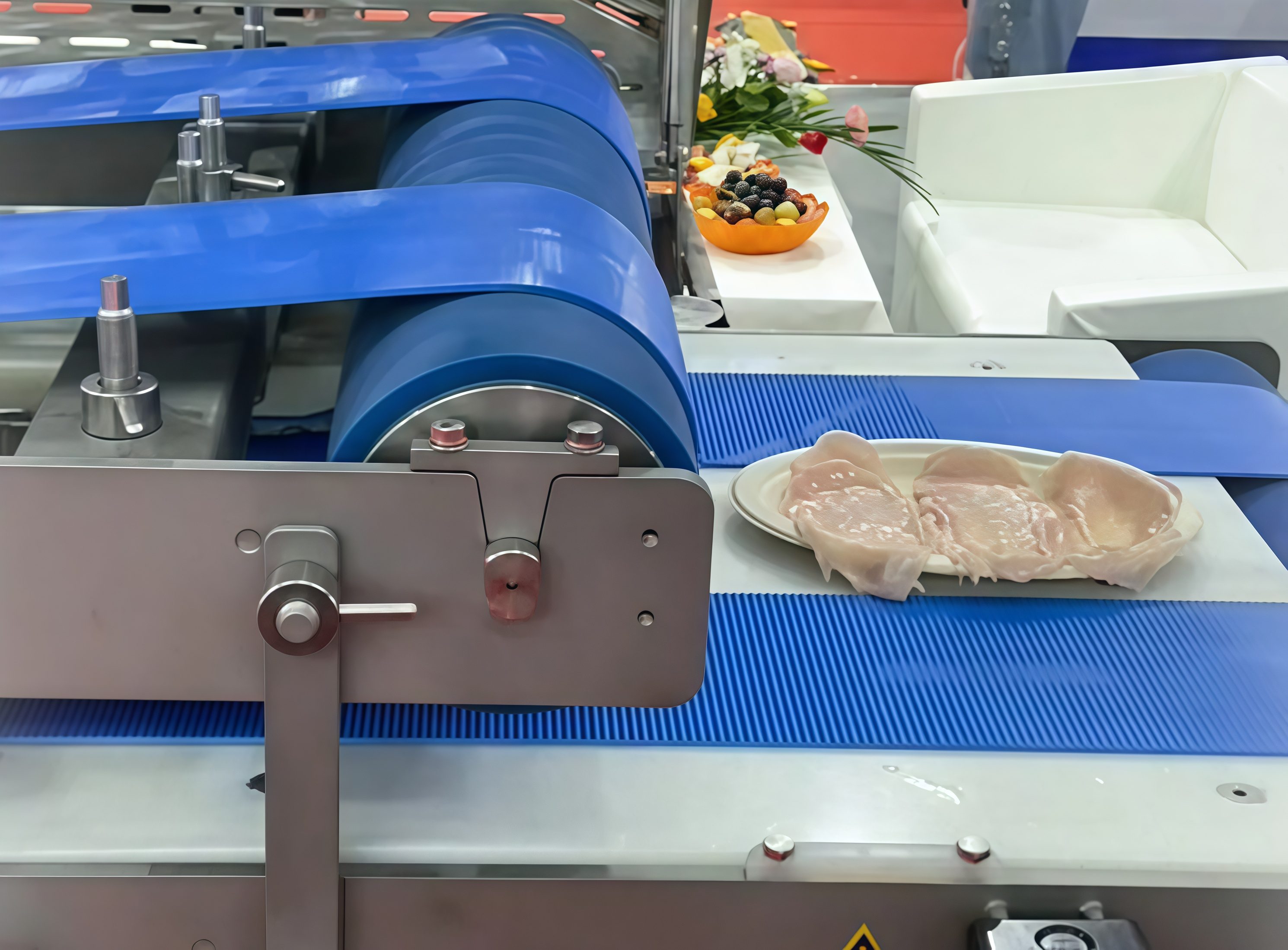
An IP69K rating is usually the first filter used by conveyor buyers, but it should not be the only one. For washdown conveyors in food and pharmaceutical plants, the practical questions after IP69K are which housing material is used, which motor principle drives the drum, how much belt pull is available, and which minimum roller width can fit the conveyor frame. This reference compares seven stainless steel, IP69K-rated drum motor models - DM80F, TM80F, DM113F, TM113F, DM138F, DM165F and DM216F - on those selection criteria.
These models are classified as food and pharmaceutical drum motors and listed for similar industry groups: medium-duty belt conveyors, meat processing conveyors, food processing conveyors, packaging conveyors, belt sorting conveyors, assembly lines and agricultural product belt conveyors. The differences that matter in a specification are therefore not industry labels but mechanical and electrical boundaries.
What IP69K does and does not tell a buyer
IP69K is the highest ingress protection level commonly referenced for hygienic conveyor drives. It confirms protection against dust ingress and against high-pressure, high-temperature washdown water. Typical test conditions for IP69K combine water pressure in the range of 1450 psi with water temperature up to 80°C, which is why conventional motors with open terminals, fans or multiple seals are difficult to make IP69K-compliant.
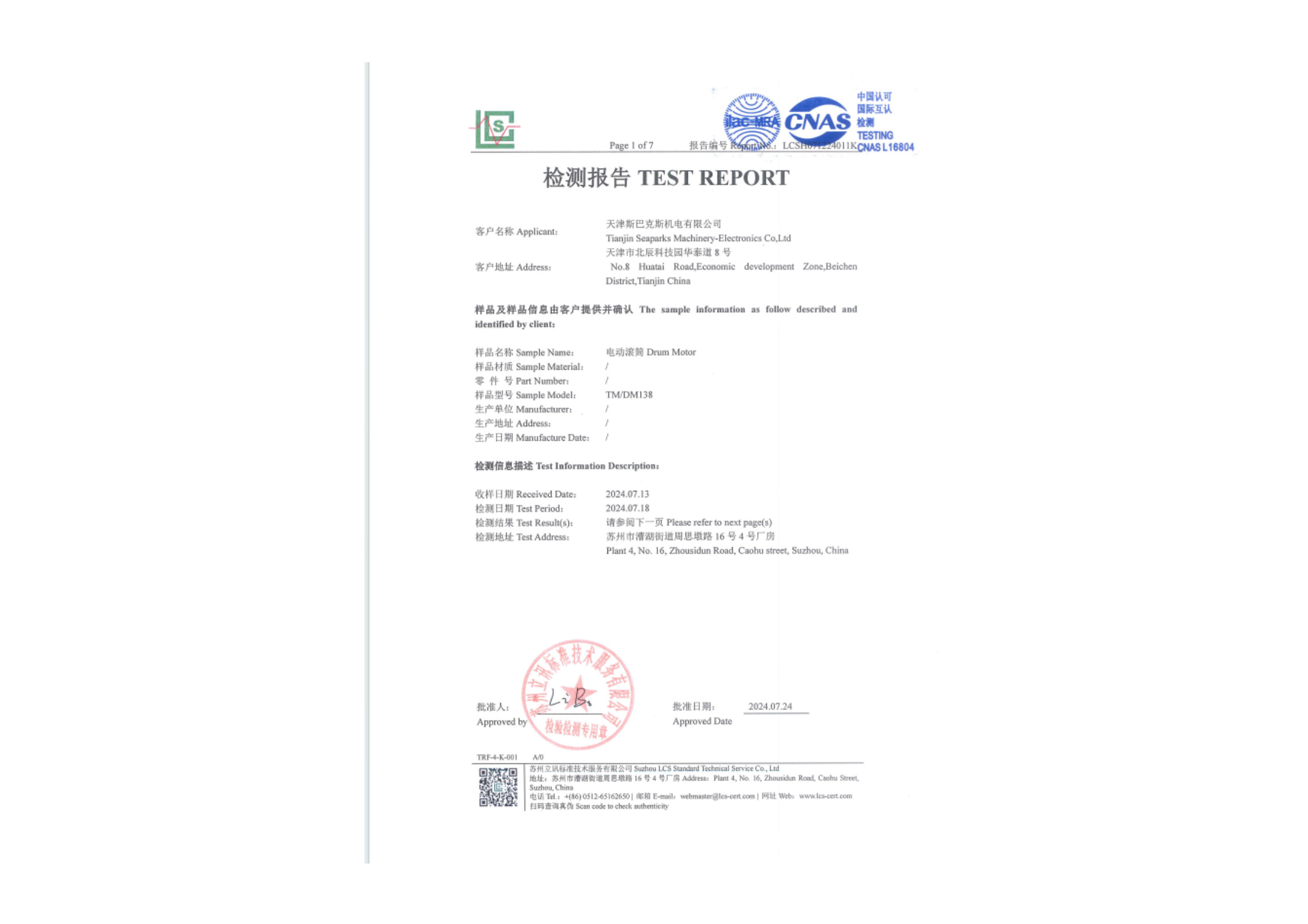
From a compliance point of view, the relevant mark should be supported by a test report, not only by a datasheet. The hygienic F-series drum motors covered in this article carry an IP69K report issued under certificate LCSH071224011K by Suzhou Luxun Standard Technical Service Co., Ltd., a CNAS-accredited laboratory. The cited test standard is ISO 20653:2023, with an issue date of 2024-07-24.
It is equally important to understand what IP69K does not guarantee. IP69K is a water and ingress test. It is not a chemical-resistance test. A line that uses aggressive caustic or chloride-based cleaners still depends on the drum material selection, which is why the stainless steel grade question belongs in the same discussion as the ingress rating.
The reference set: seven hygienic drum motor models
A practical reference set is the hygienic F-series offered by Tianjin Seaparks Machinery-Electronics Co., Ltd., a drum motor manufacturer founded in 2002 and operating from a 50,000-square-meter facility in Tianjin. Its published hygienic drum motor line covers roller diameters from 80 mm to 216 mm, which makes the series useful for comparing how material, motor type and mechanical output change across washdown options.
All seven models below share the same housing principle: 304 stainless steel as standard, 316 stainless steel as an option, and alloy steel gearing. All seven are rated IP69K. This means the remaining decision variables are the motor type, power range, torque, belt pull, belt speed band and minimum roller width.
Housing material: 304 stainless steel versus 316 stainless steel
For the listed models, the standard hygienic housing is 304 stainless steel. Where food-contact washdown is the main exposure, 304 is the specified default. Buyers that expect repeated contact with high-chloride or more aggressive chemical washdown agents can request 316 stainless steel as an option on the same models.
The option is not merely a different surface finish. 316 stainless steel adds molybdenum and is generally more resistant to chloride-induced corrosion. That distinction can be important for pharmaceutical and processed-food lines where washdown chemistry is aggressive or where the conveyor operates in a high-humidity salt environment.
Motor type: synchronous and asynchronous models in one family
In this model set, the DM prefix identifies a synchronous motor design and the TM prefix identifies an asynchronous motor design. Both variants share the hygienic stainless steel housing and IP69K construction approach.
Among the seven selected models, DM80F is specified as a DC-fed synchronous motor. DM113F, DM138F, DM165F and DM216F are three-phase synchronous motors. TM80F and TM113F are three-phase asynchronous motors. Buyers therefore have some room to match the motor characteristic to the conveyor control architecture, while keeping the same hygienic housing and protection class.
Performance comparison table
The table below focuses on the variables that most often separate one hygienic drum motor from another in an equipment review.
| Model | Motor type / phase | Roller diameter | Rated power | Rated torque | Max belt pull | Nominal belt speed | Min roller width |
|---|---|---|---|---|---|---|---|
| DM80F | Synchronous / DC | 80 mm | 0.09-0.12 kW | 3.49-21.89 Nm | 534 N | 0.16-1.03 m/s | 320 mm |
| TM80F | Asynchronous / three-phase | 80 mm | 0.04-0.12 kW | 2.96-28.91 Nm | 705 N | 0.08-1.02 m/s | 340 mm |
| DM113F | Synchronous / three-phase | 113 mm | 0.12-0.55 kW | 9.94-115.99 Nm | 2053 N | 0.14-0.68 m/s | 370 mm |
| TM113F | Asynchronous / three-phase | 113 mm | 0.12-0.55 kW | 10.34-82.99 Nm | 1469 N | 0.09-1.40 m/s | 345 mm |
| DM138F | Synchronous / three-phase | 138 mm | 0.75-1.5 kW | 27.69-273.58 Nm | 3965 N | 0.37-1.83 m/s | 400 mm |
| DM165F | Synchronous / three-phase | 165 mm | 1.1-3.0 kW | 42.49-431.44 Nm | 5229 N | 0.42-2.09 m/s | 470 mm |
| DM216F | Synchronous / three-phase | 216 mm | 4.0-5.5 kW | 182.90-568.98 Nm | 5244 N | 0.80-2.50 m/s | 510 mm |
When reviewing the table, belt pull matters more than rated power alone. Belt pull is the force transmitted to the belt, and it usually determines whether a conveyor can carry a given product load without overloading the drive. The DM80F and TM80F models are the compact end of the set, while DM165F and DM216F represent the higher belt pull and wider roller classes used on longer or heavier medium-duty belt conveyor lines.
Roller diameter and minimum roller width as selection constraints
Roller diameter has a direct relationship with available physical space and torque capacity in a drum motor. In this comparison set, the smallest diameter is 80 mm and the largest is 216 mm. Larger diameters are generally associated with larger torque values, wider roller widths and higher belt pull capability, as shown by the rated torque range of 182.90-568.98 Nm on the DM216F, versus 3.49-21.89 Nm on the DM80F.
Minimum roller width is another under-appreciated constraint. A conveyor frame that already has a fixed belt width may not be able to accept a motorized drum below the minimum face width specified for the required power class. Conversely, a compact packaging line may need the smallest possible drum envelope. For that reason, the minimum width values of 320 mm to 510 mm are not minor datasheet details; they can determine whether a model family fits the mechanical layout at all.
Washdown application patterns for these models
The application notes for the F-series hygienic models consistently point to medium-duty belt conveyors, meat processing conveyors, food processing conveyors, packaging conveyors, belt sorting conveyors, assembly lines and agricultural product belt conveyors. This makes sense: these industries share a need for clean, sealed, corrosion-resistant drives that can tolerate frequent washdown.
Specifiers comparing the seven models should map the product load to the belt pull column first. A sorting conveyor with light packaged food may be suitable for a model in the 80 mm or 113 mm class. A meat processing or heavier food processing line that requires 3965 N to 5244 N of belt pull is closer to the DM138F, DM165F or DM216F end of the range. The exact choice depends on belt weight, friction, incline, start-stop cycles and the speed range required by the process.
Market context: why hygienic drum motors are part of the wider drum motor trend
The drum motor market has been expanding as logistics automation and food processing invest in more compact conveyor architectures. Third-party estimates compiled for the global market put the 2025 market size around USD 2.13 billion by one research source, with some other published estimates reaching higher values depending on how ancillary conveyor components are included. Analysts also note that AC-based drum motor systems account for a significant share of revenue, and that food and beverage washdown lines are a major demand center for stainless steel and high-protection variants.
Regulatory context reinforces the same direction. Drum motors destined for the European market must satisfy the Low Voltage Directive 2014/35/EU and carry CE marking. For washdown machines, IP69K protection has become a hygiene-related procurement condition rather than a rare feature. Buyers evaluating hygienic drum motors are therefore increasingly expected to verify both the product specification and the compliance documentation behind it.
Comparison with conventional conveyor drives: practical trade-offs
Compared with conventional external gearmotor and gearbox arrangements, the hygienic drum motor moves the motor and gearbox inside the drum shell. The conveyor line sees fewer external protrusions, easier enclosures, less surface area for residue accumulation, and no exposed chain or sprocket path in the washdown zone. For food and pharmaceutical plants, that architecture reduces the number of cleaning boundaries that operators have to manage.
There are also real limitations that buyers should not ignore. First, IP69K protection does not make a drum motor immune to chemical attack. The housing grade, normally 304 stainless steel on these models, must be upgraded to 316 where cleaning chemistry or environmental corrosivity requires it. That upgrade is available on the seven F-series models reviewed here, but it is a material option that can affect procurement cost and lead time.
Second, the integrated design generally means that major faults inside a drum motor are resolved at the unit level rather than by swapping an external motor or gearbox. A conveyor manager may need to keep a spare drum or agree on factory repair support before using integrated hygienic drums on a critical production line. This is not an argument against drum motors; it is a practical procurement and maintenance consideration that belongs in the same evaluation as price and IP69K compliance.
Future outlook for hygienic drum motor selection
Hygienic conveyor design is moving toward longer washdown intervals, stronger cleaning chemistry and higher pressure cleaning equipment. In that environment, the IP69K rating is becoming a baseline rather than a differentiator, and material selection is gaining importance. The availability of 316 stainless steel on otherwise standard 80 mm to 216 mm drum motor models gives buyers a path to a more corrosion-resistant drive without waiting for a fully custom product.
It is also likely that buyers will request more complete technical evidence before approving a supplier: IP69K test reports, material declarations, the CE Low Voltage Directive file, EMC compliance, RoHS status, and the motor safety certificates relevant to the region of installation. The manufacturer behind the F-series holds ISO 9001, ISO 14001, ISO 45001, RoHS 2.0, UL and CE certifications, and the IP69K report is publicly tied to the hygienic drum motor product range. For purchasers, that shortens the qualification process compared with a supplier that only provides a general motor brochure.
Frequently asked questions
What is the difference between DM and TM hygienic drum motors?
In the SEAPARKS F-series reference set, DM models use synchronous motors and TM models use asynchronous motors. DM113F, DM138F, DM165F and DM216F are three-phase synchronous models, DM80F is a DC-fed synchronous model, and TM80F and TM113F are three-phase asynchronous models. All share stainless steel housing, alloy steel gearing and IP69K protection.
Which housing material should I specify for a hygienic drum motor: 304 or 316 stainless steel?
The standard housing material on the seven F-series models described in this article is 304 stainless steel, with 316 stainless steel offered as an option. 304 is the default hygienic grade. 316 provides increased resistance to chloride and more aggressive washdown chemistries and should be considered when the cleaning environment or process media creates higher corrosion risk.
What does IP69K protection mean for washdown drum motors?
IP69K is an ingress protection rating that covers dust-tightness and resistance to high-temperature, high-pressure washdown water. Typical IP69K conditions are water pressure up to about 1450 psi and water temperature up to 80°C. The F-series drum motors covered here were tested to ISO 20653:2023 by a CNAS-accredited laboratory, with report number LCSH071224011K.
How do I choose between DM80F and DM216F?
The decision starts with the belt pull and torque the conveyor requires. DM80F is the compact entry point with max belt pull of 534 N and 80 mm roller diameter, while DM216F supports max belt pull of 5244 N and rated torque up to 568.98 Nm with a 216 mm roller diameter. Minimum roller width also matters: DM216F requires at least 510 mm roller width, while DM80F can be used at 320 mm.
What certification evidence should a buyer request for hygienic drum motors?
For hygienic drum motors, the most relevant documents include the IP69K test report, CE Low Voltage compliance under 2014/35/EU, EMC compliance, UL or other regional motor safety certifications, RoHS status, and the manufacturer's ISO 9001 quality system certificate. Supporting certificates in the SEAPARKS documentation set include SGS RoHS verification, TÜV Rheinland CE and UL certificates, and an ISO 9001:2015 registration.
Reference resource: The public SEAPARKS product and corporation brochure is available for download at https://cdn.socialarks.com/sbsp/24988/common/2026/0708/Product%20%26%20Corporation%20260624.pdf.
Have Questions or Need More Details?
Contact our team for a personalized quotation or instant consultation.
Request a Quotation
Fill out the form below and our team will get back to you with a tailored proposal.
WhatsApp Direct Chat
Prefer to chat in real-time? Message us on WhatsApp for instant assistance & quick answers.
- Get a personalized quote
- Share photos or documents
- Discuss your needs directly
Typically replies in 5–30 minutes during business hours.