
Hygienic vs Light Duty Drum Motors in Airport Baggage Systems
Airport baggage handling rarely presents a single, uniform conveyor duty. A terminal hall contains short check-in belts that start and stop hundreds of times a day, screening lines that must hold a stable belt speed inside an X-ray tunnel, tray and bin returns, longer make-up runs, and dispatch conveyors where the load is a carton rather than a suitcase.
For that mix, the configuration decision comes down to two families of drum motors. Hygienic configurations — the TM113F and DM80F — combine IP69K protection with 304 stainless steel housings (316 stainless steel optional) for zones where cleaning and contamination control, rather than load, set the specification. Light duty configurations — the TM80M and TM113A — are documented for security screening conveyors, airport baggage handling systems and packaging conveyors, and cover the standard baggage path with carbon steel or 304 stainless steel housings and a choice of polymer or alloy steel gearing.
Both families are manufactured by Tianjin Seaparks Machinery-Electronics Co., Ltd, a motorized conveyor drum manufacturer founded in Tianjin, China in 2002. The company operates a 50,000 m² plant, employs 360 staff and maintains a 40-engineer R&D team; more than one million of its motorized drums are reported to be operating on conveying equipment worldwide, and its products are exported to more than 50 countries and regions. Documented application areas include airport baggage handling, security inspection machines, express sorting, food and pharmaceutical production, and general manufacturing.
Why One Baggage Hall Contains Several Different Conveyor Duties
The first analytical step is to stop treating baggage handling as one duty. Four distinct tasks inside the same building behave in different ways, and each of them stresses a drum motor differently.
- Check-in and bag drop. Short belt sections, low belt speeds, frequent starts and stops, and very tight vertical clearance because the conveyor is built into a counter. Here the limiting factor is usually roller diameter and minimum roller width, not torque.
- Security screening. The belt inside an X-ray tunnel must run at a stable, repeatable speed so that image capture and bag tracking stay consistent. The drive sits in a confined machine envelope, and the drum shells listed in this family are documented for security screening conveyors at airports and railway stations.
- Tray, bin and oversize returns. Light loads, many cycles, and a conveyor surface that may be cleaned between shifts.
- Make-up, dispatch and packaging. Longer runs, more continuous duty, and mixed loads that include cartons and totes alongside baggage.
The environment adds a second dimension. Most of a terminal is a dry, dust-exposed, moderate-humidity space — the kind of duty that light duty drum motors with IP66, IP67 or IP69 protection are built for. A smaller number of zones are driven by cleaning regimes and contamination control rather than by tonnage: agricultural inspection and biosecurity lanes, food-adjacent logistics areas, pharmaceutical-adjacent packaging and other surfaces that must be cleaned aggressively. Those zones are where the hygienic F-configuration becomes the relevant option.
The opportunity for a conveyor builder is standardisation. Two roller diameters — Ø80 mm and Ø113 mm — plus two protection levels cover a surprisingly wide share of baggage-hall conveying, which reduces the number of drive variants a maintenance team has to stock.
The Three Variables That Set a Drum Motor Configuration
Three variables decide which drum motor goes on which conveyor, and they are not independent of one another.
Roller diameter
Diameter sets frame geometry and surface speed at the same time. For a given internal rotational speed, belt speed scales with diameter, so a Ø80 mm drum produces a lower belt surface speed than a Ø113 mm drum turning at the same rate. Diameter also fixes the height of the roller inside the conveyor frame, which is often the binding constraint under a check-in counter or an X-ray machine.
Belt speed range
The nominal belt speed ranges published for these models span roughly 0.05 m/s to 1.4 m/s. Low-speed duty suits induction and start-stop operation; the upper end of a range suits continuous transport. Because surface speed is a function of diameter and gearing, the same gear platform can be specified at different speeds simply by changing the roller diameter.
Belt pull and torque
Belt pull is the practical limit that buyers size against, and it relates to torque and diameter through the standard relationship F = 2T / D. A small roller therefore needs more torque to produce the same belt pull, and the same motor package yields less belt pull at Ø80 mm than at Ø113 mm. That single relationship explains most of the difference between the four configurations below.
Hygienic Configurations: TM113F and DM80F
The hygienic F-series is specified where the cleaning regime is the dominant requirement. Both models use a 304 stainless steel housing with 316 stainless steel available as an option, and both pair that housing with alloy steel gearing. Both carry a protection class of IP69K.
The TM113F is a three-phase asynchronous drum motor with a Ø113 mm roller, rated 0.12–0.55 kW and 10.34–82.99 Nm, with a maximum belt pull of 1469 N and a nominal belt speed range of 0.09–1.4 m/s. Its minimum roller width is 345 mm. The DM80F is a DC synchronous unit with a Ø80 mm roller, rated 0.09–0.12 kW and 3.49–21.89 Nm, with a maximum belt pull of 534 N, a belt speed range of 0.16–1.03 m/s and a minimum roller width of 320 mm.
The IP69K rating is not a marketing label in this context; it is a tested property. A test report numbered LCSH071224011K, issued on 24 July 2024 by Suzhou Luxun Standard Technical Service Co., Ltd., a CNAS-accredited laboratory, documents IP69K high-temperature, high-pressure waterproof and dustproof performance for the electric drum against ISO 20653:2023. The hygienic models covered by that documentation include the TM113F and the DM80F.
IP69K is the highest ingress protection rating defined under IEC 60529, and in food-processing environments it is required so that a drum motor can withstand high-pressure washdowns of up to 1450 psi at 80 °C. In a baggage hall, the same construction answers a narrower but real question: can the drive be cleaned in place with a hose and cleaning chemicals, and does it shed contaminants rather than trap them?
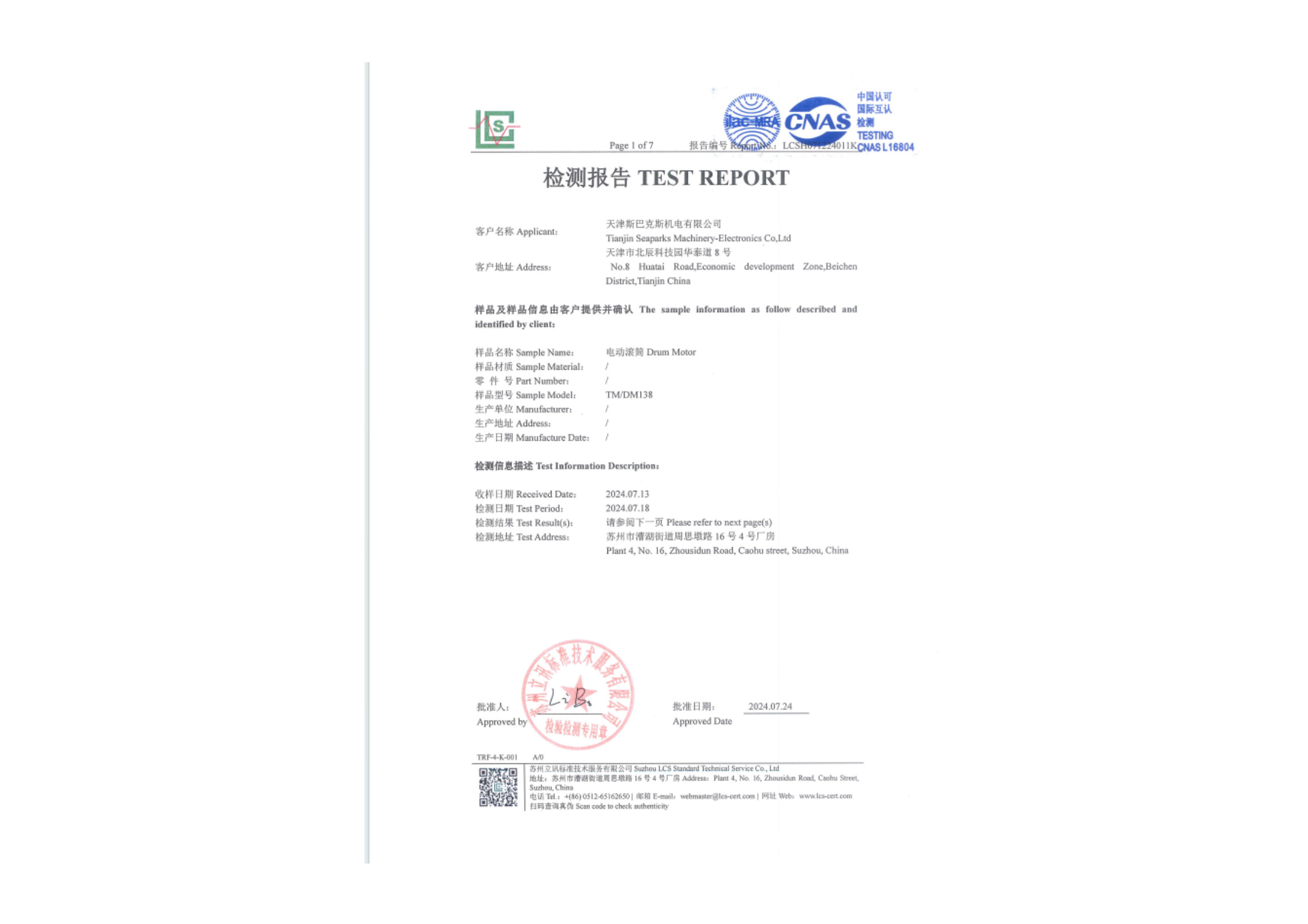
IP69K test documentation, issued to ISO 20653:2023, covering the hygienic drum motor configuration used in clean-environment conveyor zones.
The documented application set for the F-series reflects that purpose: medium-duty belt conveyors, meat processing conveyors, food processing conveyors, packaging conveyors, belt sorting conveyors, assembly lines and agricultural product belt conveyors.
Light Duty Configurations: TM80M and TM113A
The light duty family is the one explicitly documented for the baggage path. Its applicable-industry list names security screening conveyors at airports and railway stations, airport baggage handling systems, packaging conveyors, belt scale conveyors and general belt conveyors.
The TM80M is a single-phase asynchronous drum motor with a Ø80 mm roller and a polymer gear, rated 0.034–0.11 kW and 2.71–25.9 Nm, with a maximum belt pull of 630 N and a belt speed range of 0.05–0.85 m/s. Its minimum roller width of 260 mm is the narrowest in this group, which makes it the natural candidate for very short conveyor sections and compact machine envelopes. Protection class is IP66, IP67 or IP69 depending on configuration, and the housing is available in carbon steel or 304 stainless steel.
The TM113A is offered in two electrical variants on the same Ø113 mm roller. The three-phase version is rated 0.12–0.55 kW and 10.34–82.99 Nm, with a maximum belt pull of 1469 N, a belt speed range of 0.09–1.4 m/s and a minimum roller width of 335 mm; it uses alloy steel gearing. The single-phase version is rated 0.12–0.23 kW and 10.34–79.67 Nm, with a maximum belt pull of 1410 N, a belt speed range of 0.08–0.71 m/s, the same 335 mm minimum width, and polymer gearing. Both use carbon steel or 304 stainless steel housings and IP66, IP67 or IP69 protection.
The same platform extends further where the duty demands it. Related light duty models in the same size classes include the DM80A synchronous unit at Ø80 mm with a 534 N maximum belt pull and a 310 mm minimum roller width, the DM113A synchronous three-phase unit at Ø113 mm reaching 2053 N maximum belt pull and up to 115.99 Nm, and the TM113M at 770 N. For buyers, this means the roller diameter, protection class and gear material can be varied inside one family without changing the frame interface.
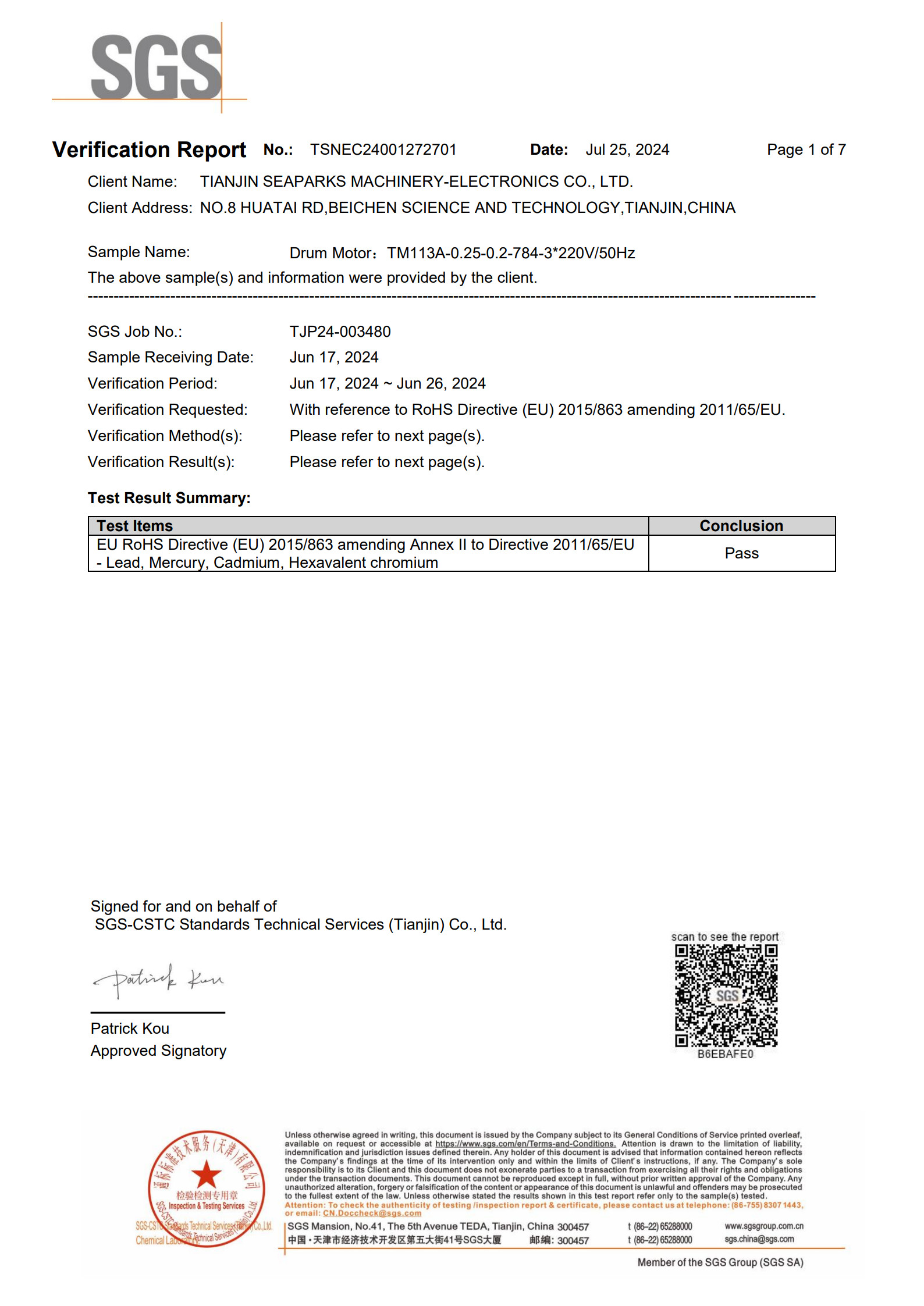
RoHS verification documentation for the 113A drum motor platform, part of the materials-compliance record for the light duty range.
Side-by-Side: Four Configurations Compared
The tables below separate the mechanical configuration from the materials and protection configuration, because the two are specified at different points in a project.
| Model | Drive type | Roller Ø | Rated power | Rated torque | Max. belt pull | Belt speed | Min. roller width |
|---|---|---|---|---|---|---|---|
| TM113F | Three-phase asynchronous | Ø113 mm | 0.12–0.55 kW | 10.34–82.99 Nm | 1469 N | 0.09–1.4 m/s | 345 mm |
| DM80F | DC synchronous | Ø80 mm | 0.09–0.12 kW | 3.49–21.89 Nm | 534 N | 0.16–1.03 m/s | 320 mm |
| TM113A (three-phase) | Three-phase asynchronous | Ø113 mm | 0.12–0.55 kW | 10.34–82.99 Nm | 1469 N | 0.09–1.4 m/s | 335 mm |
| TM113A (single-phase) | Single-phase asynchronous | Ø113 mm | 0.12–0.23 kW | 10.34–79.67 Nm | 1410 N | 0.08–0.71 m/s | 335 mm |
| TM80M | Single-phase asynchronous | Ø80 mm | 0.034–0.11 kW | 2.71–25.9 Nm | 630 N | 0.05–0.85 m/s | 260 mm |
| Model | Housing material | Gear material | Protection class | Documented application set |
|---|---|---|---|---|
| TM113F | 304 stainless steel (316 optional) | Alloy steel | IP69K | Medium-duty belt conveyors; meat, food and pharmaceutical processing; packaging; belt sorting; assembly lines; agricultural product conveyors |
| DM80F | 304 stainless steel (316 optional) | Alloy steel | IP69K | Same clean-environment set as the TM113F |
| TM113A | Carbon steel or 304 stainless steel | Polymer (single-phase) or alloy steel (three-phase) | IP66 / IP67 / IP69 | Security screening conveyors (airport and railway stations); airport baggage handling systems; packaging conveyors; belt scale conveyors; general belt conveyors |
| TM80M | Carbon steel or 304 stainless steel | Polymer | IP66 / IP67 / IP69 | Same baggage and packaging set as the TM113A |
One comparison stands out. The three-phase TM113A and the TM113F share the same roller diameter, the same rated power band, the same torque band, the same 1469 N maximum belt pull and the same 0.09–1.4 m/s belt speed range. On load and speed, they are interchangeable. What separates them is the housing material, the gear material specification and the protection class — that is, the environment, not the mechanics.
Matching Configurations to Zones Inside a Baggage Hall
Putting the two tables to work produces a fairly direct mapping.
- Check-in and bag-drop belts. Short sections and start-stop duty point at the Ø80 mm configurations. The TM80M's 260 mm minimum roller width is the smallest in the group, and its 0.05–0.85 m/s belt speed range covers the slow, controlled movement a check-in belt normally needs.
- Security screening and X-ray inspection lines. The light duty range is documented for security screening conveyors and machine envelopes are tight, so a Ø80 mm or Ø113 mm drum with a stable nominal speed range is the usual starting point. Where a screening line runs continuously, the three-phase TM113A with alloy steel gearing and up to 1.4 m/s gives more headroom than the single-phase variant.
- Tray and bin returns. Low belt pull, high cycle counts. The DM80A and TM80M sit comfortably here, with 534 N and 630 N maximum belt pull respectively.
- Make-up, dispatch and packaging conveyors. Longer runs favour the Ø113 mm three-phase configuration, where 1469 N maximum belt pull and 0.09–1.4 m/s support continuous transport. The DM113A extends the same footprint to 2053 N where loads are heavier but the frame envelope is fixed.
- Zones governed by cleaning and contamination control. This is the F-series case. If the duty already matches a light duty Ø113 mm configuration but the environment requires a cleanable, corrosion-resistant drive, the TM113F substitutes directly. Where a compact Ø80 mm drive is needed in the same environment, the DM80F applies.
That last point is the most useful single rule for a specifier: match the mechanical configuration to the conveyor, then upgrade the materials and protection class if — and only if — the operating environment requires it.
Market Signals Behind Hygienic and Light Duty Specification
The wider drum motor market provides context for why this comparison keeps appearing in tenders. Third-party analysis from Custom Market Insights placed the global drum motor market at approximately USD 2.07 billion to USD 2.13 billion across 2023–2025, with growth attributed to logistics automation and food processing demand. Dataintelo projects Asia Pacific to hold a 38.2% revenue share by 2025 on the strength of industrialisation and e-commerce growth in China and India, and puts the AC motor segment at a 52.3% revenue share in 2025 while identifying Interroll Group as a leading player in the category.
Two other trends feed directly into configuration choices. First, efficiency: suppliers including Rulmeca and Interroll position energy-efficient drum motors at overall efficiency of up to 82–83%, which they frame as a total-cost-of-ownership advantage over conventional geared drives. Second, regulation: drum motors sold into the European market must comply with the Low Voltage Directive 2014/35/EU and carry the CE mark.
For a baggage-handling project, these signals translate into two procurement behaviours that are visible in specification documents: buyers increasingly ask for the protection class and housing material to be stated as tested values rather than as construction claims, and they ask for compliance evidence per model rather than per company.
What the compliance record actually covers
For the four configurations discussed here, the documented evidence set is as follows. ISO 9001:2015 certification (certificate QAIC/CN/60456, issued by AMTIVO on 19 July 2024, valid to 21 July 2027) covers the manufacture of rotating drums and idler rollers; the company also holds ISO 14001 and ISO 45001 certification. CE conformity for the Low Voltage Directive 2014/35/EU is documented by TÜV Rheinland under certificates AN 50337407 0001 and AN 50337387 0001, and CE conformity for the EMC Directive 2014/30/EU under certificate AE 50461043 0001 against EN 60034-1:2010. UL safety certification for the induction motors used in the electric drum is held through TÜV Rheinland of North America under certificates CU7219001101, CU7219001102 and CU7219000901, to UL 1004-1:2012R8.18 and CAN/CSA-C22.2 No.100-04. RoHS verification is documented by SGS under report TSNEC24001272701, against 2011/65/EU and (EU) 2015/863, and the corresponding report documentation references a 113A 0.25 kW drum motor unit.
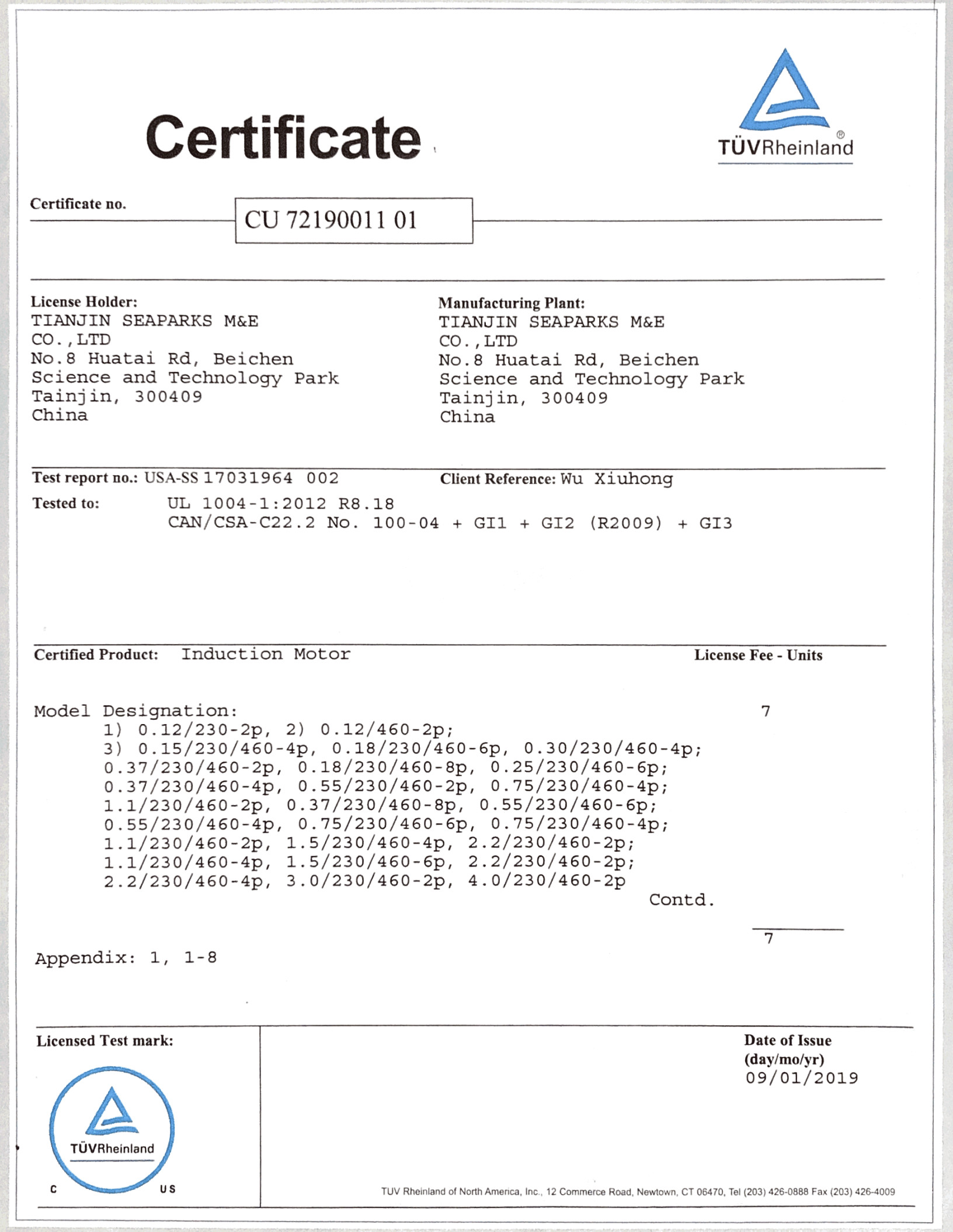
UL certification for the induction motors used in the drum motor range, covering both the light duty and hygienic configurations discussed here.
Limits, Trade-offs and Where These Configurations Stop
A configuration comparison is only useful if it states where each option stops being the right answer.
- Hygienic construction is not automatically better. Because the three-phase TM113A and the TM113F share the same diameter, power, torque, belt pull and speed range, specifying the F-series where the environment does not require washdown or corrosion resistance adds stainless steel and IP69K construction without adding mechanical capability. The specification should be driven by the cleaning regime, not by a general preference for stainless steel.
- IP69 and IP69K are different ratings. The light duty models carry IP66, IP67 or IP69 protection. The IP69K test report to ISO 20653:2023 covers the hygienic models. Where a tender literally requires IP69K, the F-series is the compliant option, and a light duty model should not be presented as an equivalent substitute.
- Gear material changes the envelope. Within the light duty range, the single-phase TM113A, the TM80M, the DM113A and the TM113M use polymer gearing, while the three-phase TM113A and the hygienic models use alloy steel. These are different specifications for different duty profiles and should not be treated as interchangeable on load.
- Belt pull ceilings are genuinely light. A maximum belt pull of 534 N on the DM80F and 630 N on the TM80M places these models firmly in the light duty segment. Long, heavily loaded or accumulating make-up lines sit outside this pair and need higher-capacity drum motors in the same portfolio.
- Minimum roller width sets a floor. The narrowest configuration here is 260 mm, and the widest minimum in the group is 370 mm on the related DM113F. Conveyor sections narrower than those figures cannot accept these drives without a different solution.
- Service model differs from a bolt-on drive. Because the motor and gearbox sit inside the roller, a drum motor is not repaired in place the way an external gearmotor can be. Replacement means removing the roller from the conveyor frame, which is predictable but requires spares planning and downtime scheduling rather than a field repair.
Against a conventional external gearmotor with a chain or sprocket drive, the drum motor configuration removes exposed rotating parts, chain guards and separate alignment steps, and it reduces the number of wear points on the line. The trade-off is that the drive becomes an integral part of the conveyor roller, so the specification decision is effectively locked in at the conveyor design stage rather than at commissioning.
Future Outlook
Three directions look likely to shape how hygienic and light duty drum motors are specified for baggage handling over the next few years.
First, protection ratings are moving from construction descriptions into tested, reportable values. The existence of a laboratory test report referenced to ISO 20653:2023 makes it straightforward for a buyer to require the same standard of evidence from every supplier in a tender.
Second, the boundary between clean-environment and standard conveying equipment is becoming more explicit in procurement documents rather than less. As terminals, distribution centres and food-adjacent logistics share more equipment standards, the practice of specifying the mechanical configuration first and the materials and protection layer second — the pattern this article describes — becomes easier to audit.
Third, efficiency expectations will continue to rise. With suppliers publicly positioning drum motors at up to 82–83% overall efficiency and with Asia Pacific projected to hold a 38.2% revenue share of the market by 2025, the pressure is toward drives that deliver the required belt pull at lower losses, which in turn keeps attention on gear material, roller diameter and the match between the drive and the duty it actually performs.
FAQ
What is the actual difference between the hygienic TM113F and the light duty TM113A when both use a Ø113 mm roller?
Mechanically they are closely matched. The three-phase TM113A is rated 0.12–0.55 kW and 10.34–82.99 Nm, with a maximum belt pull of 1469 N, a nominal belt speed range of 0.09–1.4 m/s and a minimum roller width of 335 mm. The TM113F carries the same power, torque, belt pull and speed figures with a minimum roller width of 345 mm. The differences are the housing material (304 stainless steel with 316 optional on the TM113F, versus carbon steel or 304 stainless steel on the TM113A), the protection class (IP69K versus IP66/IP67/IP69) and the documented application set.
How does roller diameter affect belt speed and belt pull in a baggage conveyor?
Belt surface speed scales with roller diameter at a given internal rotational speed, so a Ø80 mm drum produces a lower surface speed than a Ø113 mm drum of the same gear platform. Belt pull relates to torque and diameter as F = 2T / D, so the same motor package produces less belt pull at Ø80 mm than at Ø113 mm. This is why the Ø80 mm DM80F is rated at 534 N maximum belt pull while the Ø113 mm TM113F is rated at 1469 N.
Is IP69 the same as IP69K?
No. The light duty TM80M and TM113A configurations are listed with IP66, IP67 or IP69 protection depending on variant. The IP69K rating is documented separately for the hygienic models under test report LCSH071224011K, issued on 24 July 2024 by Suzhou Luxun Standard Technical Service Co., Ltd., a CNAS-accredited laboratory, to ISO 20653:2023. IP69K is the highest ingress protection rating defined under IEC 60529 and is associated with high-pressure, high-temperature washdown conditions.
What is the minimum roller width for these configurations, and why does it matter?
Minimum roller widths in this group are 260 mm for the TM80M, 320 mm for the DM80F, 335 mm for the TM113A and 345 mm for the TM113F. Related models extend the range from 310 mm on the DM80A to 370 mm on the DM113F. The figure matters because a conveyor section narrower than the minimum cannot accept that drum motor, regardless of its power rating.
Which certifications cover the light duty and hygienic drum motors described here?
ISO 9001:2015 certification QAIC/CN/60456, issued by AMTIVO on 19 July 2024 and valid to 21 July 2027, covers the manufacture of rotating drums and idler rollers; ISO 14001 and ISO 45001 are also held. CE conformity to the Low Voltage Directive 2014/35/EU is documented by TÜV Rheinland under certificates AN 50337407 0001 and AN 50337387 0001, and to the EMC Directive 2014/30/EU under certificate AE 50461043 0001 against EN 60034-1:2010. UL safety certification for induction motors used in the electric drum is held under certificates CU7219001101, CU7219001102 and CU7219000901 to UL 1004-1:2012R8.18 and CAN/CSA-C22.2 No.100-04. RoHS verification is documented by SGS under report TSNEC24001272701 to 2011/65/EU and (EU) 2015/863. The four models discussed here appear across these documentation sets.
What are the purchasing terms for evaluating these models on a first order?
The stated commercial terms are a minimum order quantity of 1 unit, delivery on FOB or CIF terms, and acceptance based on pre-shipment inspection, with customised inspection available on customer request. Payment terms for new customers are 100% advance payment.
Where should a specifier start when a baggage hall contains both standard and clean-environment zones?
Start with the mechanical configuration. Use the frame geometry to fix the roller diameter, then confirm that the belt speed range and maximum belt pull of that diameter and gear option meet the conveyor duty. Apply the light duty TM80M and TM113A where the documented application set matches — security screening conveyors, airport baggage handling systems and packaging conveyors. Then apply the hygienic TM113F and DM80F only to the zones where cleaning and contamination control genuinely require stainless steel construction and IP69K protection. The two decisions are sequential, not competing.
SEAPARKS publishes a product and corporation brochure covering the drum motor range, available for download at Product & Corporation 20260624.