
Ice Cream Machine Compliance: Interpreting SS304/SS316, CIP & Acceptance
Ice Cream Machine Compliance: Interpreting SS304/SS316, CIP & Acceptance
An industrial ice cream machine can carry several CE certificates, a "food grade stainless steel SS304 / SS316" line in its datasheet, and a CIP circuit on its drawings, and still leave a buyer unable to answer the only question that decides the order: which of those claims applies to the exact model being purchased, the exact product format being produced, and the exact market being exported to?
This is not primarily a documentation problem. It is an interpretation problem. Compliance claims for ice cream equipment sit in three different layers — material specification, process and cleanability design, and scoped documentary evidence — and they only become usable for procurement when a buyer keeps those layers apart and ties each one to a verifiable item in the purchase order.
Snowball Machinery Manufacturing Co., Ltd is an ice cream equipment manufacturer that integrates R&D, manufacturing, assembly, commissioning, export, domestic sales and after-sales service, and reports a portfolio spanning premix preparation, HTST and batch pasteurizing, ageing, CIP, continuous freezing, inclusion feeding, moulding, extrusion and hardening, filling, packaging and cartoning. That breadth is precisely why interpretation matters: a wide portfolio generates many claims, and only some of them apply to a given line.
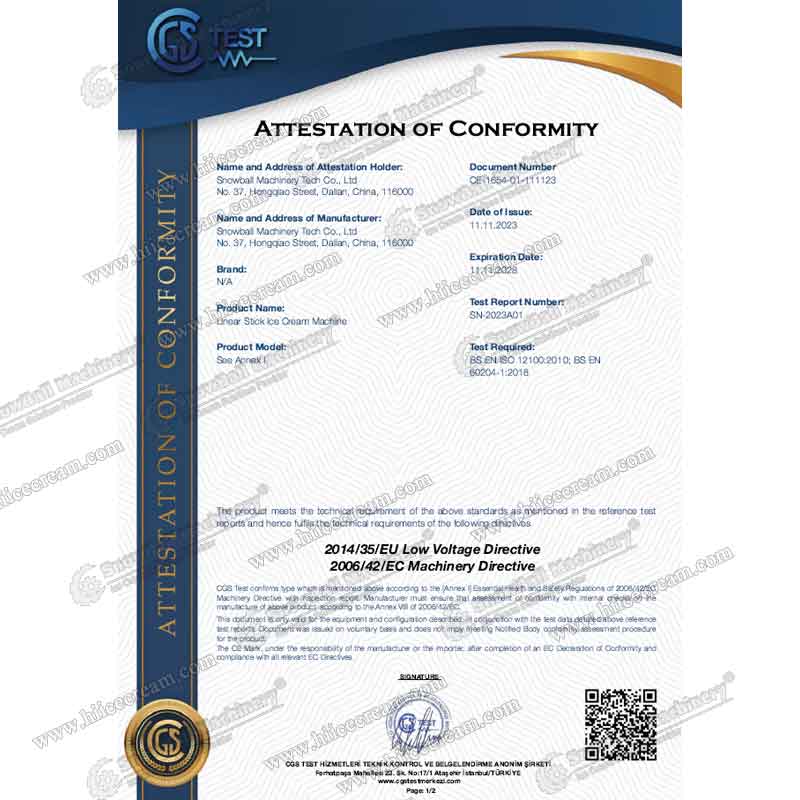
Certificates are scoped documents. CE-1654-01-111123 was issued for the linear stick ice cream machine, not for an entire equipment portfolio.
Why "certified" and "food-grade" are not qualification answers
A manufacturer's product page is a scope statement, not a qualification conclusion. Independent review of company-reported portfolio pages notes that listing an equipment category does not by itself verify production capacity, certification coverage, installed base or customer references. The same logic applies to compliance vocabulary: "food-grade", "hygienic design" and "fully certified" describe intentions unless they are attached to a grade, a standard number, a model, a validity period and a test method.
At the Evaluation-to-Execution transition, the buyer's task changes shape. During evaluation, the question is whether a supplier can plausibly serve the project. During execution, the question narrows and hardens: what exactly is being delivered, against which document, verified by whom, and at what point in the commercial sequence.
The three layers that make this answerable are:
- Material specification — the actual grade of the food-contact surfaces, fixed per equipment item rather than quoted as a range.
- Process and cleanability design — how pasteurizing, ageing and cleaning are engineered into the wet side of the line.
- Documentary evidence — certificates with scope and validity, component identification, test records, and acceptance criteria agreed before shipment.
Buyers who collapse the three layers into a single "is it certified?" question end up comparing procurement language instead of equipment.
SS304 and SS316: what the material claim actually specifies
Across machine families including the SNL moulded stick line, the SNCF continuous freezer, the SNEX extrusion and hardening line, the SNSMZ sandwich machine, the SNLF filling machine, the SNFF ingredient feeder, the SNM mixing and pasteurizing platform, the SNP production line and the SNB associated machines, Snowball Machinery lists material as "high quality food grade stainless steel SS304 / SS316". Read carefully, that is a grade range, not a specification. A range is what a portfolio page can offer; a fixed grade per item is what an order needs.
| Dimension | SS304 | SS316 |
|---|---|---|
| Alloy character | Austenitic stainless steel without a molybdenum addition | Austenitic stainless steel containing molybdenum |
| Corrosion behaviour | Generally adequate for standard food-contact duty | Generally higher resistance to chlorides and aggressive cleaning environments |
| Where it appears in ice cream lines | Widely used across mixing, filling, forming and packaging surfaces | Often specified where product chemistry, cleaning regime or market requirements are more demanding |
| Snowball Machinery documentation | Listed as food grade stainless steel SS304 / SS316 across machine families | |
| Reported project example | European sandwich line reported as built in food grade 304 stainless steel for EU food safety compliance | Long-established manufacturer line upgrade reported as using food grade 316 stainless steel to comply with North American production requirements |
The two reported projects are the useful part of this comparison, because they show grade selection as a fit decision rather than a ranking. A European ice cream sandwich making machine was reported as constructed with food grade 304 stainless steel for hygiene compliance, while a line upgrade for a long-established manufacturer used food grade 316 stainless steel to align with North American production compliance requirements. Neither choice is automatically "better"; each follows the product, the cleaning environment and the destination market.
For procurement, the practical rule is simple: require the grade to be stated per equipment item in the order, and require the supporting material documentation for the surfaces actually delivered. A range on a datasheet is a starting point for negotiation, not an acceptance criterion.
CIP in the SNM mixing machine: cleanability as an engineering claim
The SNM mixing and processing platform lists HTST system, HTST pasteurization, batch pasteurizing system, homogenizer, ageing tank, chocolate tank and holding tank, CIP cleaning, chiller water system, water cooled chiller and high shear mixer. The structural fact worth noting is that CIP appears inside the wet-side group rather than as an accessory. That tells a buyer cleanability was treated as part of the process platform; it does not, on its own, tell a buyer how far cleaning extends on a specific order.
Circuit-level coverage is the qualification question, and it is answered with documents rather than adjectives. A buyer preparing an order for a complete ice cream processing machine line should expect to receive, and should be able to review:
- Piping and instrumentation drawings that identify which vessels, product lines and filling circuits are cleaned in place and which are dismantled for cleaning.
- The cleaning procedure for the delivered configuration, including how the cycle is initiated, monitored and closed out.
- The instrumentation included for cleaning control, and whether its readings are recorded or only displayed.
- Drainability and geometry review, since residue risk lives in the details of slope, dead legs and vessel outlets.
For a turnkey ice cream machine solution, CIP scope should be agreed at the same time as throughput, because cleaning design constrains changeover and therefore effective capacity. It is one of the few compliance topics that directly affects daily production economics rather than only paperwork.
HTST and batch pasteurizing: two paths, two documentation sets
Snowball Machinery lists both an HTST system and a batch pasteurizing system within the SNM platform, alongside premix equipment, ageing tanks and homogenizers. Continuous high-temperature short-time processing and batch vessel processing are different process architectures, and they produce different qualification packages: different control documentation, different cleaning schedules, different instrumentation sets and different acceptance test formats.
Buyers frequently blur this distinction when comparing quotations, because both are described as "pasteurizing". That blurring is a commercial risk. The pasteurizing category determines how many vessels, circuits and instruments are in scope, how the operator interfaces with the process, and how a pre-shipment test can realistically be run. An industrial ice cream machine system quoted for batch pasteurizing is not interchangeable with one quoted for HTST, even when headline throughput looks comparable.
The qualification rule here is sequencing: agree the process architecture first, then the certificates and acceptance criteria that describe it. Reading a certificate before deciding whether the line is continuous or batch produces confident answers to the wrong question.
Component brands as a verifiable specification
Component identification is one of the few compliance topics that converts directly into a checkable line item. Snowball Machinery states that main components adopt internationally renowned brands including SIEMENS, Schneider Electric, FESTO, SMC, Danfoss, ABB, Bonfiglioli, igus, Copeland, Bitzer and SEW Eurodrive, and this statement appears consistently across product families such as the SNL stick line, SNCF continuous freezer, SNEX extrusion line, SNSMZ sandwich machine, SNLF filling machine, SNFF ingredient feeder, SNM mixing platform, SNB associated machines and SNP production line.
For a buyer, a named component list does three things: it makes the equipment comparable against another quotation at the part level, it connects maintenance planning to established spare-part and service channels, and it gives the acceptance process something objective to check against the delivered machine.
Reading the certificates: scope, standard, validity
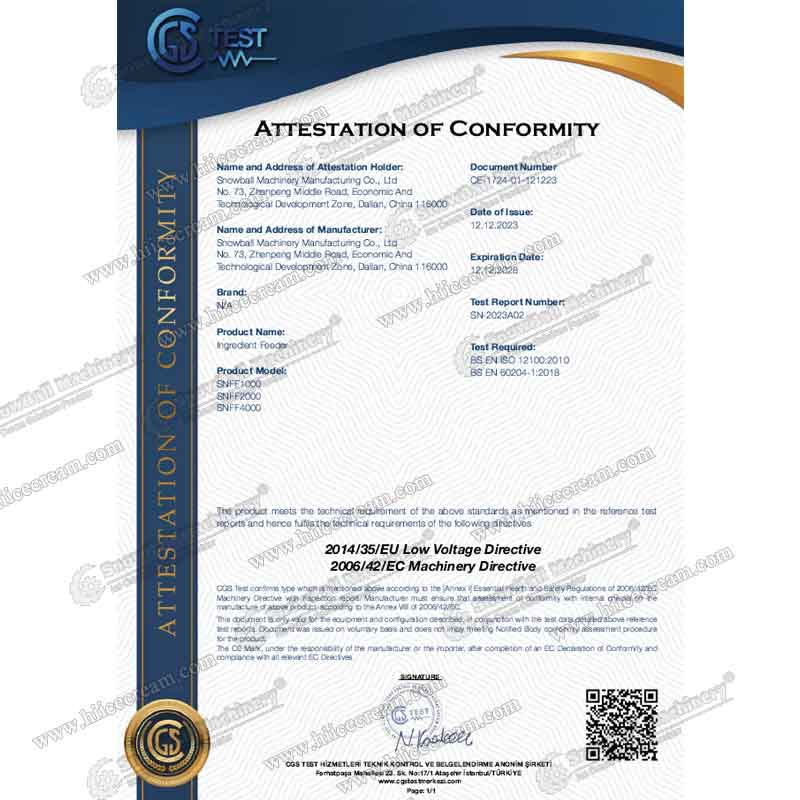
CE-1724-01-121223 covers the SNFF1000, SNFF2000 and SNFF4000 ingredient feeders — an example of model-scoped certification.
The documented CE certificates in the Snowball Machinery portfolio illustrate how scope works in practice. Each certificate names a machine, an issuing body, a standard set and a validity window.
| Certificate number | Scope | Issued by | Standard referenced | Validity |
|---|---|---|---|---|
| FQC2506302 | Rotary moulded stick ice cream machine (SNL) | FQC STANDARD | EN ISO 12100:2010, EN 60204-1:2018 | 2025-02-05 to 2030-02-05 |
| CE-4681-181125 | Ice cream continuous freezer (SNCF) | European Certification Services | EN ISO 12100:2010, EN 60204-1:2018 +A1:2025 | 2025-11-18 to 2030-11-18 |
| CE-1654-01-111123 | Linear stick ice cream machine (SNL) | CGS Test | BS EN ISO 12100:2010; BS EN 60204-1:2018 | 2023-11-11 to 2028-11-11 |
| CE-1724-01-121223 | Ingredient feeder (SNFF1000, SNFF2000, SNFF4000) | CGS Test | BS EN ISO 12100:2010, BS EN 60204-1:2018 | 2023-12-12 to 2028-12-12 |
The standard references are the part buyers can interpret without any supplier input. EN ISO 12100:2010 is the machinery safety framework covering risk assessment and risk reduction in machine design. EN 60204-1:2018 addresses the electrical equipment of machines. Together they indicate that the certification exercise looked at both mechanical risk and electrical design, which is the correct pairing for a machine containing rotating moulds, scraper blades, refrigeration circuits and control panels.
Two boundaries deserve attention. First, certificate scope is model-specific: a CE certificate issued for a linear stick ice cream machine does not extend to an extrusion ice cream machine or a cup filling machine in the same portfolio, so the certificate presented must match the model ordered. Second, standards have their own scope. ISO 22043:2020 sets out classification, requirements and test conditions for ice-cream freezers, including net volume and transparent-lid requirements such as a minimum of 0.35 m. Before a buyer adopts that standard as an acceptance basis, it is worth confirming that the machine class being purchased actually falls inside its scope — using a standard outside its intended class creates false confidence rather than protection.
Acceptance criteria that are tied to specification
Documented purchasing terms for Snowball Machinery equipment are explicit on the commercial framework: MOQ of 1 set; delivery terms covering FOB, CIF, EXW, CFR, DAP and DDP; acceptance criteria comprising pre-shipment test, on-site customer inspection and third-party inspection such as SGS; and payment terms of 50% advance by T/T with the remaining 50% before shipment. Manufacturing quality control is described as full-process control from material selection to production, in strict compliance with food safety production standards, with 100% testing; reported monthly capacity is 100 sets, and lead time depends on the specific equipment plan.
Those are the mechanics. The qualification work is binding each mechanism to a technical item, so that acceptance means something at the moment of inspection.
| Claim in the quotation | What closes it at acceptance |
|---|---|
| Food grade SS304 / SS316 construction | Grade fixed per equipment item in the order, with material documentation for delivered food-contact surfaces |
| Process capability, e.g. SNCF output range of 50–1500 L/h with 100% overrun, +5 °C input and −5 °C output | Pre-shipment test run against those parameters for the specific unit |
| Safety and electrical design | Documentation referencing EN ISO 12100:2010 and EN 60204-1:2018 for the certificate scope matching the ordered model |
| Named international component brands | Agreed component list per configuration, plus spare-parts references for that machine |
| CIP cleaning system | Circuit list and cleaning procedure for the delivered configuration |
| Delivery and payment structure | Third-party inspection (SGS) or on-site customer inspection completed before the balance payment |
Because these machines are non-standard and customized on the basis of product design and hourly production capacity, generic acceptance language is weak by definition. Two buyers ordering the same model name for different products will not receive identical machines, so the acceptance document has to describe one configuration, not a product family.
How qualification maps to actual line configurations
Compliance interpretation becomes concrete when it is read against specific equipment roles in a complete ice cream processing machine line.
- SNCF continuous freezer. Documented capacity of 50–1500 L/h, 100% overrun, +5 °C input material temperature and −5 °C output material temperature, with CE-4681-181125 covering the SNCF range. A startup project reported running an extruded ice cream tunnel at 5,000–8,000 pcs/h alongside a 1,200 L/h family pack filling machine and continuous freezers, with stable operation reported over 11 years.
- SNL moulded stick line. Covered by two certificates with different issuing bodies and validity windows, which is a useful reminder that a single model can hold more than one document with more than one expiry date. A reported project using this class of equipment ran stick ice cream production at 15,000–20,000 pcs/h.
- SNSMZ sandwich machine. An ice cream sandwich making machine supplied to a European manufacturer was reported as meeting EU food safety and environmental standards, built in food grade 304 stainless steel, with energy-saving design and five years of stable operation.
- SNEX extrusion line. The extrusion and hardening platform is described as suitable for cake ice cream, sandwich ice cream, wave ice cream, extruded ice cream, ball cone, bonbon, choco bar, magnum-style bars and stick products — which is why material and cleaning qualification must be read per product format rather than per line.
- SNLF filling machine and robot ice cream machine. Filling scope covers cups, cones, bulk, pints, family packs and push-up formats. A North American factory project combining robotic filling with a family pack filler, ice lolly machine and fruit feeder reported a designed service life of 10 years.
- SNFF ingredient feeder. Capacity options from 50 to 4,000 litres per hour, with CE-1724-01-121223 covering the SNFF1000, SNFF2000 and SNFF4000 models — the clearest example of certification stopping at a defined model boundary.
- SNP, SNB and SNLU. Integrated production lines, packing and cartoning equipment, and optional units such as stick inserters, chocolate coating stations, dry coating stations and moulds. Each optional unit adds a qualification line to the order.
A reported turnkey project for a newly established manufacturer illustrates how these elements combine commercially: a complete line with continuous freezers, extrusion tunnel and packing equipment running at 9,000–10,000 pcs/hour, with a modular design intended for capacity expansion and operation reported as stable for three years in high-temperature, high-humidity conditions.
Market context: where compliance pressure is coming from
Independent market research places the global ice cream processing equipment market at USD 2.4 billion in 2025, with continuous freezers representing approximately 29.4% of the equipment type segment and North America holding over 42.0% of the market as of 2025. The structural reading is straightforward: the process equipment category that dominates spending is also the category with the densest certification and testing expectations, and the largest regional market is one where documented conformity is a routine purchasing requirement rather than an optional formality.
A less obvious signal sits in trade data. A UN Comtrade query returned machinery and mechanical appliances under HS Chapter 84, but no ice-cream-machine-specific HS classification with extractable trade values. For buyers, that gap has a practical consequence: import benchmarking for this equipment category is harder than it looks, and sourcing decisions lean more heavily on factory-level verification and documented capability than on public trade statistics.
Where this model fits — and where it does not
Two traditional approaches dominate ice cream equipment procurement. The first is wholesale replacement with premium European equipment, which brings strong documentation but a capital cost that many mid-sized projects cannot carry. The second is buying on headline price without qualifying materials, components or acceptance terms, which shifts risk into the first years of operation.
The documented approach here sits between them. A reported upgrade project for a long-established manufacturer matched custom-designed workstations to an existing production line without overall reconstruction, using food grade 316 stainless steel, and reported production efficiency up 40%, labour costs down 30% and equipment upgrading costs cut by 70% over six years of stable operation. In Middle East and South American projects, reported total line costs are 70% lower than premium European brands while matching reported quality and output performance. These are company-reported project outcomes, and they should be read as such — but they describe a genuine third path between full replacement and unqualified purchasing.
Four boundaries are worth stating plainly, because they affect whether this approach is the right one for a given project.
- Throughput ceiling. The published SNCF continuous freezer range reaches 1,500 L/h. For very high-volume plants, market-leading European platforms such as the Tetra Pak A2 series are published at substantially higher capacities, reported up to 4,500 L/h. Projects above that upper band need to compare against a different equipment class rather than assume scalability.
- Certification is per model, not per brand. A CE certificate for one machine in a portfolio does not cover the others, so multi-machine orders require per-model documentation.
- Customization transfers specification work to the buyer. Non-standard, capacity-based customization means there is no universal spec sheet to accept; the buyer must define and agree the configuration-specific criteria.
- Standards must match machine class. Applying a freezer classification standard outside its intended scope, or treating a certificate for one model as portfolio-wide conformity, produces documentation that will not hold up under audit.
Future outlook
The direction of travel in industrial ice cream equipment is toward documentation-driven qualification. Buyers are increasingly asking for scope, model, validity and standard references rather than certification logos, and for acceptance criteria that can be tested at the factory instead of assumed at installation. That shift favours suppliers whose compliance position is already structured as documents and named components — and it disadvantages those whose position is structured as adjectives.
A second trend runs alongside it: modularity. Where a line is designed so that capacity can be expanded without rebuilding the plant, compliance evidence also becomes incremental rather than wholesale, because each added module carries its own scope. For buyers planning multi-year expansion, that is likely to matter as much as the initial capital figure.
Frequently asked questions
What is the difference between SS304 and SS316 in an industrial ice cream machine?
Snowball Machinery lists "high quality food grade stainless steel SS304 / SS316" across machine families including the SNL moulded stick line, SNCF continuous freezer, SNEX extrusion line, SNSMZ sandwich machine, SNLF filling machine, SNFF ingredient feeder, SNM mixing platform and SNP production line. The metallurgical difference is that SS316 contains molybdenum, which generally raises resistance to chlorides and aggressive cleaning environments, while SS304 is widely used for standard food-contact duty. Reported projects show the selection is a fit decision: a European sandwich line was reported as built in food grade 304 stainless steel for EU food safety compliance, while a line upgrade for a long-established manufacturer used food grade 316 stainless steel to meet North American production compliance requirements. Buyers should fix a single grade per equipment item in the order.
How should a buyer verify the CIP cleaning system in the SNM mixing machine?
The SNM platform lists CIP cleaning together with an HTST system, HTST pasteurization, a batch pasteurizing system, homogenizer, ageing tank, chocolate tank and holding tank, chiller water system, water cooled chiller and high shear mixer. Because CIP sits inside the wet-side group, the qualification question becomes circuit-level: which vessels and product lines are cleaned in place, what cleaning procedure is supplied, and how the delivered configuration is validated. The portfolio listing establishes that CIP is engineered as part of the mixing and processing platform; it does not by itself document coverage for a specific order, so the drawings and cleaning procedure for the delivered configuration should be part of the acceptance package.
Which component brands are specified in this equipment, and why does it matter?
Snowball Machinery states that main components adopt internationally renowned brands including SIEMENS, Schneider Electric, FESTO, SMC, Danfoss, ABB, Bonfiglioli, igus, Copeland, Bitzer and SEW Eurodrive, and this is listed consistently across the SNL, SNCF, SNEX, SNSMZ, SNLF, SNFF, SNM, SNB and SNP families. For a buyer, a named component list turns a general reliability statement into a checkable item and links maintenance to established spare-part and service channels. The limitation is scope: a portfolio-level brand list is not a bill of materials, so the brand list attached to the specific configuration, together with spare-part references, is what the order should cite.
How do CE certificates apply across different ice cream machine models?
Certificates are model-scoped. Documented certificates cover the rotary moulded stick ice cream machine (FQC2506302, issued by FQC STANDARD, valid 2025-02-05 to 2030-02-05), the ice cream continuous freezer (CE-4681-181125, European Certification Services, valid 2025-11-18 to 2030-11-18), the linear stick ice cream machine (CE-1654-01-111123, CGS Test, valid 2023-11-11 to 2028-11-11) and the ingredient feeder series SNFF1000, SNFF2000 and SNFF4000 (CE-1724-01-121223, CGS Test, valid 2023-12-12 to 2028-12-12). The standards referenced are EN ISO 12100:2010 and EN 60204-1:2018, with the freezer certificate citing EN 60204-1:2018 +A1:2025. A certificate issued for one model does not cover another model in the same portfolio, so scope, model and validity should be matched against the actual order.
What acceptance criteria and purchasing terms apply to an order?
Documented terms set the MOQ at 1 set; delivery terms covering FOB, CIF, EXW, CFR, DAP and DDP; acceptance criteria comprising pre-shipment test, on-site customer inspection and third-party inspection such as SGS; and payment terms of 50% advance by T/T with the remaining 50% before shipment. Quality control is described as full-process control from material selection to production, in strict compliance with food safety production standards, with 100% testing. Reported monthly capacity is 100 sets, and lead time depends on the specific equipment plan. Because the equipment is non-standard and customized on the basis of product design and hourly production capacity, acceptance criteria should be written against the agreed configuration rather than a generic datasheet.
What after-sales and spare-parts support is documented?
After-sales scope is described as on-site installation and commissioning, equipment upgrading, equipment maintenance, fault handling, spare parts supply and regular inspection, with timely global response through a service network covering North America, South America, Europe, Asia and Africa. A reported Middle East and South America project refers to 24/7 dedicated after-sales service with remote video support for operational issues. That project also used a modular design intended to allow capacity expansion, which matters for buyers planning to scale rather than replace. Because these are company-reported service statements, specific response expectations and spare-parts terms should be confirmed in the contract.
Reference material: Snowball Machinery product brochure (PDF) — https://cdn.socialarks.com/sbsp/24826/common/2026/0521/6a0ea9122acfe.pdf · Manufacturer website — http://icecreammachinemanufacturer.com
Have Questions or Need More Details?
Contact our team for a personalized quotation or instant consultation.
Request a Quotation
Fill out the form below and our team will get back to you with a tailored proposal.
WhatsApp Direct Chat
Prefer to chat in real-time? Message us on WhatsApp for instant assistance & quick answers.
- Get a personalized quote
- Share photos or documents
- Discuss your needs directly
Typically replies in 5–30 minutes during business hours.