
Ice Cream Machine Configurations: A 2026 Shortlist for Small and Medium Plants
Ice Cream Machine Configurations: A 2026 Shortlist for Small and Medium Plants
Most small and medium ice cream projects do not fail because one machine was poorly chosen. They fail because the machines were bought as separate transactions rather than as one process configuration, and the line never behaves as a single system. The practical question for 2026 is therefore not which supplier offers the largest freezer, but which configuration can deliver a defined product at a defined hourly output and still accept the next unit later.
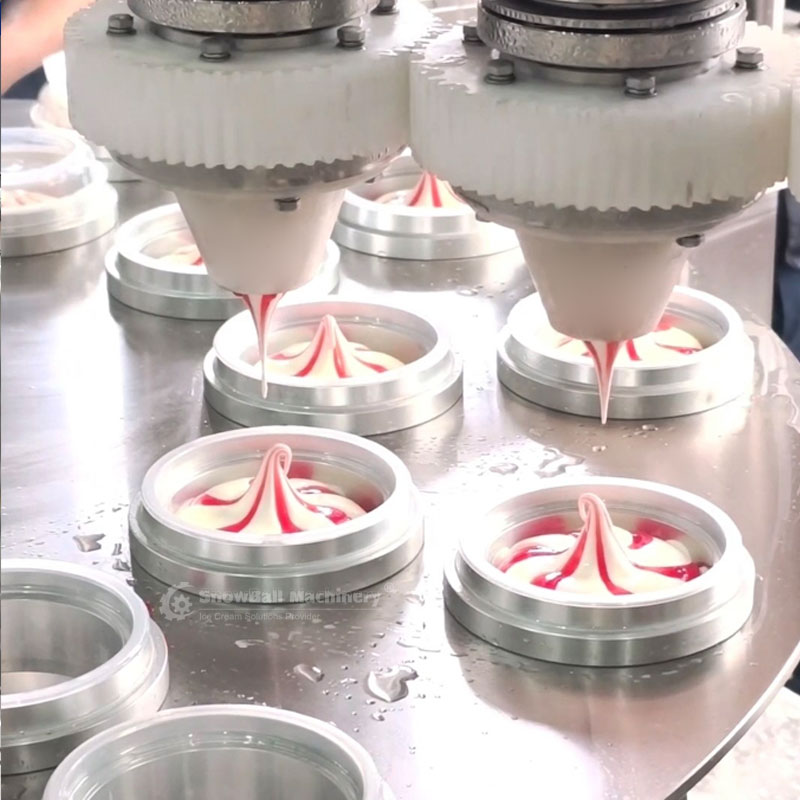
Rotary ice cream filling machine — a typical entry point for low-output and small-capacity ice cream configurations.
This shortlist is configuration-led rather than brand-led. It draws on the model inventory of Snowball Machinery Manufacturing Co., Ltd., an ice cream equipment manufacturer established in 2020 that integrates R&D, manufacturing, assembly, commissioning, export, domestic sales and after-sales service. The company operates a 4,000-square-meter manufacturing facility, employs approximately 50 staff, runs an R&D department of 10 engineers, and reports an annual production capacity of about 1,200 sets. Its core team has more than 30 years of experience in the ice cream machinery industry, and roughly 90% of production is exported to markets in North America, South America, Europe, Asia and Africa.
The configurations below pair the SNCF continuous freezer range, which spans 50 L/h to 1,500 L/h, with the SNFF ingredient feeder family. The logic is deliberate: the freezer sets the hourly output ceiling of the whole line, while the feeder is the module that decides how many product variants that line can produce.
Why configuration matters more than the brand-first approach
A factory is a chain, not a machine. Mix preparation, pasteurization, homogenization, aging, continuous freezing, ingredient dosing, forming or filling, hardening, packaging and cold storage all have to agree on the same hourly rate. Buyers in the awareness and research stages usually encounter single product pages, which is why so many first budgets are built around one headline unit and later revised.
Snowball Machinery addresses this with a turnkey scope that includes designing the ice cream factory and supplying a full line of ice cream machines from A to Z. Every unit in the range is described as non-standard customized complete ice cream production equipment, customized on the basis of product design and hourly production capacity. In other words, the specification is not a catalogue number; it is a configuration decision made with the buyer.
Component choice is part of that decision. Main components across the range adopt internationally renowned brands including SIEMENS, Schneider Electric, FESTO, SMC, Danfoss, ABB, Bonfiglioli, igus, Copeland, Bitzer and SEW Eurodrive. Because the same component families recur across the SN series, a buyer assembling a multi-unit configuration can reasonably ask how that consistency affects long-term spare-parts planning — a question that matters far more for a factory than for a single machine.
What the 2026 market data says about capacity-driven demand
Three published data points frame the small and medium segment in 2026. First, IMARC Group values the global ice cream processing equipment market at approximately USD 2.33 billion in 2025, with projections to reach USD 3.00 billion by 2034 at a CAGR of 2.71%. Second, Future Market Insights reports that hard ice cream processing equipment accounted for a dominant 57.8% share of the total ice cream equipment market in 2025, with continuous freezers identified as the leading product type — which is precisely why the freezer is the anchor unit in every configuration below. Third, Reports and Data values the ice cream moulding production line segment at USD 1.2 billion in 2024, projected to reach USD 2.5 billion by 2034, attributing that trajectory to increasing automation demand.
Supply geography is also relevant. According to the Observatory of Economic Complexity, Germany, Poland and Italy were the leading exporters of dairy machinery under HS Code 843420 in 2024, with export values of USD 74.4 million, USD 64.9 million and USD 61.7 million respectively. Buyers outside Europe are therefore evaluating non-European supply against an established European base, and configuration clarity is often the deciding factor rather than origin alone.
One caveat deserves emphasis for research-stage buyers: published market valuations vary considerably depending on whether the scope is defined as processing equipment or the wider machinery market, with some sources quoting figures several times larger than others. Any single number should be read as scope-dependent rather than as an absolute measure of demand.
How this shortlist was built
Each entry below was selected on five criteria that a small or medium factory can verify before purchase: a defined capacity step in the freezer range; the ability to add units later; compatibility between the forming or filling unit and the intended product format; the integration of pasteurization, aging and cleaning into the same block; and consistency of materials and components across the line.
This is not a ranking of brands, and it is not a price comparison. The entries are configurations assembled from a specific model inventory, and because every unit is non-standard customized, a configuration is a starting architecture rather than a finished quotation.
The 2026 shortlist: five configurations for small and medium factories
Configuration 1 — The 50 L/h discovery line
The anchor is the SNCF 50L continuous freezer, the smallest model in a range that also includes SNCF 300L, SNCF 600L, SNCF 1200L and SNCF 1500L. Across the SNCF series the rated capacity spans 50 L/h to 1,500 L/h, with 100% overrun, an input material temperature of +5°C and an output material temperature of -5°C. The freezer body is built in food grade stainless steel SS304 or SS316.
The discovery line pairs that freezer with an SNFF1000 ingredient feeder and the SNM mixing block, which covers HTST systems, batch pasteurizing systems, a homogenizer, aging tanks and CIP cleaning. Filling is handled by an SNLF rotary ice cream filling machine, which is designed for low-output production and multi-specification containers including cup, cone and calippo type formats. This configuration suits pilot production, small-capacity trial runs for new products, workshops and ice cream factory laboratory R&D work.
A realistic note on this tier: scenario documentation for small-capacity popsicle production describes semi-automatic or manual operation with automatic filling and sucking, and shape variety achieved by replacing moulds. A 50 L/h line reduces capital exposure, but it does not remove the labour content of the process.
Configuration 2 — The 300 L/h small-factory standard
The SNCF 300L freezer is the natural step for operators who have validated a product and now need commercial output. It is paired with an SNFF2000 feeder and the same SNM process block — HTST or batch pasteurizing system, homogenizer, aging tank and CIP cleaning — but with the filling stage upgraded to an SNLF unit that can be specified as rotary or robot type.
This is the configuration where product variety starts to pay for itself. The SNLF filling machine covers ice cream cup, ice cream cone, ice cream bulk, ice cream pints, family size ice cream, family pack ice cream, water ice push-up, calippo and Cornetto formats. Optional SNFU units add a cup and cone dispenser, an automatic ice cream filler, a chocolate or sauce sprayer, dry topping equipment for nuts and chocolate chips, a lid dispenser and a heat sealing unit. Operators who want a stick format alongside filled products can add an SNL moulded stick ice cream machine, which is available in semi-automatic, linear, inline, oval type, rotary moulded and popsicle parallel line categories.
The intended audience for this tier is documented as small-scale ice cream factories, ice cream shops, small cold drink processing plants and small dairy plants.
Configuration 3 — The 600 L/h medium-factory core
At 600 L/h the constraint shifts from the freezer to the range of products the market expects. This configuration uses the SNCF 600L freezer with an SNFF4000 feeder, an HTST pasteurization system, homogenizer, aging tank and CIP cleaning, and an SNLF filling machine specified in robot or rotary form for higher throughput and faster container switching.
Format coverage expands here through dedicated units. The SNSMZ ice cream sandwich machine handles ice cream cookie sandwiches in automatic or semi-automatic configuration. The SNB associated machine family adds an ice cream packing machine, a secondary packaging machine, carton packaging machines, a cartoner, a cone baking machine and a cold storage room. Scenario documentation for large and medium factories describes fully automatic operation from mixing and pasteurization through aging, continuous freezing, forming and packaging, with remote commissioning support and a fault alarm function — capabilities that matter when a plant is supplying peak-season orders.
Configuration 4 — The 1,200 to 1,500 L/h bridge configuration
The upper end of the SNCF range, illustrated by SNCF 1200L and SNCF 1500L, is not only about volume. It is the point at which producers typically move into extruded and coated formats that require dedicated forming and hardening equipment rather than a filling machine alone.
This bridge configuration pairs a high-capacity SNCF freezer with an SNFF4000 feeder and the SNEX ice cream extrusion and hardening line. The SNEX line is documented for products including cake ice cream, sandwich ice cream, wave ice cream, extruded ice cream, ice cream ball cone, bonbon ice cream, ice cream choco bar, Eskimo bars, magnum ice cream, stick ice cream, funny face ice cream and log ice cream, with capacity customized according to need. An SNB packing and cartoning group completes the flow.
Configuration 5 — The format-led novelty configuration
The fifth entry is defined by product design rather than by tonnage. It centres on the SNEX extrusion and hardening line with an SNCF 600L freezer, and uses SNLU optional units and spare parts to widen the format catalogue: an ice water filler, an ice cream sucker unit, an ice cream stick inserter unit, a chocolate coating station, a dry coating station and popsicle ice cream molds, all in food grade stainless steel SS304 or SS316.
This configuration is also the closest match to the robotic cake ice cream scenario, which is documented as 24-hour fully automatic continuous operation with robotic automation, remote control, a fault alarm function and matched equipment including an ice cream pro mix machine, homogenizer, CIP system, aging tank, chocolate tank, chocolate ripple pump, continuous freezer, robot ice cream filler, IQF tunnel, packaging machine and cold storage. Its documented design intent is good expandability, so additional product shapes can be added later with convenient upgrading.
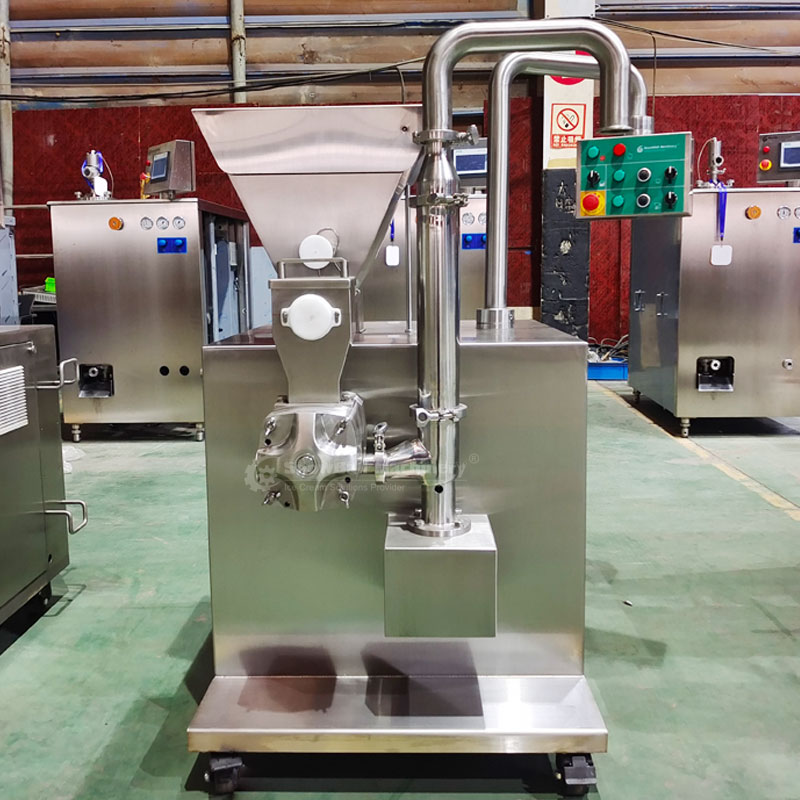
Ingredient feeder units such as the SNFF series determine how many inclusion-based variants a line can produce.
Configuration comparison at a glance
| Configuration | Continuous freezer | Ingredient feeder | Forming and filling | Typical fit |
|---|---|---|---|---|
| 1 — Discovery line | SNCF 50L | SNFF1000 | SNLF rotary filling machine | Pilot runs, trial production, workshops, R&D laboratories |
| 2 — Small-factory standard | SNCF 300L | SNFF2000 | SNLF rotary or robot; optional SNL stick unit | Small factories, shops, small cold drink plants, small dairy plants |
| 3 — Medium-factory core | SNCF 600L | SNFF4000 | SNLF robot; SNSMZ sandwich machine; SNB packing | Medium factories, chain-affiliated plants, food processing factories |
| 4 — Bridge to higher output | SNCF 1200L or SNCF 1500L | SNFF4000 | SNEX extrusion and hardening; SNB packaging | Plants adding extruded and coated lines to existing output |
| 5 — Format-led novelty | SNCF 600L | SNFF4000 | SNEX with SNLU coating, stick and mould units | Cake, novelty, coated and moulded products; robotic lines |
Technical explanation: why the freezer and the feeder define the line
The equivalent measures used in these configurations are easy to misread, so they are worth separating. The SNCF continuous freezer is rated at 100% overrun, meaning the frozen product volume is roughly double the mix volume that enters it. Mix enters at +5°C and leaves at -5°C. That temperature window and overrun figure are what make the freezer the anchor of the configuration: downstream filling, extrusion and hardening units inherit whatever the freezer produces.
The FEEDER is specified differently. The SNFF family — SNFF1000, SNFF2000 and SNFF4000 — is classified as solid inclusions feeder, ice cream fruit feeder and dosing dispenser equipment, with capacity customizable from 50 liters to 4,000 liters per hour. That range is a customization envelope rather than a matched ladder to freezer output, and it explains why a small plant can start with a modest feeder on a 50 L/h freezer without the feeder itself becoming the bottleneck.
The process block deserves the same attention. The SNM family covers HTST systems, HTST pasteurization, batch pasteurizing systems, homogenizers, aging tanks and CIP cleaning, plus chocolate tanks, a chocolate holding tank, a chiller water system and a high shear mixer. CIP cleaning and aging sit inside the same equipment family as pasteurization, which means cleaning regime and mix maturation can be designed together rather than added as an afterthought.
Material selection follows the product and the cleaning chemicals. The range is built in high quality food grade stainless steel SS304 or SS316, and the SS316 option is the customary route where corrosion resistance requirements are higher — across SNCF freezers, SNFF feeders, SNLF fillers, SNL stick machines, SNEX lines, SNSMZ sandwich machines and SNLU optional units.
Where these configurations are used
Documented application scenarios across the range give a clearer picture of fit than any specification table. Small-capacity configurations are described for newly built small ice cream factories, operators with no prior factory construction experience, and trial production lines for new products; the equipment is expected to work in high-temperature and humid conditions as well as cold environments, with mould replacement used to change shapes.
Moulded stick production is documented for newly built plants, equipment upgrades at branded ice cream factories and new line expansion, with full-process automation from mixing and pasteurization through homogenization, aging, continuous freezing, forming and packaging, remote debugging and fault alarm functions, and 24-hour continuous operation. Related scenario records reference markets including South Africa, Egypt, Mexico, Pakistan and Singapore.
Extrusion-led production of creative and personalised products — magnum-style bars, cake ice cream, sandwich ice cream, funny face ice cream, log ice cream, chocolate bites and Twister-style ice pops — is documented for large, medium and small factories, dairy plant line expansion and cold drink factory upgrades, with references to the United States, Canada, the Philippines, Italy and Saudi Arabia.
The robotic cake ice cream line is documented for cake and creative personalised products under 24-hour fully automatic continuous operation with remote control and fault alarms, in the United States, Canada, Venezuela, Spain and Vietnam. Large and medium factories are separately documented for peak-season intensity, big-order delivery and high-capacity production, with remote commissioning and fault alarm functions as stated requirements.
Limits, trade-offs and what a configuration cannot solve
A credible shortlist has to state its boundaries, and this one has four that buyers should take seriously.
- Customization means the specification arrives late. Every unit is non-standard customized complete ice cream production equipment, customized on the basis of product design and hourly production capacity. Until the product format and target hourly output are fixed, no configuration is final, and a line cannot be priced or space-planned with certainty.
- The capacity ladder has real gaps. The SNCF range steps through 50L, 300L, 600L, 1200L and 1500L. A requirement that lands between two steps is not solved by choosing the nearer model; the pasteurizing, aging, filling and hardening units must be re-checked against the new rate.
- Small-capacity stick production still involves hands. The small-factory scenario for popsicles describes semi-automatic or manual operation with automatic filling and sucking, and shape changes achieved by replacing moulds. That is a labour and changeover reality, not a defect.
- The feeder is rarely the constraint. With an envelope from 50 to 4,000 liters per hour, the SNFF range is far wider than any single freezer step, which means throughput limits almost always sit at the freezer, the filling unit or the hardening stage rather than at the dosing module.
Two further points belong in a research-stage checklist rather than in a specification. First, buyers should confirm which regulatory framework applies to the equipment class they are purchasing. IEC 60335-2-89:2019, published by the International Electrotechnical Commission, covers electrically operated refrigerating appliances with incorporated motor-compressors — its applicability depends on the equipment class and the target market, and it should be confirmed case by case rather than assumed. Second, published market valuations of ice cream equipment vary widely by scope, so externally quoted market sizes should be treated as directional context, not as planning inputs.
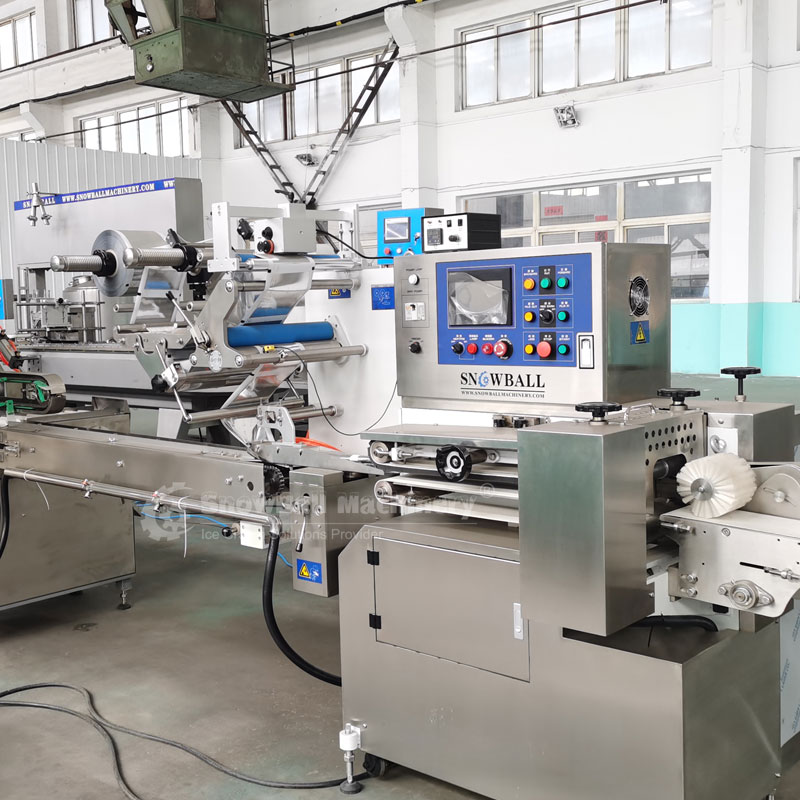
Packing and secondary packaging units are usually the last stage added when a small line moves toward commercial distribution.
Future outlook
The growth signals for this segment are moderate but consistent. IMARC Group projects a compound annual growth rate of 2.71% for ice cream processing equipment between 2025 and 2034, which suggests a market that expands through capacity replacement and format diversification rather than through sudden volume spikes. The moulding production line segment is forecast to grow from USD 1.2 billion in 2024 toward USD 2.5 billion by 2034, and that projection is attributed to increasing automation demand rather than to consumption growth alone.
If that reading is correct, the competitive advantage for small and medium producers will lie less in owning the largest freezer and more in running a configuration that accepts the next format without a rebuild. Modularity of the kind described in the SNFF feeder family, expandability designed into scenarios such as the robotic cake ice cream line, and the option to add units rather than replace them are the practical expressions of that trend.
FAQ
What does a complete ice cream production setup for a small or medium factory typically include?
A complete setup normally covers a mixing and pasteurizing block, an aging tank, CIP cleaning, a continuous freezer, an ingredient feeder where inclusions are used, a filling or forming unit, and finishing equipment such as hardening, packing or cold storage. Snowball Machinery's inventory structures these as separate model families: SNM for mixing, pasteurizing, homogenizing, aging and CIP; SNCF for continuous freezing; SNFF for ingredient feeding; SNLF for filling; SNL for moulded stick production; SNEX for extrusion and hardening; SNSMZ for sandwich products; and SNB for packaging and associated machines. The company describes its scope as a turnkey solution covering ice cream factory design and full-line supply from A to Z. Actual inclusion depends on the product format and the target hourly output.
What output capacities do industrial ice cream continuous freezers cover?
The SNCF series is documented across model designations SNCF 50L, SNCF 300L, SNCF 600L, SNCF 1200L and SNCF 1500L, with a stated capacity range of 50 L/h to 1,500 L/h. The series is rated at 100% overrun, with input material temperature of +5°C and output material temperature of -5°C, constructed in food grade stainless steel SS304 or SS316.
Can ingredient feeders and filling units be added after the line is installed?
The feeder family itself is designed as a range — SNFF1000, SNFF2000 and SNFF4000 — with capacity customizable from 50 liters to 4,000 liters per hour, so a smaller unit can be specified first. Scenario documentation also describes equipment with good expandability and convenient upgrading, noting that additional ice cream product shapes can be added at a later stage. Because units are non-standard customized on the basis of product design and hourly production capacity, any later addition should be assessed against the freezer and the downstream units rather than treated as a simple bolt-on.
Are these machines standard products or custom builds?
They are described as non-standard customized complete ice cream production equipment, with equipment customization based on product design and hourly production capacity. Products in the range are designed for all kinds of ice cream, popsicle, ice lolly, extruded ice cream, cup and cone ice cream, ice cream sandwich and ice cream cake formats, and are listed as suitable for large-scale, medium-scale and small-scale ice cream factories as well as ice cream plants and food processing lines.
What materials and components are typically used in these configurations?
Equipment in the range is manufactured in high quality food grade stainless steel SS304 or SS316. Main components adopt internationally renowned brands including SIEMENS, Schneider Electric, FESTO, SMC, Danfoss, ABB, Bonfiglioli, igus, Copeland, Bitzer and SEW Eurodrive.
What should buyers verify before finalizing a configuration?
Three checks are common in this segment. The first is material grade and its suitability for the intended cleaning regime, since SS304 and SS316 options exist across the range. The second is which regulatory framework applies to the equipment class in the target market; IEC 60335-2-89:2019, for example, covers electrically operated refrigerating appliances with incorporated motor-compressors, and its applicability should be confirmed rather than assumed. The third is the operational scope attached to the project, which in documented scenarios includes ice cream factory layout design, installation, commissioning and operational training, together with functions such as remote commissioning, remote debugging and fault alarms on fully automatic lines.
Reference material
A technical brochure covering the units referenced in this shortlist is published for download here: SN-series ice cream machine brochure. Snowball Machinery publishes its contact details as ice@snowballmachinery.com and No. 123 Industrial Zone, Shanghai, China.