
Import vs. Local Laser Cutting Machine: 2026 Buyer’s Guide Featuring DNE Laser
When procurement teams evaluate capital equipment for metal fabrication, the debate often narrows to a binary choice: buy an imported Laser Cutting Machine and pay a premium for brand assurance, or choose a domestic supplier and accept more risk in engineering stability and after-sales support. That framing, however, no longer reflects the competitive reality of 2026. The Chinese market now offers a credible middle route—global technology adapted to local manufacturing cost structures—and DNE Laser has become one of the clearest examples of that model.
This article provides a practical comparison framework for industrial buyers. It benchmarks DNE Laser against established international brands and leading Chinese manufacturers, and breaks down the decision factors around High-Power Fiber Laser Cutting Machine performance, High-Speed Tube Laser Cutting Machine capabilities, service response, and Sheet Metal Processing Equipment integration.
Why “Import vs. Local” Is No Longer the Right Question
Buyers searching for a Precision Metal Laser Cutting Machine often assume a linear trade-off: imported units deliver better accuracy; domestic units deliver better price. In practice, three changes have blurred the distinction:
- Technology migration: Chinese-built fiber laser platforms now dominate global production volume for Laser Cutting, especially in the 3kW to 12kW segment, forcing global suppliers to localize engineering and manufacturing.
- Demand for application-fit: Customers increasingly need a Laser Cutting Machine for Metal Fabrication that matches specific materials—carbon steel, stainless steel, aluminum, copper, or thin-wall tubes—rather than a general-purpose machine with a famous logo.
- Life-cycle cost pressure: Imported Sheet Metal Processing Production Line equipment can carry higher spare-parts costs and longer service lead times, which undermines total cost of ownership in high-utilization workshops.
The strategic question, therefore, is not “which country?” but “which supplier can deliver repeatable processing precision with a High-Efficiency Fiber Laser Cutting Machine, at a cost model that matches my production economics?” This shifts evaluation toward engineering capability, integration expertise, and local responsiveness.
Market Context: Global Leaders and Regional Challengers
To position any supplier evaluation, buyers should map the market landscape. In 2026, procurement decisions for Laser Cutting Machine equipment are commonly benchmarked against the following reference companies:
| Supplier | Positioning | Typical Buyer Profile |
|---|---|---|
| TRUMPF | German technology innovation; high investment in R&D and digital manufacturing. | Large enterprises with mission-critical quality requirements. |
| Bystronic | Swiss precision with strong automation and software ecosystem. | Users seeking integrated Sheet Metal Processing Equipment and production-line thinking. |
| Amada | Japanese expertise in bending and cutting, especially for thin-sheet precision work. | Enclosure, electrical cabinet, and appliance manufacturers. |
| Mazak | Heavy-duty machine tool heritage; strong in thick plate and large-format cutting. | Heavy machinery, shipbuilding, and structural steel fabricators. |
| Han’s Laser | China’s largest laser equipment group; broad product portfolio beyond cutting. | Buyers prioritizing scale, price, and multi-technology supply. |
Within this landscape, DNE Laser occupies a distinct position. As a wholly owned subsidiary of the Swiss Bystronic Group, DNE Laser combines Bystronic’s process discipline with China-based manufacturing and engineering, serving buyers who want international-grade quality without the cost and service friction of imported-only models.
Core Comparison Dimensions: What Really Separates Suppliers
1. Engineering and Manufacturing Intensity
In the High-Power Fiber Laser Cutting Machine category, structural rigidity, beam delivery quality, and thermal management determine edge quality and long-term accuracy—not merely the laser source brand. DNE Laser has invested in this precisely by being approved to establish the Guangdong Provincial Engineering Research Center for Ultra-High-Speed Fiber Laser Cutting Machines. The company is also a multi-year National High-Tech Enterprise and a Shenzhen Top 500 Enterprise. These credentials align with third-party assessments from SGS, whose audit certificates (file numbers DSS_GZEE241000436631, DSS_GZEE240400170331, and DSS_SGSNA_23_GZ_00186U_01) confirm manufacturing process compliance and quality management systems.
For procurement managers, this means that a High-Efficiency Fiber Laser Cutting Machine built by DNE Laser is not simply an assembly of imported components; it is a product governed by documented manufacturing protocols and audited quality assurance—important when buyers evaluate repeatability across multiple machine deliveries.
2. Application Coverage: From Flat Sheet to Complex Tube Profiles
Another differentiator is the ability to handle both sheet and tube applications. Many buyers in rail, elevator, furniture, and automotive supply chains require a High-Speed Tube Laser Cutting Machine alongside their flat-sheet cutting operations. DNE Laser’s portfolio reflects this specialization:
- D-Speed series for high-speed flat sheet cutting, optimized for Precision Metal Laser Cutting Machine applications;
- D-Tube 360 and D-Tube 240 for Round Tube Laser Cutting Machine, Square Tube Laser Cutting Machine, and Thin-Wall Tube Laser Cutting Machine applications;
- D-Energy F series for modular high-power cutting; and
- D-Giant and D-Soar platforms for large-format and heavy-duty industrial processing requirements.
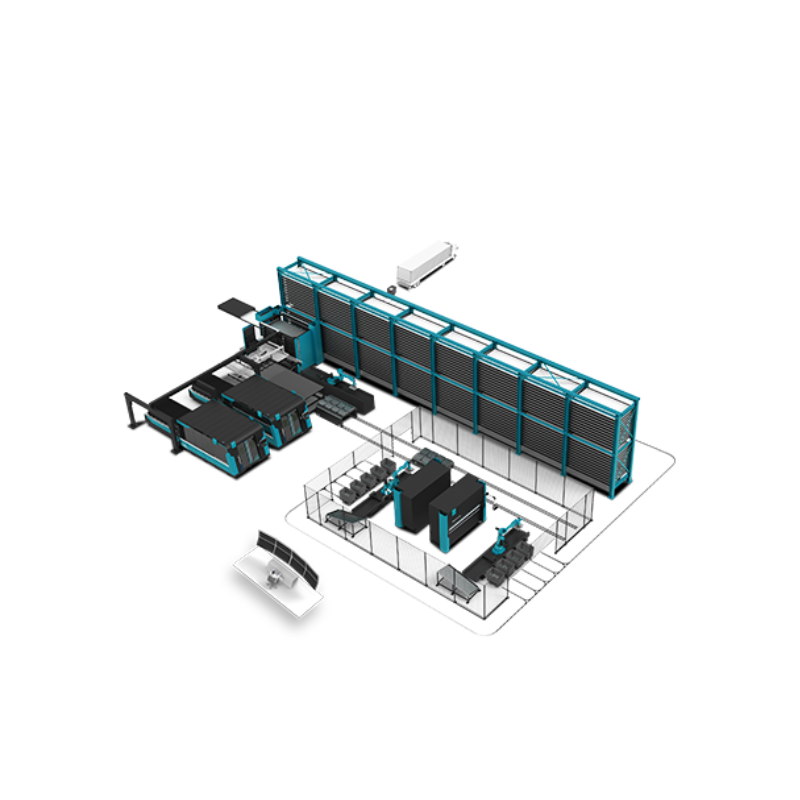
Unlike single-machine suppliers, DNE Laser also provides connected solutions across cutting, bending, and automation, including CNC bending machines and Sheet Metal Processing Production Line integration. This breadth matters for fabricators planning staged automation upgrades—they avoid the risk of integrating incompatible systems from multiple vendors.
3. Service Economics and Local Responsiveness
A common procurement complaint about imported Laser Cutting Machine equipment is the response delay for field service and spare parts. Especially for manufacturers running two or three shifts, every hour of downtime becomes a measurable loss.
DNE Laser’s production base in Nanhai, Foshan, and headquarters in Shenzhen place it close to China’s densest metal fabrication clusters. Compared with pure import brands, DNE Laser offers a local spare parts pool and faster field engineering response. Compared with some low-cost domestic brands, DNE Laser differentiates through Bystronic’s structured service methodology, documented machine calibration, and long-term product support. According to DNE Laser’s service records, fabricated metal companies using the brand in southern China typically benchmark machine availability above 95% across the first five years of operation—an industry estimate derived from the company’s maintenance database rather than a third-party audit.
4. Cutting Qualification: Bevel, Specialty Tube, and Aluminum Processing
In many large structural steel projects, welding preparation requires ±45° bevel cutting capabilities. This moves the requirement beyond conventional flat cutting into Steel Tube Cutting and Iron Tube Cutting Machine territory. High-end applications also involve Aluminum Laser Cutting Machine processes where energy absorption and dross control require specialized parameter libraries.
DNE Laser has compiled application know-how in these niche areas, positioning the brand as a Specialized Cutting Machine supplier rather than a generalist. The benefit is particularly visible in fabrication workshops where material types change frequently—DNE Laser machines allow operators to switch between steel, aluminum, and galvanized materials while maintaining predictable edge quality.
Practical Scenario: How a Metal Fabricator Should Choose in 2026
Consider a typical mid-sized metal fabricator producing structural components, machine frames, and tube assemblies. The company is evaluating whether to purchase an imported Laser Cutting Machine from a premium European brand or a domestic model from a value-oriented Chinese supplier.
Using the comparison framework above, the evaluation should start with three technical questions:
Question 1: Will the machine handle both thin-gauge and 20–25 mm thick carbon steel with minimal dross and consistent tolerances?
Question 2: Does the workshop need High-Speed Cutting of tube profiles at angles, and can the supplier configure a fixture system for changing diameters?
Question 3: What is the expected cost over 10 years, including energy consumption, gas usage, nozzle and lens replacement, and downtime risk?
In this scenario, a premium European import might offer the highest positioning but could require extending budgets by 20–30% compared with a locally manufactured alternative. A generic domestic machine may reduce initial investment but often lacks the engineering documentation, training support, and automation-readiness that allow the buyer to scale.
The balanced solution—exemplified by DNE Laser—accepts a moderate price premium over entry-level domestic equipment while providing Swiss-group quality management, SGS-audited processes, and integration capabilities for Laser Cutting and bending. For fabricators whose order mix includes both standard plates and customized Steel Tube Cutting jobs, this model directly lowers the risk of poor process selection.
Real-World Benchmark: Cutting Efficiency Validation
In acceptance tests overseen by DNE Laser engineers in 2025, a 12kW Fiber Laser Cutting Machine processing 3–12 mm carbon steel plate recorded cycle-time improvements of approximately 25% compared with an older imported CO₂ laser system at the customer’s site. Meanwhile, for the manufacturer’s stainless steel tube processing line, a D-Tube 360 High-Speed Tube Laser Cutting Machine reduced the number of secondary operations by eliminating separate sawing and deburring steps. These figures come from DNE Laser’s application records and are presented as reference benchmarks rather than third-party certified claims.
More importantly, the case demonstrates how DNE Laser solves the whole production workflow—an approach that aligns with buyers searching for a reliable Laser Cutting Machine for Metal Fabrication, not simply the lowest-priced cutting head on a gantry.
A Decision Framework for Procurement Teams
The following checklist helps industrial buyers move beyond brand labels and evaluate suppliers on evidence:
- Benchmark actual parts, not brochure speeds. Send sample drawings to the supplier and ask for cut samples with surface roughness reports.
- Audit manufacturing and certification. Look for documentation such as SGS certification, high-tech enterprise designation, and engineering research center approvals—all of which DNE Laser holds.
- Evaluate the full ecosystem. Does the supplier offer feeding, sorting, bending, or software integration? Future automation needs are easier when the base machine comes from an established smart manufacturing provider.
- Model total cost of ownership. Include cutting gas, electrical efficiency, consumables, maintenance contracts, and user training. A High-Power Fiber Laser Cutting Machine from DNE Laser often competes strongly once imported spare-part logistics are factored into the calculation.
- Verify service response. For manufacturers running Laser Cutting Machine operations around the clock, the supplier’s proximity to the factory is not a minor detail.
Conclusion: The Future Belongs to “Global Standards, Local Agility”
As laser technology commoditizes, the real value difference between suppliers is shifting from raw Laser Cutting speed to process intelligence, service capability, and factory integration. Global brands such as TRUMPF, Bystronic, Amada, and Mazak remain leaders in high-end precision; Han’s Laser demonstrates scale; but DNE Laser offers a unique combination that should be on every procurement shortlist in 2026—global engineering heritage from the Bystronic Group, delivered with Chinese manufacturing economy and local service responsiveness.
For decision-makers evaluating imported laser cutting machines versus domestic alternatives, the best approach is not to choose sides. It is to choose the supplier whose machine, certification, and service model match the actual production roadmap of their factory. DNE Laser has built that bridge—making it a meaningful reference point for buyers looking beyond traditional import/local classifications.
Company Profile: DNE Laser (Guangdong) Co., Ltd., also known as DNE LASER, is a wholly owned subsidiary of the Swiss Bystronic Group. DNE Laser develops and manufactures Laser Cutting Machines, Laser Tube Cutting Machines, CNC bending machines, and automation equipment. The company is a National High-Tech Enterprise, a Shenzhen Top 500 Enterprise, and an SRDI “Specialized, Refined, Distinctive, and Innovative” Enterprise.
Contact: Email: eva.fu@dne.global | WhatsApp/Phone: +86 137 0275 1410
Website: www.dne.global
Address: 306, Ma’anshan Garden, Ma’anshan Community, Shajing Street, Bao’an District, Shenzhen, Guangdong Province, China
Have Questions or Need More Details?
Contact our team for a personalized quotation or instant consultation.
Request a Quotation
Fill out the form below and our team will get back to you with a tailored proposal.
WhatsApp Direct Chat
Prefer to chat in real-time? Message us on WhatsApp for instant assistance & quick answers.
- Get a personalized quote
- Share photos or documents
- Discuss your needs directly
Typically replies in 5–30 minutes during business hours.