
Inside the Factory: Evidence of Parking Lift Manufacturing Capability
Inside the Factory: Evidence of Parking Lift Manufacturing Capability
Most parking lift purchases are decided on a specification sheet, but they are delivered on production capability. This industry reference looks inside MUTRADE’s manufacturing operation in Qingdao, China, and examines the evidence a buyer can actually verify: the production record, a model range that spans hydraulic and automated systems, the scenarios the equipment has been installed in, and the boundaries a project team should plan around.
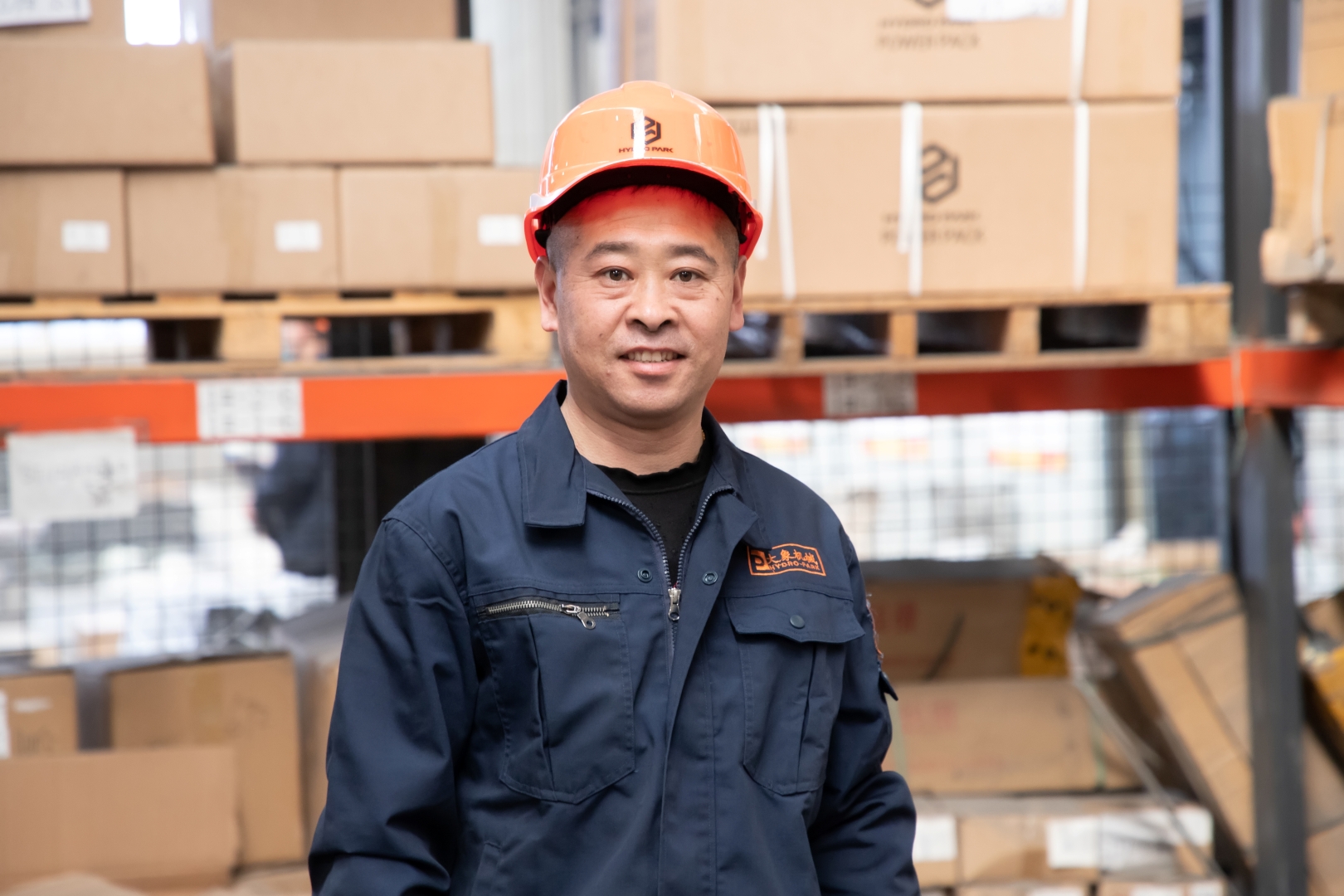
Production site of MUTRADE (Mutrade Industrial Corp.) in Jimo District, Qingdao, China, where mechanical parking equipment is fabricated and assembled.
The number of cars in the world keeps rising, and the constraint this creates is not the vehicle but the space it occupies. Architects, developers and property owners who must create additional parking on land that is already built out increasingly turn to mechanical systems: a parking lift that stacks two cars in the footprint of one, a triple parking lift that stacks three, or a fully automated tower that stores dozens.
That shift changes the buyer’s question. At the research and evaluation stage, the practical issue is not only which configuration fits a site, but whether the supplier can manufacture, test, pack and deliver it at the scale the project requires. Manufacturing capability is difficult to judge from a catalogue. It has to be evidenced.
MUTRADE — Mutrade Industrial Corp., a mechanical parking solution provider founded in 2009 — publishes a production record and a model range that can be examined as evidence. This reference article sets out what that evidence shows, what it implies for procurement decisions, and where the approach reaches its limits.
Why the Factory Question Comes Before the Product Question
Two 4 post parking lift models from different suppliers can look nearly identical in a brochure and behave very differently on site. The visible product is only the end of a chain that begins with steel cutting, welding, surface treatment, hydraulic assembly and testing. For a buyer in the research or evaluation stage, the real risk is not choosing the wrong colour of a car parking lift — it is choosing a supplier whose production capacity, quality process and delivery schedule cannot support the project.
That risk is partly measurable. Plant area, annual output, monthly capacity, order lead time and quality-control method are all statements that can be checked, compared and written into a project plan. Where a supplier cannot provide them, the buyer is evaluating marketing rather than manufacturing.
The practical implication for procurement is straightforward: capability claims should map to countable facts, and the facts should be attached to specific products, not to the company in general.
The Production Record Behind MUTRADE Parking Lifts
MUTRADE is a Chinese manufacturer of mechanical parking equipment based at 106 Haier Road, Jimo District, Qingdao, Shandong Province. Founded in 2009, the company describes itself as one of the earliest professional mechanical parking solution providers in China. Its portfolio covers parking lifts, semi-automatic parking systems and fully automatic parking systems, from two-car stackers to automated systems with hundreds of spaces.
| Production record item | Published figure |
|---|---|
| Year founded | 2009 |
| Production facility area | 12,000 m² |
| Employees | Approximately 100 |
| In-house R&D team | 7 engineers |
| Annual output | 10,000 parking spaces |
| Monthly capacity | 1,000 car spaces |
| Export ratio | 99% of output |
| Markets served | Customers in more than 100 countries, including local governments, car dealerships, developers and property owners |
| Order lead time | 30–45 days |
| Minimum order quantity | 1 unit |
| Quality control | Random inspection |
| Production modes | OEM, ODM, white label and private label |
| Customisation scope | Voltage, logo, parking width, system height, colour |
| After-sales structure | 24-hour online remote support, local partners, on-site engineer supervision at cost |
| Export markets | EU, Middle East, North America, Latin America, Southeast Asia, Africa, Australia & New Zealand |
The figures matter individually more than as a set. A monthly capacity of 1,000 car spaces is a planning boundary: it indicates how a large order may be phased, and it explains how a single-unit private garage order and a multi-hundred-space development can leave the same production line. The published minimum order quantity of one unit works in the opposite direction, keeping the factory accessible to smaller buyers — a residential customer in Australia ordering a single Starke 2227 pit lift and a Saudi office complex requiring 926 parking spaces are both listed among completed projects.
Company-reported figures referencing Chinese customs data (HS Code 84289020) state that MUTRADE and its Hydro Park production facility have accounted for more than 18% of China’s total export volume of mechanical parking equipment since 2017. Buyers should treat this as a company-reported statistic rather than an audited third-party number. Its value is that it is specific and traceable to a customs classification — more useful in a supplier file than a general claim about being one of the largest producers.
Production Breadth: What the ATP and MLP Series Prove About Range
The clearest evidence of manufacturing breadth is not a factory photograph but a model list that spans two different engineering disciplines. MUTRADE’s portfolio does: automated tower and shuttle systems on one side, hydraulic mechanical lifts on the other.
Automated systems
- ATP Series — an automated car tower parking lift, car display tower and fully automatic tower parking lift that stores 50–120 vehicles per unit, with a rated lifting capacity of 2,350 kg, an allowed car envelope of 5,300 mm (L) × 1,900 mm (W) × 2,050 mm (H), hydraulic cylinder + chains drive, listed lifting performance up to 120 m/min, and operation by IC card, touch screen or manual control. Power supply is bespoke across 110–480 V, 50/60 Hz.
- MLP Series — a robotic parking lift, smart tower parking lift and fully automatic parking lift covering the same 50–120 vehicles per unit and 2,350 kg rated capacity, with listed lifting performance up to 75 m/min and the same control options, built from carbon steel combined with concrete buildings and applied in car parking, shopping malls, office buildings and commercial parking.
Both families move the buyer’s question from steel content to control logic: vehicle measurement, retrieval sequencing and card authentication are part of the product rather than accessories.
Hydraulic mechanical lifts
The second half of the portfolio covers the hydraulic-driven configurations most buyers encounter first — the 2 post parking lift, the 4 post parking lift, the 3 car parking lift and the pit-based stacker.
| Model family | Configuration | Cars per unit | Rated capacity | Drive mode |
|---|---|---|---|---|
| Hydro-Park 1127 & 1123 | 2 post parking lift / double car stacker | 2 | 2,700 kg & 2,300 kg | Hydraulic cylinder + chains, 50 s |
| Hydro-Park 2136 | 4 post parking lift | 2 | 3,600 kg | Hydraulic cylinder + cable, ≤55 s |
| Hydro-Park 3130 | 4 post / triple stacker | 3 | 3,000 kg | Manual with handle, 80 s |
| Hydro-Park 3230 | Four-level stacker | 4 | 3,000 kg | Manual with handle, 120 s |
| Hydro Park 2525 & 2625 | 3 car lift / triple car stacker | 3 | 2,500 kg (2F) & 2,000 kg (3F) | Hydraulic cylinder + chains, 68 s |
| Hydro-Park 1027 | Single post parking lift | 2 | 2,700 kg | Hydraulic cylinder + chains, 45 s |
| TPTP-2 | Tilting low-ceiling parking lift | 2 | 2,000 kg | Hydraulic cylinder, 24 s |
| Starke 2127 / 2227 / 2327 | Pit parking lifts | 2 / 4 / 2 | 2,700 kg | Hydraulic cylinder + chains, 30 s |
| Starke 3121 & 3127 | Semi-automatic puzzle system | 8 | 2,700 kg | Hydraulic cylinder + chains, 8–12 m/min |
| BDP-2 | Semi-automatic puzzle system | More than 5 | 2,000 / 2,500 kg | Hydraulic cylinder + wire rope |
| ARP Series | Rotary / carousel parking lift | 8–20 | 2,000 kg sedan / 2,500 kg SUV | Hydraulic cylinder + chains, 90–150 s |
| S-VRC-2 | Scissor lift platform for underground garage | 2 | 3,000 kg | Hydraulic cylinder |
| FP-VRC | Floor-to-floor car elevator | 1 platform | 2,000–10,000 kg | Hydraulic cylinder + double steel chains, 4 m/min |
Producing a 2,000 kg tilting two-post lift for a 2,900 mm ceiling basement and a 120-vehicle automated tower in the same company is significant because the two products share very few engineering assumptions. One is a fabricated steel structure with a hydraulic power unit; the other is a steel-and-concrete building with an automated control layer. A buyer planning to start with a car parking lift system for twenty spaces and add automated capacity later should confirm that both capabilities exist before they are needed.
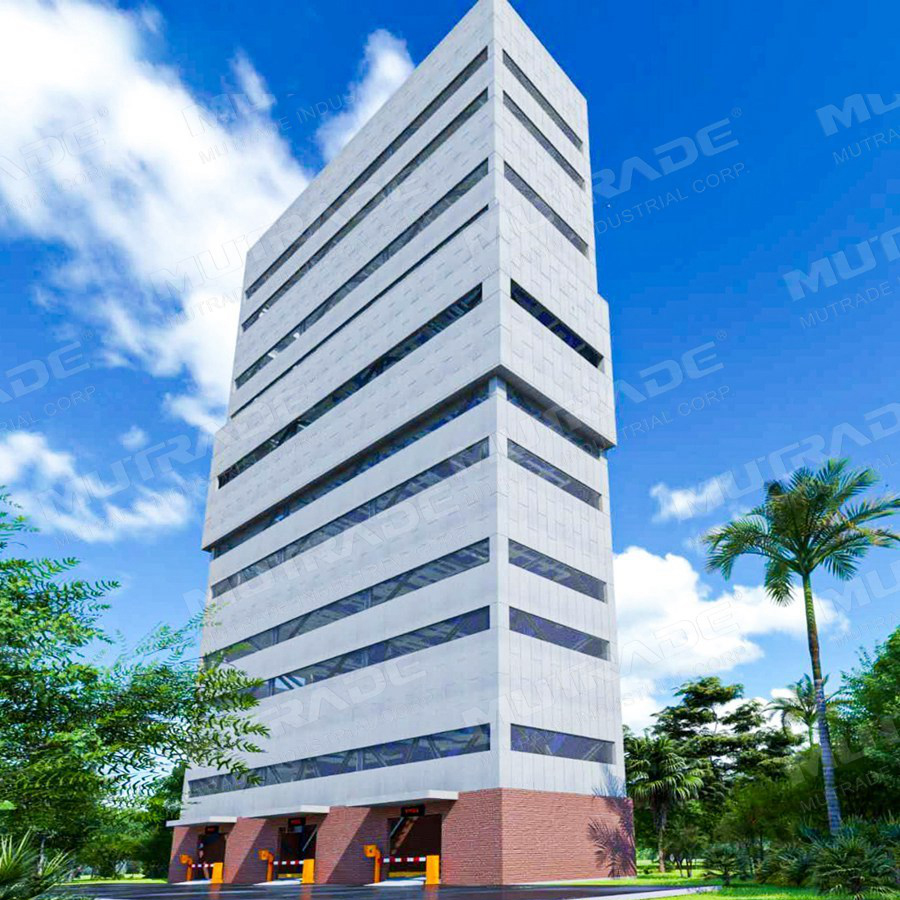
ATP Series automated tower configuration, part of a portfolio that also includes hydraulic two-post, four-post and pit parking lifts.
From Steel to System: What the Technical Evidence Covers
Mechanical parking equipment is usually described in terms of capacity and price, but the details that determine service life sit one layer down. Across the listed MUTRADE products, the published material is carbon steel Q235, with drive mode matched to duty rather than standardised across the range.
- Drive modes vary by model: hydraulic cylinder + chains on the Hydro-Park 1127 and 1027, the triple parking lift families and the ATP and MLP towers; hydraulic cylinder + cable on the Hydro-Park 2136; hydraulic cylinder + wire rope on the BDP-2 puzzle system; manual handle operation on the Hydro-Park 3130 and 3230; and hydraulic cylinder with double steel chains on the FP-VRC car elevator.
- Control and safety details documented in the manufacturer’s project records include a 24 V control voltage for electric shock protection, a dynamic mechanical anti-falling lock with electric auto release, and a key switch as the standard operation interface on most mechanical units.
- Platform construction in the case records uses a galvanised wave plate with anti-water, anti-rust and anti-slip properties plus a drainage function, finished with AkzoNobel powder coating for rust protection.
- Component testing is documented at component level: bolts and nuts on a residential project in Australia are recorded as passing a 72-hour salt spray test.
- Structural efficiency is addressed through column-sharing designs, described as saving cost, installation space, time and transport cost while making the structure stronger.
- Power flexibility is consistent across the mechanical range: bespoke supply from 110–480 V at 50/60 Hz, which matters for projects in markets with different grid standards.
For an engineer, the useful conclusion is that the range is not a single platform sold in different sizes. The drive systems, control voltages and platform treatments change with the duty cycle, and those differences are documented in the specification rather than left to interpretation.
Scenario Evidence: Where the Range Has Been Installed
Specifications describe what a product can do; installed projects show what it has done. The manufacturer’s project records cover residential, commercial, municipal and private applications across several continents.
In Russia, a residential complex developer installed 206 units of the Hydro-Park 1127 two-post lift, providing 412 parking spaces, with half the units installed on the ground floor and half on the roof. The recorded outcome was meeting the required number of parking spaces and doubling capacity within the existing footprint. In Canada, eight units of the same model created 16 spaces for a luxury auto dealership, used for both indoor inventory storage and vehicle display.
Low-ceiling and constrained sites appear repeatedly. In Romania, a residential developer used 20 TPTP-2 tilting two-post units to overcome a restricted basement, where the minimum ceiling requirement of 2,900 mm allowed installation in space that conventional stackers could not use. In Bulgaria, a municipal urban infrastructure project installed 45 TPTP-2 units under an overpass with a 3.1–3.3 m ceiling height and an 8% ground slope, converting what had been unusable space into 90 parking places.
Higher-capacity projects follow a different logic. A Saudi office complex used the BDP-2 hydraulic two-level semi-automatic puzzle system to create 926 parking spaces for employees and visitors, and a business district in Costa Rica used the same model family on a roof for 216 spaces. For fully automated parking, an installation in China combines underground and aboveground floors in a single shuttle system providing 75 spaces, with IC card authentication for retrieval. A private garage in Australia uses one Starke 2227 unit for four independent spaces, and a commercial facility in Turkey installed an ARP-16 rotary system for 16 SUVs at 2,500 kg per space.
Two further scenario details matter for project planning. For indoor car warehousing, the manufacturer lists applications from two to four levels of car storage in existing warehouse or parking spaces, operating in long-term storage mode, with supporting equipment that includes independent or centralised hydraulic power units, electric control systems and safety protection devices. The stated special requirements for that scenario include manual vehicle removal in case of power failure, remote control and a private labelled logo — practical constraints that should be designed in, not discovered later.
Market Signals: Why Supplier Evidence Is Being Scrutinised More
Demand for vehicle lifting and stacking equipment is expanding, and with it the number of suppliers claiming capability. Third-party estimates give a sense of scale, though definitions differ.
- The global car lifts market, covering parking and service lifts, was valued at USD 2.8 billion in 2025 and is projected to reach USD 4.7 billion by 2034 (Dataintelo).
- The narrower global market for car stacker lifts was valued at approximately USD 4.6 billion in 2023 and is expected to reach USD 6.72 billion by 2030 (QYResearch).
- Hydraulic mechanisms hold a leading share of 57.2% of the global car lift market, attributed to their reliability in heavy-duty applications (Dataintelo, 2025).
- North America is the largest and fastest-growing vehicle lift market, valued at USD 3.25 billion in 2024, driven by light trucks accounting for 77% of new sales (Custom Market Insights).
Published market sizes diverge because the scope differs: estimates that include parking management services are materially larger than those counting mechanical parking equipment hardware only. That divergence is itself a buyer lesson. When the same category can be sized two ways, product-level evidence — what a supplier actually builds, in what volume, for which projects — is more decision-relevant than a headline market figure.
Parking Lifts Versus Traditional Parking Construction: Where the Limits Are
A car parking lift system is usually compared with two alternatives: flat surface parking, which consumes land, and a new multilevel concrete structure, which consumes capital and construction time. Mechanical systems win on footprint efficiency, but they are not unconditionally suitable, and the constraints are documented in the product data.
| Approach | Primary advantage | Documented constraint |
|---|---|---|
| Surface parking | Simple operation, no equipment | Consumes land that is often unavailable or more valuable when built on |
| New multilevel concrete structure | Large capacity in one build | Limited to new-build or major reconstruction scenarios; long construction timelines |
| Mechanical parking lift | Doubles or triples capacity in the existing footprint | Depends on ceiling height, floor conditions and, for pit models, excavation depth |
| Automated tower or shuttle system | Highest density per square metre, with card-based retrieval | Requires carbon steel and concrete structures plus a control layer and ongoing service support |
The boundaries are specific rather than general. Pit-based models need excavation: the Starke 2327 requires a pit depth greater than 1,600 mm and a ceiling height greater than 2,700 mm, while the Starke 2127 is recorded with a standard pit depth from 1,750 mm. Where a pit is impossible, the tilting two-post TPTP-2 reduces the ceiling requirement to around 2,900 mm but is rated at 2,000 kg with a maximum vehicle height of 1,550 mm — a sedan-oriented envelope rather than an SUV one.
Access logic is a second boundary. The Starke pit models are documented as providing independent access, meaning the lower vehicle does not have to be moved to retrieve the upper one. Buyers who need that independence should confirm it against the specific configuration quoted rather than assuming it applies across every two-post parking lift.
Operational conditions form a third. Indoor installation is the standard case; outdoor use is possible with an outdoor package, and the wider product data specifies operation from -15 °C to +40 °C with a proper concrete foundation and rust resistance against snow and melting agents. Certain products also carry a scenario note that vehicles must be removed manually in the event of a power failure. Finally, delivery planning has a real ceiling: a 30–45 day lead time and 1,000 car spaces of monthly capacity mean that very large orders are phased projects, not single shipments.
How Buyers Can Test a Manufacturer’s Capability Claims
The following checkpoints convert the evidence above into questions a procurement or engineering team can put to any supplier of parking lift equipment, including MUTRADE.
- Production record: plant area, annual output in parking spaces, and monthly capacity in car spaces — figures that can be compared year on year.
- Model coverage: confirmation that the supplier builds both the mechanical configuration you need now and the automated configuration a later phase may require.
- Drive-mode documentation: hydraulic cylinder plus chains, cable, wire rope or manual handle, stated per model rather than per brochure.
- Envelope fit: allowed car length, width and height for the specific model, checked against the largest vehicle in the fleet.
- Site prerequisites: ceiling height, pit depth, floor condition and foundation requirements in writing.
- Power and customisation: voltage range and frequency support, plus the available scope for logo, width, height and colour changes under OEM, ODM, white label or private label production.
- Quality process: how inspection is carried out and at which stage of production.
- Delivery modelling: lead time and monthly capacity, mapped against the project schedule.
- After-sales structure: remote support hours, whether local partners exist in the destination market, and how on-site engineer supervision is arranged and charged.
- Comparable references: projects of similar capacity, ceiling height and climate, rather than a general customer list.
Brand comparison is part of the same exercise. Search behaviour shows buyers using named manufacturer terms such as “bendpak parking lift” alongside generic category queries, which suggests brands are compared early. BendPak is identified as a major player in the North American vehicle lift market and, as of 2024, operates the world’s first eight-armed car lift (Octa-Flex), according to SEMA Show and company reporting. The overlap with mechanical parking is only partial: service and repair lifts address garage workflow, while a parking lift addresses space multiplication. Buyers weighing both should compare on application fit and documented evidence rather than brand recognition alone.
Future Outlook
Two directions look likely to shape the next phase of the mechanical parking market. The first is continued growth in automated, high-density systems in urban projects where land cost dominates the business case — the segment where the ATP and MLP families sit, with 50–120 vehicles per unit and card or touch-screen operation. The second is the durability of hydraulic mechanical equipment, which still holds the majority of the car lift market on the strength of heavy-duty reliability, and which remains the pragmatic choice for residential basements, dealerships and private garages.
Suppliers able to operate in both worlds — fabricating hydraulic stackers and integrating automated control systems — are better positioned than those confined to one. For buyers, the practical consequence is a shift in evaluation criteria: from specification comparison towards production evidence, documented constraints and installed references. A supplier with a 12,000 m² plant, 7 in-house engineers, a 1,000 car space monthly capacity and projects recorded across more than 100 countries is offering a traceable record, and traceable records are what survive contact with a construction schedule.
Frequently Asked Questions
What evidence should a buyer request to confirm a parking lift manufacturer’s production capability?
Ask for plant area, annual output, monthly capacity, order lead time, minimum order quantity and the quality-control method. As a reference point, MUTRADE publishes a 12,000 m² facility, 10,000 parking spaces of annual output, a monthly capacity of 1,000 car spaces, a 30–45 day lead time, a one-unit minimum order quantity and random-inspection quality control. These are checkable statements that can be compared with other suppliers on the same basis.
Which parking lift configuration suits a low-ceiling underground garage?
Low-ceiling projects are usually served by tilting or pit-based models. The TPTP-2 tilting two-post lift is documented with a minimum ceiling height requirement of 2,900 mm and is rated at 2,000 kg with a maximum vehicle height of 1,550 mm. The Starke 2327 tilted pit lift requires a ceiling height greater than 2,700 mm and a pit depth greater than 1,600 mm. The Starke 2127 pit model is recorded with a standard pit depth from 1,750 mm and provides independent access to each level.
Can a car parking lift be installed outdoors?
The standard configuration is for indoor installation, but outdoor use is possible with an outdoor package. The wider product data specifies operating conditions from -15 °C to +40 °C with a proper concrete foundation, plus rust resistance against snow and melting agents in outdoor applications. Bespoke colour and customised dimensions are listed among the available modifications for outdoor projects.
What is the difference between a hydraulic parking lift and an automated tower system?
A hydraulic parking lift such as the Hydro-Park 1127 stores two vehicles per unit with a key switch and a hydraulic cylinder and chains drive, while a triple parking lift such as the Hydro Park 2525 stores three. An automated system such as the ATP or MLP Series stores 50–120 vehicles per unit at 2,350 kg rated capacity, uses carbon steel with concrete buildings, and is operated by IC card, touch screen or manual control. The mechanical units suit smaller footprints and lower capital exposure; the automated units suit high-density commercial and municipal sites.
What order volume and lead time should a project plan for?
MUTRADE lists a minimum order quantity of one unit and an order lead time of 30–45 days, with a monthly production capacity of 1,000 car spaces. For large projects, that monthly capacity is the constraint that determines phasing. Export markets covered in the published capability data are the EU, Middle East, North America, Latin America, Southeast Asia, Africa, and Australia & New Zealand.
What support is available after installation?
The published after-sales structure comprises 24-hour online remote support, local partners in destination markets, and on-site engineer supervision arranged at cost. For products used in long-term storage scenarios, the manufacturer also notes requirements such as manual vehicle removal in the event of a power failure and remote control availability, which buyers should confirm against their own operating plan.
For readers who need the full technical and commercial detail behind the evidence discussed here, the MUTRADE company profile is available as a downloadable document: Mutrade Profile 2025 (EN) – PDF.
Market data in this article is attributed to Dataintelo, QYResearch and Custom Market Insights. Production, product and project figures are drawn from MUTRADE’s published capability, specification and case records and are presented as company-reported information.