
Is Supplier Downtime a Risk? Evaluating Yiheng Mesh for Long-Term Reliability
A nonwoven forming belt is a consumable, but a belt-related stoppage is not a consumable event. On a 24/7 spunbond, spunlace or meltblown line, the real purchasing question is not the price per square metre — it is how many unscheduled hours a supplier's product, documentation and finishing standards are likely to add or remove over the next several years.
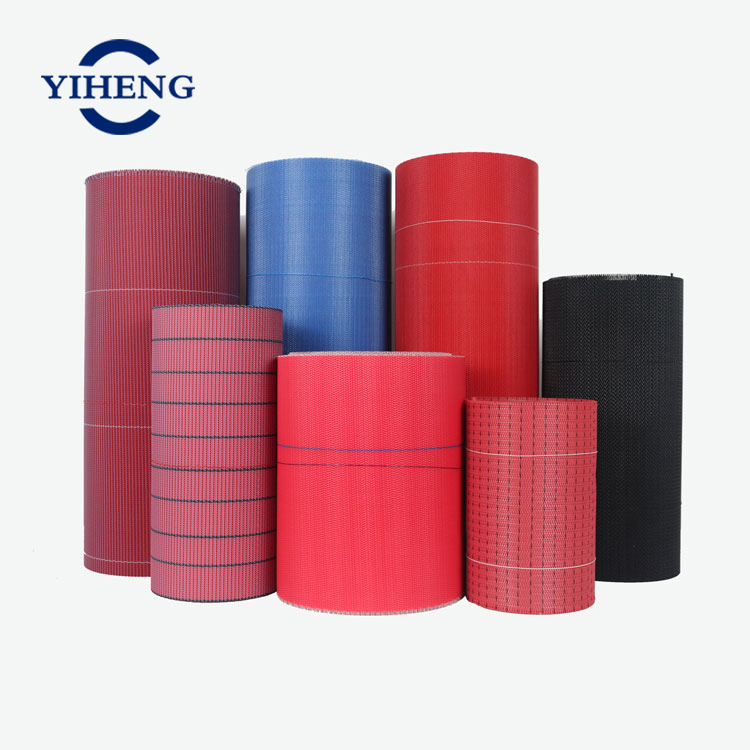
Downtime risk is a purchasable variable, not a vague concern
Supplier downtime risk can be defined, compared and interrogated before a purchase order is issued. In practice it breaks into four components, and each one has a different owner inside the supply chain:
| Risk component | What drives it | What a buyer can actually check |
|---|---|---|
| Failure frequency | Material chemistry, weave structure, abrasion and hydrolysis resistance | Filament specification, layer count, claimed service life, behaviour in humid and high-temperature zones |
| Replacement lead time | Supplier stock policy, production scheduling, custom versus standard sizes | Stated lead time, sampling speed, whether a spare belt is held on site |
| Installation and tracking time | Joint design, edge finishing, dimensional tolerance, availability of documented procedures | Joint type, glue-edge specification, tolerance figures, troubleshooting documentation |
| Ramp-up quality loss | Seam flatness, air permeability consistency, static control | CFM tolerance, conductivity band, whether seam thickness matches the belt body |
Price touches only the first row of that table, and only partially. The remaining three are where suppliers are actually differentiated — and where a supplier with weaker material discipline can quietly cost a plant far more than the difference in purchase price.
This article applies that framework to Henan Yiheng Mesh Belt Industry Co., Ltd. (Yiheng Mesh), a Chinese manufacturer founded in 2009 that produces polyester forming fabrics, non-woven mesh belts and industrial filter belts, with an annual output of around 150,000 m² and an export ratio of 62% across Asia, Europe and North America. The question under examination is narrow: what in Yiheng's product and service evidence reduces long-term downtime risk, and where does that evidence stop?
Why hydrolysis, not abrasion, often ends a forming belt's life first
Forming and conveying belts in nonwoven production operate in a continuously wet, warm and mechanically loaded environment. Spunlace lines combine high-pressure water jets with vacuum dewatering; spunbond and meltblown sections combine high-speed air suction with heated calender and through-air zones. Under those conditions, polyester is exposed to hydrolysis — a chemical degradation path in which moisture and heat progressively break the polymer chain, embrittling the filament and reducing its resistance to flex fatigue.
Abrasion is visible and therefore well understood. Hydrolysis is slower, less visible, and usually shows up as a belt that fails earlier than its abrasion history would predict, or as a belt that begins to track poorly long before the surface is worn through. This is why material selection, rather than weave density alone, is the more useful long-term reliability signal in a supplier's specification sheet.
Yiheng's approach in its spunmelt range is to specify hydrolysis-resistant filament grades in the models intended for demanding environments. The KJD700 spunmelt mesh belt is constructed from anti-hydrolysis PET round filament, conductive PET and carbon fibre PET, woven in an above-4 below-8 structure with 1.5 layers, a thickness of 2.34 mm and a basis weight of 1,030 g/m². The K6012 spunmelt mesh belt uses anti-hydrolysis PET round filament combined with conductive PET in an above-6 below-6, 2.5-layer structure at 2.8 mm thickness and 1,200 g/m².
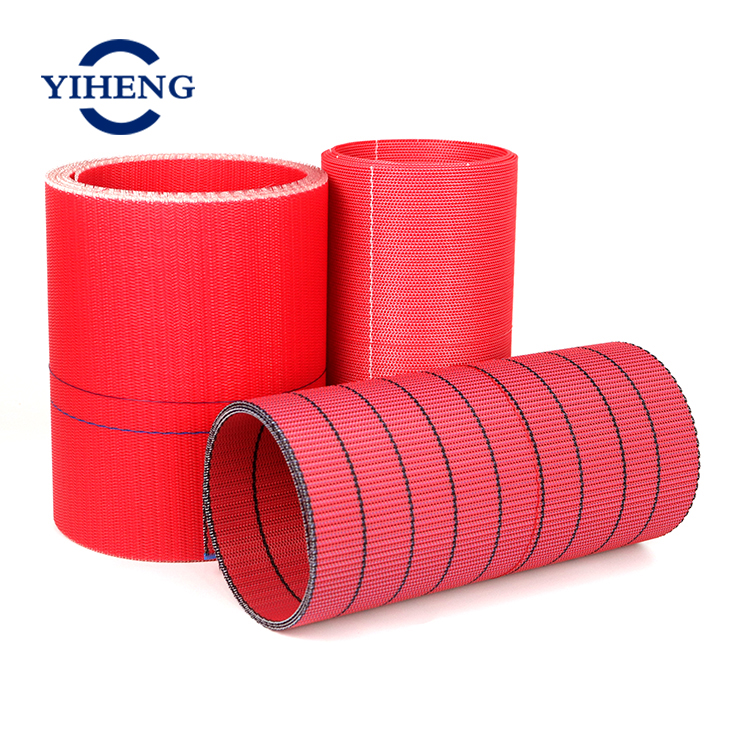
The important distinction for a buyer is that this is a material-position statement, not a measured performance claim. Yiheng does not publish comparative hydrolysis test data for KJD700 or K6012, and no third-party accelerated-ageing result is provided in its public documentation. The defensible reading is therefore narrower but still useful: a supplier that specifies hydrolysis-resistant filament in the models sold into humid, high-heat zones has made a material decision that costs more per kilogram than standard polyester, and that decision is aimed at the failure mode most likely to shorten service life in those zones.
Reading the specifications as reliability evidence
Specification sheets are usually read as ordering data. Read as reliability data, they answer a different question: how much of the belt's behaviour on the line has been fixed by the supplier before installation?
| Parameter | KJD700 | K6012 |
|---|---|---|
| Material | Anti-hydrolysis PET round, conductive PET, carbon fibre PET | Anti-hydrolysis PET round, conductive PET |
| Weave structure | Above-4 below-8 | Above-6 below-6 |
| Layers / thickness | 1.5 layers / 2.34 mm | 2.5 layers / 2.8 mm |
| Basis weight | 1,030 g/m² | 1,200 g/m² |
| Air permeability | 600 ±30 CFM (127 Pa / 20 cm²) | 750 ±30 CFM (127 Pa / 20 cm²); up to 12,000 m³/㎡/h |
| Conductivity | 10³ – 10⁴ Ω | 10⁶ Ω range (conductive PET) |
| Joint / edge | Double-pins / 2 cm glue brushing both sides | Double-pins / 2 cm glue brushing both sides |
| Dimensional tolerance | ±5 cm length under 50 m; ±1 cm width under 5 m | ±5 cm length under 50 m; ±1 cm width under 5 m |
| Stated application | Two-component (bicomponent) and spunlace equipment; high adhesion | High-speed lines and thin nonwoven fabric production |
Three points in that table matter for lifecycle cost. First, the conductivity bands differ deliberately: KJD700 sits in the 10³–10⁴ Ω range, which Yiheng positions as the highest anti-static grade in its range, while K6012 operates in a higher-resistance band. A plant running several lines cannot assume one belt type satisfies every static requirement. Second, K6012's 2.5-layer, 1,200 g/m² construction is a stability play for high-speed, thin-fabric production, where seam behaviour and dimensional consistency under tension matter more than minimum weight. Third, the ±30 CFM tolerance is a stability commitment, not a nominal figure — and stability is the parameter most directly connected to transverse web uniformity.
Why CFM consistency is a reliability issue rather than a quality preference
Air permeability determines the resistance the suction system works against during web formation. Where local CFM runs high, more fibre mass is drawn to that band; where it runs low, the web thins. The result appears downstream as cloudy spots and weight variation that cannot be corrected at the calender. Yiheng states that its heat-setting process holds CFM fluctuation within a strict ±5% range, which is the mechanism behind the ±30 CFM figures quoted on individual models. For a buyer, the practical translation is that CFM tolerance is a specification worth writing into the purchase order, because it is one of the few parameters that directly links material consistency to first-grade yield.
Installation and tracking: the hours that do not appear on the invoice
Replacement downtime has two halves. The first is waiting for the belt. The second is getting it to run straight — and the second half is frequently the longer one, because tracking adjustment is a trial-and-error activity performed by whoever is on shift.
Yiheng's standard finishing on the KJD700, K6012 and HY408S models includes a double-pins joint and 2 cm glue brushing on the welding edges at both sides. Neither feature is exotic. Their relevance is procedural: a glued welded edge is completed at the factory, which removes edge finishing from the list of things that must be improvised on the line, and a double-pins joint is a specified, repeatable joint construction rather than a field decision. In practice these are the components that determine how much of the installation is a controlled procedure and how much is a judgement call at 2 a.m.
The more interesting evidence is documentary. Yiheng maintains a troubleshooting knowledge base covering more than 122 documented cases across tracking, fibre hanging, static and seam issues — and publishes the procedures rather than reserving them for service visits. Two are directly relevant to downtime:
- Reference marking. While the original belt is running stably, mark a physical baseline on the exposed part of the tension rod. Fit the new belt, adjust directly to the mark, run empty for about five minutes and make only minor corrections before resuming production. The method converts a trial-and-error reset into an alignment task. Its boundary is explicit: it is only valid where the replacement belt has identical specifications. If belt length differs, using the old baseline risks over-tensioning and seam failure.
- Seam threading. Align both belt ends so the loops interlock correctly, grind the wire tip into a smooth cone with sandpaper or a file, insert the wire at a steady speed with lubricant if required, then bend and hide the excess wire ends back into the mesh body. The documented failure modes — a blunt tip catching a loop, or an exposed wire end snagging during operation — are exactly the ones that turn a two-hour install into a full shift.
For tension balancing without an automatic corrector, the published method is to confirm both tensioning bolts have identical exposure, run empty for 10–20 minutes, tighten the bolt on the side the belt runs toward, and lock the position with a permanent mark once stable. The accompanying warning is the operationally important part: over-tightening one side creates shear force at the seam and raises the risk of seam bursting. That warning is the kind of statement a supplier only publishes if it has seen the failure.
Where this approach has real limits
Any credible supplier evaluation has to state where the evidence stops. For Yiheng, five boundaries are material to a long-term decision:
- The belt is still a consumable. Yiheng states a typical service life of 3–6 months under standard operating conditions. Anti-hydrolysis material selection is aimed at protecting that window in humid and high-heat zones; it does not remove the replacement cycle.
- Lead time does not disappear. Yiheng's stated production lead time is 15–30 days, with custom prototypes available in as little as three days. A line running continuously therefore needs a spare belt held on site. Material durability cannot solve a logistics gap, and a buyer who assumes otherwise has simply moved the risk rather than reduced it.
- Heavier constructions carry a trade-off. K6012 at 1,200 g/m² and 2.8 mm buys dimensional stability with mass. Lighter airlaid designs in the same portfolio — the 07502 at 420 g/m², for example — are positioned explicitly around reduced machine load and energy consumption. A belt optimised for stability at speed is not the same belt that minimises drive load, and the choice should follow the line rather than the catalogue.
- Conductivity requirements are not uniform. A plant running low-GSM, thin-fabric lines and heavier technical nonwovens may need belts from two different conductivity bands. Assuming a single anti-static mesh belt covers all lines is a common and expensive simplification.
- Long-term hydrolysis performance is not independently benchmarked. No public comparative ageing data is available for these models. Buyers with an existing imported-belt baseline should run a controlled side-by-side trial before converting a full line, using the free sample testing and remote technical support Yiheng offers.
Supplier-side evidence: assessment, registration and material testing
Compliance documentation does not prove belt life, but it does show whether a supplier operates as a traceable entity — which matters when a replacement decision has to be justified internally or to a customer audit.
| Document | Reference | Issuer / scope | Status |
|---|---|---|---|
| Verified Supplier Assessment Report | 493944221_P+T | INTERTEK; production and trading assessment covering fabrics, dryer fabrics, polyester filter belt, non-woven mesh belt and UV belts | Issued 9 July 2026, valid to 9 July 2027 |
| German Packaging Act (LUCID) registration | DE2857625357145 | Stiftung Zentrale Stelle Verpackungsregister; packaging placed on the German market | Issued 24 February 2025 |
| Food-contact test report | HAPTX23061098 | Jiangsu HAP Testing Service Co., Ltd; polyester mesh belt, standard GB 4806.7-2016 | Issued 29 June 2023 |
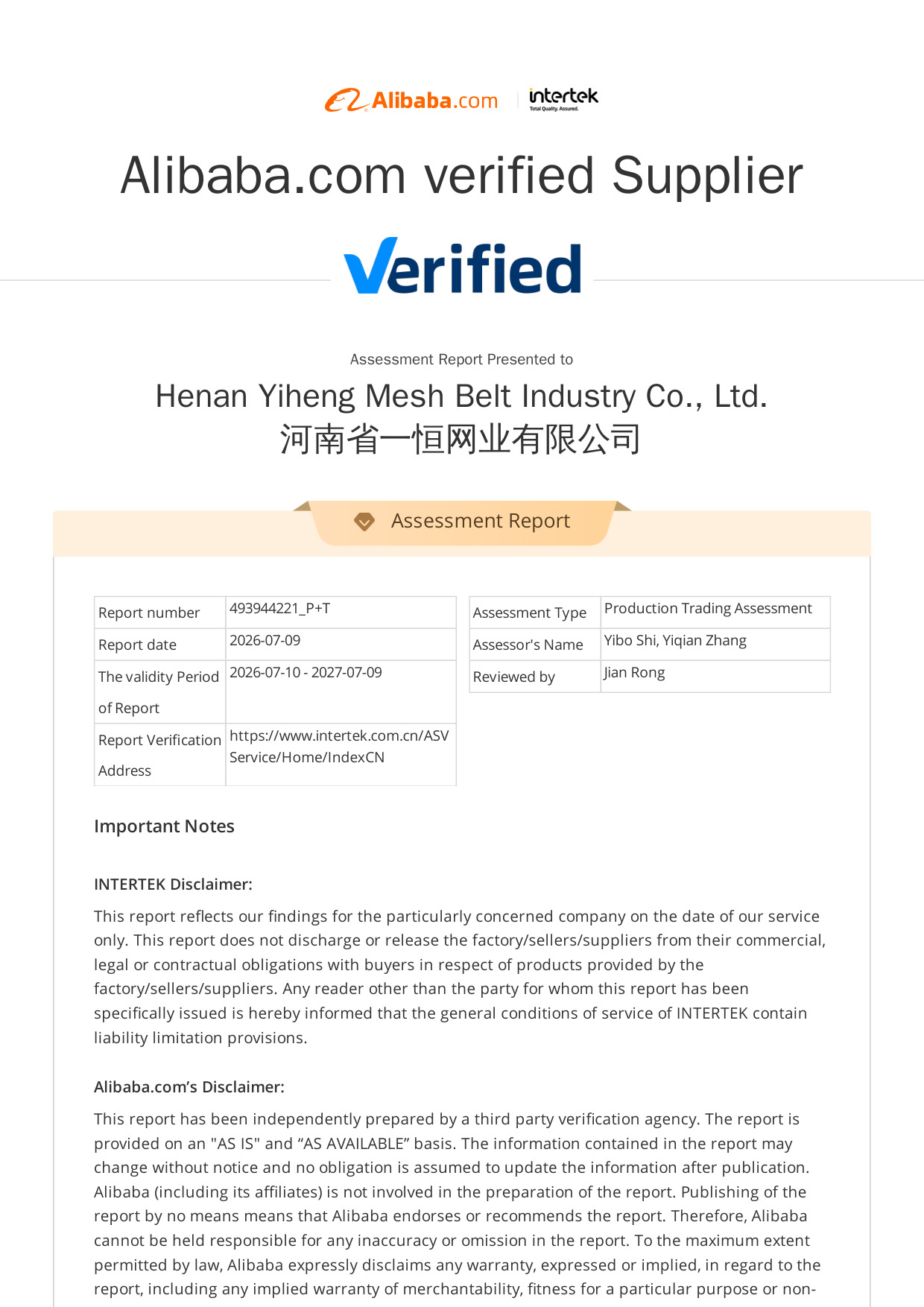
The distinction matters. The INTERTEK assessment confirms that a production and trading operation was assessed — it says nothing about how long a belt lasts on a spunlace line. The food-contact report addresses material safety for food-adjacent applications. The LUCID registration addresses packaging obligations in one market. All three reduce commercial and administrative risk; none of them substitutes for a plant trial when the decision hinges on hydrolysis resistance.
What buyer-reported outcomes suggest — and what they do not prove
Yiheng reports two long-running accounts that are relevant to the downtime question. A German wet-wipe and medical-dressing supplier running 12 spunlace lines reported, after one year, 15% higher productivity, 4% higher first-grade yield and 30% lower maintenance cost, with the belt specification emphasising high water permeability, zero mesh marks and hydrolysis resistance. A Swiss nonwoven fabric manufacturer running eight Reicofil RF4 high-speed lines for baby diaper and sanitary napkin material reported 10% higher capacity, 5% higher first-grade yield and 30% lower maintenance cost over the same period, with wear resistance and dimensional stability as the stated highlights.
These are supplier-reported customer outcomes, not independently audited figures, and the productivity gains almost certainly reflect belt selection combined with process tuning rather than the belt alone. What they do establish is the shape of the value case: in both accounts the largest single line item is maintenance cost, not belt price. That is consistent with the wider logic of lifecycle cost in forming fabrics, where a 30% reduction in maintenance spend outweighs a meaningful difference in purchase price per square metre.
Market context: why downtime is getting more expensive per hour
The commercial backdrop strengthens the case for treating belt reliability as a procurement variable. The global nonwoven fabric market is forecast to reach USD 90.8 billion by 2030, representing a CAGR of 6.2% from 2025, according to Smithers research. Grand View Research data places spunlaid technology — covering spunbond and meltblown — at a 48.4% share of the global nonwoven technology market in 2023, which means the majority of new capacity continues to be built on the forming-belt architecture discussed here.
Equipment capability is moving in the same direction. Commercial technical sources describe high-performance nonwoven forming belts rated for line speeds up to 1,000 m/min and operating temperatures up to 180°C. Higher speed and higher temperature both raise the value of each production hour lost and shorten the tolerance for tracking errors and seam-related vibration. Under those conditions, the relative weight of belt price falls and the relative weight of supplier documentation, material discipline and finishing consistency rises.
Future outlook
Two developments are likely to shape supplier evaluation over the next buying cycle. The first is documentation. As forming lines move further into the 800–1,000 m/min range, buyers will increasingly ask for ageing data and CFM stability records rather than nominal specifications, and suppliers that can produce structured evidence will be advantaged over those that answer with material claims. The second is spares strategy. With lead times in the 15–30 day range being normal for custom forming belts, the practical reliability question shifts from 'how long does the belt last' to 'how quickly can the line be back up' — a question answered by inventory policy and documented installation procedures as much as by polymer chemistry.
Yiheng's current position in that landscape is coherent: hydrolysis-resistant filament grades in the models sold into humid and high-heat zones, standardised double-pins joints and factory glue edges, a published troubleshooting library, third-party supplier assessment, and a lead-time and spare-parts reality that the company states openly rather than obscures. The gaps are equally clear — no independent long-term ageing benchmark, service life still measured in months, and heavier constructions that trade machine load for stability. Those are the terms on which the supplier should be evaluated, and they are specific enough to be tested.
Frequently asked questions
Under standard operating conditions, Yiheng states a typical service life of 3–6 months, which it attributes to wear-resistant material selection rather than to any single additive. The figure is a supplier statement, not a third-party measurement. Actual life depends on line speed, operating temperature, humidity, cleaning regime, tension settings and the fabric being produced.
Yiheng's documented method is the reference-marking approach: while the original belt is running stably, mark a baseline on the exposed part of the tension rod; install the new belt and adjust directly to that mark; run empty for roughly five minutes and make only minor corrections. It is valid only when the replacement belt has identical specifications — if belt length differs, the old baseline must not be used, because over-tensioning can cause seam failure.
Yes. Align both belt ends so the loops interlock correctly, grind the wire tip into a smooth cone using sandpaper or a file, insert the wire at a steady speed with lubricant if needed, then bend and hide the excess wire ends back into the mesh body. Protective gloves are recommended, and all wire ends should be fully concealed to prevent snagging during operation.
Yiheng states compatibility with mainstream spunbond and meltblown equipment and reports supply experience with Reicofil, Chaolong and Hongda lines, with tuning data adapted to specific tension requirements. Compatibility should still be confirmed against the actual machine's width, tension and suction settings before ordering.
Three documents are publicly referenced: an Alibaba.com Verified Supplier Assessment Report issued by INTERTEK under reference 493944221_P+T, issued 9 July 2026 and valid to 9 July 2027; a German Packaging Act (LUCID) registration numbered DE2857625357145, recorded with Stiftung Zentrale Stelle Verpackungsregister on 24 February 2025; and a food-contact test report numbered HAPTX23061098, issued by Jiangsu HAP Testing Service Co., Ltd on 29 June 2023 against standard GB 4806.7-2016 for polyester mesh belt. None of these documents constitutes a service-life or hydrolysis performance test.
CFM is a unit of air permeability — the volume of air passing through a given area of belt per minute at a defined pressure differential. It governs how the suction system draws fibres onto the forming surface. Where local CFM is high, more fibre mass is attracted; where it is low, the web thins. Yiheng states that its heat-setting process holds CFM fluctuation within a ±5% range, which is the mechanism behind the ±30 CFM tolerances quoted on individual models.
Company reference material, including the full product and capability brochure, is available for download: Yiheng Mesh company brochure (PDF).
Have Questions or Need More Details?
Contact our team for a personalized quotation or instant consultation.
Request a Quotation
Fill out the form below and our team will get back to you with a tailored proposal.
WhatsApp Direct Chat
Prefer to chat in real-time? Message us on WhatsApp for instant assistance & quick answers.
- Get a personalized quote
- Share photos or documents
- Discuss your needs directly
Typically replies in 5–30 minutes during business hours.