
JH-2219: A Pulp Molding Strength Enhancer for Food-Grade Tableware
Molded pulp has moved from a low-cost cushioning material to a specification-driven packaging format. Egg trays, fruit trays, protective inserts and single-use tableware are now judged on the same terms as any other packaging: dimensional consistency, load resistance and suitability for the product they touch. The variable that most often decides whether a molded pulp article passes or fails is not the forming machine — it is how well the fibers bond after they have already been recycled once or twice.
JH-2219 is a pulp molding strength enhancer supplied by Qingzhou Jinhao New Material Co., Ltd., a papermaking fine chemicals manufacturer founded in 2005 and located in Mihe Industrial Park, Qingzhou City, Shandong Province, China. The company trades under the brand JHDA. JH-2219 is classified as a molded pulp reinforcement additive, a pulp molding dry strength agent and a disposable pulp tableware strength agent. It is intended for the pulp molding and paper manufacturing industries, and it is positioned for recycled pulp applications, food-grade pulp tableware and food packaging pulp molds.
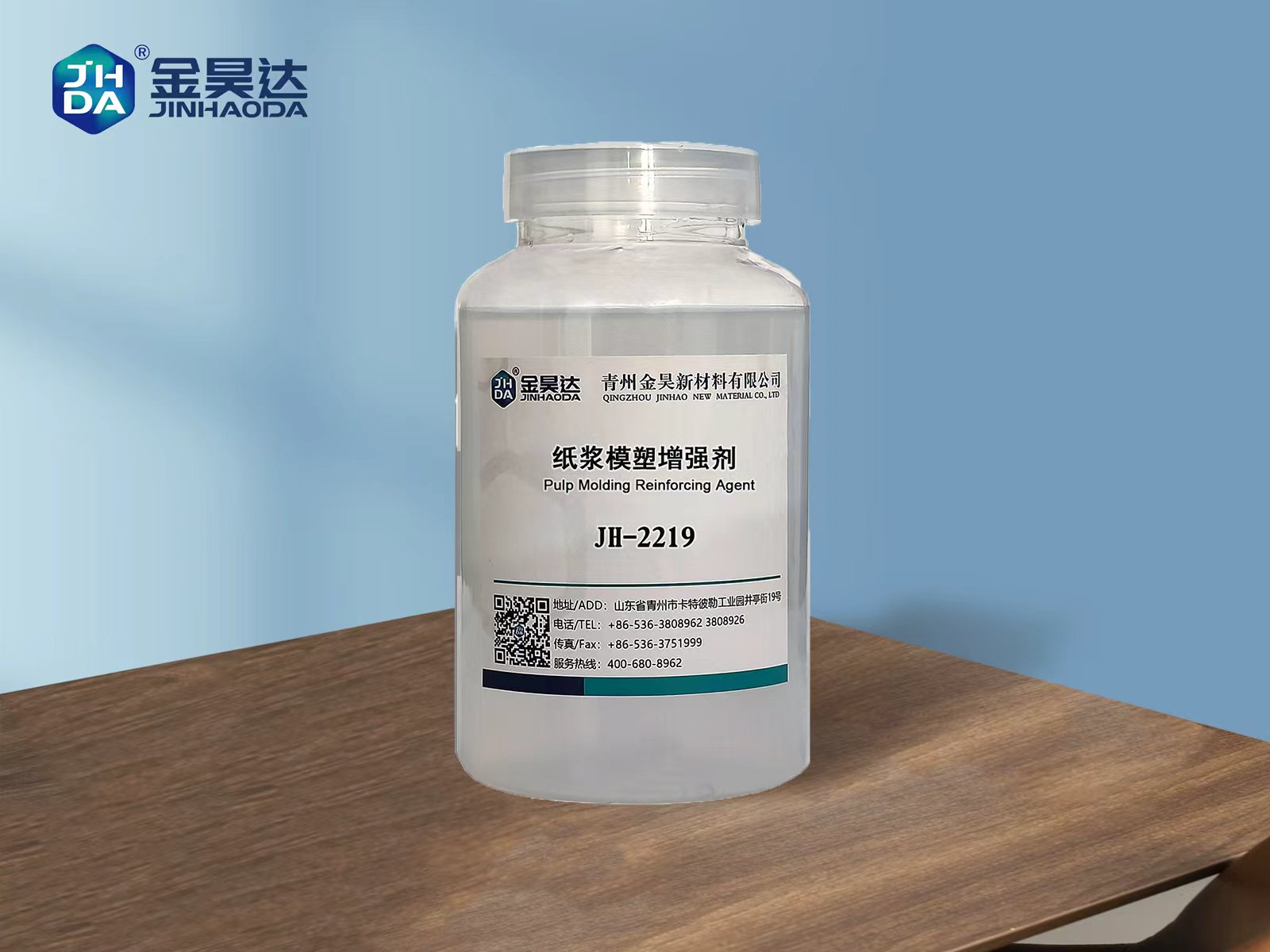
JH-2219 is supplied as a water-based amphoteric liquid dry strength agent for molded pulp and food-contact tableware production.
Why Recycled Fiber Changes the Strength Equation
Every additional recycling cycle shortens the cellulose fiber and reduces its ability to form hydrogen bonds with its neighbors. Secondary fiber also carries a higher share of fines and inorganic filler, and its quality fluctuates from bale to bale. In a molded pulp line, those characteristics surface as brittleness in the finished article, cracking at the hot-press stage, warping during drying, and a higher breakage rate in trimming and packing.
Historically, molders have addressed this in three ways. The first is to blend in longer virgin kraft fiber, which raises raw material cost and increases dependence on a fiber grade that is itself under price pressure. The second is to increase chemical reinforcement through starch or conventional dry strength additives, which may require cooking or additional dosing equipment. The third is simply to increase wall thickness or basis weight, spending more fiber to reach the same performance.
None of these approaches is wrong. But each of them adds cost at a point in the process where molded pulp producers are being asked to compete with injection-molded and thermoformed alternatives on unit price, while simultaneously meeting stricter food-contact expectations.
What JH-2219 Is
JH-2219 is not a wet strength resin and it is not a sizing agent. It is a wet-end dry strength additive specifically formulated for molded pulp furnishes, where the fiber network is formed under vacuum on a shaped screen rather than on a continuous fourdrinier wire. That distinction matters, because molded pulp articles are three-dimensional, thick-walled and dried under restraint — the strength requirement is not only tensile, but also stiffness and compression resistance in a formed shape.
According to the supplier's technical data, JH-2219 is a light white to transparent liquid with a mild acidic pH and a relatively high viscosity, supplied as a water-soluble amphoteric product.
| Parameter | JH-2219 (as documented) |
|---|---|
| Product type | Pulp molding dry strength agent; molded pulp reinforcement additive; disposable pulp tableware strength agent |
| Appearance | Light white to transparent liquid |
| Solid content | 20.0 ± 1.0% |
| pH | 2.0 – 5.0 |
| Viscosity (25 °C) | 5000 – 12000 cps |
| Ionic type | Amphoteric |
| Solubility | Soluble |
| Shelf life | 6 months |
| Principal materials | Polyacrylamide, polyamine, polyamide epichlorohydrin resin, starch derivatives, cationic polyacrylamide copolymer, acrylic acid copolymer, water-based cationic resin |
| Intended industries | Pulp molding; paper manufacturing |
The amphoteric charge character is worth noting for buyers who are comparing it with standard papermaking dry strength agents. A cationic-only additive can be sensitive to the charge balance of a recycled furnish, particularly when the pulp mix contains deinking residue, coated broke or high filler loading. An amphoteric chemistry is intended to remain effective across a wider band of wet-end conductivity and pH, which is closer to the day-to-day reality of a molded pulp plant than to a tightly controlled paper machine.
How the Reinforcement Mechanism Works
JHDA's product documentation describes the mechanism as rapid adsorption of the polymer onto the pulp fiber surface, where it forms a stable ionic bonding network. In practical terms, the additive bridges fiber segments that would otherwise only be joined by the limited number of bonding sites left on a recycled fiber surface. The result described by the supplier is a measurable improvement in stiffness, tensile toughness and compression resistance of the molded article.
Three process-level consequences follow from that:
- Dimensional stability under heat. Better bonded fiber networks resist deformation, warping and cracking during hot pressing and drying, which is where a large share of molded pulp rejects originate.
- Less reliance on long virgin fiber. The additive allows molders to lower the proportion of long fiber in the furnish, which is the single largest controllable cost line in most molded pulp operations.
- Cleaner mold release behavior. JHDA documents less sticky residue on the molding die surface, which reduces mold cleaning frequency and extends forming mold service life.
Compatibility with Defoamers and Sizing Agents
Wet-end additive compatibility is one of the most common reasons a strength additive underperforms in real production. Antifoaming agents, internal sizing emulsions and surface sizing chemistry can all interfere with a strength polymer if the charges are mismatched, producing flocculation, system blockage or a loss of sizing efficiency.
JHDA's documentation states that JH-2219 is compatible with sizing agents and antifoaming agents and does not cause flocculation or system blockage in the pulp circulation system. Because it is supplied as a water-based liquid, it can be diluted in cold water and mixed uniformly into the pulp slurry without a heating step before dosing — a meaningful operational simplification for plants that already run continuous stock preparation.
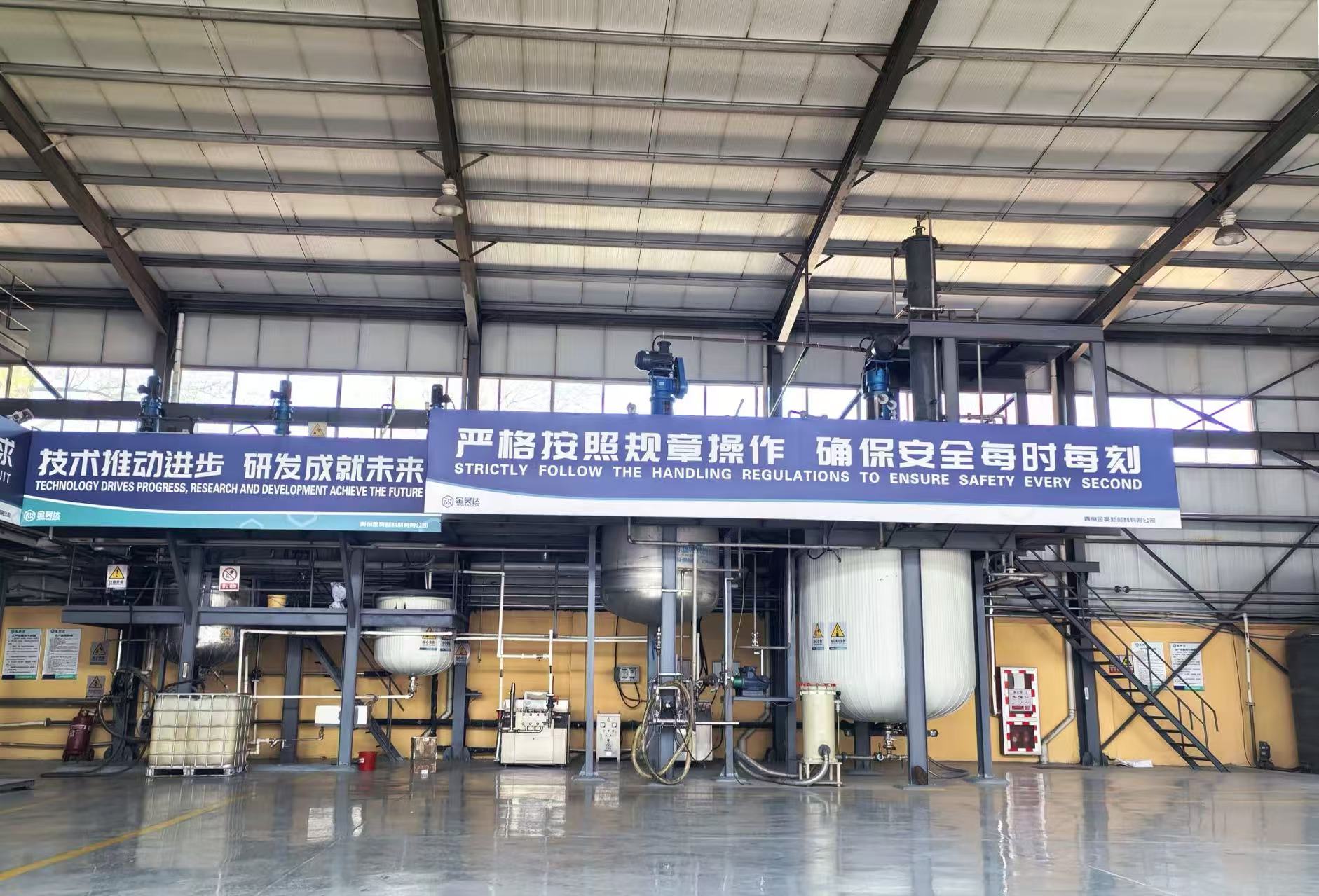
Liquid additive production for pulp molding and papermaking applications is metered and batch-controlled to keep dosing behavior consistent between deliveries.
Where JH-2219 Fits in Production
The application set documented for JH-2219 covers the mainstream molded pulp article families that use waste paper recycled pulp:
- Egg trays and egg cartons — where compression resistance in stacking and resistance to cracking during de-nesting are the defining quality criteria.
- Fruit and produce trays — where surface integrity and dimensional accuracy matter for automated packing lines.
- Industrial buffer packaging molds — where impact absorption depends on a fiber network that does not delaminate or shatter.
- Food-grade pulp tableware and single-use pulp tableware — where strength must be achieved without compromising the safety profile of the article.
- Food packaging pulp molds — where the molded article contacts food directly or indirectly.
Beyond raw strength, the supplier lists improvements in finished-article machining performance, with reduced breakage during cutting, trimming and packaging transport. In plants where the reject rate is driven by handling damage rather than by forming defects, that is often the most visible commercial effect of a strength additive upgrade.
Market Signals Behind the Demand
Several verifiable market indicators explain why a product like JH-2219 has moved from a niche additive to a mainstream procurement item.
Recycled fiber is now the default, not the exception. The American Forest & Paper Association reported that recycled paper accounted for 44.4% of all fiber used at U.S. mills in 2024. As recycled content requirements spread across packaging categories, the furnish going into molded pulp lines becomes progressively harder to reinforce with fiber blending alone.
Dry strength chemistry is a large and growing category. Intel Market Research valued the global paper dry strength agent market at approximately USD 864 million in 2024, with Asia-Pacific accounting for roughly 40% of that market. Fact.MR projects the broader dry strength resin market to reach USD 1.4 billion by 2026, growing at a CAGR of 4.8% through 2036. Market Research Future estimated the total pulp and paper chemicals market at USD 23.64 billion in 2024.
Polyacrylamide remains the dominant chemistry. Fact.MR estimates that polyacrylamide (PAM) resins account for about 40.0% of the dry strength resin market. JH-2219 sits within that chemistry family, which means buyers can evaluate it against a well-understood performance baseline rather than treating it as an unproven formulation.
Packaging leads application demand. The packaging and containerboard segment represents the largest paper grade usage for dry strength additives at a 38.0% share, according to Fact.MR. Molded pulp tableware and trays are an adjacent, fast-developing application within that packaging demand pool.
Regulation is tightening around food contact. In the European Union, paper and board intended for food contact must comply with standards including EN 645, EN 646 (colorfastness) and EN 648 (fluorescent fastness). Germany's BfR Recommendation XXXVI is widely cited globally as the safety framework for paper and board chemicals in food contact. These frameworks do not regulate additives in isolation — they regulate the finished article — but they determine which chemistries a molder can realistically put into a food-contact furnish.
Comparison with Established Reinforcement Approaches
JH-2219 should be evaluated as one option among several, not as a universal answer. The table below compares the main routes a molded pulp producer can take to raise dry strength in a recycled furnish.
| Approach | Primary strength role | Practical considerations |
|---|---|---|
| Blending long virgin kraft fiber | Directly raises fiber bonding potential | Highest raw material cost impact; increases exposure to virgin pulp price movements |
| Starch-based reinforcement | Bulk bonding improvement | Typically requires cooking or dedicated preparation; adds organic load to white water systems |
| Conventional cationic dry strength agents | Tensile and ring crush improvement in paper grades | Charge-sensitive in high-filler or high-conductivity recycled furnishes; formulated for flat paper, not shaped molded articles |
| JH-2219 pulp molding strength enhancer | Stiffness, tensile toughness and compression resistance in molded shapes | Liquid form carries higher transport weight and a 6-month shelf life; requires correct dilution and metering |
Where JH-2219 Has Clear Boundaries
Credible procurement evaluation requires knowing what a product does not do.
- It is a dry strength additive, not a wet strength resin. Where an article must retain mechanical integrity after saturation — for example certain food-service items requiring wet strength — a dedicated PAE wet strength resin such as JH-1201 remains the appropriate chemistry. JH-2219 addresses dry strength in the formed and dried article.
- Shelf life is 6 months. That is shorter than the 12-month shelf life documented for JHDA's solid dry strength agents JH-1697 and JH-1699. Plants planning high-volume buffer stock should account for this in inventory rotation.
- It is a liquid with viscosity between 5000 and 12000 cps at 25 °C. Correct dilution before dosing is not optional; the product is designed for uniform mixing into the pulp slurry, not for direct undiluted addition.
- It operates in an acidic range (pH 2.0–5.0). Dosing equipment and dilution water quality should be reviewed against plant practice before full-scale conversion.
- Performance depends on the furnish. No strength additive overrides a poorly classified recycled stock or an unstable white water system. The supplier's documented position is that reinforcement remains stable under variable pulp water conductivity and pH, but verification must always happen on the buyer's own fiber.
What Buyers Should Verify Before Qualification
For a molded pulp or tableware producer moving from awareness to evaluation, the qualification list is short but non-negotiable:
- Complete TDS and MSDS documentation. JHDA provides full technical data sheet and material safety data sheet files, along with one-stop export documentation covering commercial invoice, packing list, certificate of origin, pre-shipment inspection report and dangerous goods transport certification.
- Compliance evidence. JHDA holds ISO9001 quality management system certification and ISO14001 environmental management system certification, and has passed SGS product compliance test reports covering packaging paper chemicals.
- Trial on the actual furnish. Because recycled pulp composition varies by region and by collection stream, dosing should be validated on the buyer's own waste paper mix and hot-press conditions.
- Wet-end compatibility testing. Confirm behavior alongside the specific defoamer and sizing agent already in use, rather than relying only on category-level compatibility statements.
- Supply continuity. JHDA operates through a Vietnam-based supporting production entity, CRM Chemical Technology Co., Ltd. in Long An Province, for regional delivery, and the company supports factory audit visits for chemical distributors and terminal paper manufacturers.
- Commercial terms. Bulk liquid orders are quoted from an MOQ of 1MT, with export documentation prepared for customs clearance and L/C settlement.
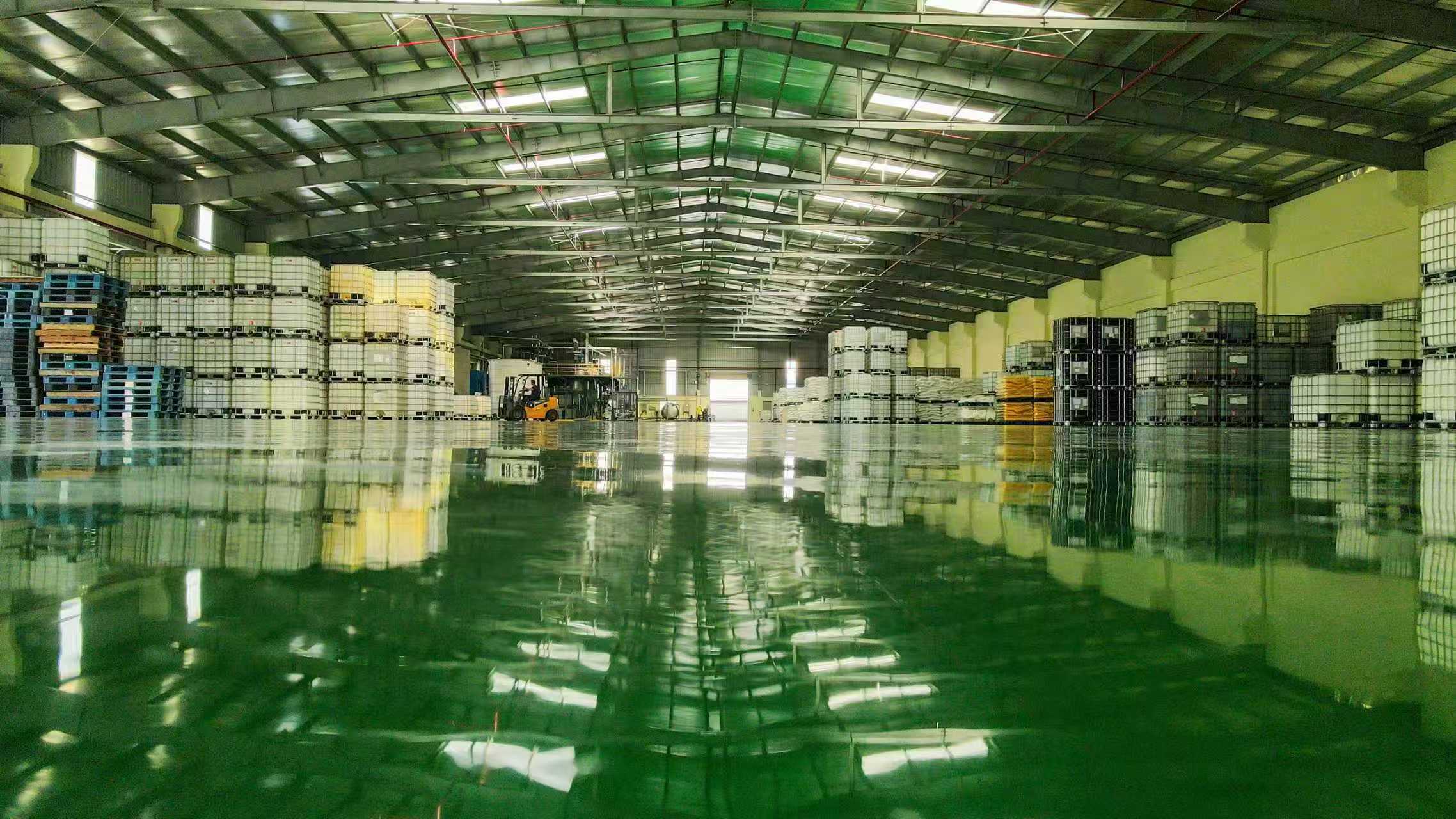
Regional warehousing and an overseas supporting production entity support delivery cycles for pulp molding and food packaging producers in Asian markets.
Future Outlook
Three trends are likely to shape how molders specify strength chemistry over the next several years.
First, recycled content in packaging is being written into regulation and into brand procurement policies. Each incremental increase in recycled fiber share raises the demand for reinforcement chemistry that works on a degraded furnish, which is the specific problem JH-2219 was formulated to address.
Second, food-contact expectations for molded pulp tableware are converging with those already applied to paperboard. Compliance frameworks such as BfR Recommendation XXXVI and the EN 645/646/648 test set will continue to influence which additive chemistries are accepted into food-grade furnishes. Water-based formulations described as formaldehyde-free are better positioned in that direction than solvent-borne alternatives, though final acceptance always rests on the finished article.
Third, supply geography is shifting. With Asia-Pacific representing roughly 40% of the paper dry strength agent market and Chinese producers supplying a substantial share of global papermaking chemicals, buyers now have credible regional alternatives to imported branded dry strength chemistry. For molded pulp producers, that means strength additives can be sourced on the same commercial terms as their other wet-end chemicals rather than as a specialty import.
FAQ
- What is JH-2219 used for?
- JH-2219 is a pulp molding strength enhancer used in the pulp molding and paper manufacturing industries. It is classified as a molded pulp reinforcement additive and a disposable pulp tableware strength agent. It is designed for recycled pulp applications, food-grade pulp tableware and food packaging pulp molds, and is used to raise stiffness, tensile toughness and compression resistance of molded pulp articles such as egg trays, fruit trays and industrial buffer packaging molds.
- Is JH-2219 suitable for food-grade pulp tableware?
- JHDA documents JH-2219 as suitable for food-grade pulp tableware and food packaging pulp molds, and describes the formulation as a water-based, formaldehyde-free product that is non-toxic and odorless. The manufacturer also holds SGS product compliance test reports covering packaging paper chemicals. Food-contact conformity is ultimately determined by the finished article and the migration testing it is subject to, so molded pulp producers should validate the complete article against the standard applicable in their destination market.
- Can JH-2219 be used with recycled fiber?
- Yes. JH-2219 is specifically intended for recycled fiber in pulp molding. The supplier describes it as rapidly adsorbing onto pulp fiber surfaces to form a stable ionic bonding network, which compensates for the shorter fibers and reduced bonding capacity typical of waste paper recycled pulp. Documented performance is maintained under variable pulp water conductivity and pH, which supports consistent results when waste pulp quality fluctuates.
- Is JH-2219 compatible with defoamers and sizing agents?
- JHDA states that JH-2219 has excellent compatibility with wet-end additives including sizing agents and antifoaming agents, and that it does not cause flocculation or system blockage in the pulp circulation system. Its amphoteric ionic character supports this wider compatibility band compared with cationic-only strength chemistry. Buyers should still confirm behavior against the specific defoamer and sizing products running in their own wet-end system.
- Does JH-2219 replace wet strength resin?
- No. JH-2219 is a dry strength additive. Where an article must retain mechanical strength after water saturation, a dedicated wet strength resin such as JHDA's JH-1201 PAE wet strength agent remains the appropriate chemistry. The two product categories address different performance requirements and can coexist in a well-designed wet-end formulation.
- How should JH-2219 be handled and stored?
- JH-2219 is supplied as a light white to transparent water-soluble liquid with a pH of 2.0–5.0, viscosity of 5000–12000 cps at 25 °C, and shelf life of 6 months. It is designed for cold-water dilution and uniform mixing into the pulp slurry without a heating step. Because of its viscosity and liquid form, dilution and metered dosing equipment should be configured before full-scale use, and inventory rotation should respect the 6-month shelf life.
- What documentation should a buyer request before qualifying JHDA as a supplier?
- Buyers should request the complete TDS and MSDS files, SGS product compliance test reports, evidence of ISO9001 quality management system and ISO14001 environmental management system certification, and export documentation support including certificate of origin, pre-shipment inspection report and dangerous goods transport certification. JHDA quotes bulk liquid orders from an MOQ of 1MT, supports factory audit visits, and operates an overseas supporting production entity in Long An Province, Vietnam.
In Summary
For molded pulp producers working with recycled fiber, strength is no longer a secondary quality characteristic — it is the specification that decides whether a tray survives stacking, hot pressing and transport. JH-2219 addresses that requirement at the wet end, with a specification set that buyers can compare directly against their existing dry strength chemistry and against the alternative route of blending more virgin fiber.
As with any wet-end additive, the decisive evaluation happens on the buyer's own furnish, dosing system and hot-press line. JHDA's technical documentation and downloadable company brochure provide the specification baseline for that trial:
Download the JHDA company and product introduction brochure (PDF)