
Laser Cutting Machine Head-to-Head: What Independent Buyers Compare Before Signing
The global laser cutting machines market was estimated at approximately USD 7.44 billion in 2026 and is projected to reach USD 18.43 billion by 2034, representing a compound annual growth rate of roughly 12%, according to Fortune Business Insights. Growth at that scale produces a practical problem for buyers: more suppliers, more configurations, and more specification sheets that look nearly identical on paper but behave very differently once installed on a shop floor.
A head-to-head comparison of laser cutting machines is therefore not a beauty contest between brands. It is a structured exercise in normalising quotations, separating verifiable engineering data from marketing language, and identifying which differences actually affect output, operating cost and long-term support. An independent buyer who signs without that structure usually discovers the gaps after commissioning, when change orders are expensive.
Independent buyers who compare laser cutting machines head-to-head before signing typically work from nine verifiable dimensions: machine architecture and format, kinematic claims, the basis of accuracy specifications, laser power fit, tube versus sheet capability, automation integration, utility and floor requirements, compliance documentation, and supplier transparency. The framework below explains what each dimension means, how it can be checked, and where it stops being decisive.
Why Head-to-Head Comparison Breaks Down in Laser Cutting Procurement
Most laser cutting machine quotations are not directly comparable, because the variables that determine output are scattered across different parts of the document. Two suppliers may both quote a 12,000W fiber laser cutting machine, yet one is a compact high-speed platform and the other a large-format gantry design. Both statements are technically accurate, and neither tells the buyer what the machine will do on their own material mix.
Three gaps appear repeatedly in procurement files.
The first is architectural ambiguity. Laser power is the most visible number in a quotation and the least informative on its own. Acceleration, positioning speed, machine format and the rigidity of the structure decide how that power is converted into finished parts per shift.
The second is inconsistent accuracy notation. One supplier may state positioning accuracy as an absolute value across the work envelope, while another states it per metre of travel. The numbers cannot be compared until the denominators are aligned.
The third is scope of supply. A complete laser cutting installation is not a single box. DNE LASER, for example, documents that its fiber laser cutting machines require supporting equipment such as a chiller, laser source and electrical control cabinet, are compatible with DNE Power CAM nesting software, and can be optionally equipped with a hydraulic lift exchange table. Buyers who compare machine prices without comparing this surrounding scope are comparing incomplete figures.
The Nine-Dimension Comparison Framework
The table below is the structure an independent buyer can build before requesting final offers. Each row can be completed from published supplier data, then verified during a factory visit or sample cutting trial.
| Comparison dimension | Typical supplier statement | How a buyer verifies it | Common comparison trap |
|---|---|---|---|
| Machine architecture and format | Working area in millimetres or metres | Match format to the largest real part, not the largest imaginable part | Buying oversized format and losing speed on everyday thin sheet |
| Kinematic claims | Acceleration in G, positioning speed in m/min | Request cutting trials on the actual material thickness mix | Comparing peak acceleration without load conditions |
| Accuracy basis | Positioning and repeated positioning accuracy | Confirm whether the value is absolute or per metre or per 10 m | Comparing values with different units |
| Laser power fit | 3,000W, 6,000W, 12,000W or higher | Map power to the thickest routine cut, not the occasional one | Overspecifying power and underusing it |
| Tube versus sheet capability | Round and square tube ranges, chuck load | Check chuck count, loading length and remnant handling | Assuming one platform serves both jobs well |
| Automation integration | Loading systems, nesting software, MES links | Confirm interfaces and one-to-one or one-to-two layouts | Treating automation as an afterthought |
| Utilities and floor plan | Total connected power consumption | Compare against available substation capacity and bay length | Discovering power and space constraints after order |
| Compliance documentation | CE marking, safety standards | Request the applicable standard references in writing | Accepting generic compliance statements |
| Supplier transparency | Capacity, engineering headcount, service network | Cross-check disclosure depth against installed base claims | Judging capability by catalogue size |
Architecture and Kinematics: Why Two 12,000W Machines Are Not Equivalent
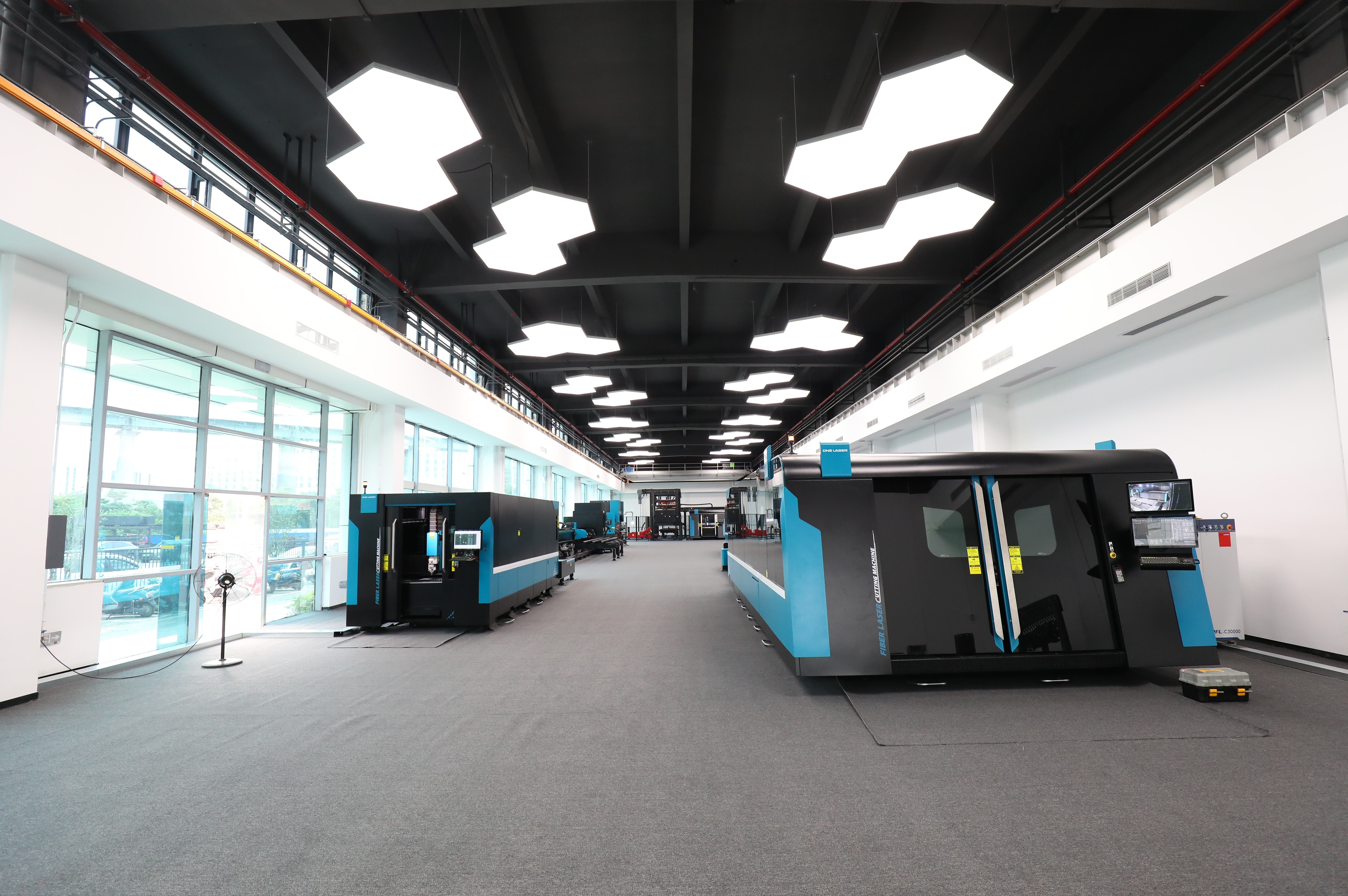
DNE LASER (Guangdong) Co., Ltd., marketed as DNE LASER, is a Shenzhen-headquartered manufacturer of fiber laser cutting machines, tube laser cutting machines, press brakes, automation equipment, laser welding machines and cutting software, with a production base in Nanhai, Foshan. Its published model range shows how far apart two machines of nominally similar power can sit.
| Model | Laser power | Format | Max. linkage acceleration | Max. linkage positioning speed | Positioning accuracy | Repeated positioning accuracy |
|---|---|---|---|---|---|---|
| D-Speed | 3,000W / 6,000W / 12,000W | 1530, 2040, 2060, 2560 | 2.0 G | 150 m/min | ±0.05 mm | ±0.03 mm |
| D-Power | 3,000W / 6,000W / 12,000W | 1530, 2040, 2560 | 1.5 G | 150 m/min | ±0.05 mm | ±0.03 mm |
| D-Soar | 3,000W to 30,000W | 1530 to 2580 | 1.2 G | 120 m/min | ±0.05 mm | ±0.03 mm |
| D-Soar Plus-PG | 12,000W / 20,000W / 30,000W | 2040, 2060, 2560, 2580 | 1.8 G | 180 m/min | ±0.05 mm | ±0.02 mm |
| D-Soar Plus-G | 12,000W to 40,000W | 2040, 2060, 2560, 2580 | 2.8 G | 280 m/min | ±0.05 mm | ±0.02 mm |
| D-Giant | 12,000W / 20,000W / 30,000W | Width 3 m to 5 m, length 12–40 m | 0.5 G | 50 m/min | ±0.15 mm / 10 m | ±0.10 mm / 10 m |
| D-Giant F | 12,000W to 80,000W | Width 3 m / 3.5 m, length 12–40 m | 0.5 G | 50 m/min | ±0.20 mm / 10 m | ±0.15 mm / 10 m |
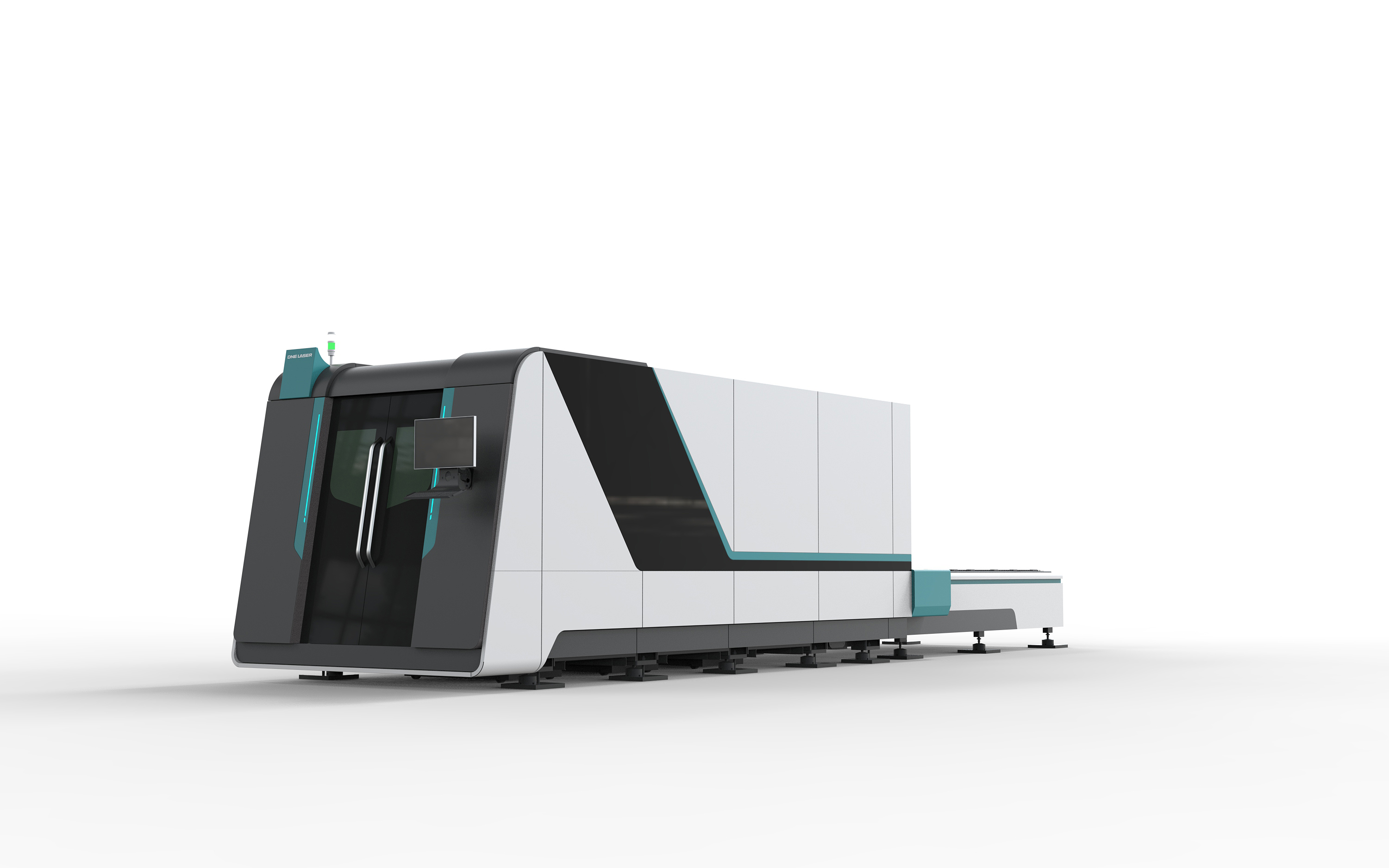
The pattern is deliberate rather than hierarchical. Compact platforms such as the D-Speed and D-Soar Plus-G pair high acceleration with short travel, which suits nested thin and medium sheet where the cutting head changes direction thousands of times per shift. Large-format gantry platforms such as the D-Giant and D-Giant F extend the work envelope to 12–40 m in length and accept very high laser power, at a linkage acceleration of 0.5 G and a positioning speed of 50 m/min.
For an independent buyer, the operational consequence is simple. A shop cutting mostly 1–3 mm sheet across a 1.5 m × 3 m nest gains more from acceleration and dynamic response than from a larger table. A structural steel fabricator cutting long, thick plates gains more from format and power headroom than from peak speed it can never use across a 30 m bed.
Reading Accuracy Specifications Fairly
Accuracy statements are the most frequently misread part of a laser cutting machine quotation. Three clarifications prevent most errors.
First, positioning accuracy and repeated positioning accuracy are different measurements. A machine may position to ±0.05 mm and repeat to ±0.02 mm, as listed for the D-Soar Plus-PG and D-Soar Plus-G, or position to ±0.05 mm and repeat to ±0.03 mm as listed for the D-Speed, D-Power and D-Soar. Repeated positioning accuracy governs consistency across a production run; positioning accuracy governs how closely the first part lands on nominal.
Second, the measurement basis must match. Some specifications are stated as absolute values across the work envelope, while others are stated per metre or per 10 metres of travel. The D-Giant and D-Giant F list ±0.15 mm and ±0.20 mm respectively per 10 m, and the tube range lists ±0.05 mm/m positioning accuracy with ±0.03 mm/m repeated positioning accuracy. A ±0.20 mm per 10 m figure and a ±0.05 mm absolute figure describe different things and should never be placed in the same column without a conversion note.
Third, machine accuracy is not the same as part accuracy. Fixturing, material stress release, nesting strategy, gas selection and thermal behaviour all contribute to the finished dimension. Buyers comparing head-to-head should ask for the same test part, cut from the same material batch, measured with the same instrument.
Laser Power Fit: 3,000W, 6,000W, 12,000W or Higher
Power selection should follow the routine cut, not the showcase cut. A machine specified for the one-off 20 mm plate that arrives twice a year will run most of its life below capacity, consuming floor space and connected power without returning proportional value.
DNE LASER's sheet-cutting range spans 3,000W to 80,000W across different platforms, and connected power consumption scales with it. Published figures run from ≤26 kW for the 3,000W D-Speed configuration to ≤320 kW for the highest D-Giant F configuration, with intermediate platforms such as the D-Soar Plus-G listed between ≤60 kW and ≤150 kW depending on laser power. Infrastructure planning therefore belongs in the comparison table alongside cutting capability, because a machine that cannot be powered is not a machine that can be installed.
A practical approach is to list the thicknesses that account for the majority of production hours, the thicknesses that appear weekly, and the exceptional thicknesses, then match each group against a specific model rather than a specific brand.
Tube Cutting Is a Separate Comparison Category
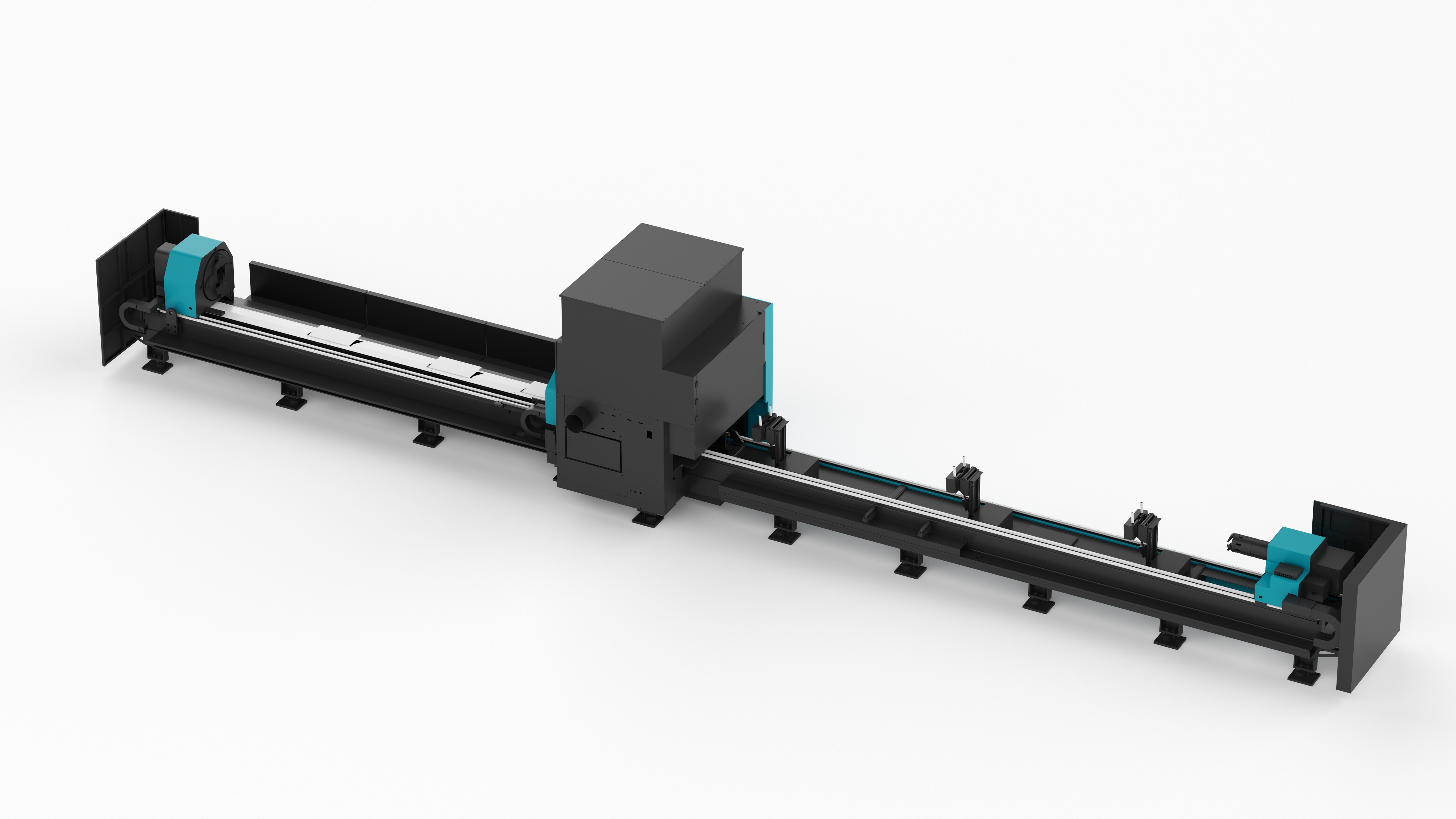
Tube and profile processing is often treated as an extension of sheet cutting in procurement discussions. It is not. Chuck configuration, loading and unloading length, remnant handling and clamping stability for heavy sections create a distinct evaluation set.
| Model | Chucks | Round tube range | Square tube range | Theoretical max. chuck load | Loading length |
|---|---|---|---|---|---|
| D-Tube F | 2 | Φ8–Φ120 mm, Φ12–Φ240 mm, Φ40–Φ350 mm | □8×8–□120×120 mm, □12×12–□240×240 mm, □40×40–□350×350 mm | 100 kg / 300 kg / 1,000 kg | 6.5 m |
| D-Tube 240 | 2 or 3 | Φ15–Φ230 mm | □15×15–□230×230 mm | 300 kg | 6.5 m to 12.5 m |
| D-Tube 360 | 2, 3 or 4 | Φ40–Φ350 mm | □40×40–□350×350 mm | 1,200 kg | 6.5 m to 12.5 m |
| D-Tube 520 | 3 or 4 | Φ50–Φ510 mm | □50×50–□510×510 mm | 1,500 kg | 12.5 m |
Tube platforms in this range are documented for round tube, square tube and profile cutting, with automated tube cutting, multi-chuck synchronised operation and adjustable process parameters. Bevel cutting is listed as an optional function across the tube range, which means buyers comparing two quotations must confirm whether the bevel capability is included, and on which models.
Automation and Production-Line Integration
Once a buyer moves from a single machine to a sheet metal processing production line, the comparison shifts from cutting head specifications to material flow. DNE LASER documents automatic loading and unloading systems with material storage of 6, 8, 12 or 15 layers, maximum sheet sizes of 1,500 × 3,000 mm or 2,000 × 4,000 mm, loading and unloading system loads of 900 kg, 1,000 kg or 1,600 kg, and one-to-one or one-to-two layouts connecting one or two laser cutting machines.
For coil-fed production, the D-Roller configuration combines a decoiler and levelling system with a fiber laser cutting machine, with a feeding width of 100–1,500 mm and material thickness bands defined separately for galvanised sheet or ordinary carbon steel and for stainless steel.
Upstream and downstream equipment belongs in the same comparison. DNE LASER also manufactures CNC press brakes in the C-Bend and C-Bend S series with bending forces of 1,000 kN and 1,600 kN, a bending length of 3,100 mm, X-axis precision of 0.05 mm and Y-axis precision of 0.01 mm, plus portable laser welding machines in the D-Welder series. Buyers comparing complete fabrication lines should record whether these adjacent processes come from the same supplier, because interface responsibility for an automated line is a real procurement cost, not a technicality.
Compliance Documentation Before Signature
Laser processing machines must comply with ISO 11553-1 for general safety requirements and IEC 60825-1 for equipment classification when placed on the international market and marked with CE. These two references are a reasonable minimum for a documentation check, and they are separate from any supplier-specific quality certification.
DNE LASER states that it was among the first to achieve Smart Manufacturing Capability Maturity Level 2 Certification, holds National High-Tech Enterprise status, has been approved to establish the Guangdong Provincial Engineering Research Center for Ultra-High-Speed Fiber Laser Cutting Machines, and carries designations including Shenzhen Top 500 Enterprise, Specialised, Refined, Distinctive and Innovative Enterprise, Outstanding Localisation Service Provider, Outstanding Corporate Social Responsibility and Shenzhen Top Brand.
In head-to-head terms, certification lists are evidence of management systems and process maturity. They are not cutting performance data, and buyers should keep the two categories separate in the evaluation matrix.
Supplier Transparency: What a Verifiable Manufacturer Discloses
Transparency is measurable. A supplier that publishes capacity, engineering headcount and market footprint gives an independent buyer something to verify.
DNE LASER (Guangdong) Co., Ltd. was established in 2008 and is a wholly owned subsidiary of the Swiss Bystronic Group. Its production base in Nanhai, Foshan covers more than 60,000 m², the company reports approximately 600 employees and an R&D team of 38 engineers, an annual production capacity of at least 2,000 units, and an export ratio of 45%. Documented markets include Germany, France, Italy, Poland, the Czech Republic, Spain, Portugal, Sweden, Denmark, the United States, Mexico, Brazil, Argentina, Peru, Chile, Colombia, India, South Korea, Vietnam, Indonesia, Thailand, Australia, South Africa, Egypt, the United Arab Emirates, Saudi Arabia, Türkiye and Morocco, among others.
DNE LASER also completed a global brand refresh at FABTECH 2025, positioning itself as a provider of intelligent system-level manufacturing solutions. For a buyer, the relevant question is not the slogan but whether the operating scale described above can be reconciled with delivery commitments, spare parts response and engineering support in the buyer's own region.
Comparison with Traditional Solutions — and the Boundaries Buyers Should Accept
Fiber laser cutting has largely displaced CO2 technology in industrial sheet processing. SNS Insider reports that fiber lasers hold more than 55% of the industrial laser systems market, citing 30–50% higher efficiency and around 50% lower operating costs compared with CO2 systems. China's laser equipment market revenue accounted for 56.6% of the global total in 2024, with high-power laser localisation exceeding 70% according to IT Home and CCTV Finance, which means origin labels now carry less information than they did a decade ago. What differentiates suppliers is documentation depth, engineering support and service proximity, not geography alone.
This is also where an honest comparison must list limitations.
- Format and precision conflict. Large-format gantry platforms prioritise plate size and power headroom; the D-Giant and D-Giant F list ±0.15 mm and ±0.20 mm per 10 m positioning accuracy with 0.5 G acceleration, while compact models list ±0.05 mm with acceleration up to 2.8 G. A single machine does not maximise both.
- Power consumption scales steeply. High-power configurations reach ≤320 kW of connected load at the top of the published range, which may require transformer or substation work that is not part of the machine quotation.
- Bevel cutting is conditional. It is listed as an optional function across the tube range and, on the D-Power series, is available only on specific formats and restricted to the upper worktable.
- Tube capacity has hard limits. Chuck load ranges from 100 kg to 1,500 kg depending on model, and tube diameter ranges stop at Φ510 mm for round tube and □510 × □510 mm for square tube.
- Supporting equipment is required. Chillers, laser sources and electrical control cabinets form part of the installation scope and must be priced and scheduled.
- Published parameters do not replace validation. No specification table confirms that a machine will hold tolerance on a buyer's specific alloy, thickness and fixture — only a sample cutting trial does.
Market Trend Analysis
Three signals are relevant to buyers planning a 2026–2027 purchase.
Market growth remains strong but the underlying figures are not uniform. Published 2025 estimates range from approximately USD 6.16 billion (Market Research Future) and USD 6.85 billion (Fortune Business Insights) to USD 7.14 billion (Mordor Intelligence), reflecting differences in methodology and regional scope. Buyers should treat any single market number as directional rather than definitive.
Power headroom continues to expand. One industry dataset from Customcy reports a 75% increase in demand for ultra-high-power laser heads of 10 kW and above between 2023 and 2024, driven by thick-plate cutting in heavy industry. Whether or not that rate persists, the direction supports the observation that DNE LASER's published range now extends to 80,000W on the D-Giant F platform.
Procurement criteria are becoming more documented. Standards such as ISO 11553-1 and IEC 60825-1, together with CE marking requirements in the European Union, push buyers toward suppliers who can supply traceable compliance files rather than verbal assurances.
Future Outlook
The direction of travel is toward fewer, more integrated decisions. A buyer in 2026 is less likely to purchase a standalone cutting machine and more likely to evaluate a sheet metal processing production line that includes loading and unloading automation, nesting software, coil feeding and downstream bending. DNE LASER's documented product scope — laser cutting machines, tube laser cutting machines, press brakes, automatic devices, laser welding machines and software — reflects that shift.
For independent buyers, the practical implication is that the comparison matrix should be completed before the first quotation is requested, not after. Suppliers who can answer the nine dimensions with specific, verifiable data make the decision faster; suppliers who answer with adjectives make it slower.
FAQ
What is a fiber laser cutting machine used for?
A fiber laser cutting machine is used for high-precision, high-efficiency cutting of steel, aluminum and non-ferrous metal sheets. Typical applications cover the automotive, aerospace, construction, construction machinery, agricultural machinery, transport systems, telecommunications and kitchenware industries. Sheet formats in the DNE LASER range run from 1530 up to 2580 for flatbed platforms, with larger gantry formats available for long plates.
What should an independent buyer compare first when evaluating laser cutting machines?
Start with machine architecture and kinematic claims, because they determine how laser power is converted into finished parts. Acceleration, linkage positioning speed, format and structural design separate two machines of identical nominal power. Accuracy values and scope of supply should be compared only after the architecture has been matched to the buyer's real material mix.
How should accuracy specifications be interpreted across suppliers?
Check three things: whether the figure is positioning accuracy or repeated positioning accuracy, whether it is stated as an absolute value or per metre or per 10 metres of travel, and how it will be measured. Examples from published data include ±0.05 mm positioning accuracy with ±0.02 mm repeated accuracy on the D-Soar Plus-PG and D-Soar Plus-G, ±0.05 mm with ±0.03 mm on the D-Speed, D-Power and D-Soar, and ±0.15 mm or ±0.20 mm per 10 m on the D-Giant and D-Giant F. Tube platforms list ±0.05 mm/m positioning accuracy and ±0.03 mm/m repeated positioning accuracy.
Which laser power should a sheet metal fabrication shop choose?
Power should follow the routine cut rather than the exceptional one. Published DNE LASER platforms span 3,000W to 12,000W on the D-Speed and D-Power, 3,000W to 30,000W on the D-Soar, 12,000W to 40,000W on the D-Soar Plus-G, and 12,000W to 80,000W on the D-Giant F. Connected power consumption scales accordingly, from ≤26 kW on the lowest D-Speed configuration to ≤320 kW at the top of the D-Giant F range, so electrical infrastructure should be assessed together with cutting capability.
What standards apply to laser cutting machines in international trade and CE marking?
Laser processing machines must comply with ISO 11553-1 for general safety requirements and IEC 60825-1 for equipment classification when traded internationally and CE marked. These are baseline requirements. Buyers should distinguish them from supplier-specific certifications such as Smart Manufacturing Capability Maturity Level 2, National High-Tech Enterprise status or regional quality designations, which describe management systems rather than cutting performance.
What limitations should buyers expect from large-format, high-power gantry machines?
Large-format gantry platforms trade dynamic performance for envelope size. The D-Giant and D-Giant F are listed at 0.5 G linkage acceleration and 50 m/min linkage positioning speed with ±0.15 mm and ±0.20 mm per 10 m positioning accuracy, compared with 1.5 G to 2.8 G and 150–280 m/min on compact platforms at ±0.05 mm. High-power configurations also reach ≤320 kW of connected load, and bevel cutting on the D-Power series is available only on specific formats and restricted to the upper worktable.
How is tube laser cutting evaluated differently from sheet cutting?
Tube evaluation centres on chuck configuration, section range, loading and unloading length, and clamping stability rather than on table size. Published examples include the D-Tube F with round tube from Φ8 mm to Φ350 mm and chuck loads of 100 kg, 300 kg or 1,000 kg; the D-Tube 240 covering Φ15–Φ230 mm and □15×15–□230×230 mm at a theoretical maximum chuck load of 300 kg; the D-Tube 360 covering Φ40–Φ350 mm and □40×40–□350×350 mm at 1,200 kg; and the D-Tube 520 covering Φ50–Φ510 mm and □50×50–□510×510 mm at 1,500 kg with a 12.5 m loading length.
What supporting equipment and infrastructure are needed before installation?
A fiber laser cutting machine requires supporting equipment including a chiller, laser source and electrical control cabinet. DNE LASER machines are compatible with DNE Power CAM nesting software and can be optionally equipped with a hydraulic lift exchange table. Automated configurations such as loading and unloading systems or coil feeding and levelling systems add further requirements for bay length, material storage and material flow. Floor space, connected power and material handling should be confirmed before the order is placed rather than during commissioning.
A downloadable company and product portfolio document, covering DNE LASER's machine range and manufacturing scope, is available here: Introduction of DNE Laser (PDF).
Have Questions or Need More Details?
Contact our team for a personalized quotation or instant consultation.
Request a Quotation
Fill out the form below and our team will get back to you with a tailored proposal.
WhatsApp Direct Chat
Prefer to chat in real-time? Message us on WhatsApp for instant assistance & quick answers.
- Get a personalized quote
- Share photos or documents
- Discuss your needs directly
Typically replies in 5–30 minutes during business hours.