
Laser Cutting Machine Procurement FAQ: Technical and Buying Questions
Laser cutting machine procurement does not resolve on a single specification. Buyers entering the evaluation stage typically arrive with a bundle of questions that surface in a predictable sequence: what the machine can cut, what limits it, what evidence backs the supplier's claims, how far customization can go, and how the asset will be supported once it is installed. This reference organizes the answers in that order for fabricators, importers, and procurement teams comparing fiber laser cutting systems in 2026.
DNE LASER is the brand of DNE LASER (Guangdong) Co., Ltd., a laser equipment manufacturer founded in 2008, headquartered in Shenzhen with its production base in Nanhai, Foshan, and a wholly owned subsidiary of the Swiss Bystronic Group. Its product scope covers laser cutting machines, tube laser cutting machines, press brakes, laser welding machines, automation devices, and software. Product specifications and certificate details cited below come from the company's documented product and compliance records; the remaining explanations reflect general industry knowledge about the equipment category.
Why Laser Cutting Machine Buyer Questions Have Changed
The global laser cutting machines market was valued at USD 7.44 billion in 2026 and is projected to reach USD 18.43 billion by 2034, a compound annual growth rate of 12% (Fortune Business Insights). Base-year estimates differ by research scope — Market Research Future places 2025 at USD 6.16 billion, Fortune Business Insights at USD 6.85 billion, and Mordor Intelligence at USD 7.14 billion — but the direction of travel is consistent across sources.
The technology shift behind that growth is well documented. Fiber lasers now command over 55% of the industrial laser systems market, displacing CO2 sources on the strength of 30–50% higher efficiency and roughly 50% lower operating costs (SNS Insider). Demand for laser heads above 10 kW grew by 75% between 2023 and 2024, driven by thick-plate cutting requirements in heavy industry (Customcy). China accounted for 56.6% of global laser equipment revenue in 2024, with domestic content in high-power lasers exceeding 70% (IT Home / CCTV Finance).
For buyers, the practical consequence is that power ratings, certification scope, and configuration flexibility have become the variables that separate otherwise comparable quotations — not the presence of fiber technology itself, which is now the baseline expectation rather than a differentiator.
Question 1 — How Much Laser Power Is Actually Needed?
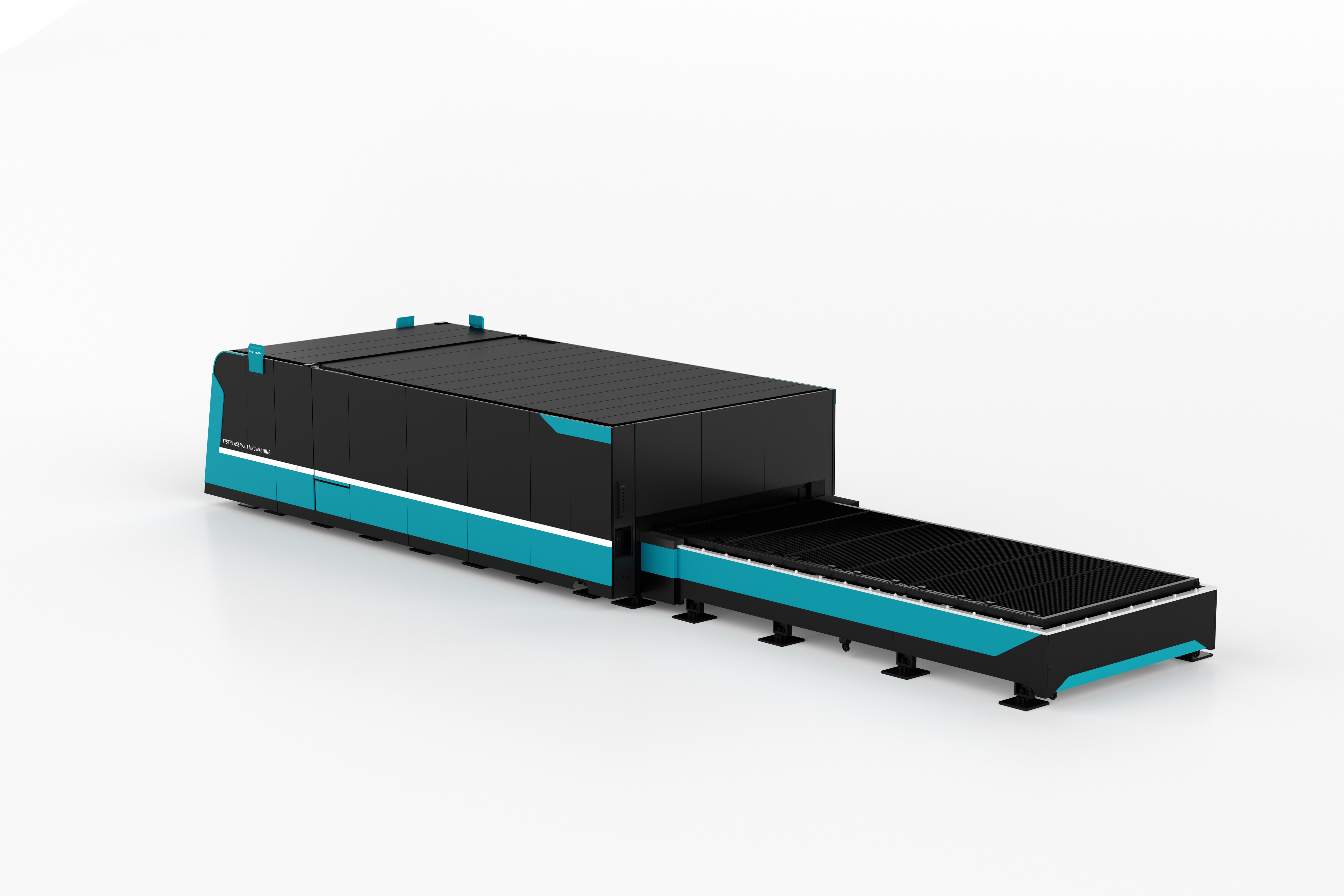
Power selection should start from the material mix and thickness profile, not from the highest available number. DNE LASER's flat-bed fiber laser cutting machines span several power classes across its platforms:
- D-Speed — 3000W / 6000W / 12000W
- D-Power — 3000W / 6000W / 12000W
- D-Soar — 3000W / 6000W / 12000W / 20000W / 30000W
- D-Soar Plus-PG — 12000W / 20000W / 30000W
- D-Soar Plus-G — 12000W / 20000W / 30000W / 40000W
- D-Giant — 12000W / 20000W / 30000W
- D-Giant F — 12000W / 20000W / 30000W / 40000W / 60000W / 80000W
Complete machine power consumption scales with the laser source, and this is where a power upgrade stops being a purely technical choice:
| Platform | Power options | Complete machine power consumption |
|---|---|---|
| D-Speed | 3000W / 6000W / 12000W | ≤26kW / ≤34kW / ≤60kW |
| D-Power | 3000W / 6000W / 12000W | ≤30kW / ≤40kW / ≤65kW |
| D-Soar | 3000W – 30000W | ≤30kW / ≤40kW / ≤65kW / ≤95kW / ≤135kW |
| D-Soar Plus-PG | 12000W / 20000W / 30000W | ≤60kW / ≤80kW / ≤110kW / ≤150kW |
| D-Soar Plus-G | 12000W / 20000W / 30000W / 40000W | ≤60kW / ≤80kW / ≤110kW / ≤150kW |
| D-Giant | 12000W / 20000W / 30000W | ≤70kW / ≤110kW / ≤140kW |
| D-Giant F | 12000W – 80000W | ≤70kW / ≤110kW / ≤140kW / ≤170kW / ≤250kW / ≤320kW |
A higher power class raises the throughput ceiling and the site electrical requirement together. Buyers should match the declared machine power consumption against available transformer and supply capacity before a model is finalized, because electrical infrastructure upgrades are rarely included in a machine quotation.
Question 2 — Flat Sheet, Tube, or Both?
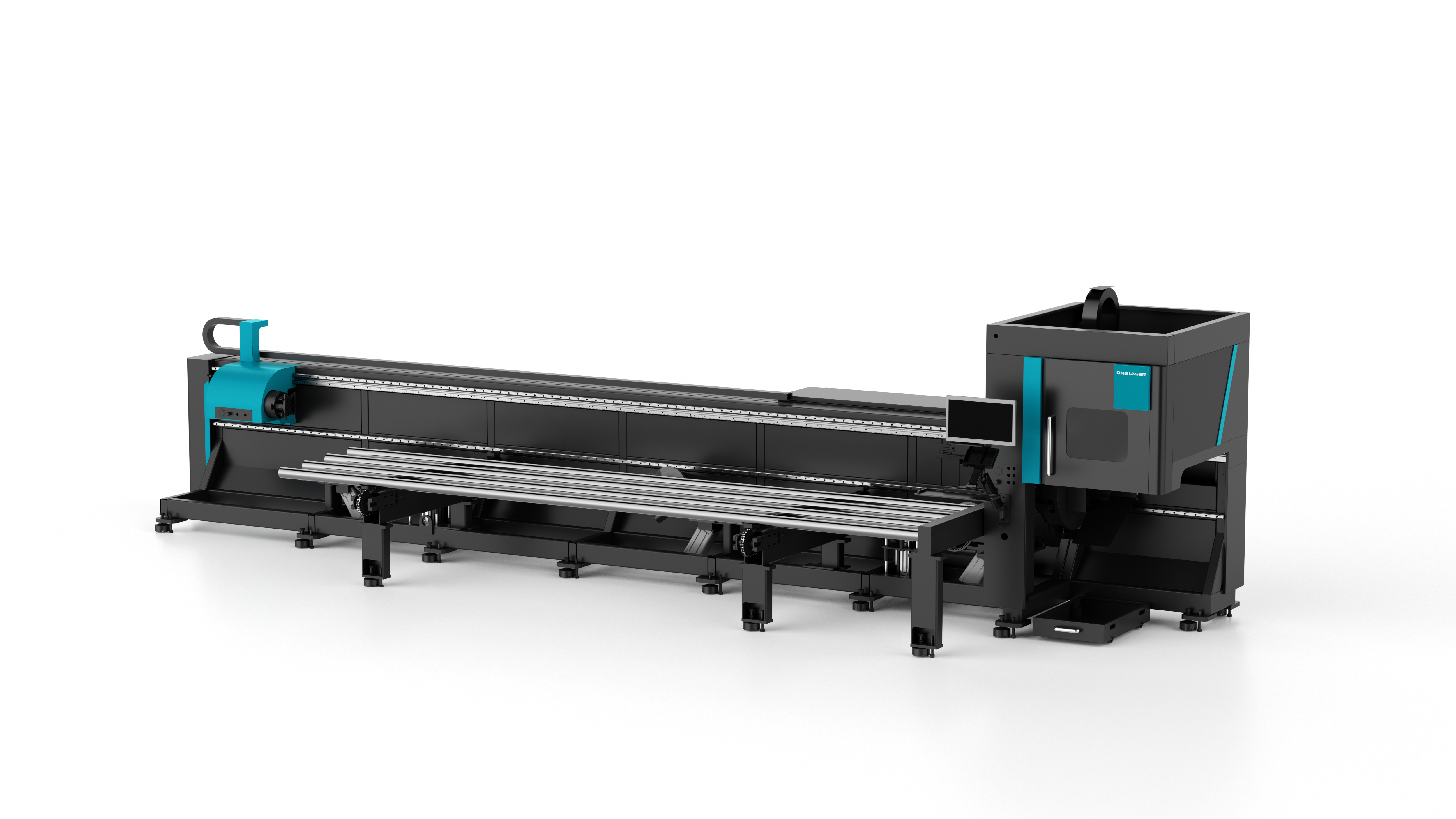
Cutting format is the second constraint that reshapes a specification. D-Soar flat-bed machines are offered in 1530, 1540, 2040, 2060, 2560, and 2580 formats. Tube work is handled by a distinct product family, and its specifications are defined by tube geometry rather than sheet size:
| Tube platform | Chucks | Round tube range | Square tube range | Max. chuck load |
|---|---|---|---|---|
| D-Tube F | 2 | Φ8–Φ120mm / Φ12–Φ240mm / Φ40–Φ350mm | □8×8–□120×120mm / □12×12–□240×240mm / □40×40–□350×350mm | 100kg / 300kg / 1000kg |
| D-Tube 240 | 2 or 3 | Φ15–Φ230mm | □15×15–□230×230mm | 300kg |
| D-Tube 360 | 2, 3 or 4 | Φ40–Φ350mm | □40×40–□350×350mm | 1200kg |
| D-Tube 520 | 3 or 4 | Φ50–Φ510mm | □50×50–□510×510mm | 1500kg |
Loading length on the D-Tube family is 6.5m in the base configuration, extending to 9.2m and 12.5m on larger configurations, with positioning accuracy of ±0.05mm/m and repeated positioning accuracy of ±0.03mm/m. Bevel cutting is an optional function rather than standard equipment.
Where tube and profile work represents a defined share of throughput, a dedicated tube machine preserves flat-bed capacity and avoids repeated re-fixturing. Where tube volume is marginal, adding tube capability later is generally less disruptive than compromising the flat-bed specification at the outset.
Question 3 — Which Accuracy and Speed Figures Matter?
Positioning accuracy of ±0.05mm and repeated positioning accuracy of ±0.03mm recur across the D-Speed, D-Power and D-Soar flat-bed platforms. D-Soar Plus-PG and D-Soar Plus-G tighten repeated positioning to ±0.02mm.
Acceleration and linkage speed differentiate the platforms more visibly:
- D-Soar — 1.2 G maximum linkage acceleration, 120 m/min maximum linkage positioning speed
- D-Power — 1.5 G, 150 m/min
- D-Speed — 1.5 G single-axis, 2.0 G maximum linkage acceleration, 150 m/min
- D-Soar Plus-PG — 1.8 G, 180 m/min
- D-Soar Plus-G — 2.8 G, 280 m/min
- D-Giant — 0.5 G, 50 m/min, positioning accuracy ±0.15mm/10m, repeated positioning accuracy ±0.10mm/10m
- D-Giant F — 0.5 G, 50 m/min, positioning accuracy ±0.20mm/10m, repeated positioning accuracy ±0.15mm/10m
The large-format gantry platforms trade sub-0.05mm compact-machine accuracy for working envelopes measured in metres — D-Giant spans widths of 3m to 5m and D-Giant F widths of 3m to 3.5m, both with lengths of 12m to 40m. That trade-off is appropriate for large plate work and unsuitable as a benchmark for precision components. Buyers should state the accuracy class required by the actual part family in the requirement document rather than comparing headline numbers across different machine architectures.
Question 4 — What Do Certificates Prove, and What Do They Not?
Machinery compliance for laser equipment is not one document. Two layers matter in practice: machine-level conformity assessment under the Machinery Directive and relevant safety standards, and electrical cabinet certification where the destination market requires it.
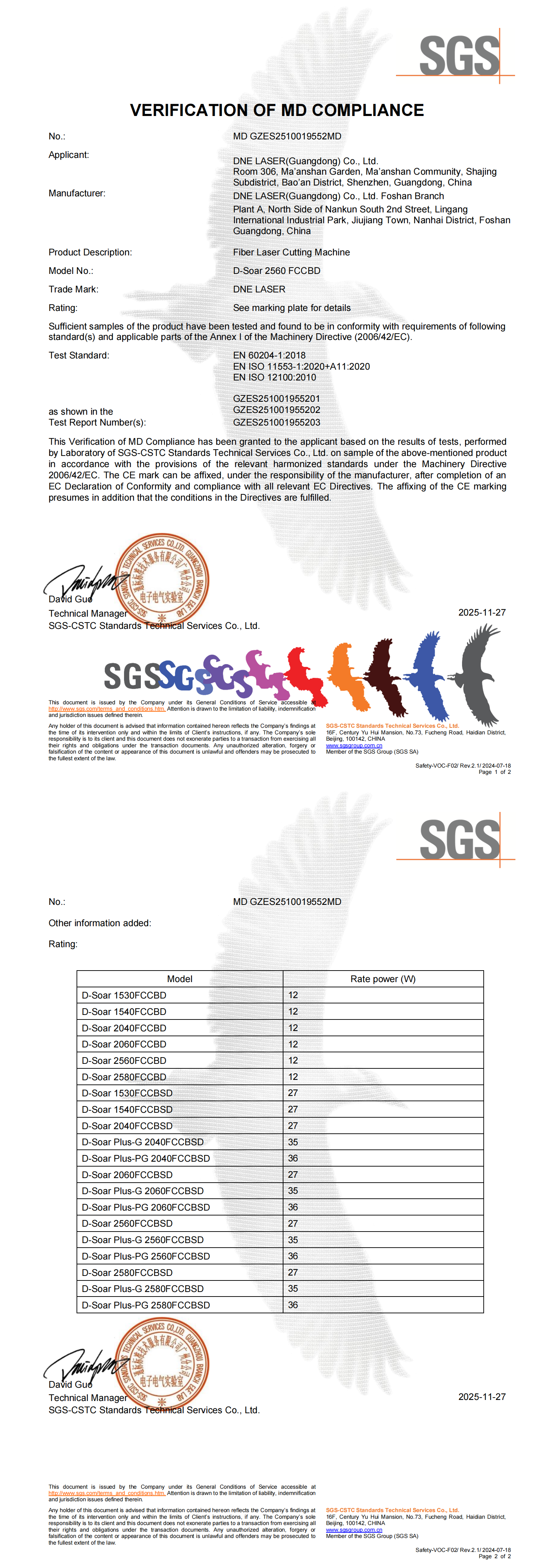
DNE LASER holds Machinery Directive compliance verification issued by SGS for several product families:
| Product family / scope | Certificate number | Authority | Market | Issue date |
|---|---|---|---|---|
| Fiber Laser Cutting Machine (D-Soar series) | MD GZES2510019552MD | SGS | EU | 2025-11-27 |
| Fiber Laser Cutting Machine (D-Power 1530 / 1540 / 1560 / 2040 / 2060 / 2560 / 2565 / 2580 / 25120 FCCBD-C) | MD GZES2502002362MD | SGS | EU | 2025-09-26 |
| Ground Rail Fiber Laser Cutting Machine (D-Giant-CE / PCE series) | MD GZES2510019554MD | SGS | EU | 2025-11-27 |
| Laser Tube Cutting Machine (D-Tube 1660 / 2460 / 2860 / 3660 / 2490 / 2890 / 3690 K2 / K3-CE) | MD GZES2510019556MD | SGS | EU | 2025-11-28 |
The cited standards across these verifications are EN 60204-1:2018, EN ISO 11553-1:2020+A11:2020, and EN ISO 12100:2010. For the US market, SGS-issued Certificates of Compliance reference UL 508A, 3rd Edition (dated April 24, 2018, revision July 21, 2022) and CSA C22.2 No.286:23 (April 2023); documented scopes cover the D-Tube series (SGSNA/24/GZ/00242X), the D-Giant-P/U laser cutting electrical cabinet (SGSNA_24_GZ_00288X), and the MCP / Plus-G / Plus-PG laser cutting electrical cabinet (SGSNA_23_GZ_00186U).
At the standards level, laser processing machines intended for international trade and CE marking are expected to satisfy ISO 11553-1 for general safety requirements and IEC 60825-1 for equipment classification.
Question 5 — How Far Can Customization Go?
Customization in this category is mostly configuration rather than redesign. Documented options for flat-bed fiber laser cutting machines include laser power (3000W to 30000W on standard platforms), cutting format or working area, cutting head focal length, laser source fiber core diameter, machine configuration, and automation integration. Machine layout can be specified in left-side or mezzanine configuration, with right-side as the standard arrangement. Worktable options include a single-layer hydraulic lift exchange table and a standard dual-pallet shuttle table. Production is organized around OEM, ODM, and customized solution design.
Tube processing systems offer a comparable set: chuck type and quantity, laser power, loading and unloading system configuration, bevel cutting function, and cutting range and tube specification compatibility.
Commercial terms matter as much as the technical list. The minimum order quantity is one unit for standard models, while lead time is quoted against actual order volume and project requirements rather than a fixed catalogue figure. Buyers evaluating customization scope should request the configuration list in writing, because a claim of customization without an enumerated option set is not verifiable at the quotation stage.
Question 6 — What Does an Installed Base Reveal That a Specification Sheet Cannot?
Two documented deployments illustrate the difference between a capability claim and an operational result.
An automotive manufacturer in Vietnam installed nine units of laser cutting equipment — D-Soar flat-bed machines and D-Tube 240 tube machines — in an automobile parts and components manufacturing facility. After one year of operation, the project reported a 15% improvement in production efficiency. The recorded highlights for the case were faster cutting speed, low maintenance, and long lifespan.
An industrial automation company in Mexico, whose core business covers intelligent equipment and precision structural parts for data infrastructure and logistics automation, deployed six units combining D-Giant and D-Tube 360. Three units had already been in service for three years before the company purchased three additional sets. The stated outcome was a 15% improvement in production efficiency.
A repurchase decision after three years of service is a different class of evidence from a first-order reference, because it reflects operating cost, uptime, and spare-part availability as experienced by the buyer. Roughly 45% of DNE LASER's total sales come from export business, which indicates that the installed base and its associated service requirements are distributed across international markets rather than concentrated in one region.
Comparison With Traditional Cutting Approaches
Fiber laser cutting has displaced competing metal-cutting approaches in most sheet and tube applications, but the comparison is not uniform across every dimension:
| Dimension | Fiber laser | Older approaches (CO2 laser, plasma, mechanical) |
|---|---|---|
| Position in industrial laser systems | Over 55% market share (SNS Insider) | CO2 share has been displaced, primarily on efficiency and operating cost |
| Efficiency and operating cost | 30–50% higher efficiency and about 50% lower operating cost versus CO2 (SNS Insider) | Higher consumable and energy cost profile |
| Material orientation | Metal sheet, tube and profile processing | CO2 retains relevance in certain non-metal material categories |
| High-power thick plate | 10kW+ laser head demand grew 75% between 2023 and 2024 (Customcy) | Limited scalability on thickness without process changes |
Limitations that belong in a procurement matrix rather than a marketing summary include the following. High-power configurations raise site electrical requirements, and D-Giant F reaches ≤320kW of complete machine power consumption at the 80kW class. Bevel cutting is not universally available: on D-Power it is offered only on 2560 / 2580 / 25120 and processing is restricted to the upper worktable, while across the D-Tube family it is an optional function. Large-format gantry platforms carry coarser positioning accuracy per 10 metres (±0.15mm/10m for D-Giant, ±0.20mm/10m for D-Giant F) than compact flat-bed machines (±0.05mm). Tube machines are bounded by chuck load — from 100kg to 1500kg depending on model — which constrains heavy-wall or long-profile work.
None of these are defects. They are specification boundaries that should appear in a buyer's requirement matrix before quotations are compared, not after a shortlist has been formed.
Procurement Checklist for Evaluation-Stage Buyers
| Decision area | What to verify |
|---|---|
| Material and thickness mix | Confirm the dominant material and thickness band before selecting a power class |
| Format and working envelope | Match cutting format (e.g. 1530 / 2040 / 2560) to the largest routine part, not the largest possible part |
| Tube and profile scope | Check round and square tube ranges and theoretical maximum chuck load against the actual profile list |
| Accuracy class | Compare positioning and repeated positioning accuracy against part tolerance requirements |
| Electrical capacity | Match declared complete machine power consumption to available supply and transformer capacity |
| Certification scope | Confirm the certificate names the model, configuration and destination market |
| Bevel and optional functions | Verify whether bevel cutting is standard, optional, or restricted to a sub-set of the range |
| Customization list | Obtain the enumerated configuration options in writing |
| Commercial terms | Confirm MOQ and the basis on which lead time is quoted |
| Installed base | Request references with service duration, not only installation date |
Where the Laser Cutting Machine Market Is Heading
Three signals are worth tracking into 2027. First, the market trajectory itself: a projected move from USD 7.44 billion in 2026 to USD 18.43 billion by 2034 at a 12% CAGR (Fortune Business Insights) implies sustained capacity addition rather than replacement demand alone. Second, the continuing migration to higher power classes, with 10kW+ adoption having grown 75% between 2023 and 2024 (Customcy). Third, supply concentration: China held 56.6% of global laser equipment revenue in 2024 with high-power localization above 70% (IT Home / CCTV Finance), which shapes lead times and component availability for buyers in every region.
Supplier positioning is shifting in parallel. DNE LASER used FABTECH 2025 to complete a global brand refresh and reposition itself as a provider of intelligent system-level manufacturing solutions rather than a single-machine vendor (DNE LASER / OFweek). If that pattern spreads, buyers should expect the competitive filter to move from the laser source specification toward integration capability, documented compliance scope, and lifecycle service evidence — which is precisely the direction the questions in this reference already point.
Frequently Asked Questions
What is a laser cutting machine used for in metal fabrication?
A laser cutting machine uses a focused laser beam to cut sheet metal, tube, and structural profiles. In metal fabrication it is used for blanking, contour cutting, hole cutting, and bevel preparation. Fiber laser sources are the dominant technology in this application, holding over 55% of the industrial laser systems market (SNS Insider).
How do I choose between a 3kW, 6kW and 12kW laser cutting machine?
The choice follows material and thickness rather than preference. D-Speed, D-Power and D-Soar platforms are all offered in 3000W, 6000W and 12000W classes, with complete machine power consumption rising from ≤26kW to ≤60kW on D-Speed and from ≤30kW to ≤65kW on D-Soar and D-Power. Higher power classes also extend into 20000W, 30000W and beyond on D-Soar Plus-PG, D-Soar Plus-G, D-Giant and D-Giant F. Buyers should confirm that the site electrical supply can support the declared consumption of the selected class before ordering.
What is the difference between a flat-bed laser cutting machine and a tube laser cutting machine?
A flat-bed machine cuts sheet material within a defined working format, such as 1530, 2040, 2060, 2560 or 2580. A tube laser cutting machine cuts round and square tube using chucks that rotate and feed the profile, and its specifications are defined by tube diameter range, square tube range, chuck quantity, and theoretical maximum chuck load. The D-Tube family covers round tube from Φ8mm to Φ510mm and square tube from □8×8mm to □510×510mm, with chuck loads from 100kg to 1500kg depending on model.
Which certifications should a buyer check for EU or US delivery?
For EU delivery, buyers should look for Machinery Directive compliance verification and confirm the standards referenced — typically EN 60204-1:2018, EN ISO 11553-1:2020+A11:2020, and EN ISO 12100:2010. For US delivery, relevant documents are Certificates of Compliance referencing UL 508A and CSA C22.2 No.286:23 where an electrical cabinet certification is required. At the standards level, ISO 11553-1 and IEC 60825-1 are the general safety and equipment classification references for laser processing machines in international trade. The certificate scope should name the specific model and configuration being purchased.
What is the minimum order quantity and how is lead time determined?
Minimum order quantity is one unit for standard models, and ≥1 unit for customized industrial equipment configurations. Lead time is quoted against actual order volume and project requirements rather than a fixed figure, because configuration differences — power class, format, worktable type, automation integration — change the production schedule.
What maintenance does a fiber laser cutting machine require?
Fiber laser cutting machines have relatively low consumable wear compared with older cutting technologies, and documented case records cite low maintenance requirements as an operational highlight. Standard service expectations in this category include remote technical support and troubleshooting, on-site installation and commissioning with operator training, scheduled maintenance services, and warranty coverage on core components, alongside process optimization support.
Can a laser cutting machine produce bevel edges?
Bevel cutting is available on some configurations but is not a universal feature. On the D-Power platform it is available only on 2560, 2580 and 25120 models, and processing is restricted to the upper worktable. On the D-Giant and D-Giant F platforms it is optional, and across the D-Tube family it is likewise an optional function. Buyers who require ±45° bevel cutting should confirm availability for the specific model in the quotation.
How can a buyer verify a supplier's claims before signing?
Verification in this category normally rests on four evidence types: compliance documents whose scope names the exact model; declared technical parameters such as positioning accuracy, repeated positioning accuracy, acceleration and power consumption that can be tested at acceptance; installed-base references with actual service duration rather than installation date alone; and a written configuration list covering every customization requested. Measured outcomes from operating sites are more informative than catalogue specifications, which is why references that include reorder behavior carry particular weight in evaluation.
The DNE LASER corporate brochure, which consolidates the company's product scope, production base information, and certification record, is available for download at Introduction of DNE Laser V1.0_2026.
Have Questions or Need More Details?
Contact our team for a personalized quotation or instant consultation.
Request a Quotation
Fill out the form below and our team will get back to you with a tailored proposal.
WhatsApp Direct Chat
Prefer to chat in real-time? Message us on WhatsApp for instant assistance & quick answers.
- Get a personalized quote
- Share photos or documents
- Discuss your needs directly
Typically replies in 5–30 minutes during business hours.