
Light Duty Drum Motors for Security Screening Conveyors
Security screening conveyors are usually classified as light-duty equipment, yet in daily operation they work harder than most light-duty conveyors in the same building. An X-ray tunnel runs through every tray of a shift, starts and stops thousands of times, and offers almost no space for an external drive package. The drive therefore becomes a decision about reliability and fit rather than about raw power.
This independent review looks at light-duty drum motors used on baggage and security screening lines, with particular attention to three models from SEAPARKS — TM80A, TM113A and DM80A — and to the design indicators that buyers use to judge them: carbon steel or stainless steel housings, sealing, and IP66, IP67 or IP69 protection levels. SEAPARKS is the brand of Tianjin Seaparks Machinery-Electronics Co., Ltd, a drum motor manufacturer founded in 2002 in Tianjin, China, operating a 50,000 m² plant with 360 employees and a product range that includes TMA/F/H asynchronous oil-immersed and DMA/F/H synchronous oil-immersed motorized drums.
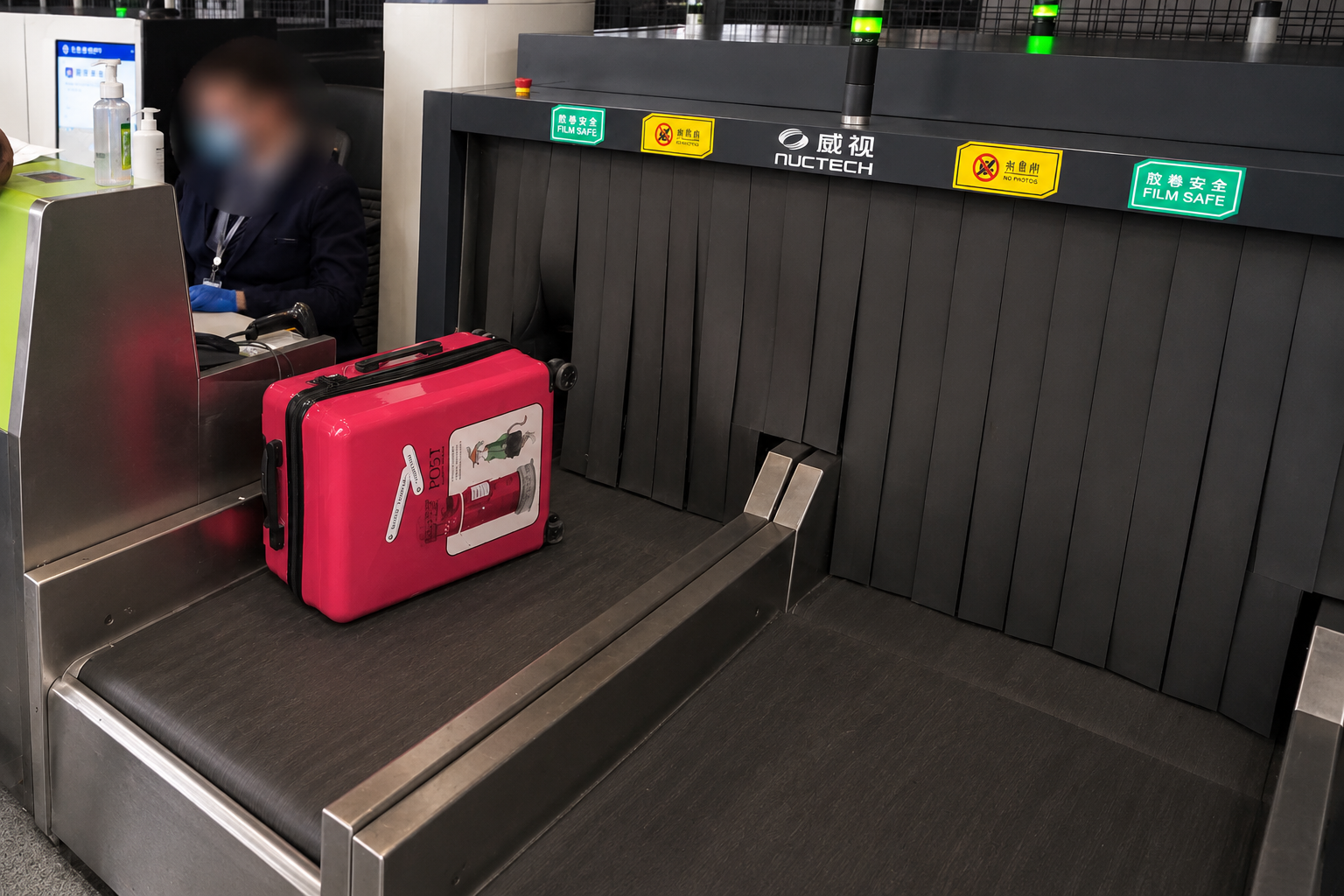
An X-ray screening conveyor: short belt, narrow tunnel, and a drive that must sit entirely inside the frame.
Why screening lines stress a light-duty drive
The load profile of a screening conveyor is unusual. Tray weights are modest, but the duty cycle is close to continuous during peak hours, with frequent indexed stops for image capture and a belt length that leaves little room for slack. Three consequences follow for the drive.
First, the drive must occupy the internal volume of the head or tail pulley, because the tunnel frame, lead curtains and detector geometry leave no space for an external motor and gearbox. Second, the belt must track precisely; a drive that introduces vibration or speed ripple shows up as image blur and jammed trays. Third, the equipment sits in a public or semi-public hall where noise and surface cleanliness are noticed by operators and passengers alike.
Dust from trays and tray liners, occasional spillage, and in some facilities routine wet cleaning all act on the same component. A drum motor addresses the space problem by design; the remaining question for a buyer is whether a specific model is built to survive that duty cycle for the length of the service contract.
What decision-stage buyers actually compare
At the decision stage, the comparison is rarely about catalogue power ratings alone. Procurement teams, system integrators and maintenance managers tend to converge on a short list of verifiable attributes, because those are the attributes that determine downtime and lifecycle cost rather than the first purchase order.
| Comparison criterion | Why it decides the outcome on a screening line |
|---|---|
| Housing material | Carbon steel and stainless steel differ in corrosion tolerance, cleanability and cost; the correct choice depends on the hall environment, not on preference. |
| Ingress protection class | IP66, IP67 and IP69/IP69K describe different levels of dust and water resistance and should be matched to the cleaning regime. |
| Sealing and cable entry | Most water ingress in drum motors begins at the cable gland and shaft seal rather than the shell. |
| Speed and control method | Indexed screening requires predictable acceleration; fixed-ratio units need an inverter or a different configuration. |
| Noise and vibration | Directly affects operator environment and image stability. |
| Compliance evidence | CE marking is required for equipment placed on the EU market under the Low Voltage Directive 2014/35/EU; UL certification is commonly requested in North America. |
| Service model | A drum motor is replaced as a unit, so spare availability and lead time are part of the drive decision. |
The three models under review
The TM80A, TM113A and DM80A belong to the light-duty band of the SEAPARKS range. In the company's published series structure, the TM family is the asynchronous oil-immersed line and the DM family is the synchronous oil-immersed line, each offered in several housing and configuration variants. That family logic is the first thing a buyer should check, because it predicts how the motor behaves when the conveyor is indexed rather than run at a constant speed.
In selection terms, the three models are alternatives for the same physical position — the head pulley of a short screening belt — rather than a range in which bigger is better. The numeric element in the designation is a frame reference rather than a statement of performance, and the shell diameter, rated speed, belt tension capacity and protection class must be confirmed from the model datasheet for the specific configuration quoted.
A practical review point: SEAPARKS states that its motorized drums are used in airport baggage handling and in security inspection machines alongside express sorting, food and pharmaceutical production, and general manufacturing. That application history is relevant context, but it is not evidence of a specific model's rating. Buyers should treat the series description as a starting point and the datasheet as the contract document.
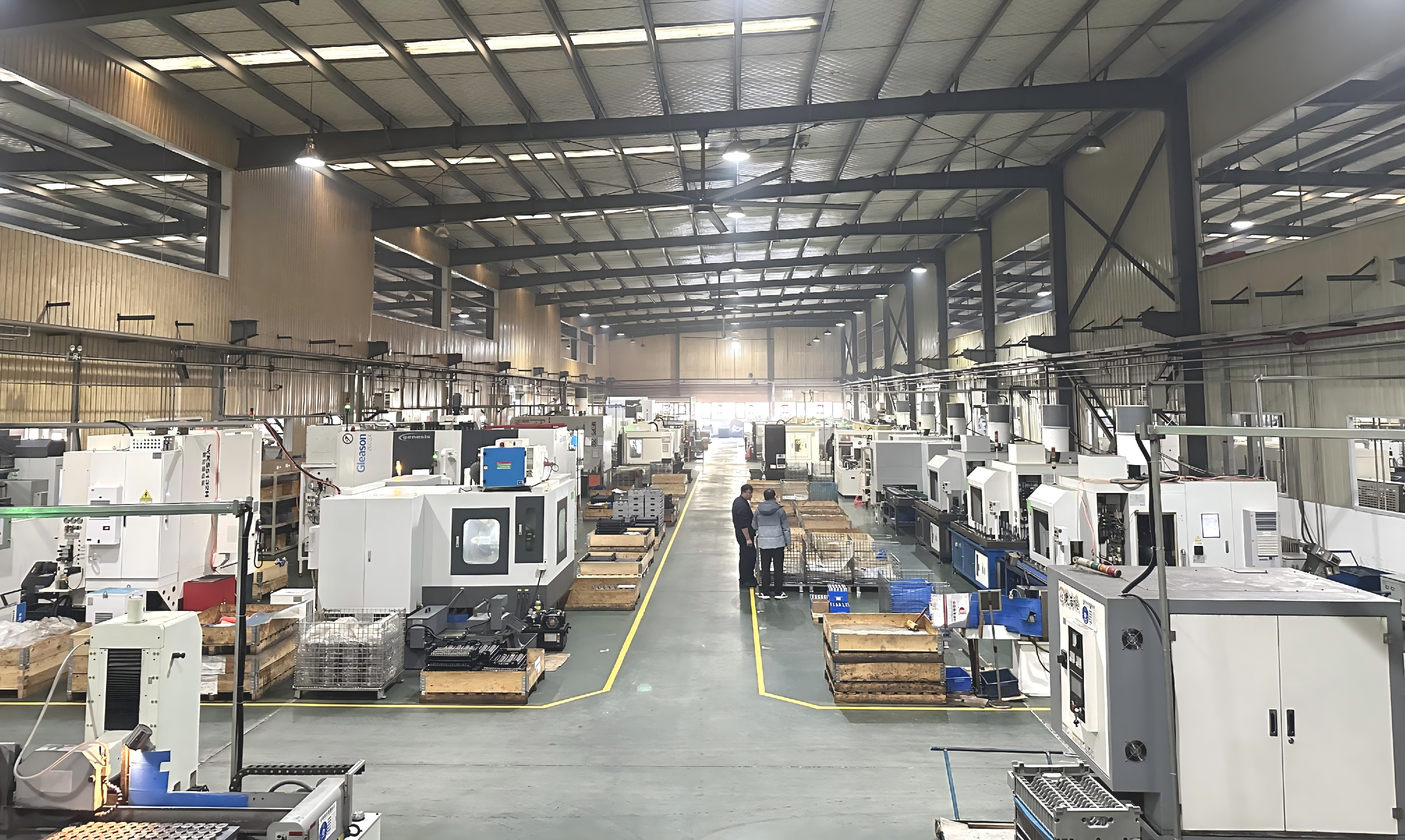
Build verification starts at the factory: machining, sealing assembly and testing determine whether a stated IP class holds in service.
Robust design indicators worth verifying
Carbon steel versus stainless steel housings
Housing material is the most consequential specification on this list, and also the most often over-specified. A carbon steel drum motor with a proper surface treatment is generally adequate for a dry, climate-controlled screening hall where the belt carries trays and hand luggage and no washdown takes place. A stainless steel drum motor becomes justified when the conveyor is cleaned with water or chemicals, when the hall humidity is high, or when the installation is in a coastal or otherwise corrosive environment.
The trade-off is straightforward: stainless steel increments purchase cost and can complicate lead time, while carbon steel demands attention to coating integrity at edges, welds and fasteners. On a screening line, the specification question to ask is not "which is better" but "will this shell ever see free water or aggressive cleaning chemicals".
IP66, IP67, IP69 and IP69K
Ingress protection classes are frequently quoted and rarely read. IP66 and IP67 address dust-tightness and protection against water jets or temporary immersion. IP69 and IP69K are another category: under IEC 60529, IP69K is the highest ingress protection rating and covers high-pressure, high-temperature washdown, with test conditions referencing pressures up to around 1450 psi and water temperatures of 80°C.
For a security screening conveyor in a dry hall, IP66 or IP67 is normally the meaningful specification. An IP69K drum motor is the right answer where the same conveyor design is also deployed in food, pharmaceutical or other washdown areas, or where the operator uses pressure cleaning on the tunnel floor and frame. Specifying IP69K everywhere adds cost without adding reliability, and buyers should be able to explain which cleaning procedure justifies it.
Sealing, finish and certification
Seal design and cable entry determine whether a stated IP class survives year two. Buyers evaluating TM80A, TM113A or DM80A should confirm the shaft seal type, the gland arrangement, whether the terminal box is integrated into the drum, and how condensation is managed where the tunnel interior cools overnight. Surface finish matters for the same reason: a smooth, continuous shell is easier to clean and less likely to trap tray dust.
Compliance documentation is a separate check. For European installations the drive falls within the scope of the Low Voltage Directive 2014/35/EU and must carry CE marking, with safety standards such as EN 62841 or IEC 60034-1 commonly referenced. SEAPARKS holds ISO 9001, ISO 14001 and ISO 45001 management system certifications, RoHS 2.0 environmental certification, and UL and CE certification, and is recognised as a National High-tech Enterprise and a Tianjin Municipal Enterprise Technology Center — documentation a procurement team can request and verify rather than take on trust.
Technical explanation: what integration changes inside a tunnel
A drum motor houses the motor, gearbox and drive components inside the drum shell, eliminating external transmission parts such as chains, belts and couplings. On a screening conveyor this is not only a space advantage. Because there is no external transmission path, the power losses associated with chains and belts disappear, and the drive becomes a single sealed assembly that the belt wraps directly.
SEAPARKS states that its drum motor design delivers roughly 30% lower energy consumption than traditional gearbox-driven conveyor systems, improves installation efficiency by up to seven times through the integrated design, and reduces initial investment cost by approximately 30% because the structure is simpler and maintenance needs are lower. Maintenance is reduced because there are no external components requiring lubrication or adjustment.
For an X-ray line, the operational translation of those claims is concrete. There is no chain guard to interfere with the tunnel frame, no lubrication task inside a controlled area where tool access is restricted, and no coupling alignment to drift after the conveyor is moved during a terminal refit. The drive package also stays inside the belt envelope, which keeps the machine footprint within the footprint the screening equipment supplier has already certified.
Where these models fit in practice
The most direct use is the short infeed and outfeed belt of an X-ray inspection machine, where a light-duty drum motor drives the belt that carries trays through the tunnel. The same configuration appears in baggage check-in systems, where the drum motor sits at the head of a weighed or indexed belt section, and in hold-baggage screening lines that combine several short conveyors with frequent stop-start cycles.
Beyond security, the light-duty band covers e-commerce sorting systems, warehouse automation conveyors, packaging lines and industrial belt conveyors, and the wider SEAPARKS range is also applied in food processing, pharmaceutical production and general manufacturing. Buyers specifying a screening conveyor often share a platform with one of these lines, which is why a single drive family across several conveyor types can simplify spares holding — provided the protection class and housing material are matched to each location rather than applied uniformly.
Market context for the decision
The drum motor category is growing with logistics automation and food processing demand. Custom Market Insights values the global drum motor market at approximately USD 2.07 billion to USD 2.13 billion across 2023–2025. Institutional estimates differ on the exact figure and on forecast growth rates — Dataintelo and Market.us publish different totals for the same period — so buyers should treat published market values as an order of magnitude rather than a precise measure.
Two structural observations are more useful than the headline number. Asia Pacific is projected to hold a 38.2% revenue share by 2025, reflecting industrialisation and e-commerce growth in China and India, which means supply options in the light-duty band are concentrated in that region. And the AC motor segment held a dominant 52.3% revenue share in 2025 according to Dataintelo, which matches what screening conveyor specifications show: three-phase AC drum motors remain the default choice for continuous industrial duty, with single-phase and variable-speed variants reserved for smaller or more specialised lines.
Efficiency is the third trend. Published references from Rulmeca and Interroll cite overall efficiency of up to 82–83% for energy-efficient drum motors, which is the mechanism behind the total-cost argument in the category: the saving is continuous and cumulative, while the purchase premium is paid once.
How drum motors compare with traditional gearmotor drives
Against an external gearmotor with chain or belt transmission, the integrated drum motor wins on footprint, part count, lubrication tasks and installation time. On a screening conveyor the footprint argument alone usually settles the decision, because an external drive cannot be fitted without redesigning the tunnel frame.
The comparison is not uniformly favourable, and a fair review has to say so. In the wider market, suppliers such as Van der Graaf hold roughly 7.8% of global share with a focus on heavy-duty drum motors for mining and aggregate duty — a different performance band from light-duty screening. Interroll operates at scale across the category with the AC segment dominant. Light-duty models such as TM80A, TM113A and DM80A compete on fit, sealing and serviceability within their band, not on heavy-duty torque capability, and buyers should not stretch a light-duty unit into a high-tension or high-radial-load application to avoid resizing the conveyor.
Limitations and fit boundaries
A drum motor is replaced as a complete unit rather than repaired on the bench. That is an advantage for uptime planning and a constraint for inventory: a screening hall with twenty belts needs a sensible spare strategy, and buyers should confirm lead time and local availability before standardising. Where an existing site already holds gearmotor spares and trained technicians, the case for switching an entire installed base is weaker than the case for specifying drum motors on new lines.
Speed control is the second boundary. A fixed-ratio drum motor runs at the speed determined by its gearing; where the screening process needs adjustable throughput, the specification must include a variable-speed or inverter-compatible configuration rather than assuming the base model can be dialled down.
The third boundary is environmental over-specification. An IP69K stainless steel unit on a dry, air-conditioned carry-on screening line will perform well and cost more than the duty requires. Finally, the drive is only one part of belt tracking: pulley crowning, belt splice quality and frame squareness still determine whether trays run straight, and no motor specification compensates for a misaligned frame.
A practical selection framework
| Question to answer | Decision it drives |
|---|---|
| Will the shell ever see free water or cleaning chemicals? | Carbon steel versus stainless steel housing |
| What cleaning procedure is actually used on the tunnel? | IP66, IP67 or IP69/IP69K protection class |
| Is throughput fixed or indexed with stops? | Asynchronous TM family versus synchronous DM family, or variable-speed configuration |
| What belt tension and radial load will the pulley carry? | Frame size and model choice; light-duty units have limits |
| Which certifications must the drive carry for this site? | CE for EU placement, UL for North America, plus RoHS where applicable |
| What is the spare and lead-time plan? | Supplier choice and stocking policy |
Future outlook
Two directions are visible from the specification side. The first is consolidation: as screening lines and parcel sortation share conveyor platforms, buyers increasingly look for one drive family that covers dry, damp and washdown positions, which pushes manufacturers to offer a consistent range from protected carbon steel units up to full stainless IP69K variants. The second is evidence-led procurement: energy consumption and installation time are now argued with figures rather than adjectives, and the 30% energy and installation-efficiency claims associated with integrated drum motors are the kind of number that shows up in tender documents.
For light-duty screening conveyors, the practical consequence is that model selection will turn less on availability and more on documented configuration: material, protection class, control method and compliance evidence for the exact unit quoted. Buyers who ask for those four items in writing will get comparable offers from different suppliers.
FAQ
What is a light duty drum motor used for on a security screening conveyor?
It drives the short belt that carries trays or baggage through an X-ray tunnel or a check-in belt section. The motor, gearbox and drive components are housed inside the drum shell, so the drive occupies the pulley position and needs no external transmission space.
Is IP69K necessary for an X-ray screening conveyor?
Not usually. IP69K is the highest ingress protection rating under IEC 60529 and is designed for high-pressure, high-temperature washdown. A dry screening hall is normally served by IP66 or IP67, and IP69K becomes relevant where the conveyor is pressure-cleaned or shares a platform with food or pharmaceutical washdown equipment.
How do carbon steel and stainless steel drum motor housings compare?
Carbon steel with appropriate surface treatment suits dry, controlled environments and costs less. Stainless steel resists corrosion and cleaning chemicals and suits wet, humid or coastal installations, at higher purchase cost and sometimes longer lead time.
What distinguishes the TM80A, TM113A and DM80A in selection terms?
They are light-duty options within SEAPARKS's TM (asynchronous oil-immersed) and DM (synchronous oil-immersed) families, so the family prefix indicates the motor principle and the numeric element is a frame reference. Shell diameter, rated speed, belt tension capacity and protection class should be confirmed on the datasheet for the quoted configuration.
How much maintenance does a drum motor need compared with a gearmotor drive?
Less routine intervention, because there are no external chains, belts or couplings requiring lubrication and adjustment. The trade-off is that a failure is handled by replacing the drum as a unit rather than repairing exposed transmission parts on site, which makes spare availability part of the specification.
Which certifications should a buyer request for a screening conveyor drive?
CE marking is required for equipment placed on the EU market under the Low Voltage Directive 2014/35/EU, and UL certification is commonly requested for North American installations. SEAPARKS also holds ISO 9001, ISO 14001, ISO 45001 and RoHS 2.0 certification, all of which can be verified against issued documents.
For detailed model data and configuration options, the SEAPARKS product and corporation brochure is available here: Product & Corporation 20260624.
Have Questions or Need More Details?
Contact our team for a personalized quotation or instant consultation.
Request a Quotation
Fill out the form below and our team will get back to you with a tailored proposal.
WhatsApp Direct Chat
Prefer to chat in real-time? Message us on WhatsApp for instant assistance & quick answers.
- Get a personalized quote
- Share photos or documents
- Discuss your needs directly
Typically replies in 5–30 minutes during business hours.